Categories
Corruption, Crime and Compliance

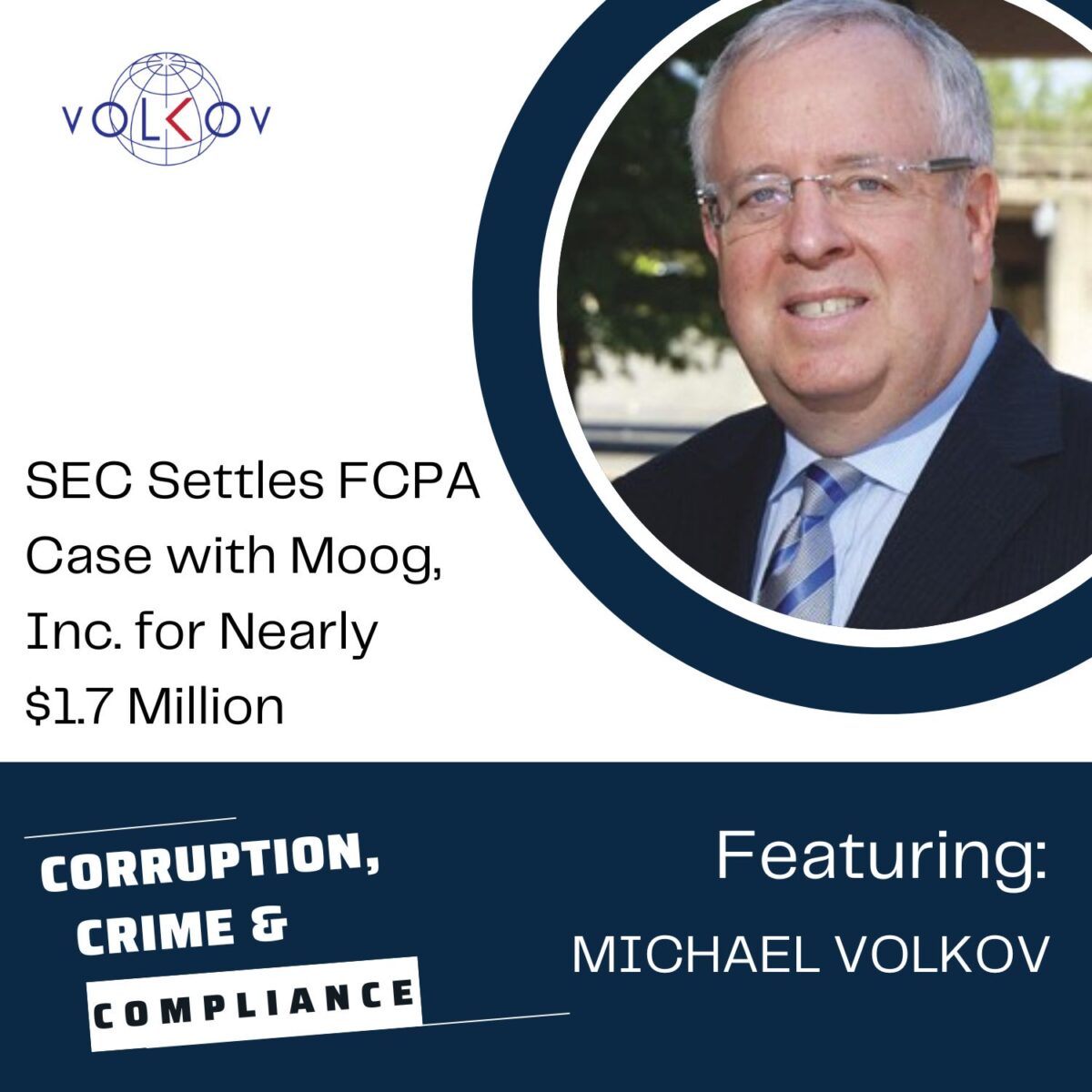
SEC Settles FCPA Case with Moog, Inc. for Nearly $1.7 Million

The SEC notched another FCPA settlement, continuing its steady pursuit and resolution of FCPA cases. In the meantime, the Justice Department has been silent in the FCPA enforcement arena. In this episode of Corruption, Crime, and Compliance, Michael Volkov dives into the SEC’s recent FCPA settlement with Moog, a global manufacturer that faced severe bribery allegations within its Indian subsidiary. From navigating India’s complex tender processes to revealing corrupt practices and hefty penalties, Michael dissects Moog’s compliance failures and highlights the critical role of ethics in international business dealings.

Listen in as he discusses:

  • Moog, Inc. (“Moog”), a New York-based global manufacturer of motion controls systems for aerospace, defense, industrial, and medical markets, agreed to pay a civil penalty of $1.1 million and disgorge nearly $600,000 for a total of $1.7 million, to resolve FCPA charges arising out of bribes paid by its wholly owned Indian subsidiary, Moog Motion Controls Private Limited (Moog Motion Controls).
  • Moog India allegedly bribed officials from the South Central Railway (SCR) and Hindustan Aeronautics Limited (HAL) to influence tender processes and exclude competitors. These bribes were often disguised as “contractor services.”
  • From 2020 to 2022, Moog employees bribed various Indian officials to win business. They also used various schemes to make improper payments, including funneling them through third-party agents and distributors. These same Moog employees also offered cash bribes to Indian officials to cause public tenders in India to favor Moog’s products and exclude competitors.
  • The case highlights significant gaps in Moog’s internal controls, including improper invoice recording, inadequate oversight of third-party agents, and a lack of compliance training.
  • Moog self-reported the misconduct, terminated those involved, enhanced its compliance program, and strengthened accounting controls and auditing procedures for third-party interactions.

Resources:

Michael Volkov on LinkedIn | X (Twitter)

The Volkov Law Group

Categories
Adventures in Compliance

Adventures in Compliance – Leadership Lessons from Sherlock Holmes in The Illustrious Client

In this new season of Adventures in Compliance, host Tom Fox takes a deep dive into the Sherlock Holmes collection The Case-Book of Sherlock Holmes by Arthur Conan Doyle. It is the final set of twelve Sherlock Holmes short stories by Arthur Conan Doyle, first published in the Strand Magazine between October 1921 and April 1927. In this episode, we consider the story, The Adventure of the Illustrious Client, and the leadership lessons from the compliance professional that can be found in the story.

In this episode, we delve into the Sherlock Holmes story ‘The Illustrious Client,’ where Holmes and Watson aid Sir James Damery in rescuing General de Merville’s daughter, Violet, from the clutches of the dangerous Baron Gruner. The story unfolds with Holmes’s meticulous strategy to expose the Baron’s true nature, culminating in dramatic action and revealing leadership lessons for compliance professionals. Key leadership lessons include persistence in pursuing justice, strategic collaboration, deep contextual knowledge, risk mitigation, integrity and courage, adaptable tactics, and leveraging transparency to combat deception. These insights showcase how ethical behavior and accountability can be fostered in an organization.

Highlights include:

  • Holmes’ Strategy and Allies
  • Leadership Lessons from Holmes
  • Strategic Collaboration
  • Risk Awareness and Mitigation
  • Leveraging Transparency

Resources:

The New Annotated Sherlock Holmes

Sherlock Holmes FAQ by Dave Thompson

For more information on the Ethico Toolkit for Middle Managers, available at no charge, click here.

Check out the full 3-book series, The Compliance Kids, on Amazon.com.

For an audio/video version of the Compliance Kids book, Speaking Up is AWESOME, contact Tom Fox.

Connect with Tom Fox:

Instagram

Facebook

YouTube

Twitter

LinkedIn

Categories
FCPA Compliance Report

FCPA Compliance Report – Episode 732 – Understanding Anti-Boycott Compliance with Alexander Cotoia

Welcome to the award-winning FCPA Compliance Report, the longest-running podcast in compliance. In this edition, Tom Fox welcomes back Alexander Cotoia to discuss the intricate and profoundly impactful topic of anti-boycott compliance related to U.S. companies involved in international trade.

They delve into the specifics of the EAR’s anti-boycott provisions, a framework designed to prohibit U.S. companies from participating in or supporting foreign-imposed boycotts not endorsed by the U.S. government. The conversation highlights the strict reporting requirements enforced by BIS and IRS to ensure transparency and adherence to U.S. trade compliance interests. Alexander explains the details of Quantum Corporation’s recent settlement over violations, emphasizing the importance of active reporting to maintain U.S. trade relationships. The discussion also touches on potential compliance challenges, particularly regarding China and Taiwan. Tune in for best practices in anti-boycott compliance and learn how to navigate this complex regulatory landscape.

Highlights in this episode:

  • Understanding Anti-Boycott Law
  • Deep Dive into EAR’s Anti-Boycott Provisions
  • Enforcement and Compliance
  • Case Study: Quantum Corporation
  • Best Practices for Compliance
  • Global Implications and Future Concerns

 Resources:

Alexander Cotoia on LinkedIn

Volkov Law Group

Alexander Cotoia’s article on BIS – Quantum Corp Enforcement Action

Tom Fox

Instagram

Facebook

YouTube

Twitter

LinkedIn

For more information on the Ethico Toolkit for Middle Managers, available at no charge, click here.

Categories
Blog

10 Compliance Lessons Learned from the Telefónica Venezolana FCPA Enforcement Action

Last week, the Department of Justice (DOJ) announced a resolution of a Foreign Corrupt Practices Act (FCPA) enforcement action involving Telefónica Venezolana, the Venezuelan subsidiary of Telefónica S.A. (Telefónica) involving significant compliance failures. Telefónica agreed to a $85.2 million penalty and Deferred Prosecution Agreement (DPA). Tom Fox will review the Top 10 Lessons for Compliance Professionals in this blog post.

  • Understanding the FCPA Risks in High-Risk Jurisdictions

Telefónica confirms the compliance risks inherent in high-risk jurisdictions where government intervention and currency restrictions are common. If you had any question that Venezuela was not high risk, this matter confirms it once again. Currency access is tightly controlled, creating opportunities for corruption in currency auctions that companies might exploit to obtain preferential treatment. Telefónica’s bribery of Venezuelan officials for U.S. dollar access exemplifies how companies in such markets might resort to unethical tactics to stay competitive.

Lesson Learned. High-Risk. High-Risk. High-Risk. Businesses operating in high-risk regions must be vigilant in identifying regulatory challenges that could prompt employees or agents to seek shortcuts, including bribery or fraud. Implementing strong local compliance measures, training employees on anti-bribery practices, and emphasizing adherence to legal processes—no matter the regulatory hurdles—are essential to maintaining compliance integrity.

  • The Role of Third Parties in Concealing Corrupt Practices

In the scheme, the Company indirectly engaged suppliers to pay bribes, concealing these payments as inflated prices on equipment purchases. Third-party risks remain one of the most challenging aspects of compliance, as intermediaries are often used to circumvent direct involvement in corrupt activities, thereby masking unethical practices from internal oversight.

Lesson Learned. For the past 25 years, corrupt third parties have had the highest risk in FCPA compliance. This makes comprehensive third-party due diligence as crucial as any other part of your compliance program. Every relationship with suppliers, contractors, or intermediaries should undergo rigorous vetting, including checks for conflicts of interest, bribery risks, and financial irregularities. Companies should employ contract clauses requiring third parties to comply with anti-corruption laws and establish transparent compliance reporting and monitoring mechanisms. However, the key is managing the relationship after the contract is signed.

  • Internal Controls and Transaction Monitoring: The First Line of Defense

The bribery scheme involved purchasing equipment from two suppliers at inflated prices and funneling bribes through manipulated invoices. A robust internal control system might have flagged these irregularities, potentially preventing or detecting the misconduct earlier. The case illustrates the importance of scrutinizing financial transactions, especially those that deviate from standard pricing practices.

Lesson Learned. This case demonstrates that strengthening internal controls is vital, particularly in financial transaction monitoring. Implementing controls such as approval hierarchies, independent review of non-standard transactions, and regular financial audits by third parties can reduce opportunities for corrupt practices. Compliance professionals should also integrate forensic accounting expertise into their monitoring and investigative functions to analyze suspicious transactions and identify potential compliance breaches.

  • A Proactive Approach to Third-Party Payment Oversight

Telefónica used inflated equipment purchase prices to conceal bribes, showing how intermediaries and indirect payments can mask corrupt practices. The company has since improved its compliance framework, including enhanced oversight of third-party payments through proprietary software.

Lesson Learned. For Compliance Professions, the lesson is that companies must develop and enforce rigorous third-party payment controls. Companies can detect unusual payment patterns that may signal compliance risks by implementing technology solutions to monitor payment flows. Finally, compliance teams must collaborate with finance departments to establish alerts for atypical payment activities, thus fostering cross-departmental vigilance against corruption.

  • Building a Robust and Independent Compliance Function

In response to its FCPA violations, Telefónica strengthened its compliance function, appointing a Chief Compliance Officer (CCO) with direct access to the Audit Committee and investing in compliance resources. This demonstrates the need for compliance independence and empowerment to address corporate misconduct effectively.

Lesson Learned. For a compliance program to be effective, it must be both empowered and independent. The CCO should report directly to the Board of Directors or the Audit Committee to ensure unfiltered communication of compliance concerns directly to the company’s top. Companies should also continually assess their compliance structures and allocate sufficient resources to compliance functions, ensuring the team has the tools and authority to address risks proactively.

  • The Importance of Timely and Transparent Cooperation in Government Investigations

Telefónica’s delayed cooperation with the DOJ affected the investigation’s efficiency and ultimately impacted the company’s cooperation credit. It also no doubt frustrated the DOJ lawyers handling the matter. While the Company later assisted DOJ investigators, this case reinforces that delays in providing relevant information can result in increased penalties or reduced credit in FCPA investigations.

Lesson Learned. When under investigation, timely, transparent cooperation with government authorities is essential. Delaying the disclosure of relevant information hinders the investigation and may also increase penalties or other sanctions. Companies should have protocols for efficiently gathering and disclosing information to authorities, especially when compliance breaches are suspected.

  • Remedial Actions as a Key to Reducing Penalties

Telefónica implemented significant remedial measures to address its compliance failings, including employee terminations, third-party vetting improvements, and transaction review process overhauls. These actions likely contributed to the DOJ’s decision to reduce the penalty by 20%, reflecting the importance of remedial actions in mitigating penalties.

Lesson Learned. Remediation is critical when responding to compliance failures. Swift and decisive action—such as disciplining or terminating employees involved in misconduct, overhauling control processes, and enhancing compliance programs—demonstrates a genuine commitment to addressing and preventing future issues. These actions can positively influence regulators’ decisions, potentially reducing fines or penalties.

  • Lessons on the Impact of Prior Compliance Failures

Telefónica’s parent company, Telefónica S.A., has a history of compliance failures, including a prior FCPA enforcement action involving a subsidiary, Telefónica Brasil. The enforcement action involving the Venezuelan subsidiary shows how previous infractions can impact a company’s current settlement terms, as regulators consider a company’s past compliance record when determining penalties.

Lesson Learned. Companies should be mindful that a history of compliance breaches can affect regulatory leniency in future cases. Ensuring that corrective actions are implemented following any past compliance issues—and documented as part of a continuous improvement process—is critical for maintaining regulatory goodwill and potentially reducing penalties in subsequent cases.

  • Global Cooperation in Compliance Investigations

In Telefónica’s case, the DOJ coordinated with international authorities in Panama, Switzerland, and Luxembourg to gather evidence and move the investigation forward. The international cooperation underscores the global nature of anti-corruption enforcement and the heightened risk of detection and prosecution across jurisdictions.

Lesson Learned. Compliance officers should understand that global regulatory cooperation makes it harder for companies to evade accountability. With enforcement agencies increasingly sharing information and resources, companies must adopt a global approach to compliance, ensuring their practices align with international regulations and anti-bribery standards.

  • Long FCPA Tail

The underlying facts of this matter occurred in 2012-2013. This demonstrates the lengthy (some say forever) tail of FCPA enforcement. Writing in Law360, Dorothy Martin noted, “But prosecutors allege in 2014, Telefónica Venezolana participated in a corrupt currency auction that allowed the telecom giant to exchange its local currency for more than $110 million in U.S. dollars. According to court documents, during the auction, Telefónica  allegedly won more than 65% of the $172 million that the local government awarded to 16 telecom companies.”

Lesson Learned. The lesson for compliance professionals is that actions from a subsidiary from many years can come back and bite you in your collective corporate backside. It was clear that Telefónica did not self-disclose, nor did it initially cooperate with the DOJ. These actions and positions taken by the Company may have been because the distance of time between the illegal actions and investigation may have made the Company perform an investigation and even dig out documents. This involves data and access to data by the compliance function.

The Telefónica Venezolana FCPA enforcement is a stark reminder of the consequences of FCPA violations, particularly in high-risk markets where bribery and corruption risks are prevalent. This case highlights the critical need for strong internal controls, rigorous third-party oversight, and a proactive approach to compliance culture. By learning from these lessons, compliance professionals can better equip their companies to navigate complex regulatory environments and avoid the costly consequences of corruption.

Categories
Sunday Book Review

Sunday Book Review: November 10, 2024 – The Books on Middle Manager Edition

In the Sunday Book Review, Tom Fox considers books that interest the compliance professional, the business executive, or anyone curious. It could be books about business, compliance, history, leadership, current events, or anything else that might interest Tom.

In today’s edition of the Sunday Book Review, Tom Fox looks at four top books on being a middle manager and the importance of the role of middle management in November 2024.

  1. Beyond the Hammer by Brian Gottlieb
  2. Leading from the Middle by Scott Mautz
  3. Managing from the Middle by Ken Wilkins
  4. Power to the Middle by Schaninger, Hancock, and Field


Resources:

For more information on the Ethico Toolkit for Middle Managers, available at no charge, click here.

For more information on the first Annual Compliance Podcast Network Agora Awards for Excellent in Podcasting and to register, click here. There is no charge for this event.

Categories
Because That's What Heroes Do

Deep Space 9: Episode 17 – Sacrifice of Angels: Forging New Alliances with Bonds that Defy Time and Space

Get ready for an exciting new season of Because That’s What Heroes Do. In this season, they take a deep dive into their favorite 15 episodes of Deep Space 9. Alex Murphy (Murphy), a Star Trek aficionado from Montreal, joins Tom and Megan in this exploration. He is a local historian, a cinema and TV enthusiast, and a lover of weird foreign films, all things horror, and obscure media. He has been a fan of Star Trek since he was a young punk, and his love for the show has endured throughout his life. In this episode, the team reviews the conclusion of Sacrifice of Angels, the two-part ending of the first phase of the Dominion War.

Character development is an essential component of storytelling that enriches narratives by allowing audiences to witness the evolution and transformation of characters over time. The DS9 episode “Sacrifice of Angels” vividly illustrates this through pivotal moments for characters such as Rom and Gul Dukat, among others. Megan reflects on Gul Dukat’s complex character arc, particularly his descent into madness following the loss of his daughter, and contrasts the cultural philosophies of the Dominion and Cardassians, noting Dukat’s more human, narcissistic evil. Tom highlights the importance of character growth, especially Rom’s development, and appreciates the narrative risks taken, such as the use of magical elements that deepen the storyline. Meanwhile, Murphy emphasizes the evolving relationship between Rom and Quark, describing Rom’s transformation from a naïve younger brother to a forward-thinking character while also appreciating the expansive universe that facilitates dynamic character interactions and growth.

Key highlights:

  • Character Developments and Emotional Impacts in DS9
  • Cultural Eradication vs. Diversity: Intergalactic Ideologies
  • Prophets’ Theoretical Interactions Enhance Show Dynamics
  • Sacrificial Choices in Moral Dilemmas
  • Gul Dukat’s Emotional Rollercoaster and Descent into Madness

Resources:

Megan Dougherty 

LinkedIn

One Stone Creative

Twitter

Tom 

Instagram

Facebook

Categories
10 For 10

10 For 10: Top Compliance Stories For the Week Ending November 9, 2024

Welcome to 10 For 10, the podcast that brings you the week’s Top 10 compliance stories in one podcast each week. Tom Fox, the Voice of Compliance, brings you the compliance professional and the compliance stories you need to know to end your busy week. Sit back, and in 10 minutes, hear the stories every compliance professional should know from the prior week. Every Saturday, 10 For 10 highlights the most important news, insights, and analysis for the compliance professional, all curated by the Voice of Compliance, Tom Fox. Get your weekly filling of compliance stories with 10 for 10, a podcast produced by the Compliance Podcast Network.

  • Canada shuts down TikTok. (NYT)
  • US backs Argentina in fight of YPF. (FT)
  • FinTechs need to be more proactive around regulatory compliance. (American Banker)
  • French soccer corruption investigations expand. (Bloomberg)
  • The cost of flouting corruption. (Forbes)
  • Fat Leonard was sentenced. (USNI)
  • How corruption facilitates organized crime. (UN)
  • SEC needs to prepare for more regulatory challenges.  (WSJ)
  • It turns out audit reports do matter.    (WSJ)
  • Warren rebukes DOJ over TD Bank settlement.    (WSJ)

For more information on the Ethico Toolkit for Middle Managers, available at no charge, click here.

You can check out the Daily Compliance News for four curated compliance and ethics-related stories each day, here.

Check out the full 3-book series, The Compliance Kids, on Amazon.com.

Connect with Tom 

Instagram

Facebook

YouTube

Twitter

LinkedIn

Categories
Compliance and AI

Compliance and AI: John Sun on Enhancing Compliance Processes with AI Technology

What is the role of Artificial Intelligence in compliance? What about Machine Learning? Are you using ChatGPT? These are but three questions we will explore in this cutting-edge podcast series, Compliance and AI, hosted by Tom Fox, the award-winning Voice of Compliance. In this episode, Tom visits with John Sun, the founder and CEO of Spring Labs.

Spring Labs is a pioneering advocate for viewing compliance processes as crucial drivers of business efficiency rather than mere regulatory obligations. With his extensive experience in financial institutions, John understands the profound impact of well-managed compliance on decision-making and resource allocation. He argues that leveraging AI and data analytics in compliance enhances precision and effectiveness and transforms customer feedback into actionable insights that can lead to product innovation and operational improvements. At Spring Labs, John leads the charge by developing cutting-edge AI tools that empower compliance teams, demonstrating that a proactive approach to compliance can significantly boost an organization’s ROI and drive long-term growth.

Key highlights:

  • Insights from Complaints: Enhancing Business Operations
  • Compliance Processes as Business Efficiency Enhancers
  • Enhancing Compliance Processes with AI Technology
  • Enhancing Business Efficiency through AI Analysis
  • Enhancing Compliance Operations with AI Technology

Resources:

John Sun on LinkedIn

Spring Labs

Tom Fox

Instagram

Facebook

YouTube

Twitter

LinkedIn

Categories
Daily Compliance News

Daily Compliance News: November 8, 2024 – The Rewriting How Business is Done Edition

Welcome to the Daily Compliance News. Each day, Tom Fox, the Voice of Compliance, brings you compliance-related stories to start your day. Sit back, enjoy a cup of morning coffee, and listen in to the Daily Compliance News—all from the Compliance Podcast Network. Each day, we consider four stories from the business world: compliance, ethics, risk management, leadership, or general interest for the compliance professional.

  • Canada shuts down TikTok. (NYT)
  • US backs Argentina in fight of YPF. (FT)
  • FinTechs need to be more proactive around regulatory compliance. (American Banker)
  • Will the Trump Admin rewrite how the US does business?  (WSJ)

For more information on the Ethico Toolkit for Middle Managers, available at no charge, click here.

Check out the full 3-book series, The Compliance Kids, on Amazon.com.

Categories
12 O’Clock High-a podcast on business leadership

12 O’Clock High, a podcast on business leadership – Leadership Lessons from A Man for All Seasons

12 O’Clock High, a podcast on business leadership, brings together stories from history, the arts and movies, research, and current events to consider leadership lessons. In this episode, we believe the movie Man for All Seasons.

  • Movie Storyline
  • Favorites Scenes
  • Memorable Quotes

“Let Your Conscience Be Your Guide”

More never condemned the King. “The king’s good servant, but God’s first.”

Wrongdoing Makes You Lose Your Conscience-Cromwell and Richard Rich

  • Leadership Lessons

Practicing integrity is not simple and straightforward for the modern business leader, and social media only exacerbates this.

A modern leader is “poured into the world’s mold of compromise and deceit.” You need an ethical grounding.

Practicing integrity demands that we, as leaders, constantly assess our relationships. Business and Personal

  •  Standard of Trust Leadership

Competence, Proactive, and Accountability.

Creating an environment that allows strong moral roots to grow and be sustained.

Resources:

Ten Timely Lessons from A Man For All Seasons

Leadership Lessons from St. Thomas More

A Leader for All Seasons

Virtuous Leadership-Thomas More