Categories
Blog

Boldly Going Together: Cross – Cultural Compliance Lessons from Star Trek’s “Journey to Babel”

In the ever-expanding universe of corporate compliance, the question of how to bridge cultural divides is as critical as it is complex. Navigating global operations, integrating diverse teams, and balancing conflicting interests. These challenges would be familiar to Captain Kirk and the crew of the Enterprise, particularly in the Star Trek: The Original Series classic “Journey to Babel.”

In this episode, the Enterprise is tasked with transporting 114 ambassadors from across the Federation to a pivotal diplomatic conference. The plot thickens as old enmities, conflicting interests, and even attempted murder threaten the mission’s success. At the heart of the episode lies a powerful message: cross-cultural competence is not just an HR catchphrase. It is a critical compliance and ethical imperative.

Today, we explore five essential cross-cultural compliance lessons, each grounded in a scene from “Journey to Babel.” These insights are not simply for the Starship Enterprise. Instead, they are vital for every compliance professional in today’s globalized business world.

Lesson 1: Cultural Awareness is the Foundation of Trust

Illustrated By: The Enterprise hosts a diplomatic reception. Ambassadors Sarek (Vulcan) and Gav (Andorian) nearly come to blows over the proposed admission of Coridan to the Federation.

The opening scenes aboard the Enterprise are a masterclass in cultural complexity. The ambassadors, each representing worlds with deep-seated histories and conflicting interests, demonstrate how easily cultural misunderstandings and political baggage can undermine trust.

Compliance Lesson: Cultural awareness is the bedrock of ethical business practice. As compliance professionals, we must recognize that every culture brings its perspectives, values, and sensitivities to the table. Failure to understand these nuances can breed suspicion and derail collaboration, just as the Vulcan and Andorian ambassadors struggle to find common ground.

Prioritize cultural training as part of compliance education. Ensure that codes of conduct are not only translated but also contextually adapted, and that your team is prepared to identify and address cultural gaps before they become compliance risks.

Lesson 2: Personal Bias Must Never Trump Professional Duty

Illustrated By: Kirk discovers that Spock’s parents, Sarek and Amanda, are aboard. Despite personal tensions—especially between Spock and his father—Spock insists on performing his duties during the crisis, even when Sarek’s life is at stake.

This episode famously reveals Spock’s human mother and Vulcan father, bringing family dynamics into the mix. Yet, when Sarek is gravely injured and a heart operation is required, Spock refuses to leave the bridge while the ship is in danger. His professional commitment outweighs personal emotion.

Compliance Lesson: In cross-cultural or high-pressure environments, personal biases and relationships can threaten objective decision-making. Compliance professionals must create policies and foster cultures that prioritize professional integrity above personal interest, even (or especially) when emotions run high.

Implement clear conflict-of-interest policies and foster an environment where recusal and transparency are not just encouraged but expected—train staff to recognize when personal loyalties or cultural allegiances might compromise objective action.

Lesson 3: Open Communication is Critical in Preventing Escalation

Illustrated By: Tensions flare after Ambassador Gav’s murder. Accusations fly, especially toward Sarek, who had argued publicly with Gav just before his death. The crew’s refusal to jump to conclusions, coupled with ongoing dialogue among all parties, helps keep the situation from spiraling.

The murder mystery at the heart of “Journey to Babel” is propelled by suspicion and lack of trust. Yet Kirk, Spock, and Dr. McCoy consistently push for fact-based investigation, communication, and transparency, resisting pressure to act on rumor or assumption.

Compliance Lesson: When dealing with culturally diverse teams or stakeholders, open and transparent communication is your most effective defense against misunderstanding, rumor, and escalation. Silence or closed-door decisions breed mistrust and can quickly escalate a manageable issue into a full-blown crisis.

Establish robust reporting, investigation, and escalation protocols that emphasize transparency and communication. Utilize regular cross-cultural dialogues and forums to identify concerns before they become compliance issues.

Lesson 4: Ethical Leadership Means Making the Hard Call

Illustrated By: Kirk, gravely wounded during an assassination attempt, insists on returning to the bridge rather than receiving treatment so that Spock can perform surgery on Sarek. Both men make personal sacrifices for the greater good and the safety of the mission.

At the height of the crisis, leadership is defined not by rank but by the ethical choices made. Kirk’s and Spock’s willingness to sacrifice for the mission —Kirk risking his life, Spock postponing surgery on his father —demonstrates that ethical leadership means prioritizing the welfare of the collective over personal comfort or interest.

Compliance Lesson: Effective compliance leaders are those who lead by example, making tough decisions that may be unpopular or personally costly, but which uphold the organization’s mission and values. This is especially true in global environments, where decisions often have cross-cultural ripple effects.

Cultivate leadership at all levels that models ethical decision-making. Recognize and reward those who act in the organization’s best interests, even when it is personally inconvenient. Build ethics into leadership development and performance evaluations.

Lesson 5: Unity Through Diversity Drives Mission Success

Illustrated By: Despite assassination attempts, sabotage, and political intrigue, the Enterprise ultimately succeeds in its mission. Thanks in large part to the combined talents and perspectives of its diverse crew and the ambassadors aboard.

In the final act, the ship faces a Romulan attack, and only through the unique expertise of its multicultural crew does the Enterprise survive. The message is clear: unity does not require uniformity. Diversity of culture, thought, and background can be a superpower when harnessed ethically and collaboratively.

Compliance Lesson: In global organizations, diversity is not a problem to be managed, but an asset to be leveraged. Cross-cultural teams, when managed ethically, produce better solutions, more robust risk assessments, and more effective compliance outcomes. But this only works if compliance programs move beyond lip service to real inclusion and empowerment.

Ensure your compliance program explicitly values diversity, not just demographically, but also in terms of ideas and problem-solving approaches. Involve diverse voices in policy creation, risk assessments, and investigations. Use cultural differences as a resource, not a barrier.

Final ComplianceLog Reflections

Journey to Babel” reminds us that successful missions, whether in interstellar diplomacy or global business, depend on more than technical expertise or strategic positioning. They require cultural competence, ethical leadership, and a willingness to prioritize the mission over personal interests.

For the compliance professional, the lessons are clear: invest in cultural awareness, build transparency, foster ethical leadership, and leverage diversity as a driver of success. In today’s interconnected world, the road to Babel is one we all travel. It is your job as a compliance professional to ensure we do so ethically, collaboratively, and boldly.

Resources:

Excruciatingly Detailed Plot Summary by Eric W. Weisstein

MissionLogPodcast.com

Memory Alpha

Categories
Blog

COSO’s Corporate Governance Framework: Component 5 – Communication

We continue our exploration of the recently released COSO  Corporate Governance Framework (the Framework) as a Public Exposure Draft.  Today, we begin a deep dive into the six individual components with a discussion of Component 5—Communication. Suppose culture is the heart of an organization, and people are its muscle. In that case, communication is the circulatory system, carrying oxygen (information), nutrients (values), and antibodies (escalations and feedback) to every part of the governance body.

Most assuredly, it is not a side note. Communication is a core governance function, equally as critical as oversight, strategy, and culture. This component affirms something that compliance professionals have long known: poor communication creates risk, while effective communication fosters trust, resilience, and accountability. The Framework lays out a comprehensive roadmap for governing the quality, flow, and purpose of information both inside and outside the enterprise. It addresses communication as both a technical capability and a leadership responsibility, making it a perfect area for compliance professionals to lead from the front.

Today, we examine what Component 5 encompasses and identify five actionable lessons for compliance professionals who are ready to champion the communication function in governance.

What Does the Communication Component Cover?

COSO organizes this component around four principles:

  1. Commit to Information Quality
  2. Engage Stakeholders Strategically
  3. Communicate Effectively with Internal Stakeholders
  4. Communicate Effectively with External Stakeholders

Taken together, these principles stress that communication is strategic, multidirectional, and accountable. It is not just about what is said; rather, it is about who says it, how it is said, where it flows, and whether the message enables ethical decision-making, risk awareness, and stakeholder engagement.

Why Communication Matters to Compliance

For compliance professionals, communication is both a tool and a test. How we communicate policies, processes, and expectations shapes how employees behave. How the board receives information determines the quality of its decisions. How stakeholders perceive our transparency defines our license to operate.

More than ever, regulators, investors, and employees demand not just disclosure but meaningful, timely, and values-driven communication. That means compliance must go beyond the whistleblower hotline and annual training; we must build communication systems that enable governance excellence.

Five Key Lessons for Compliance Professionals

Lesson 1: Information Quality Is a Governance Issue—Own the Integrity of the Message

Principle 17: Commit to Information Quality

Boards and management must ensure that all internal and external information is accurate, complete, timely, and relevant to the decisions being made. This includes maintaining systems and controls to validate data and eliminate ambiguity in terminology.

Compliance Tip: Perform a communication audit of compliance reporting. Are your dashboards jargon-heavy or decision-ready? Do your risk reports help the board prioritize issues or confuse the message? Work with IT, internal audit, and risk to deploy governance, risk, and compliance (GRC) platforms that centralize and standardize your reporting. Use these tools not just to track activities but to tell a governance story.

Lesson 2: Stakeholder Engagement Is Risk Management—Make Communication Strategic

Principle 18: Engage Stakeholders Strategically

Executive management must identify key internal and external stakeholders and ensure that appropriate channels exist to share information, solicit feedback, and address concerns. This includes employees, investors, regulators, customers, suppliers, and communities.

Compliance Tip: Map your stakeholder communication channels, including the messages sent to whom, when, and through which medium. Identify gaps where feedback isn’t captured or transparency is lacking. Lead a quarterly cross-functional stakeholder forum with representatives from legal, ESG, investor relations, operations, and compliance. Use it to review messaging consistency, flag potential disconnects, and align on communication strategy for high-impact governance topics.

Lesson 3: Internal Communication Must Flow in All Directions—Not Just Top-Down

Principle 19: Communicate Effectively with Internal Stakeholders

Effective communication within the entity must support timely, secure, and informed decision-making across all departments and levels. It must include not only top-down directives, but also cross-functional collaboration and bottom-up feedback.

Compliance Tip: Evaluate whether your policies and training materials are accessible and understandable to frontline employees. Simplify complex legal language. Reinforce messaging across multiple touchpoints, not just once a year. Establish a compliance “listening architecture.” This could include monthly manager check-ins, anonymous digital suggestion boxes, and cultural pulse surveys. Use the insights to adapt your messaging, identify unspoken risks, and refine your program in real-time.

Lesson 4: External Communication Requires Guardrails—Balance Transparency and Confidentiality

Principle 20: Communicate Effectively with External Stakeholders

Boards and executive management must govern external communications with care, thereby ensuring transparency while protecting sensitive information and aligning with legal, regulatory, and reputational considerations. This includes formal disclosures, media engagement, investor briefings, and even social media interactions.

Compliance Tip: Coordinate with legal, investor relations, and public affairs to ensure external compliance disclosures (e.g., investigations, regulatory actions, ESG updates) are accurate and strategically timed. Recommend creating or expanding the entity’s disclosure committee beyond financial reporting. Include ethics, cybersecurity, and ESG in its scope. This ensures consistent governance over all public-facing statements, not just 10-Ks and earnings calls.

Lesson 5: Escalation Protocols and Whistleblower Systems Are Core Communication Channels

COSO stresses that communication is not simply about planned messaging, but it is about creating pathways for critical issues to reach decision-makers quickly. That includes whistleblower programs, hotline escalation, and crisis protocols that support real-time visibility and accountability.

Compliance Tip: Review your escalation policy. Is it clear when, how, and to whom an issue must be reported? Is there redundancy if a leader is implicated? Does the board know what “red lines” exist? Include whistleblower trends and escalation effectiveness as standing items in your board or audit committee materials. Go beyond volume and share insights about culture, responsiveness, and process quality. That’s how you earn board confidence and budget support.

Building a Governance Communication Program

To operationalize COSO’s Communication Component, compliance leaders should help lead the development of an integrated governance communication program with the following features:

  • Message alignment across all internal and external platforms;
  • Defined roles for who speaks, who approves, and who responds;
  • Feedback mechanisms like surveys, listening sessions, and open-door policies;
  • Secure reporting systems that support anonymity and protect whistleblowers; and
  • Crisis playbooks that define escalation paths, communications teams, and messaging protocols.

The goal? To ensure that communication is not just noise, but a narrative that guides behavior, enables decisions, and builds trust with all stakeholders.

What Boards Need to Hear from Compliance

Here’s what to communicate to your board:

  • The quality of governance depends on the quality of information.
  • Misaligned or confusing communication creates regulatory and reputational risk.
  • Stakeholders expect timely, truthful, and values-aligned information, not just compliance.
  • Compliance has a unique view into cross-functional communication gaps and whistleblower data.
  • The board should actively monitor communication systems and protocols, just as it does financial reporting.

When the board understands that communication is a control, not just a convenience, they will begin to ask better questions and set higher expectations.

Final Thoughts: Communication Is Governance in Motion

To determine whether your governance program is effective, listen to what people say and, equally importantly, what they do not. COSO’s Communication Component reminds us that in governance, silence is a risk, confusion is a vulnerability, and transparency is a strength.

As compliance professionals, we are communicators by necessity, but COSO invites us to become communicators by design. That means building systems that convey messages, address concerns, and connect people to their purpose. Governance is not just about structure; in many ways, it is about story. Make sure yours is told well.

To read or comment on the full CGF Public Exposure Draft, click here. The comment period closes July 11, 2025.

Categories
Hill Country Authors

Hill Country Authors – Exploring Texas History and Writing with Jack Woodville London

Welcome to a new season of the award-winning Hill Country Authors Podcast, sponsored by Stoney Creek Publishing. In this podcast, Hill Country resident Tom Fox visits with authors who live in and write about the Texas Hill Country. In this episode, Tom visits author Jack Woodville London, discussing his intriguing career and novels focused on Texas history.

London, a seasoned courtroom lawyer with a background in aviation accidents, delves into his journey from practicing law to writing creatively. They explore his experiences at Oxford University and his fascination with historical research. London shares insights into his books, particularly the ‘French Letters Series’ and ‘Dangerous Latitudes,’ highlighting lesser-known events in Texas history. The discussion also touches on public education, historical figures, and the Mexico-Texas conflicts, providing a rich tapestry of historical and literary insights.

Key highlights:

  • Jack’s Professional Background
  • Oxford Experience and Writing Journey
  • Books and Writing Process
  • Texas History and Dangerous Latitudes
  • Lamar and Texas Politics
  • Research and Publishing

Resources:

Dangerous Latitudes on Stone Creek Publishing

Dangerous Latitudes on Texas A&M University Press

Stoney Creek Publishing Website

Jack Woodville London Website

Podcast Cover Art

Nancy Huffman Fine Art

Tom Fox

Instagram

Facebook

YouTube

Twitter

LinkedIn

Categories
Daily Compliance News

Daily Compliance News: July 9, 2025, The TACO Don Caves Again Edition

Welcome to the Daily Compliance News. Each day, Tom Fox, the Voice of Compliance, brings you compliance-related stories to start your day. Sit back, enjoy a cup of morning coffee, and listen in to the Daily Compliance News. All, from the Compliance Podcast Network. Each day, we consider four stories from the business world, including compliance, ethics, risk management, leadership, or general interest, relevant to the compliance professional.

Top compliance stories:

  • What happens when your bot goes antisemitic? (⁠NYT⁠)
  • Spanish PM announces new ABC laws amid graft probe. (⁠Bloomberg)⁠
  • Trump pushes back on tariff dates yet again. (⁠WSJ⁠)
  • Vibe coding for compliance. (⁠WSJ⁠)

You can donate to flood relief for victims of the Kerr County flooding by going to the Hill Country Flood Relief ⁠here⁠

Categories
Compliance Tip of the Day

Compliance Tip of the Day – Lessons from Internal Control Failures

Welcome to “Compliance Tip of the Day,” the podcast that brings you daily insights and practical advice on navigating the ever-evolving landscape of compliance and regulatory requirements. Whether you’re a seasoned compliance professional or just starting your journey, our goal is to provide you with bite-sized, actionable tips to help you stay ahead in your compliance efforts. Join us as we explore the latest industry trends, share best practices, and demystify complex compliance issues to keep your organization on the right side of the law. Tune in daily for your dose of compliance wisdom, and let’s make compliance a little less daunting, one tip at a time.

Today, we look at what happens when there is an internal control override that leads to a compliance failure.

For more information on this topic, refer to The Compliance Handbook: A Guide to Operationalizing Your Compliance Program, 6th edition, recently released by LexisNexis. It is available here.

Categories
The Hill Country Podcast

The Hill Country Podcast – Lessons from Kerrville and Kerr County’s July 4th Disaster

Welcome to the award-winning The Hill Country Podcast. In this episode, Tom Fox is joined by Marc Duncan, a disaster recovery and prevention expert, and they take a deep dive into the details of what happened in Kerr County and Kerrville over the July 4th weekend. They discuss the similarities between frameworks used in the public sector and corporate risk management, exploring the complexities of coordinating multiple stakeholders during a disaster, the importance of training and awareness, and the crucial role of effective communication. They also discuss the integrated response of public and private organizations, as well as the ongoing efforts to manage both immediate and long-term recovery after a natural disaster. This episode offers valuable insights into the multifaceted field of emergency management, as well as the practical steps involved in responding to and recovering from major weather-related events.

Key highlights:

  • Understanding Risk Management
  • Challenges in Emergency Management
  • Training and Awareness
  • Handling Weather-Related Disasters
  • Post-Disaster Coordination and Recovery
  • Role of Private and Nonprofit Organizations

Resources:

Other Hill Country Network Podcasts

Hill Country Authors Podcast

Hill Country Artists Podcast

Texas Hill Country Podcast Network

Artwork

Nancy Huffman Fine Art

Please consider donating to support the rebuilding efforts that will be necessary following this tragic event. You can donate to flood relief for victims of the Kerr County flooding by visiting the Hill Country Flood Relief here: https://bit.ly/4klTYpz.

Categories
Trekking Through Compliance

Trekking Through Compliance: Episode 38 – Professionalism in the Unknown: Compliance Leadership Lessons from “Metamorphosis”

In the universe of corporate compliance, pressure is a constant. Whether facing a sudden investigation, navigating a crisis, or mediating high-stakes negotiations, the capacity to remain professional and ethically grounded is what separates a merely good compliance officer from a great one. Few pop culture references embody this principle more vividly than the classic Star Trek: The Original Series episode, “Metamorphosis.” Today, we dive into critical lessons for compliance professionals, each illustrated by a pivotal scene from “Metamorphosis.”

Lesson 1: Maintain Calm Objectivity—Even When You’re Under Fire

Illustrated By: Upon realizing that the Companion has hijacked their shuttle and they’re trapped on the planetoid, tensions run high.

Compliance Lesson: Professionalism in such situations demands composure and objectivity. A compliance officer’s ability to remain unflappable, not just for their own sake, but to reassure and stabilize others, is essential for effective problem-solving and ethical decision-making.

Lesson 2: Empathy and Respect Are Critical—Even for Those You Don’t Understand

Illustrated By: The crew quickly learns the Companion is an alien being beyond their understanding, communicating in ways that defy their usual protocols.

Compliance Lesson:

Professionalism requires empathy, respect, and a genuine effort to understand all perspectives, not just those that align with our own.

Lesson 3: Uphold Procedural Fairness—Even When Expediency Tempts You

Illustrated By: Desperate to return Commissioner Hedford to the Enterprise for urgent medical care, Kirk considers using force against the Companion.

Compliance Lesson: Compliance professionalism means adhering to investigative protocols, ensuring fairness for all parties, even if it slows down the process or complicates things.

Lesson 4: Ethical Decision-Making Requires Teamwork and Diverse Perspectives

Illustrated By: When initial attempts to reason with the Companion fail, Kirk doesn’t go it alone. Solution: merging Hedford’s consciousness with the Companion, which saves her life and resolves the impasse.

Compliance Lesson: Compliance professionalism is reinforced by seeking out diverse viewpoints, including legal, operational, cultural, and human.

Lesson 5: Never Lose Sight of Humanity—The “Why” Behind Compliance

Illustrated By: As the Companion merges with Commissioner Hedford, she is given a second chance at life but must remain on the planetoid.

Compliance Lesson: True professionalism and ethical compliance leadership mean never losing sight of the human element. The best compliance professionals serve not just the organization but also the individuals whose lives are impacted by their actions.

Final ComplianceLog Reflections

“Metamorphosis” stands as one of Star Trek’s most poignant explorations of transformation, not just of an alien being, but of the attitudes and perspectives of everyone involved. For compliance professionals, it serves as a powerful reminder: professionalism is not merely a matter of following procedures but of embodying the best of our values under pressure.

Maintaining objectivity, empathy, fairness, teamwork, and humanity, even in the face of the unknown, are the true hallmarks of ethical leadership in compliance. Every investigation, every high-stress moment, is an opportunity to transform not only the situation but also ourselves and our organizations.

Resources:

Excruciatingly Detailed Plot Summary by Eric W. Weisstein

MissionLogPodcast.com

Memory Alpha

Categories
Blog

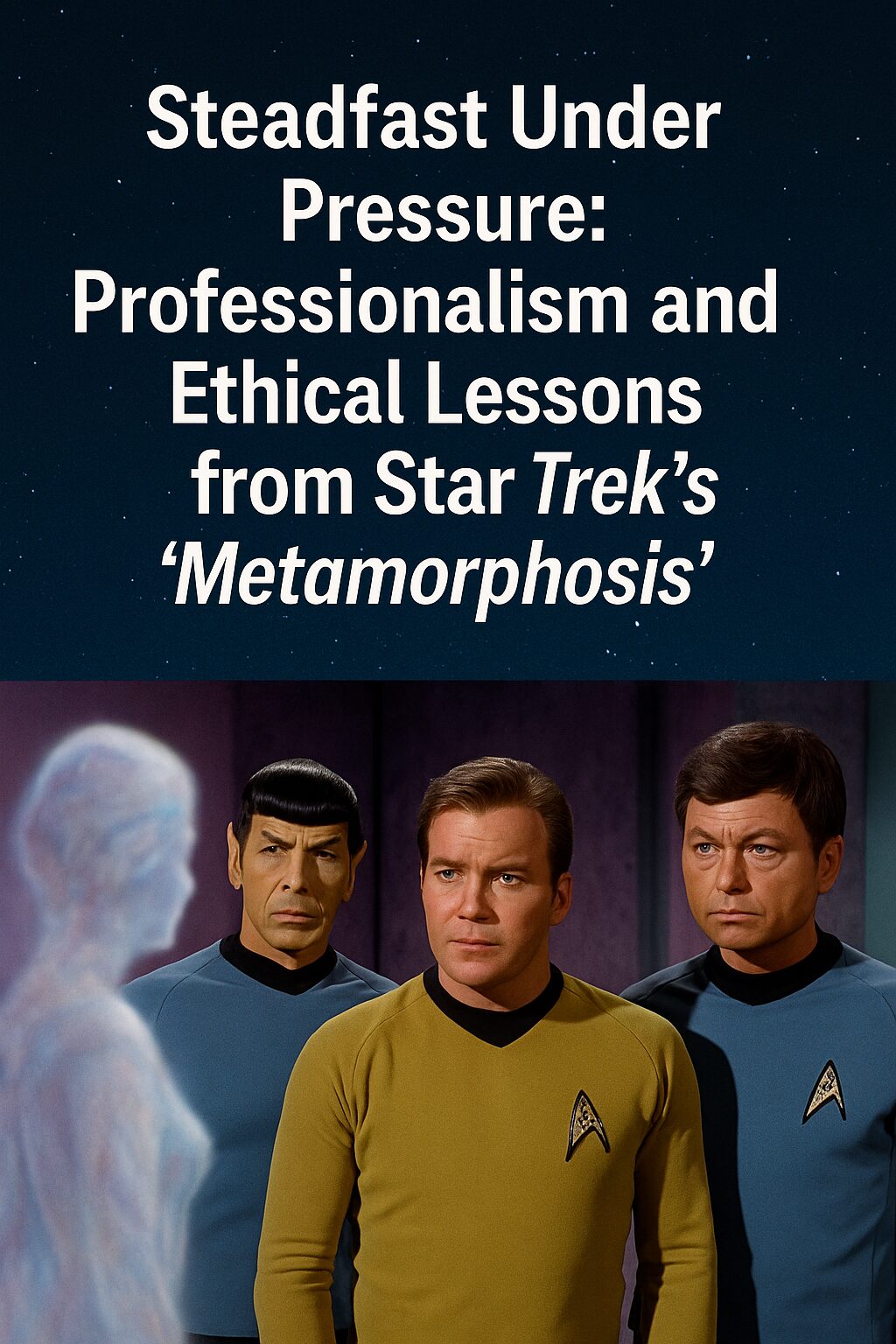
Steadfast Under Pressure: Professionalism and Ethical Lessons from Star Trek’s “Metamorphosis”

In the universe of corporate compliance, pressure is a constant. Whether facing a sudden investigation, navigating a crisis, or mediating high-stakes negotiations, the capacity to remain professional and ethically grounded is what separates a merely good compliance officer from a great one. Few pop culture references embody this principle more vividly than the classic Star Trek: The Original Series episode, “Metamorphosis.”

Set against the backdrop of a forced landing on a remote asteroid, “Metamorphosis” finds Captain Kirk, Spock, Dr. McCoy, and Commissioner Nancy Hedford stranded by an enigmatic alien entity known as the Companion. Their struggle to survive and mediate a clash of perspectives. It provides a near-perfect parallel to the kinds of professional and ethical challenges compliance professionals routinely face during investigations and stressful situations. Today, we dive into critical lessons for compliance professionals, each illustrated by a pivotal scene from “Metamorphosis.”

Lesson 1: Maintain Calm Objectivity—Even When You’re Under Fire

Illustrated By: Upon realizing that the Companion has hijacked their shuttle and they’re trapped on the planetoid, tensions run high. Commissioner Hedford, suffering from a life-threatening illness and a rapidly fading hope for rescue, becomes increasingly distraught. Yet Kirk and Spock methodically assess their environment and resources, refusing to let panic cloud their decision-making.

Compliance Lesson:

Investigations and crises often produce high-stress, high-stakes environments where anxiety and emotion run rampant. Professionalism in such situations demands composure and objectivity. A compliance officer’s ability to remain unflappable, not just for their own sake, but to reassure and stabilize others, is essential for effective problem-solving and ethical decision-making.

Train teams in stress management and crisis communication. Develop checklists and playbooks for investigative response to minimize decision-making under duress—model calm behavior to set the tone for the entire team.

Lesson 2: Empathy and Respect Are Critical—Even for Those You Don’t Understand

Illustrated By: The crew quickly learns the Companion is an alien being beyond their understanding, communicating in ways that defy their usual protocols. Instead of responding with hostility or frustration, Kirk and Spock seek to understand the Companion’s motives, with Spock even attempting a technological “translation” to bridge the communication gap.

Compliance Lesson: During investigations or stressful encounters, it’s easy to become impatient with those who seem uncooperative or “different,” whether they’re interview subjects, whistleblowers, or business partners from unfamiliar cultures. Professionalism requires empathy, respect, and a genuine effort to understand all perspectives, not just those that align with our own.

Integrate empathy training into your compliance curriculum. Remind investigators and managers that cultural, emotional, and even technological barriers are not obstacles to ignore but invitations to connect.

Lesson 3: Uphold Procedural Fairness—Even When Expediency Tempts You

Illustrated By: Desperate to return Commissioner Hedford to the Enterprise for urgent medical care, Kirk considers using force against the Companion. However, both Spock and McCoy caution against a hasty, confrontational approach. The crew ultimately respects due process, attempting diplomacy and dialogue before resorting to more drastic measures.

Compliance Lesson: Under pressure, shortcuts can seem tempting, such as skipping interviews, overlooking evidence, or rushing conclusions for the sake of expediency. However, professionalism in compliance means adhering to investigative protocols, ensuring fairness for all parties, even if it slows down the process or complicates things.

Institute clear, step-by-step protocols for investigations, and hold teams accountable for following them. Empower compliance personnel to speak up when they see due process being sidestepped.

Lesson 4: Ethical Decision-Making Requires Teamwork and Diverse Perspectives

Illustrated By: When initial attempts to reason with the Companion fail, Kirk doesn’t go it alone. He gathers input from Spock, McCoy, and even Commissioner Hedford, blending logic, medicine, diplomacy, and personal perspective. This collective approach yields a creative solution: merging Hedford’s consciousness with the Companion, which saves her life and resolves the impasse.

Compliance Lesson: Complex investigations rarely have easy answers. Ethical professionalism is reinforced by seeking out diverse viewpoints—legal, operational, cultural, and human—ensuring a comprehensive understanding of the issues at hand. The best compliance outcomes emerge from teams that respect each member’s expertise and encourage candid dialogue.

Promote cross-functional collaboration in every investigation. Debrief as a team after each case, capturing different perspectives and lessons learned for future improvement.

Lesson 5: Never Lose Sight of Humanity—The “Why” Behind Compliance

Illustrated By: As the Companion merges with Commissioner Hedford, she is given a second chance at life but must remain on the planetoid. Kirk and his crew, despite their desire to return to the Enterprise, recognize the profound importance of personal dignity and happiness in their resolution. They leave Hedford/Companion with Cochrane, honoring the choice made for love and fulfillment.

Compliance Lesson: In the rush to resolve crises or complete investigations, it’s easy to focus on policy, rules, and process at the expense of people. But true professionalism and ethical compliance leadership mean never losing sight of the human element. The best compliance professionals serve not just the organization but also the individuals whose lives are impacted by their actions.

Balance every investigative and crisis response protocol with compassion. Regularly revisit the organization’s values and “why” behind the compliance program. Use stories and real-life examples to remind teams of the human cost and benefit of ethical professionalism.

Final ComplianceLog Reflections

“Metamorphosis” stands as one of Star Trek’s most poignant explorations of transformation, not just of an alien being, but of the attitudes and perspectives of everyone involved. For compliance professionals, it serves as a powerful reminder: professionalism is not merely a matter of following procedures but of embodying the best of our values under pressure.

Maintaining objectivity, empathy, fairness, teamwork, and humanity, even in the face of the unknown, are the true hallmarks of ethical leadership in compliance. Every investigation, every high-stress moment, is an opportunity to transform not only the situation but also ourselves and our organizations.

As you lead your team through the next compliance challenge, remember the example set by Kirk, Spock, and McCoy. Stay calm. Seek to understand. Uphold fairness. Embrace teamwork. And above all, never forget the people at the heart of every compliance story.

Resources:

Excruciatingly Detailed Plot Summary by Eric W. Weisstein

MissionLogPodcast.com

Memory Alpha

Categories
Hill Country Hustlers

Hill Country Hustlers: From Oaxaca to Hill Country: Jorge Salinas’ Journey in Youth Soccer Coaching

In this episode of the Hill Country Hustlers podcast, host Zachary Green interviews Jorge Salinas, an entrepreneur and youth soccer coach. Originally from Oaxaca, Mexico, Jorge shares his journey from immigrating to the United States with his mother to settling in the Hill Country and eventually thriving as a soccer coach. Despite numerous challenges and setbacks, Jorge highlights the importance of perseverance, community support, and staying true to one’s passion. He discusses the development of Vida Es Futbol, his soccer training program, and the significance of indoor soccer in youth development. The conversation emphasizes the importance of honesty, effective communication, and their impact on children’s lives as key elements of success.

Key highlights:

  • Inspirational Journey Highlights
  • Coaching & Leadership Impact
  • Family, Faith & Values
  • Community Building & Legacy
  • Overcoming Odds & Taking Initiative

Resources:

Zach Green on LinkedIn

Jorge Salinas on LinkedIn

Categories
Blog

COSO’s Corporate Governance Framework: Component 4 – People

We continue our exploration of the recently released COSO  Corporate Governance Framework (the Framework) as a Public Exposure Draft.  Today, we begin a deep dive into the six individual components with a discussion of Component 4—People. It was allegedly Warren Buffett who coined the phrase Culture eats strategy for breakfast. But let me tell you something else that’s equally true: people make or break both. In Component 4, the focus is squarely on people: how we attract, develop, compensate, and ultimately hold them accountable for creating long-term value.

This is a vital message for compliance professionals. Why? Because the most sophisticated compliance program on paper won’t protect your organization if the wrong people are making the wrong decisions for the wrong reasons. Compliance is not about abstract rules; it is about human behavior. And COSO’s People Component brings that reality home.

The framework outlines how boards and executive leadership must take responsibility for aligning people, systems, hiring, training, leadership development, compensation, and succession planning with the entity’s purpose, culture, and strategy. In other words, governance doesn’t end at the boardroom door; it extends to the front line.

Today, we break down COSO’s guidance and explore five key lessons for compliance professionals ready to lead on the people side of governance.

What Is the People Component?

COSO’s CGF defines the People Component as the foundational element that ensures the right individuals are in the right roles, with the proper support, and aligned to the right objectives. This component contains three key principles:

  1. Deploy People Strategy and Succession Planning
  2. Manage People and Compensation
  3. Drive Performance and Development

From the board to the front line, these principles focus on accountability, integrity, ethical leadership, and performance through the lens of talent governance.

Why This Matters to Compliance

This component affirms what we in compliance have always known: talent decisions are, in fact, ethical decisions. Incentives shape behavior. Leadership shapes tone. And people’s strategy shapes resilience.

For compliance professionals, the People Component is a golden opportunity to build bridges with HR, executive management, and the board. It empowers us to bring our risk lens to hiring, our ethics lens to incentives, and our accountability lens to performance management.

Five Key Lessons for Compliance Professionals

Lesson 1: People Strategy Is a Governance Issue—Be Part of the Planning Table

Principle 14: Deploy People Strategy and Succession Planning

Executive management must align people strategy with business goals, assessing future workforce needs, talent gaps, and leadership succession. The board provides oversight to ensure that the right talent is in place to deliver strategic objectives in an ethical and effective manner.

Compliance Tip: Partner with HR to understand how workforce planning encompasses compliance-critical roles, including data privacy, risk management, internal audit, and ESG. Ask how your company identifies future leaders who can model ethical conduct and resilience. Propose a compliance risk overlay in succession planning. Ask: “If this person moves into a high-impact role, do they have a track record of integrity and sound judgment under pressure? ”Build that into leadership assessments.

Lesson 2: Compensation Drives Behavior—So Monitor It Carefully

Principle 15: Manage People and Compensation

The board and executive management must ensure that compensation structures reward long-term value creation and ethical behavior, not just short-term results. This includes executive compensation, employee incentives, and total rewards strategies that align with core values.

Compliance Tip: Request visibility into compensation metrics, especially for sales, finance, and procurement teams. If employees are being rewarded solely based on volume or cost savings, that could signal a misalignment with ethical standards. Collaborate with HR and the compensation committee to include compliance and ethics indicators in bonus calculations. Consider investigation outcomes, training compliance, audit results, and peer feedback on values-based behavior.

Lesson 3: Onboarding and Offboarding Are Compliance Moments of Truth

The People Component makes it clear: onboarding and offboarding are governance checkpoints. Onboarding is your chance to set expectations. Offboarding is your last opportunity to capture lessons and protect integrity.

Compliance Tip: Work with HR to ensure onboarding includes live ethics training, culture orientation, and clear escalation procedures. Offboarding should include structured exit interviews with questions on pressure, misconduct, and retaliation risks. Review offboarding data for red flags. If high-performing employees are leaving due to ethical concerns or if leaders with compliance histories are going quietly, you need to escalate those patterns to leadership and the board.

Lesson 4: Performance Reviews Must Reflect How Results Are Achieved—Not Just What Is Achieved

Principle 16: Drive Performance and Development

The board and executive management are responsible for performance systems that reflect both outcomes and behaviors. Reviews must consider how goals were achieved in an ethical, collaborative, and aligned manner with core values.

Compliance Tip: Request that HR include ethics-based questions in performance reviews. For example: “Does this employee act as a role model for integrity? ” or “Does this person raise concerns appropriately? Pilot a 360-degree review process for leaders that includes peer, subordinate, and compliance input on tone, transparency, and trustworthiness. Utilize these results in succession planning and leadership development initiatives.

Lesson 5: Development Programs Must Include Ethics, Governance, and Risk Awareness

Too often, leadership development focuses on financial acumen and strategy but remains silent on ethics, oversight, and compliance. COSO advocates for executive and board education that enhances governance throughout the organization.

Compliance Tip: Offer to design or co-lead development sessions on ethical decision-making, speak-up culture, conflicts of interest, and stakeholder trust. Focus not just on what leaders should do, but on how they should think. Ask the board to adopt a continuing education policy that includes topics related to compliance and ethics. Bring in external experts, regulators, or thought leaders in ethics to refresh perspectives and address emerging risks.

Compliance’s Role in Talent Governance

Compliance professionals are not necessarily HR specialists, but they are the stewards of ethical risk, organizational culture, and accountability. COSO’s People Component gives us a clear lane to add value in three ways:

  1. Risk insight: Help assess where people-related risks are most concentrated, such as in high-pressure sales, international expansion, and acquisitions.
  2. Behavioral analytics: Use data to flag misaligned incentives, weak training completion, or trends in misconduct.
  3. Governance alignment: Support the board in aligning people, systems, and ethics with strategy and long-term value creation.

By engaging early and often in talent conversations, compliance can prevent misconduct, protect stakeholders, and promote resilience.

Educating the Board on People Governance

Bring these insights to your next board or audit committee session:

  • Governance includes oversight of people, not just policies.
  • Talent gaps in ethics, risk, or leadership can derail strategy execution.
  • The board must understand how people systems align with values.
  • Compliance can help assess whether compensation, performance, and succession planning are risk-aligned.

When boards connect people’s decisions to governance outcomes, compliance moves from operational support to strategic leadership.

Final Thoughts: People Are Governance in Action

Compliance is no longer just about controls. It is about character at every level of the organization. COSO’s People Component recognizes that the fundamental drivers of governance are people: directors who ask the hard questions, managers who model ethical behavior, and employees who speak up when something doesn’t feel right.

In the spirit of the Compliance Evangelist: Use this component to engage deeply with the human side of your organization. Help your company build a workforce that not only follows the rules but also embodies its values. That should be your legacy.

To read or comment on the full CGF Public Exposure Draft, click here. The comment period closes July 11, 2025.