Categories
Blog

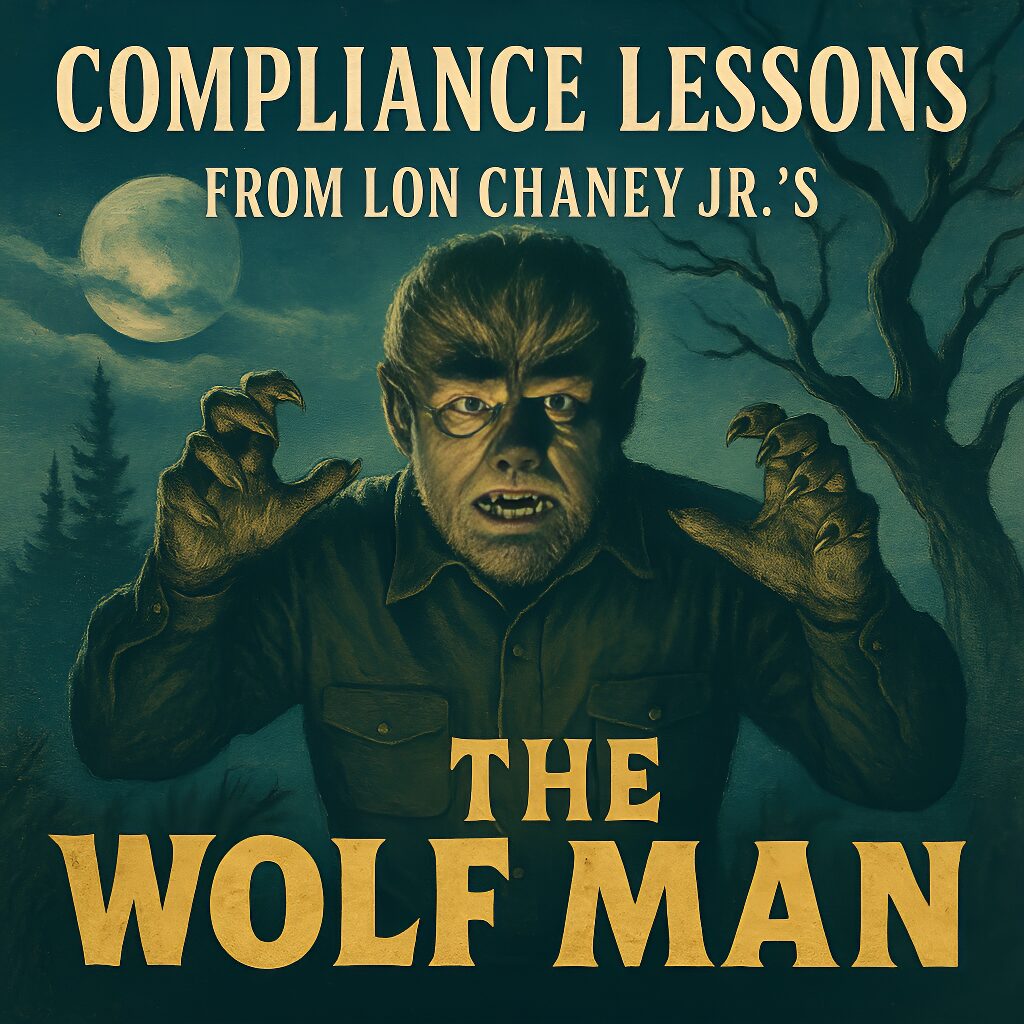
Compliance Lessons from the Lon Chaney Jr.’s The Wolf Man

As many of my readers know, I am a huge fan of the Classic Universal Picture Movie Monsters, focusing on the period from 1931 to the mid-1950s. In October, I traditionally use our Halloween-ending month to explore the Classic Universal Movie Monsters, along with other films from the Hammer Studio, those produced by Val Lewton, and those starring Vincent Price.  This year, I wanted to go back to basics by looking at the Classic Universal Movie Monsters, starting with Dracula and Frankenstein in 1931, followed by The Invisible Man in 1933, The Mummy in 1936, and ending with The Wolf Man in 1940.

Over the five Fridays in October, I will examine each of these movies through the lens of compliance and extract compliance lessons from each one. Today, I continue with perhaps the most psychologically complicated of the top 5: the Classic Universal Movie Monster Lon Chaney Jr.’s version of The Wolf Man. If you want to take a deeper dive into this movie in the podcast format, check out the special series on Popcorn and Compliance, hosted by my friends Fiona and Timothy. These podcasts will be posted alongside the blog post each Friday during October.

When Lon Chaney Jr. first appeared on screen as Larry Talbot in The Wolf Man (1941), audiences were introduced to one of the most enduring monsters in cinema. Unlike Frankenstein’s creation or Lugosi’s Dracula, Chaney’s Wolf Man was not entirely “other.” He was human, a son returning home, trying to reconnect with family, and falling victim to forces beyond his control. His torment was that he transformed into a monster against his will, unable to control the destruction he unleashed.

For compliance professionals, The Wolf Man offers some striking lessons. Chaney’s performance shows how good people can end up in bad situations, how organizations ignore warning signs at their peril, and how systems must be designed not only to catch intentional wrongdoing but also to address risks that emerge when ordinary individuals are put under pressure.

We continue our exploration of Classic Universal Monster Movies by considering five compliance lessons from Lon Chaney Jr.’s The Wolf Man.

1. Ordinary People Can Become Compliance Risks

Larry Talbot begins as an essentially decent man. He returns to his family estate, reconciles with his father, and awkwardly woos the local shopkeeper’s daughter. There is nothing inherently villainous about him. But after being bitten, he becomes something he cannot control. By moonlight, he turns into the Wolf Man and wreaks havoc. This duality mirrors what compliance professionals often see. Not every compliance violation comes from a “bad actor.” Sometimes it comes from ordinary employees under extraordinary circumstances: pressure, opportunity, or rationalization (the famous “fraud triangle”). Even good employees can become risks if they are put in the wrong situation without proper safeguards.

Compliance takeaway: Programs must be designed to account for human weakness. Training should emphasize not only rules but also ethical decision-making. Monitoring should not assume intent but look for patterns of behavior that may indicate an employee is slipping into risk. Like Larry Talbot, sometimes risk comes from within.

2. Warnings Ignored Become Disasters Realized

Throughout the film, there are clear warnings. Locals whisper about werewolves. An old Romani woman (played by great character actor Maria Ouspenskaya) gives a direct warning: “Even a man who is pure in heart and says his prayers by night, may become a wolf when the wolfsbane blooms and the autumn moon is bright.” But these warnings are dismissed as folklore, superstition, or exaggeration.

This is a common compliance failure: ignoring red flags. Whether it is a whistleblower report, suspicious payments, or unusual accounting entries, companies often rationalize risks away until they become unavoidable crises. Regulators such as the DOJ have repeatedly emphasized that ignoring warning signs is tantamount to negligence.

Compliance takeaway: Listen to the warnings. Investigate whistleblower reports promptly, document your findings, and act on them. A culture that treats red flags as noise will end up in crisis. As in The Wolf Man, the warnings were there. The failure was in dismissing them.

3. The Curse of Silence and Stigma

One of the most tragic elements of The Wolf Man is Larry Talbot’s isolation. He tries to tell others about what is happening to him, but he is met with disbelief, ridicule, or silence. The stigma of his transformation keeps him from getting the help he needs.

This resonates powerfully with the experience of corporate whistleblowers. Too often, employees who raise concerns are ignored, marginalized, or retaliated against. The result is silence, and silence allows misconduct to thrive. In its 2024 Evaluation of Corporate Compliance Programs (2024 ECCP), the DOJ emphasized the need to encourage reporting, keep whistleblowers informed, and protect them from retaliation.

Compliance takeaway: Break the curse of silence. Companies must foster cultures where employees feel safe raising concerns. Reporting channels must be confidential, retaliation must be prohibited, and whistleblowers should be treated as allies, not threats. Without breaking the stigma, organizations risk letting problems grow in the shadows.

4. Risk Is Cyclical and Predictable

Larry Talbot’s transformations follow a cycle; the full moon triggers his change into the Wolf Man. The risk is not random; it is predictable. Once you understand the pattern, you can anticipate the danger. This is precisely how compliance professionals must view risk. Corruption, fraud, and misconduct often follow cycles such as end-of-quarter pressure, market entry into high-risk jurisdictions, merger and acquisition activity, or supply chain disruptions. These moments are “full moons” in corporate life, where risks spike and vulnerabilities appear.

Compliance takeaway: Compliance must not only react but anticipate. Use data analytics and risk assessments to map the cycles of risk within your organization. Build monitoring around predictable pressure points. Just as villagers could expect when the Wolf Man would appear, compliance officers must anticipate when and where misconduct risks are most likely to emerge.

5. Tragedy Comes from Lack of Intervention

The story of The Wolf Man is, at its heart, a tragedy. Larry Talbot’s father refuses to believe him. Authorities dismiss his pleas. Friends ignore his warnings. No one intervenes until it is too late. By the end, Larry is destroyed, both man and monster, undone by neglect. The same pattern appears in many corporate scandals. Think of Wells Fargo’s sales practices scandal, Volkswagen’s emissions testing fraud, or recent FCPA enforcement actions. In nearly every case, someone knew. Red flags were visible. But intervention never came, whether out of fear, complacency, or willful blindness.

Compliance takeaway: Timely intervention is the difference between a near miss and a full-blown scandal. Compliance officers must have authority, resources, and independence to intervene early. Boards and executives must empower compliance not only to identify risk but also to act upon it. Without intervention, tragedy is inevitable.

Conclusion: The Wolf Man as a Compliance Parable

What makes Lon Chaney Jr.’s The Wolf Man so enduring is his humanity. He is not a monster by choice, but by circumstance. He represents the vulnerability of all people—how, under the wrong pressures, even the best of us can cross into dangerous territory. For compliance professionals, the lesson is not to hunt down “bad apples” alone, but to design systems that recognize, support, and mitigate human weakness before it becomes destructive.

As compliance officers, our role is to act before the full moon rises. We must listen to warnings, protect whistleblowers, anticipate risk cycles, and intervene decisively. Lon Chaney Jr.’s The Wolf Man is more than a gothic tragedy; rather, it is a case study in compliance failure.

The DOJ and SEC may not speak in the language of werewolves and curses, but their message is the same: prevent risk before it transforms into something uncontrollable. Because once the transformation occurs, once the Wolf Man is loose, no compliance officer can undo the damage already done.

Join us next Friday as we consider The Mummy.

Categories
It's art

It’s Art, Let’s Talk About It – Exploring the Journey of Shanna Kunz: From Courthouse Stenographer to Celebrated Landscape Artist

The Museum of Western Art is dedicated to excellence in the collection, preservation, and promotion of Western Heritage, as well as the education and cultural enrichment of our diverse audiences. The Museum serves as a bridge between the past and the present, ensuring that the legacy of the American West will be preserved for the future. Western Art is as engaging and important as ever. In this award-winning podcast series, Museum Executive Director Darrell Beauchamp welcomes renowned landscape artist Shanna Kunz from Ogden, Utah, to discuss her artistic journey.

Shanna shares how she transitioned from a career as a court stenographer to becoming a full-time artist after a life-changing watercolor class at age 29. She details her formal education at Utah State and the significant influences of mentors and fellow artists. Shanna also talks about balancing art with life, the importance of values and design in painting, and her pleasure in teaching workshops. Additionally, she highlights her involvement with a group of eight female artists called the Wild Women, who travel and paint together. The episode delves into her preferred techniques, favorite subjects, and upcoming projects, offering listeners valuable insights into her creative process and the business of art.

Highlights include:

  • Shanna’s Journey into Art
  • The Wild Women Artists Group
  • Advice for Aspiring Artists
  • The Importance of Values in Painting
  • The Business Side of Art
  • The Journey and Passion for Art

Resources:

Museum of Western Art

Darrell Beauchamp on LinkedIn

Shanna Kunz Fine Art website

Categories
Culture Crafters

Culture Crafters – Ethics Culture Divide, Part 2 – Enhancing Corporate Culture: The Vital Role of Ethics in Talent Retention and Acquisition

In this second episode in a 3-part series of podcasts, Tom Fox and Sam Silverstein discuss the critical divide in companies around Ethics and Culture. This series is based on data from a national survey of over a thousand people, highlighting the divide between high and low-performing companies in terms of ethics.

Sam and Tom discuss the critical importance of ethics in both talent acquisition and retention, emphasizing how these elements will serve as key differentiators for companies in the future. We explore why over a third of respondents believe ethics doesn’t help career advancement and how organizations can alter this perception by redesigning advancement criteria to include cultural and ethical values. The conversation highlights how ethical behavior begins in the hiring process and is reinforced through continuous feedback, not just annual reviews. We delve into real-world examples of ethical vs. unethical decisions impacting trust between employees, customers, and vendors, stressing the long-term catastrophic risks of ignoring ethical practices. The episode underscores that fostering an ethical culture is a top-down choice that needs to be modeled consistently at all levels to build trust and ensure long-term success.

Key highlights:

  • The Importance of Ethics in Talent Acquisition and Retention
  • Redesigning Advancement Criteria to Include Ethics
  • Impact of Ethics on Customer Trust
  • Ethical Shortcuts and Their Consequences
  • The Role of Ethics in Vendor Relationships

Resources:

 Sam Silverstein

Sam Silverstein on LinkedIn

Sam Silverstein

The Culture Audit™

Categories
AI Today in 5

AI Today in 5: October 16, 2025, The Texas Gas Edition

Welcome to AI Today in 5, the newest edition to the Compliance Podcast Network. Each day, Tom Fox will bring you 5 stories about AI, so start your day, sit back, enjoy a cup of morning coffee, and listen in to the AI Today In 5, all from the Compliance Podcast Network. Each day, we consider four stories from the business world, compliance, ethics, risk management, leadership, or general interest related to AI.

Top AI stories:

  1. Silicon Valley is pouring money into AI. (Yahoo!Finance)
  2. AI credentials program for healthcare. (BusinessWire)
  3. AI chatbots are replacing Indian call centers. (Reuters)
  4. Texas energy and AI chips. (WSJ)
  5. Microsoft to process data using AI inside the UAE. (The National)

For more information on the use of AI in Compliance programs, my new book, Upping Your Game, is available. You can purchase a copy of the book on Amazon.com.

Categories
Compliance Tip of the Day

Compliance Tip of the Day – Design Centric Internal Controls

Welcome to “Compliance Tip of the Day,” the podcast where we bring you daily insights and practical advice on navigating the ever-evolving landscape of compliance and regulatory requirements. Whether you’re a seasoned compliance professional or just starting your journey, we aim to provide you with bite-sized, actionable tips to help you stay on top of your compliance game. Join us as we explore the latest industry trends, share best practices, and demystify complex compliance issues to keep your organization on the right side of the law. Tune in daily for your dose of compliance wisdom, and let’s make compliance a little less daunting, one tip at a time.

This week, we consider issues around internal controls in a best practices compliance program. Today, we consider how design-centric internal controls can lay the foundation for an effective compliance program.

For more on this topic, check out The Compliance Handbook: A Guide to Operationalizing Your Compliance Program, 6th edition, which LexisNexis recently released. It is available here.

Categories
Daily Compliance News

Daily Compliance News: October 16, 2025, The Go with Paper Edition

Welcome to the Daily Compliance News. Each day, Tom Fox, the Voice of Compliance, brings you compliance-related stories to start your day. Sit back, enjoy a cup of morning coffee, and listen in to the Daily Compliance News. All, from the Compliance Podcast Network. Each day, we consider four stories from the business world, compliance, ethics, risk management, leadership, or general interest for the compliance professional.

Top stories include:

  • Why Danielle Sassoon resigned. (The Salt Lake Tribune)
  • UK gov says if hacked, go to paper. (BBC)
  • BOA sued over alleged ties to Epstein. (Reuters)
  • More days, more bribes paid to Trump. (Bloomberg)

The Daily Compliance News has been honored as the No. 2 in the Best Regulatory Compliance Podcasts category.

Categories
Blog

Compliance Under Pressure: Why Preventing Burnout Is a Governance Imperative

In a recent article in the MIT Sloan Management Review, author Brian Elliot says that we are living in what he calls The Burnout Age. Across industries and professions, exhaustion has become the new normal, and compliance is no exception. Recent studies show that over half of full-time U.S. employees report feeling burned out. In technology and professional services, that number climbs to over 80%. Even more telling: those who use AI tools most actively, the supposed productivity saviors, report the highest burnout levels of all.

For compliance officers, the parallels are unmistakable. You are being asked to “do more with less,” often without the resources, recognition, or rest needed to sustain that effort. You carry the responsibility of protecting your organization’s integrity, culture, and reputation, yet few roles face such unrelenting scrutiny and moral load. But here is the hard truth: burnout in compliance is not a problem solved by time off or a meditation app. It is a deeper challenge of structure, self-management, and purpose.

The author cites organizational psychologist Nick Petrie’s research, and I believe it applies directly to those of us in the compliance field. Drawing on his findings, I want to highlight three key ways compliance professionals can stop burnout before it stops them.

1. Balance “Perform Mode” and “Grow Mode”

Petrie’s research divides our work lives into two operating modes:

  • Perform mode — when we execute the skills we already know.
  • Grow mode — when we develop new capabilities and stretch into new territory.

Across thousands of professionals, he found the average split was 61% perform, 39% grow. But for high performers, including compliance officers, that ratio often becomes dangerously unbalanced. We overperform and undergrow. Compliance leaders tend to live in constant perform mode: reviewing investigations, updating policies, answering board queries, responding to regulators, or managing crises. Each task reinforces mastery, but rarely renewal. It is efficient, even satisfying, until it becomes a trap.

Here’s the danger: when you live too long in perform mode, you do not simply stagnate, you regress. Doctors, teachers, and yes, compliance professionals actually risk getting worse at their jobs over time because they stop learning, questioning, and refreshing their mental models.

To combat that, compliance professionals must build “grow mode” into their daily and strategic rhythm. That might mean:

  • Taking on projects that stretch your knowledge, such as AI governance, behavioral ethics, or cross-cultural compliance training.
  • Seeking rotation into a business unit to see risk and culture from the inside.
  • Joining a cross-functional ethics task force to collaborate differently.

Growth does not require leaving your role; it requires reframing it. Ask yourself regularly: What am I learning right now that will make me a better compliance leader a year from today?

Organizations that succeed in retaining compliance talent deliberately carve out “grow time” offering rotational opportunities, innovation labs, or even temporary secondments. If your company doesn’t provide them, advocate for them. Growth is not simply indulgence; it should be seen as sustainability.

2. Recognize Your Early Warning Signs

Compliance officers are masters of risk assessment, except, too often, when it comes to themselves. In Petrie’s work, high performers who experienced full burnout later said the signs had been “obvious in hindsight.” They just ignored them until it was too late. Compliance professionals are particularly vulnerable because of the role’s constant vigilance. You are expected to monitor everything from employee misconduct to third-party risk, but you cannot monitor your own well-being if you have normalized exhaustion.

Start with awareness. What are your personal leading indicators of burnout? For some, it is emotional: irritability, cynicism, or detachment. For others, it is behavioral: working weekends “just to catch up” or skipping lunch to squeeze in one more due diligence review. And for many, it is physical: poor sleep, headaches, fatigue that coffee cannot fix.

As Petrie put it, “I didn’t know what mine were, so I asked people close to me.” That’s a brilliant exercise for compliance leaders. Ask your peers, your partner, or even your team: What do you notice about me when I’m running on fumes?

Once you know your signs, the next step is to develop your recovery playbook. Call them your “if-thens”:

  • If I start working weekends, then I will block off an afternoon for reflection.
  • If I catch myself being short with colleagues, then I will step away from email for an hour.
  • If I’m consistently skipping exercise or hobbies, then I will schedule one small activity that re-energizes me.

For compliance officers, reflection is not a luxury. It is part of governance. You cannot sustain integrity in the organization if you are losing integrity with yourself. Recognizing and acting on those signals early is not selfish; rather, it is leadership.

3. Build Habits That Sustain, Not Deplete

Burnout does not happen overnight. It is the accumulation of small compromises: skipped meals, unchecked emails, endless meetings, and the belief that “just a little more effort” will fix everything. Compliance leaders know this pattern intimately because many of us built our reputations on it. We were the ones who said yes to every request, answered every hotline report, and took pride in responsiveness. That dedication made us successful, many of us in our 20s. But as Petrie notes, the habits that make you successful early in your career can burn you out later in it. To stop burnout, compliance professionals must build boundaries and rituals that protect their energy.

Here are three powerful habits to practice:

1. Reclaim Your Deep Work

Carve out time for deep focus; drafting a major policy overhaul, analyzing trends in internal reporting, or preparing a thoughtful presentation for the audit committee without interruptions. Turn off notifications. Close the compliance portal for a set block of time. Protecting your focus is protecting your value.

2. Create Transition Rituals

Between work and home, you need a deliberate “reattachment” moment, something that signals your brain that compliance mode is over. For some, it’s a walk, a podcast, or cooking dinner. For others, it’s journaling or a quiet drive. Do not dismiss it as small; transitions are the psychological bridge between productivity and peace.

3. Embrace Your “Opposite World”

Petrie calls this finding your “opposite world,” an activity that engages completely different parts of your mind and body. One tech executive told him, Argentinian tango saved my career.” For compliance officers, that could be cycling, painting, gardening, or volunteering. The goal is not distraction but rather renewal. When you activate different dimensions of your identity, you restore the emotional elasticity that burnout erodes. Finally, permit yourself to do less. That is not weakness, it is wisdom. As your career grows, the work will always outsize the hours. The key is to redefine success: it is not about getting everything done, but about doing what matters well.

Burnout Is a Governance Issue

It is tempting to see burnout as a personal issue, but for compliance leaders, it is also a governance risk. A burned-out compliance officer makes slower decisions, misses subtle patterns, and loses moral clarity. Fatigue is a threat to judgment, and in our field, judgment is everything. The Department of Justice’s 2024 Evaluation of Corporate Compliance Programs emphasizes continuous improvement and culture, but both rely on a compliance function that is psychologically and physically sustainable. The same applies to the board. When compliance fatigue spreads across leadership, the organization loses not just energy, but ethics.

That is why compliance leaders should view burnout prevention as part of their risk mitigation strategy. Incorporate it into team norms. Encourage “grow mode” through professional development. Recognize warning signs openly. And most importantly, lead by example, demonstrating that resilience and integrity are inseparable.

The Final Word: Bouncing Forward, Not Back

Nick Petrie calls the result of overcoming burnout “post-traumatic growth.” People who recover don’t return to where they were; they move beyond it. For compliance professionals, that’s the real opportunity of The Burnout Age. To emerge not as exhausted enforcers, but as energized leaders. To model balance, humanity, and perspective in a profession that often forgets to pause.

And always remember, the healthiest compliance programs begin with the healthiest compliance officers.

Categories
AI Today in 5

AI Today in 5: October 15, 2025, The White House Target Edition

Welcome to AI Today in 5, the newest edition to the Compliance Podcast Network. Each day, Tom Fox will bring you 5 stories about AI, so start your day, sit back, enjoy a cup of morning coffee, and listen in to the AI Today In 5, all from the Compliance Podcast Network. Each day, we consider four stories from the business world, compliance, ethics, risk management, leadership, or general interest related to AI.

Top AI stories include:

  1. AI assistant for loan compliance. (Housing Wire)
  2. AI for customer outreach compliance. (Business Wire)
  3. Streamlining compliance for marketing with AI. (CMS Wire)
  4. Anthropic is a WH target. (Bloomberg)
  5. OpenAI has a 5-year plan to spend $1tn. (FT)

For more information on the use of AI in Compliance programs, my new book, Upping Your Game, is available. You can purchase a copy of the book on Amazon.com.

Categories
Compliance Tip of the Day

Compliance Tip of the Day – Monitoring and Improvement of Internal Controls

Welcome to “Compliance Tip of the Day,” the podcast where we bring you daily insights and practical advice on navigating the ever-evolving landscape of compliance and regulatory requirements. Whether you’re a seasoned compliance professional or just starting your journey, we aim to provide you with bite-sized, actionable tips to help you stay on top of your compliance game. Join us as we explore the latest industry trends, share best practices, and demystify complex compliance issues to keep your organization on the right side of the law. Tune in daily for your dose of compliance wisdom, and let’s make compliance a little less daunting, one tip at a time.

This week, we consider issues around internal controls in a best practices compliance program. Today, we consider how to monitor and improve your internal controls.

For more on this topic, check out The Compliance Handbook: A Guide to Operationalizing Your Compliance Program, 6th edition, which LexisNexis recently released. It is available here.

Categories
Compliance Into the Weeds

Compliance into the Weeds: Navigating Effective Human Oversight for ADS/ADMT in AI Compliance

The award-winning Compliance into the Weeds is the only weekly podcast that takes a deep dive into a compliance-related topic, literally going into the weeds to explore a subject more fully, and looking for some hard-hitting insights on compliance. Look no further than Compliance into the Weeds! In this episode of Compliance into the Weeds, Tom Fox and Matt Kelly discuss Matt’s recent experience at a compliance conference in Lithuania and engage in a thorough discussion about effective human oversight in AI systems.

They examine the recent guidance from the European Data Protection Supervisor (EDPS) on maintaining human oversight of automated decision-making processes, relating it to similar regulatory requirements in California. The conversation explores the implications for corporate compliance, IT, and audit professionals, highlighting the challenge of balancing AI efficiency with the need for effective human intervention to mitigate risks and ensure regulatory compliance.

Key highlights:

  • Matt’s Experience in Lithuania
  • AI Regulation in the EU and CCPA Amendments re: ADS and ADMT
  • Effective Human Oversight in AI Systems
  • Challenges in AI Control Design
  • The Role of Compliance and Audit in AI Oversight

Resources:

Matt on Radical Compliance

Tom with a 5-Part podcast series on the CCPA Amendments on ADS/ADMT with Alyssa DeSimone on Life with GDPR

Tom

Instagram

Facebook

YouTube

Twitter

LinkedIn

A multi-award-winning podcast, Compliance into the Weeds was most recently honored as one of the Top 25 Regulatory Compliance Podcasts, a Top 10 Business Law Podcast, and a Top 12 Risk Management Podcast. Compliance into the Weeds has been conferred a Davey, Communicator, and W3 Awards for podcast excellence.