

Categories
Trekking Through Compliance

Trekking Through Compliance – Episode 14 – Investigative Lessons from Balance of Terror

In this episode of Trekking Through Compliance, we consider the episode Balance of Terror, which aired on December 15, 1966, Star Date 1709.1.

In this episode of Trekking Through Compliance, we analyze “Balance of Terror,” the tense, submarine-style showdown between the Enterprise and a Romulan Bird-of-Prey, which introduces one of Star Trek’s most enduring adversaries. The story unfolds as a mystery: Who attacked the Earth outposts? What is this new weapon? Who are the Romulans? And what do their sudden appearances mean for the Federation?

We review the critical investigative lessons this episode offers for compliance professionals: the importance of situational analysis, managing internal bias, respecting operational security, and knowing when to act and when to wait. In this cat-and-mouse episode, we find the foundations of modern investigative best practices.

Key highlights:

1. Situational Awareness and Evidence Gathering—Don’t Jump to Conclusions

🖖Illustrated by: The destruction of Outposts 2 and 3 and the cryptic communication from Outpost 4.

Captain Kirk begins his investigation without clear evidence, gathering fragmented data from the surviving outpost’s transmissions and assessing the damage patterns. For compliance professionals, this illustrates the importance of establishing a clear fact pattern before concluding. Investigations must be driven by objective evidence, not assumptions.

2. Managing Internal Bias—Appearance Is Not Proof

🖖Illustrated by: Lieutenant Stiles’ suspicion of Mr. Spock based on the physical resemblance between Romulans and Vulcans.

Stiles immediately targets Spock as a potential traitor, despite a complete lack of evidence, simply because Romulans and Vulcans share a similar appearance. This moment serves as a cautionary tale in terms of compliance: biases, whether conscious or unconscious, can derail investigations and damage team morale.

3. Strategic Surveillance—Investigate Without Provoking Retaliation

🖖Illustrated by: Kirk shadowing the Romulan ship to determine intent and capabilities before engaging.

Rather than charging into conflict, Kirk chooses to observe the Romulan ship’s behavior. In compliance investigations, particularly those involving fraud or misconduct, covert observation and the secure handling of information are crucial to preventing tip-offs or escalation.

4. Chain of Custody and Documentation—Recording and Communicating the Facts

🖖Illustrated by: The tactical logs Kirk reviews and Spock’s technical input during the confrontation.

Throughout the engagement, Kirk relies on detailed sensor data, eyewitness accounts, and Spock’s analysis to make decisions. Compliance professionals must ensure the proper documentation of interviews, timelines, and data sources for both internal review and external audit.

5. Ethical Leadership During Investigations—Calm in the Face of Conflict

🖖Illustrated by: Kirk’s balance between decisiveness and restraint, even when provoked by Romulan attacks.

Kirk refuses to act out of fear or anger—even as tensions rise. He models ethical leadership: protecting lives, preserving treaty obligations, and maintaining moral clarity. In high-stakes compliance investigations, emotional discipline and ethical consistency are vital.

Final Starlog Reflections

Balance of Terror is a masterclass in investigative poise, procedural discipline, and ethical clarity under pressure. As the Enterprise crew faces a new adversary cloaked in invisibility, we see what real leadership looks like when facts are scarce and risks are high.

For compliance professionals, this episode is a reminder that investigations require patience, vigilance, and integrity. Bias must be checked, facts must be verified, and trust must be earned. The threat may be hidden, but your investigative principles must always remain visible.

Resources:

Excruciatingly Detailed Plot Summary by Eric W. Weisstein
MissionLogPodcast.com

Memory Alpha

Categories
Blog

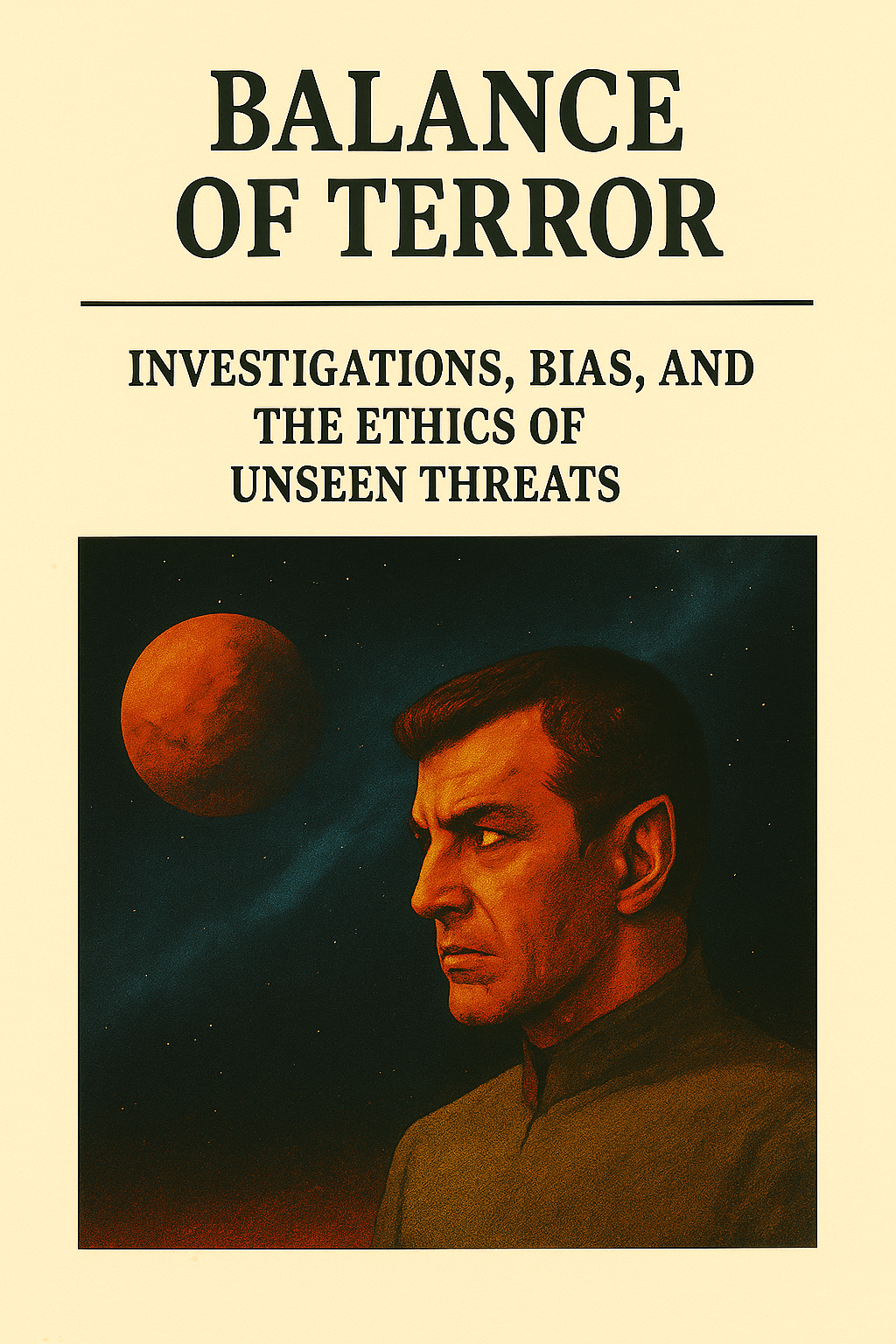
Balance of Terror: Investigations, Bias, and the Ethics of Unseen Threats

Show Summary

Today, we analyze Balance of Terror, the tense, submarine-style showdown between the Enterprise and a Romulan Bird-of-Prey that introduces one of Star Trek’s most enduring adversaries. The story unfolds as a mystery: Who attacked the Earth outposts? What is this new weapon? Who are the Romulans? And what do their sudden appearances mean for the Federation?

We consider the critical investigative lessons this episode offers for compliance professionals: the importance of situational analysis, managing internal bias, respecting operational security, and knowing when to act and when to wait. In this cat-and-mouse episode, we find the foundations of modern investigative best practices.

1. Situational Awareness and Evidence Gathering—Don’t Jump to Conclusions

Illustrated by: The destruction of Outposts 2 and 3 and the cryptic communication from Outpost 4.

When Captain Kirk is alerted to the destruction of Outposts 2 and 3, followed by a garbled and desperate message from Outpost 4, he does not leap to conclusions. Instead, he begins assembling a coherent picture from incomplete data. It is an approach every compliance professional should emulate. Kirk listens carefully to the fading transmissions, asks questions, and refrains from concluding until the evidence is strong enough to warrant a course of action. In the compliance context, this underscores the importance of establishing a clear and objective fact pattern before initiating formal charges or drawing public conclusions. Whether it is a whistleblower tip, financial irregularity, or cyber breach, investigators must resist the urge to confirm pre-existing assumptions and instead allow the data to guide the inquiry. Rushed investigations lead to false positives, reputational damage, and a loss of credibility. Thorough evidence gathering is not a luxury, and it is the cornerstone of practical and ethical investigations.

2. Managing Internal Bias—Appearance Is Not Proof

Illustrated by: Lieutenant Stiles’ suspicion of Mr. Spock based on the physical resemblance between Romulans and Vulcans.

Lieutenant Stiles immediately casts suspicion on Spock when it is revealed that Romulans resemble Vulcans despite Spock’s long and honorable service aboard the Enterprise. This reflexive distrust, based solely on appearance and ancestry, is a prime example of how bias can derail an investigation and a team. For compliance professionals, this moment serves as a powerful reminder of the damage unconscious bias can cause in investigative settings. Bias leads to tunnel vision, selective interpretation of evidence, and the marginalization of innocent individuals. Investigators must be trained to recognize and eliminate personal biases from their assessments, ensuring that findings are based on behavior and facts rather than on factors such as ethnicity, appearance, age, or background.

Additionally, leaders must protect team dynamics and morale by correcting discriminatory behavior when it arises. Stiles’s conduct not only risked undermining the investigation, but it also threatened the cohesion of the entire bridge crew. In compliance work, fairness is not only a good idea but also a foundational principle.

3. Strategic Surveillance—Investigate Without Provoking Retaliation

Illustrated by: Kirk shadowing the Romulan ship to determine intent and capabilities before engaging.

Captain Kirk chooses patience over aggression. Faced with a technologically advanced Romulan vessel capable of cloaking itself, Kirk adopts a strategy of stealth and surveillance, carefully observing enemy behavior before taking action. This restraint allows him to gather intelligence on the Romulans’ capabilities, decision-making process, and command philosophy. For compliance professionals, this offers a tactical lesson: not every investigation requires immediate confrontation. Especially in matters of internal fraud, harassment, or collusion, premature escalation can trigger retaliation, cover-ups, or destruction of evidence. Surveillance, whether through data audits, transaction monitoring, or employee behavior analytics, can provide valuable insights into patterns of misconduct while maintaining the element of surprise. However, it must be done ethically and lawfully, with careful control over access to sensitive information. Kirk’s calm, measured approach reflects the same principle: watch closely, document thoroughly, and only engage once you fully understand the scope and severity of the issue.

4. Chain of Custody and Documentation—Recording and Communicating the Facts

Illustrated by: The tactical logs Kirk reviews and Spock’s technical input during the confrontation.

Throughout the high-stakes engagement with the Romulans, Captain Kirk and his crew rely not on instinct but on a steady stream of data: tactical logs, sensor readouts, and crew input, particularly from Spock, who filters and interprets technical signals. These layers of documentation provide a clear, defensible foundation for Kirk’s strategic decisions. The lesson for compliance professionals is crystal clear: thorough, contemporaneous documentation is the bedrock of a defensible investigation. Every interview, transaction, policy exception, and timeline must be accurately recorded and stored securely to preserve integrity and facilitate external review. Furthermore, clear communication, especially among multidisciplinary stakeholders, is vital. Just as Kirk integrates science, operations, and command insights to build a complete picture, compliance teams must synthesize data across HR, IT, legal, and finance. Without this coordinated recordkeeping, investigations become vulnerable to challenge or dismissal. Proper documentation not only protects your findings but also protects your credibility.

5. Ethical Leadership During Investigations—Calm in the Face of Conflict

 Illustrated by: Kirk’s balance between decisiveness and restraint, even when provoked by Romulan attacks.

Despite being under extreme pressure and facing an adversary with unknown technology and intentions, Kirk maintains emotional control. He neither rushes to attack nor lets fear override strategic thinking. This poise under fire reflects the ideal ethical leadership model during an investigation. Compliance professionals frequently face high-stakes scenarios involving reputational risk, scrutiny from senior executives, or regulatory exposure. The temptation to react emotionally, whether defensively, aggressively, or politically, can compromise both the integrity and objectivity of the investigation. Like Kirk, compliance leaders must demonstrate restraint, transparency, and ethical consistency, even in moments of heightened tension. Your tone will shape how the team responds, how witnesses perceive the process, and how leadership views the investigation’s validity. Emotional discipline is not detachment, and it is the deliberate choice to anchor every step in principle rather than pressure. In times of uncertainty, ethical leadership is not loud but steady. And that steadiness defines whether your investigation is respected or rejected.

Final ComplianceLog Reflections

Balance of Terror is a masterclass in investigative poise, procedural discipline, and ethical clarity under pressure. As the Enterprise crew faces a new adversary cloaked in invisibility, we see what authentic leadership looks like when facts are scarce and risks are high.

For compliance professionals, this episode is a reminder that investigations require patience, vigilance, and integrity. Bias must be checked, facts must be verified, and trust must be earned. The threat may be hidden, but your investigative principles must always remain visible.

Categories
Blog

Risk Assessment Lessons from Star Trek: Balance of Terror

Last month, I wrote a blog post on the tone at the top, exemplified in Star Trek’s Original Series episode, Devil in the Dark. Based on the response, some passionate Star Trek fans are out there. I decided to write a series of blog posts exploring Star Trek: The Original Series episodes as guides to the Hallmarks of an Effective Compliance program set out in the FCPA Resources Guide, 2nd edition. Today, I continue my two-week series, looking at the following 10 hallmarks of an effective compliance program as laid out by the Department of Justice (DOJ) and Securities and Exchange Commission (SEC) in the FCPA Resources Guide, 2nd edition.

The episode Balance of Terror serves as an excellent example of risk assessment. This episode showcases the complexities and importance of evaluating risks in high-stakes situations. In this episode, the USS Enterprise is patrolling the Romulan Neutral Zone when they discover that a series of outposts have been mysteriously destroyed. The Enterprise encounters a Romulan Bird-of-Prey equipped with a powerful cloaking device and an advanced weapon capable of destroying planets. Captain Kirk must assess the risks of engaging the Romulan ship while preventing a potential war. What are some of the key risk assessment lessons?

The Risk is the Romulan threat to the Federation. The episode opens with the Enterprise facing an unknown enemy, the Romulans. This unknown factor presents a significant risk because of the Romulan’s uncertain capabilities. Their technology and tactics are shrouded in mystery, and there is a clear potential for escalation, as any misstep could lead to a full-blown war. Equally important is the impact on Federation security, as the Romulans’ aggressive actions threaten the Federation’s and its citizens’ safety.

Lesson 1 – Identifying Risks

The Enterprise crew must identify the nature and source of the threat the Romulan ship poses. This involves gathering intelligence on the Romulans’ capabilities, tactics, and intentions despite limited information. The risk assessment lesson is that effective risk assessment begins with identifying potential threats and vulnerabilities. Organizations must gather relevant data to understand the nature and scope of risks they face. This includes external threats, such as competitors or geopolitical issues, and internal vulnerabilities, such as process inefficiencies or compliance gaps.

Lesson 2 – Assessing the Risk

Captain Kirk must evaluate the Romulan threat, considering the immediate danger to the Enterprise and the broader implications of a conflict with the Empire. Captain Kirk and his crew engage in a meticulous risk assessment process to gather intelligence by analyzing the Romulan vessel’s capabilities and tactics and then devising a plan to counter the Romulan threat, including deploying a decoy and using deception tactics.

The possibility of igniting a war demands careful consideration of the consequences of each action. The risk assessment lesson is that assessing the potential impact of identified risks is crucial for prioritizing response strategies. Organizations should evaluate the possible consequences of risks in terms of financial loss, reputational damage, operational disruption, and legal implications. Understanding the severity and likelihood of risks helps in developing appropriate mitigation plans.

Lesson 3 – Developing a Risk Mitigation Strategy

Kirk and his crew analyze various response options, weighing the pros and cons of engaging the Romulan ship versus maintaining a defensive stance. They consider strategic maneuvers, potential diplomatic outcomes, and the risks of escalation. The risk assessment lesson is that a comprehensive risk assessment involves analyzing available response options and their associated risks. Organizations should explore different scenarios and develop contingency plans to address potential threats. This includes evaluating the effectiveness and feasibility of risk mitigation strategies and determining the best course of action.

Lesson 4 – Decision-Making Under Uncertainty

Kirk must make critical decisions under conditions of uncertainty, with incomplete information about the Romulans’ intentions and capabilities. Logically and intuition guide his choices, balancing immediate tactical needs with long-term strategic goals. The risk assessment lesson often involves making decisions with limited information. Organizations should develop frameworks for decision-making under uncertainty, incorporating quantitative data and qualitative insights. Open communication and collaboration among stakeholders can enhance the decision-making process.

Lesson 5 – Monitoring and Continuous Improvement

As the situation evolves, Kirk continuously monitors the actions of the Romulan ship and adjusts his strategy accordingly. His ability to adapt to changing circumstances is crucial to the Enterprise’s survival. The lesson in risk assessment is that it is an ongoing process that requires continuous monitoring and adjustment. Organizations should establish mechanisms for tracking the effectiveness of risk mitigation efforts and be prepared to adapt strategies as new information emerges. Regular reviews and updates to risk assessments help ensure that organizations remain responsive to dynamic environments.

Balance of Terror provides a compelling narrative that illustrates the essential elements of risk assessment, from identifying threats to making informed decisions under uncertainty. For compliance professionals and business leaders, the episode underscores the importance of a systematic approach to risk assessment, emphasizing the need for thorough analysis, strategic planning, and adaptability in the face of evolving challenges. By drawing lessons from Captain Kirk’s command decisions, organizations can enhance risk management practices and better navigate complex and uncertain environments.

Join us tomorrow as we consider the lessons on training and ongoing communications from the Star Trek episode The Trouble with Tribbles.

Categories
Trekking Through Compliance

Trekking Through Compliance-Episode 14- Balance of Terror

In this episode of Trekking Through Compliance, we consider the episode Balance of Terror  which aired on December 15, 1966, Star Date 1709.1
Compliance Takeaways:
  1. As a CCO, you must not allow racism in your organization.
  2. Does your speak up culture include training on how to listen?
  3. #MeToo means that if, as a by-stander you see something it is your responsibility to report it.Resources
Excruciatingly Detailed Plot Summary by Eric W. Weisstein for Balance of Terror
MissionLogPodcast.com-Balance of Terror