Categories
Blog

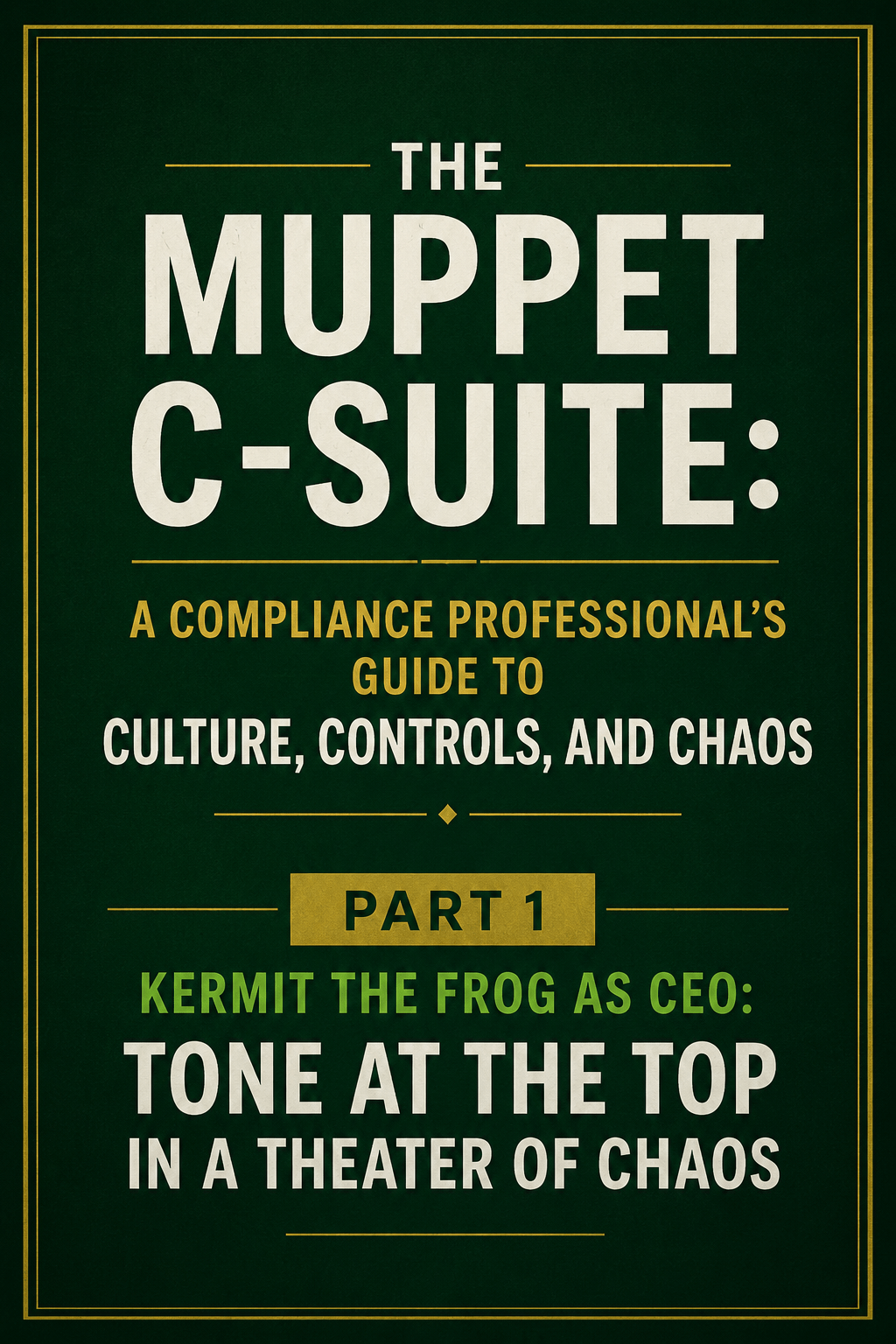
The Muppet C-Suite: A Compliance Professional’s Guide to Culture, Controls, and Chaos: Part 1 – Kermit the Frog as CEO: Tone at the Top in a Theater of Chaos

Early this year, Disney released The Muppet Show. It is a revival of the original Muppet Show series (1976–1981) created by Jim Henson, featuring recurring sketches and musical numbers interspersed with ongoing plotlines, with backstage gags and other running gags throughout the venue. The special features include Special Guest singer and actress Sabrina Carpenter, with additional guest appearances by actress and comedian Maya Rudolph, backstage gags, and other running gags throughout, and comedian Seth Rogen. In 2026, The Muppet Show revived the original show’s tone with slapstick, absurdist, and surreal humor. Within its context, Kermit the Frog acts as the showrunner and host, who tries to maintain control of the overwhelming antics of the other Muppet characters and appease the guest stars.

The Muppets may appear chaotic, but beneath the comedy lies a surprisingly sophisticated lesson in organizational leadership. Every compliance professional has worked with a Kermit, managed a Piggy, worried about a Gonzo, or tried to contain an Animal. This series uses the Muppet executive team as a framework to explore leadership, governance, innovation, operational risk, and corporate compliance through the lens of the DOJ’s Evaluation of Corporate Compliance Programs (ECCP) and modern governance expectations.

There may never have been a more realistic fictional CEO than Kermit the Frog. He is not flashy. He is not domineering. He rarely appears fully in control. In fact, most episodes of The Muppet Show depict Kermit managing a workplace that appears one step away from complete operational collapse. Explosions happen backstage. Talent refuses direction. The animal breaks containment regularly. Miss Piggy ignores authority whenever it conflicts with her personal brand strategy. Gonzo treats safety protocols as optional suggestions. And yet somehow, the show goes on.

That is leadership. More specifically, leadership in a modern corporation involves competing incentives, operational pressures, innovation demands, and cultural personalities that collide every day. For compliance professionals, Kermit offers a remarkably useful framework for understanding tone at the top and why effective governance is less about command-and-control and more about maintaining organizational coherence under stress.

Tone at the Top Is Not About Perfection

One of the more damaging myths in corporate governance is that strong leadership means projecting certainty and total control at all times. Kermit disproves this theory in nearly every episode. He is frequently overwhelmed. He becomes frustrated. He occasionally loses patience. But he continues to communicate expectations, reinforce standards, and keep the organization focused on its mission despite persistent disruption.

This matters because the DOJ’s ECCP does not ask whether leadership is perfect. It asks whether leadership demonstrates commitment to ethics and compliance through words, actions, decisions, and resource allocation. Kermit consistently demonstrates this commitment.

He tries to resolve disputes fairly. He intervenes when behavior becomes destructive. He supports the enterprise even when individual performers create personal headaches. Most importantly, he never allows the organization’s chaos to become its identity. That is the tone at the top. The lesson for compliance professionals is straightforward: employees do not expect leadership perfection. They expect leadership consistency.

Kermit Understands Culture Is Operational

Many executives treat culture as an abstract concept discussed at annual retreats or included in (what was previously called) ESG reports. Kermit understands culture differently. For him, culture is operational reality. Culture determines:

  • whether people cooperate,
  • whether concerns are escalated,
  • whether misconduct is tolerated,
  • and whether organizational dysfunction becomes normalized.

Kermit spends much of his time managing interpersonal conflict because he understands something many executives miss: operational breakdowns often begin as cultural breakdowns. Consider the dynamics of the Muppet theater:

  • Miss Piggy demands attention and exceptions.
  • Gonzo constantly pushes boundaries.
  • Fozzie requires emotional reassurance.
  • An animal creates pure operational volatility.

A weaker CEO would either overreact with authoritarian control or surrender entirely. Kermit does neither. Instead, he continually recalibrates the organization back toward functional alignment. That is exactly what compliance professionals attempt to do every day.

Under the ECCP, prosecutors are instructed to assess whether a company’s culture encourages ethical conduct and commitment to compliance. Posters or slogans do not measure culture. It is measured by behavior under pressure. Kermit’s theater is always under pressure. That is precisely why it works as a governance analogy.

Leadership Visibility Matters

Kermit is not a remote executive. He is constantly present:

  • backstage,
  • during rehearsals,
  • during crises,
  • and during failures.

This visibility creates credibility.

Employees tend to distrust leaders who appear only during earnings calls, investigations, or public relations crises. Kermit’s team knows he is engaged because they see him actively trying to keep the organization functioning every single day. Modern compliance programs increasingly recognize this principle. Tone at the top alone is insufficient. Organizations also need visible engagement from leadership and reinforced accountability from middle management.

The ECCP repeatedly emphasizes this point through its focus on:

  • commitment by senior leadership,
  • middle-management reinforcement,
  • and operational integration.

Kermit succeeds because he is operationally embedded in the business. He does not lead from a memo.

Kermit as a Crisis Manager

Every episode of The Muppet Show is essentially a live operational-risk exercise. Unexpected events occur constantly:

  • technical failures,
  • talent disruptions,
  • emotional meltdowns,
  • physical destruction,
  • and reputational threats.

Kermit’s real strength as CEO emerges during these moments. He does not freeze. He does not catastrophize. He does not blame others publicly. He focuses on containment, continuity, and getting the production across the finish line. This is a critical lesson for modern compliance professionals, as organizational resilience increasingly depends on leadership behavior during disruptions. The most sophisticated compliance program in the world can still fail if leadership collapses during a crisis.

Kermit demonstrates several best practices repeatedly:

  • maintain calm visibility,
  • prioritize continuity,
  • avoid emotional escalation,
  • focus on immediate stabilization,
  • Then return later for remediation.

That sequence matters.

Too many organizations focus exclusively on assigning blame during a crisis while neglecting operational stabilization. Kermit instinctively understands that you first keep the theater standing. Then you investigate why the cannon exploded backstage.

Compliance Cannot Function Without Cross-Functional Coordination

Kermit also demonstrates another overlooked governance truth: no single department can manage organizational risk alone.

He constantly coordinates:

  • creative personalities,
  • operational functions,
  • technical failures,
  • audience expectations,
  • and financial realities.

That mirrors the reality of corporate compliance. Compliance programs fail when they become isolated from business operations. Effective governance requires coordination between:

  • legal,
  • HR,
  • finance,
  • operations,
  • marketing,
  • innovation,
  • and leadership.

Kermit’s greatest leadership skill may be his ability to keep highly divergent personalities moving in roughly the same direction. Importantly, he accomplishes this without destroying individuality. That balance matters because mature compliance programs should not eliminate creativity or innovation. They should channel them responsibly.

Kermit does not try to turn Gonzo into Rolf. He tries to prevent Gonzo from setting the building on fire. Many compliance professionals would recognize that as success.

Why Kermit Matters Right Now

Kermit is especially relevant in today’s governance environment because modern corporations increasingly operate in a permanent state of volatility. Executives face:

  • AI disruption,
  • geopolitical instability,
  • reputational acceleration through social media,
  • regulatory expansion,
  • activist stakeholders,
  • and heightened board expectations.

Under these conditions, leadership style matters more than ever.

The organizations most likely to survive are not necessarily the most rigidly controlled. They are the ones capable of maintaining ethical alignment, operational coordination, and cultural stability during sustained uncertainty. That is Kermit’s real genius. He keeps the enterprise functioning without pretending chaos does not exist. For compliance professionals, that may be the most important lesson of all.

5 Key Takeaways for the Compliance Professional

1. Tone at the top is measured during pressure, not during presentations.

Leadership credibility is built through behavior during operational stress and organizational disruption.

2. Culture is operational.

Culture directly affects escalation, accountability, cooperation, and ethical decision-making.

3. Visible leadership engagement matters.

Employees trust leaders who are operationally present and consistently engaged with the business.

4. Compliance requires cross-functional coordination.

Effective governance depends on alignment between leadership, operations, legal, HR, finance, and compliance.

5. The goal is not to eliminate chaos.

The goal is to manage risk, maintain alignment, and preserve organizational integrity while operating in an environment of uncertainty.

Looking Ahead to Miss Piggy

If Kermit represents leadership stability, Miss Piggy represents a very different governance challenge: visibility, incentives, and reputational pressure. Because tone at the top is only the beginning. Eventually, every organization faces the same question: What happens when brand, growth, and public attention begin pushing harder than governance systems can comfortably manage?

In Part 2, we will examine Miss Piggy as Chief Marketing Officer and what she teaches compliance professionals about reputation risk, marketing pressure, incentives, and the governance challenges created by high-performing executives.

Categories
Daily Compliance News

Daily Compliance News: December 16, 2025, The Don’t Feed the Pig Edition

Welcome to the Daily Compliance News. Each day, Tom Fox, the Voice of Compliance, brings you compliance-related stories to start your day. Sit back, enjoy a cup of morning coffee, and listen in to the Daily Compliance News. All, from the Compliance Podcast Network. Each day, we consider four stories from the business world, compliance, ethics, risk management, leadership, or general interest for the compliance professional.

Top stories include:

  • The slogan that brought down the Bulgarian government. (NYT)
  • Compliance concerns with AI glasses. (NationalLawReview)
  • Trafigura appeals. (Bloomberg)
  • Is there a right way for a CEO to quit? (FT)

The Daily Compliance News has been honored as the No. 2 in Best Regulatory Compliance Podcasts category.

Categories
AI Today in 5

AI Today in 5: November 19, 2025, The Turning No into Flow Edition

Welcome to AI Today in 5, the newest edition to the Compliance Podcast Network. Each day, Tom Fox will bring you 5 stories about AI to start your day. Sit back, enjoy a cup of morning coffee, and listen in to the AI Today In 5. All, from the Compliance Podcast Network. Each day, we consider four stories from the business world, compliance, ethics, risk management, leadership, or general interest about AI.

Top AI stories include:

  1. Of APIs and AI. (Forbes)
  2. Will 2026 redefine GenAI and compliance risk? (PR Newswire)
  3. Energy is key for AI’s next chapter. (Trading View)
  4. New report on the CEO’s Guide to AI Transformation. (AINews)
  5. Teaching students to shape AI. (BusinessInsiderAfrica)

For more information on the use of AI in Compliance programs, see my new book, Upping Your Game. You can purchase a copy of the book on Amazon.com

Categories
Daily Compliance News

Daily Compliance News: July 29, 2025, The Is CEO Conduct Ever Personal Edition

Welcome to the Daily Compliance News. Each day, Tom Fox, the Voice of Compliance, brings you compliance-related stories to start your day. Sit back, enjoy a cup of morning coffee, and listen in to the Daily Compliance News. All, from the Compliance Podcast Network. Each day, we consider four stories from the business world, compliance, ethics, risk management, leadership, or general interest for the compliance professional.

Top stories include:

  • US states are leading the charge to break up big pharma. (FT)
  • What image does it have for profits: UnitedHealth. (NYT)
  • Does any CEO have Personal Conduct? (Bloomberg)
  • Corruption and battlefield failures. (NYT)

You can donate to flood relief for victims of the Kerr County flooding by going to the Hill Country Flood Relief here.

Categories
Compliance Tip of the Day

Compliance Tip of the Day: How A CEO Can Set The Tone at The Top with Town Halls

Welcome to “Compliance Tip of the Day,” the podcast where we bring you daily insights and practical advice on navigating the ever-evolving landscape of compliance and regulatory requirements.

Whether you’re a seasoned compliance professional or just starting your journey, our aim is to provide you with bite-sized, actionable tips to help you stay on top of your compliance game.

Join us as we explore the latest industry trends, share best practices, and demystify complex compliance issues to keep your organization on the right side of the law.

Tune in daily for your dose of compliance wisdom, and let’s make compliance a little less daunting, one tip at a time.

Today we review how a CEO can use the power of a Town Hall to set the right ‘tone at the top’ for any compliance program.

Categories
Compliance Tip of the Day

Compliance Tip of the Day: How A CEO Can Set The Tone at The Top with Email

Welcome to “Compliance Tip of the Day,” the podcast where we bring you daily insights and practical advice on navigating the ever-evolving landscape of compliance and regulatory requirements.

Whether you’re a seasoned compliance professional or just starting your journey, our aim is to provide you with bite-sized, actionable tips to help you stay on top of your compliance game.

Join us as we explore the latest industry trends, share best practices, and demystify complex compliance issues to keep your organization on the right side of the law.

Tune in daily for your dose of compliance wisdom, and let’s make compliance a little less daunting, one tip at a time.

Today we consider how a CEO can use the power of the humble email to set the right ‘tone at the top’ for any compliance program.

Categories
Blog

Tone at the Top Week: Part 4 – CCOs Using Team Meetings to Further Compliance

We continue our blog post series on how CEOs and top senior executives can demonstrate the ubiquitous Tone at the Top. Setting the tone of doing business ethically and in compliance is one of the most critical responsibilities for CEOs and senior executives. While large-scale communications such as town halls and corporate-wide emails certainly play an essential role, there is one venue where the tone can be effectively set in a more actionable and intimate way: team meetings.

Team meetings, often focused on operational topics, provide a unique opportunity for leaders to engage directly with their teams on compliance matters. These smaller, more focused settings allow meaningful discussions about ethical behavior, compliance risks, and policy adherence. By strategically incorporating compliance into team meetings, executives can ensure that ethical considerations are baked into daily operations and decision-making processes. This post will explore how CEOs and senior leaders can leverage team meetings to reinforce compliance and establish the right tone at the top.

  • Make Compliance a Standing Agenda Item in Leadership Team Meetings

Leadership team meetings often involve high-level business strategy, performance metrics, and operational objectives. However, these meetings are also an opportunity to highlight the importance of compliance. Senior executives and department heads are role models within the organization. When they treat compliance as a priority in their discussions, it signals to their teams that ethical behavior and adherence to the law are non-negotiable elements of the company’s operations.

How to Implement

  • Ensure that compliance is a standing agenda item in leadership team meetings. This could include updates on compliance program initiatives, discussions of recent compliance risks, or analysis of how regulatory changes might impact the business.
  • Encourage leaders to cascade these compliance messages to their direct reports, ensuring the organization is aligned at all levels.
  • Use these meetings to identify areas where compliance could be strengthened within each department and provide executives with the necessary resources to address these gaps.

By making compliance a regular part of leadership conversations, you normalize it as part of the company’s strategic considerations.

  • Lead by Example in Your Own Meetings

One of the most powerful ways to set the tone at the top is to demonstrate your commitment to compliance in team meetings. Senior executives must embed compliance into every conversation about business decisions, strategies, and performance metrics.

This is crucial because people tend to imitate their leaders’ behavior. When executives consistently incorporate compliance considerations into discussions about business operations, it becomes clear that ethical behavior is not a separate initiative but part of how the company functions.

How to Implement

  • When reviewing business strategies, ask questions about managing compliance risks. For example, if a new product is being launched, inquire about the regulatory requirements and whether the company is meeting them.
  • During performance reviews, assess how managers and employees adhere to the company’s compliance policies. Reward ethical behavior, not just financial or operational results.
  • Be transparent about the compliance challenges the company may face and how you expect the team to address them.

Leading by example shows that compliance isn’t just the responsibility of the legal or compliance department—it’s everyone’s responsibility.

  • Conduct Regular Compliance Check-ins with Department Heads

CEOs and senior executives should meet regularly with department heads or team leaders to discuss how compliance is integrated into their teams’ day-to-day operations. These check-ins provide an opportunity to evaluate how well the company’s compliance program functions. Compliance risks vary by department, so it’s important to ensure that leaders at every level actively manage them. Regular check-ins provide insight into how compliance initiatives are being implemented and whether additional support is needed.

How to Implement

  • Schedule monthly or quarterly meetings with department heads to discuss compliance. Topics should include how well the department is adhering to company policies, any challenges they face in meeting compliance requirements, and potential risks.
  • Ask for updates on compliance training within each department—are employees attending, and is the training effective? Offer resources and assistance if certain areas need more focus.
  • Use these check-ins to identify potential areas of non-compliance or emerging risks and take steps to address them before they escalate.

Regular compliance check-ins create accountability among department leaders and ensure that compliance is continuously monitored across the organization.

  • Reinforce Compliance Training and Policies in Team Meetings

One of the most practical ways to integrate compliance into team meetings is by reinforcing the importance of compliance training and company policies. While formal training sessions are crucial, ongoing reminders help ensure compliance stays at the top of employees’ minds. Compliance is an ongoing process, not a one-time event. Reminding employees about training sessions, policy updates, and regulatory changes helps keep the compliance program fresh and relevant.

How to Implement

  • Use team meetings to remind employees of upcoming compliance training sessions. Personalize your message by explaining how these training sessions directly relate to their roles and the risks they may encounter.
  • Discuss any recent updates to company policies or new regulations affecting the business. Ensure that everyone understands the implications of these changes and how they should adjust their behavior accordingly.
  • Endorse compliance training by sharing examples of how it has helped the company avoid risks or improve operations. Your endorsement will increase employee engagement with these programs.

Reinforcing training and policies regularly helps ensure that employees remain aware of their compliance obligations.

  • Open the Floor for Compliance-Related Concerns and Questions

The final and arguably most important way to set the right tone at the top is by encouraging open dialogue about compliance. Team meetings offer an opportunity to create a safe space where employees feel comfortable raising compliance concerns or asking questions. Always remember that part of a Speak Up culture is listening.

This point is of the utmost significance. When employees are afraid to speak up about compliance issues, small problems can quickly escalate into major risks. By fostering a culture of openness, you encourage employees to address potential problems proactively before they become serious.

How to Implement

  • At the end of each meeting, allocate time for employees to ask questions or raise concerns related to compliance. Make it clear that you take these issues seriously and that there will be no retaliation for speaking up.
  • Encourage managers to follow up on any concerns raised and ensure that they are addressed promptly. If necessary, escalate issues to the compliance team for further investigation.
  • Lead by example by actively engaging with any compliance concerns during the meeting. Show that you are approachable and willing to help resolve compliance issues.

Creating an environment where employees feel empowered to speak up reduces the likelihood of compliance breaches and strengthens the company’s overall integrity.

The Power of Team Meetings in Compliance Leadership

Establishing the right tone at the top for a best practices compliance program is not a one-time event; it requires ongoing engagement and consistent messaging. Often viewed as operational, team meetings offer a critical venue for CEOs and senior executives to reinforce their commitment to compliance in an actionable, intimate setting.

By making compliance a standing agenda item, leading by example in your meetings, conducting regular check-ins, reinforcing training, and opening the floor for concerns, senior leaders can build a culture where compliance is not just an expectation but a fundamental part of how the company operates.

Ultimately, this consistent, hands-on approach builds trust, fosters accountability, maintains compliance, and becomes an organizational competitive advantage.

Categories
Compliance Tip of the Day

Compliance Tip of the Day: How a CEO Can Set The ‘Tone at The Top’ – Part 3

Welcome to “Compliance Tip of the Day,” the podcast where we bring you daily insights and practical advice on navigating the ever-evolving landscape of compliance and regulatory requirements.

Whether you’re a seasoned compliance professional or just starting your journey, our aim is to provide you with bite-sized, actionable tips to help you stay on top of your compliance game.

Join us as we explore the latest industry trends, share best practices, and demystify complex compliance issues to keep your organization on the right side of the law.

Tune in daily for your dose of compliance wisdom, and let’s make compliance a little less daunting, one tip at a time.

Today, we conclude our look at how a CEO can lead with tone at the top for any compliance program.

Categories
Blog

Tone at the Top Week: Part 3 – Email as a Strategic Compliance Tool

We continue exploring how CEOs and senior executives are uniquely positioned to emphasize the importance of ethical behavior and adherence to compliance regulations. Today, we consider the humble email and how it can be one of the most effective ways to communicate this Tone at the Top on doing business ethically and in compliance. These written communications can formalize the company’s stance on compliance, ensuring that the message is clear, consistent, and accessible to employees at all levels.

Emails allow senior leadership to broadcast the company’s compliance goals and demonstrate that these goals are integral to the business’s strategic vision. Done correctly, they reinforce the notion that compliance is everyone’s responsibility and provide a continuous reminder of the company’s commitment to ethical behavior. Today, we will lay out five specific ways a CEO or senior executive can use emails to establish and maintain an appropriate tone at the top for a best practices compliance program.

  • Make Compliance a Regular Topic in CEO Communications

To ensure compliance is integrated into the company’s operations and not seen as an afterthought, it must become a consistent topic in CEO communications. When compliance is presented alongside other business goals, such as financial performance or growth strategies, it signals to employees that ethical conduct is integral to the company’s success. This matters because if doing business ethically and in compliance is only mentioned when something goes wrong, it reinforces the idea that compliance is reactive and only addressed in crises. You create a proactive compliance culture by incorporating compliance updates into quarterly or monthly CEO communications. This shows employees that compliance is as important as any other business objective.

Implementation

  1. Include a dedicated section on compliance in your regular CEO emails. Highlight the importance of staying compliant with industry regulations and company policies.
  2. Emphasize how compliance helps the company achieve its broad business objectives. For instance, explain how maintaining strong compliance practices can enhance the company’s reputation, build stakeholder trust, and create long-term value.
  3. Regularly update employees on the status of the compliance program—such as new initiatives, policy updates, or risk areas that the company is monitoring—demonstrating that compliance is part of the company’s ongoing strategic efforts.
  • Celebrate Ethical Behavior Through Recognition

One of the most impactful ways to promote a compliance culture is publicly recognizing and celebrating ethical behavior. Emails offer a convenient and highly visible platform to acknowledge individuals or teams who have supported the company’s compliance efforts. Recognizing these contributions boosts morale and sets a standard for others to follow.

This is significant because celebrating ethical behavior publicly sends a clear message to employees that compliance is valued and rewarded. It also reinforces that ethical decision-making is an achievement, not just a minimum expectation. This builds a positive association with compliance and motivates employees to take ownership of their role in the compliance program.

How to Implement

  1. Use your email communications to highlight specific examples of individuals or teams demonstrating exceptional commitment to compliance. Share what they did, why it mattered, and how their actions helped the company avoid risks or comply with regulations.
  2. If applicable, tie these recognitions to broader company values, showing how ethical behavior aligns with the company’s mission and goals.
  3. Consider establishing a regular “compliance champion” recognition in your emails to create an ongoing tradition of celebrating compliance successes.
  • Respond Promptly to Industry or Regulatory Changes

In today’s rapidly evolving regulatory landscape, staying ahead of industry changes is critical for maintaining compliance. When new regulations or legal requirements are introduced, the CEO needs to address these developments with the company quickly. This demonstrates that leadership is aware and engaged and helps employees understand how these changes impact their day-to-day responsibilities.

This is critical because the quicker a company adapts to regulatory changes, the less likely it is to fall out of compliance, reducing the risk of fines, penalties, or reputational damage. By issuing timely communications explaining how the company will adapt, the CEO sets a clear expectation that staying compliant is a priority.

How to Implement

  1. When new industry regulations or legal changes arise, send an email explaining what the changes mean for the company and what steps are being taken to comply.
  2. Provide specific guidance for departments or teams directly affected by the changes. For example, if new data privacy laws are introduced, explain what the legal team, IT department, or data-handling staff must focus on to ensure compliance.
  3. Emphasize that compliance with new regulations is not optional—it is critical to the company’s continued success and ethical standing in the industry.
  • Encourage the Reporting of Compliance Concerns

A key component of any successful compliance program is the ability for employees to raise concerns without fear of retaliation. Regularly reminding employees of the company’s whistleblower program and other reporting mechanisms demonstrates leadership’s commitment to fostering a safe and open environment.

This is imperative because employees must feel that their voices will be heard and their concerns will be addressed. The CEO reinforces that transparency and accountability are core company values by regularly encouraging employees to report ethical or compliance-related issues.

How to Implement

  1. Periodically remind employees of the available reporting channels, such as the company’s whistleblower hotline, ethics portal, or designated compliance officers.
  2. In your emails, emphasize that all reports will be taken seriously and that there is zero tolerance for retaliation against those who raise concerns in good faith.
  3. Share anonymized examples (if appropriate) of how the company has successfully addressed issues raised by employees, demonstrating that reporting leads to positive action.
  • Endorse Major Compliance Initiatives

A compliance program’s success hinges on visible support from senior leadership. By personally endorsing new compliance initiatives—policy updates, training sessions, or new risk management tools—the CEO lends credibility to the program and encourages employee engagement.

This is crucial because, as the CEO publicly supports a compliance initiative, it signals to the entire organization that the program is not just a legal requirement but a top priority for the company. Employees are more likely to participate in training sessions and adhere to policies if they know senior leadership is fully behind these efforts.

How to Implement

  1. Send a personal email when launching major compliance-related initiatives, such as a new code of conduct, mandatory training sessions, or policy updates.
  2. Explain why the initiative is important in your message and how it will benefit the company and its employees. Be clear that participation is expected and necessary for maintaining the company’s ethical standards.
  3. Follow up on the initiative’s progress in subsequent communications, reinforcing that the company is committed to maintaining compliance over the long term.

Emails offer a direct, personal, and effective way for CEOs and senior executives to establish and maintain an appropriate tone at the top for a best practices compliance program by making compliance a regular topic, celebrating ethical behavior, responding to regulatory changes, encouraging the reporting of concerns, and endorsing major compliance initiatives.

When done consistently, these email communications help build a strong compliance culture. Employees understand that ethical behavior is not just encouraged—it’s a fundamental part of how the company operates. As a result, compliance becomes integrated into daily business practices, reducing risk and fostering long-term success.

Categories
Compliance Tip of the Day

Compliance Tip of the Day: How a CEO Can Set The ‘Tone at The Top’- Part 2

Welcome to “Compliance Tip of the Day,” the podcast where we bring you daily insights and practical advice on navigating the ever-evolving landscape of compliance and regulatory requirements.

Whether you’re a seasoned compliance professional or just starting your journey, our aim is to provide you with bite-sized, actionable tips to help you stay on top of your compliance game.

Join us as we explore the latest industry trends, share best practices, and demystify complex compliance issues to keep your organization on the right side of the law.

Tune in daily for your dose of compliance wisdom, and let’s make compliance a little less daunting, one tip at a time.

Today, we continue our look at how a CEO can lead with tone at the top for any compliance program.