Categories
Compliance Into the Weeds

Microsoft OFAC Enforcement Action

The award-winning, Compliance into the Weeds is the only weekly podcast that takes a deep dive into a compliance-related topic, literally going into the weeds to explore a subject more fully. In this episode, join Tom and Matt as they delve into Microsoft’s recent sanctions enforcement action with OFAC. They explore what went wrong and how to avoid costly compliance failures, from potential red flags to reseller relationships. But it’s not all doom and gloom as they discuss how Microsoft implemented three lines of defense model for sanctions compliance, setting a benchmark for the industry. With Tom and Matt going into the weeds on the importance of centralization and persistent screening technology, this podcast is a must-listen for any compliance officer looking to stay ahead of the curve. Tune in now to find out more!” 

Key Highlights 

·      Sanctions compliance case involving Microsoft

·      Microsoft’s Sanctions Compliance Model

·      Microsoft’s Sanctions Compliance Program Remediation

·      Sanctions Compliance and OFAC Guidance

·      Impact of Russia invasion on Microsoft operations

 Notable Quote:

“It’s well worth giving the case a good look. So it was, I thought, a great lesson on resellers and the way the hardware and software industry did business.”?

 Resources

Matt  on LinkedIn

Matt on Radical Compliance

Tom

Instagram

Facebook

YouTube

Twitter

LinkedIn

Categories
Blog

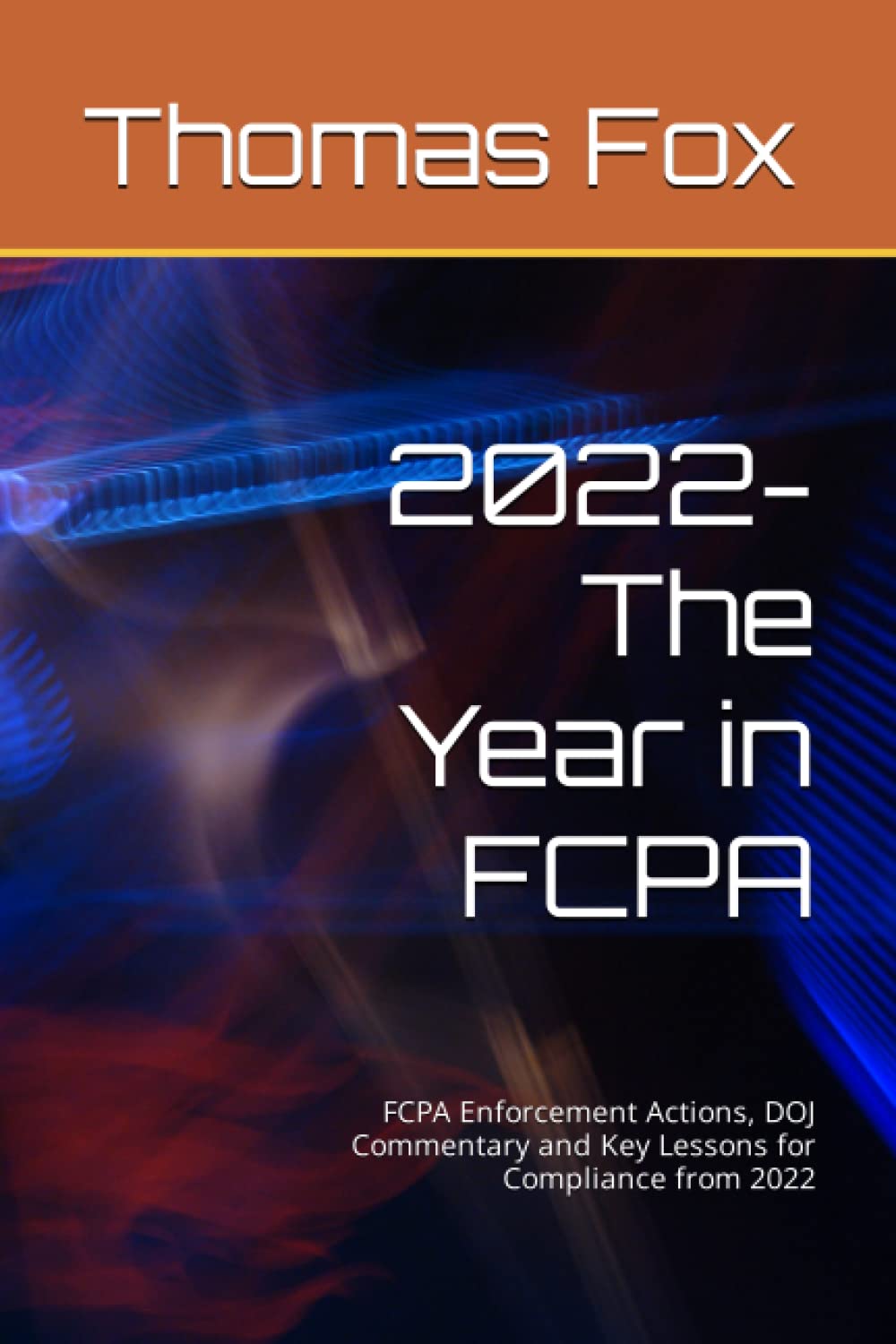
2022-The Year in FCPA

2022 saw a relatively slow year in Foreign Corrupt Practices Act (FCPA) enforcement actions. Yet, as usual, the cases themselves were packed with much for the compliance professional to digest. Moreover, 2022 was a very significant year for every compliance practitioner and compliance program. My latest book, 2022 – The Year in FCPA – FCPA Enforcement Actions, DOJ Commentary and Key Lessons for Compliance from 2022 reviews the corporate FCPA enforcement actions from the past year and mine them for lessons which can be garnered by the compliance practitioner.

The cases themselves ranged in fine and penalty values from $1.1 billion (Glencore International A.G.) down to $6.3 million (KT Corporation). The Department of Justice (DOJ) FCPA prosecutions involved the following entities: Stericycle Inc. (Stericycle), with an overall fine of $84 million; Glencore, with an overall fine of $1.1 Billion; GOL Linhas Aéreas Inteligentes S.A. (GOL), with an overall fine of $41 million; ABB Ltd. (ABB) with an overall fine of $315 million and, concluding the year, Honeywell UOP, with an overall fine of $160 million. From the Securities and Exchange Commission (SEC) we saw enforcement actions involving the following entities: KT Corp, with a penalty of $6.3 million; Tenaris S.A., with a penalty of $78 million; Oracle Corporation (Oracle), with a penalty of $23 million, and Stericycle, GOL, ABB and Honeywell, with the fine amounts noted above. Finally, Glencore was also fined by the Commodity Futures Trading Commission (CFTC).

The total fines and penalties were $1.396 billion. Under the new monitorship policy, announced in October 2021 and put into practice through the Monaco Memo, there were two cases which  included appointments of Corporate Monitors (Glencore and Stericycle). From the DOJ there were two Declinations. The first involved the French entity Safran S.A. and included a $17 million disgorgement. The second involved the UK entity Jardine Lloyd Thompson Group Holdings Ltd. (JLT) and included a $29 million disgorgement. 2022 saw one individual FCPA trial involving former Goldman Sachs Group Inc. Managing Director Roger Ng, who was convicted for criminally circumventing the firm’s internal controls. The Swedish telecom company Telefonaktiebolaget LM Ericsson (Ericsson) had its monitorship extended for 1 year amidst ongoing investigation they breached the Deferred Prosecution Agreement (DPA) and, finally, the Russian entity Mobile TeleSystems PJSC (MTS) also had its monitorship extended for 1 year.

In the realm of individuals prosecuted there were 24 individual criminal prosecutions and it appeared that individual criminal prosecutions continued at aggressive pace. With the formalization of the Monaco Memo, the DOJ will be targeting more individuals for prosecutions in 2023 so the pace of individual prosecutions will continue and probably increase. In 2022, the majority of the individual prosecution stemmed from prior FCPA actions involving a small number of companies; most notably Petróleos de Venezuela S.A. (PDVSA), Vitol Inc., Odebrecht S.A. and Sargeant Marine Inc. It is significant that the DOJ has continued its use of anti-money laundering (AML) charges, which have a 20-year maximum sentence together with FCPA charges, which have a five-year maximum sentence.

However, 2022 was a very significant year for every compliance practitioner and compliance program. While there was a paucity of corporate FCPA enforcement actions, three actions were significant, with multiple lessons for the compliance professional. In ABB, we learned about the costs of a corrupt culture and recidivism. In Glencore, we saw what happens to a company that engages in worldwide systemic bribery and corruption. Finally, in Stericycle, the company had a culture of corruption burned into the DNA of the LATAM business unit, which was so thorough that it was documented via bribery spreadsheets and analysis of revenue based on payments of bribes in LATAM. Yet even with this corrupt culture, the Stericycle enforcement action demonstrated how a company could take advantage of the discounts available under the FCPA Corporate Enforcement Policy by extensive cooperation and remediation during the pendency of the FCPA investigation, as the company obtained a 25% reduction off the bottom of the applicable US Sentencing Guidelines fine range.

September saw the announcement of a significant refinement of DOJ enforcement policies on the FCPA enforcement and corporate compliance programs. It was encapsulated in the Monaco Memo and a speech by Deputy Attorney General Lisa Monaco announcing the Monaco Doctrine. There was additional commentary by Principal Associate Deputy Attorney General Marshall Miller in a speech and by Assistant Attorney General Kenneth A. Polite. Every compliance professional should know them in detail as they significantly turn the heat up on corporate compliance programs. The Monaco Memo is further clarification and guidance for line prosecutors when considering whether to put a monitor in place. While we have seen these factors in a disparate manner, in disparate places, here they are in writing. Perhaps the greatest significance is that the Memo sets down all these matters in writing, which leads to a blueprint for DOJ thinking and a roadmap for anyone who finds themselves in an FCPA investigation or enforcement action. Finally, the Monaco Memo cemented the new DOJ requirement for CCO certification of compliance programs at the end of a resolution.

The final key event for compliance in 2022 was very much under the radar. The DOJ hired Matt Galvan to help develop data analytics expertise and capability for the FCPA Unit and the Fraud Section. Galvan was most recently the CCO at AB InBev and perhaps the top compliance professional in data analytics for a corporate compliance program. It will be most interesting to see where Galvan and the DOJ take this initiative, but it does portend the increasing use of data analytics in FCPA enforcement and compliance.

What did the year 2022 in FCPA mean for you. Check out 2022-The Year in FCPA now available on Amazon.com.

Categories
2 Gurus Talk Compliance

2 Gurus Talk Compliance – Episode 3

What happens when two top compliance commentators get together? They talk compliance, of course. Join Kristy Grant-Hart and Tom Fox for their new podcast, 2 Gurus Talk Compliance! But it is not simply Kristy and Tom talking about compliance. In this podcast series, Kristy and Tom also review other top commentators in compliance. In this podcast, we discuss the recent jail time for a Wells Fargo executive, the UK government’s plan to enforcement of anti-corruption and AML violations, due diligence before acquiring a company, and the recent charges against the co-founder of FTX. They also touch on the shift towards valuing a healthier relationship with work and the potential of the Metaverse in the compliance industry. Tune in to hear Tom and Kristy break down the latest compliance news and provide valuable insight into the industry that will keep you ahead of the curve.

 Highlights Include

·      Corporate Ethics and Compliance

·      The Wells Fargo Scandal and Criminal Accountability

·      Uncertainty surrounding CCO certification

·      UK Government’s Fight Against Corporate Crimes

·      COVID and the Future of Work

·      The Importance of Due Diligence in Acquisitions

·      Move into the compliance profession

·      Indictment of Samuel Bankman Fried

 Notable Quotes

1.      “If you buy a company engaging in bribery corruption, you’re not responsible for that. But when you take title and ownership, they are not engaging in broader corruption. It is you are engaging in broader corruption.”

2.     “I just think that flat banning of CHAT GPD is taking away hugely useful business tools to the Italian business sector.”

3.     “It is incredibly rare for a bank officer to be held criminally accountable.

4.     I think we’ll start to see that now move from becoming an extraordinary practice to a best practice to a regular practice to table stakes.

Resources 

1.     Italy Bans ChatGPT

2.     Why have workers given up the office

3.     CCO certifications

4.     Getting your first job in compliance

5.     SBF and the FCPA

6.     Carrie Tolstedt pleads guilty

7.     UK to invest in economic crime enforcement

8.     What is happening to the Metaverse

9.     Flutter settles FCPA enforcement action

Connect with Kristy Grant-Hart on LinkedIn

Spark Consulting

Connect with Tom Fox on Linkedin

Categories
31 Days to More Effective Compliance Programs

One Month to a More Effective Compliance Program for 3rd Parties – Questionnaire

The next step in the five-step process is the questionnaire. The term ‘questionnaire’ is mentioned several times in the 2020 FCPA Resource Guide. It is generally recognized as one of the tools that a company should complete in its investigation to understand better with whom it is doing business. The questionnaire should be mandatory for any third party that desires to work with your company as it mandates the proposed business partner commit to the required information in writing before beginning the due diligence process. Remember, if a third party does not want to fill out the questionnaire or will not fill it out completely, you should not walk but run away from doing business with such a party.

One of the key requirements of any successful compliance program is that a company must make an initial assessment of a proposed third party. The size of a company does not matter, as small businesses can face significant risks and will need more extensive procedures than other businesses facing limited threats. The level of risk that companies face will also vary with the type and nature of the third parties with which they may have business relationships. For example, a company that appropriately assesses that there is no risk of bribery on the part of one group of its third parties will require nothing in the way of procedures to prevent corruption in the context of those relationships. By the same token, the bribery risks associated with reliance on a third-party agent representing a company in negotiations with foreign government officials may be assessed as significant and, accordingly, requires much more in the way of procedures to mitigate those risks.
The questionnaire fills several vital roles in your overall management of third parties. It provides key information you need to know about who you are doing business with and whether they can fulfill your commercial needs. Just as important is what is said if the questionnaire is not completed or is only partially completed, such as the lack of awareness of the FCPA, U.K. Bribery Act, or anti-corruption/anti-bribery programs generally. Lastly, the information provided (or not provided) in the questionnaire will assist you in determining what level of due diligence to perform.

Three key takeaways:

  1. You must have enough information to fully identify the owners, UBOs, and related parties to determine if there is foreign official involvement.
  2. All commentary on best practices compliance programs requires questionnaires.
  3. If a third party refuses to fully respond to your questionnaire, run and don’t walk away from the proposed relationship.
Categories
Compliance Man Chooses the Target

Compliance Man Takes a EuroTrip – Tim Moves to The Netherlands

Compliance Man is back for a new season! Get ready for a EuroTrip with Tom Fox and Tim Khasanov-Batirov on their hit podcast, Compliance Man! In the latest season, the dynamic duo will give you an exclusive look into Europe’s top 5 areas of compliance perspective, featuring GDPR compliance as a priority. Want to join the podcast? Be an active listener and pay close attention! The hosts break down the key challenges faced by compliance professionals in Europe and the US, including anti-corruption, ethical business practices, ESG frameworks, and much more! Don’t miss the chance to engage in a global conversation on ethics and compliance. Tune in now to Compliance Man!

 Key Highlights

·      Tim Moves to The Netherlands

·      Compliance in Europe

·      Top Compliance Priorities in Europe and US

·      Ethical Business Conduct and ESG

·      European Businesses’ ESG Prioritization

 Notable Quotes

“In this season of Compliance Man, we entitled EuroTrip, and we’re going to focus on hot topics for Europe from the compliance practitioner point of view.

“You probably can think of the following as the most important pieces of legislation or compliance areas from the European perspective.”

“Pay big attention to data privacy.”

“In the EU, we have almost regulatory-driven ESG.”

Resources

Tim Khasanov-Batirov on LinkedIn

Tom Fox

Instagram

Facebook

YouTube

Twitter

LinkedIn

Categories
31 Days to More Effective Compliance Programs

One Month to a More Effective Compliance Program for 3rd Parties – 3rd Party Risk Management Process

As every compliance practitioner knows, third parties still present the highest risk under the FCPA. The 2020 Update devotes an entire prong to third-party management. It begins with the following:
 Prosecutors should also assess whether the company knows the business rationale for needing the third party in the transaction and the risks posed by third-party partners, including the third-party partners’ reputations and relationships, if any, with foreign officials. For example, a prosecutor should analyze whether the company has ensured that contract terms with third parties specifically describe the services to be performed, that the third party is performing the work, and that its compensation is commensurate with the work provided in that industry and geographical region.   Prosecutors should further assess whether the company engaged in ongoing monitoring of the third-party relationships through updated due diligence, training, audits, and/or annual compliance certifications by the third party.

This specifies that the DOJ expects an integrated approach operationalized throughout the company. This means you must have a process for the full third-party risk management life cycle. Five steps in the life cycle of third-party risk management will fulfill the DOJ requirements in the 2020 FCPA Resource Guide and the Hallmarks of an Effective Compliance Program. The five steps in the lifecycle of third-party management are:

  1. Business Justification by the Business Sponsor;
  2. Questionnaire to Third-party;
  3. Due Diligence on Third-party, including triage of results;
  4. Compliance Terms and Conditions, including payment terms; and
  5. Management and Oversight of Third Parties After Contract Signing.

Three key takeaways:

  1. Use the entire 5-step process for third-party management.
  2. Make sure you have business development involvement and buy-in.
  3. Operationalize all steps going forward by including business unit representatives.
Categories
Principled Podcast

S9 E7 – What are FAR Requirements? Reviewing Federal Acquisition Regulation Compliance

What you’ll learn on this podcast episode

The Federal Acquisition Regulation, or FAR, is the primary guidance followed by federal agencies—including NASA, the Department of Defense, the General Services Administration, and all others when acquiring goods and services. It’s also a regulation with its own set of compliance requirements for government contractors. How does FAR differ from other regulatory guidance, and what do government contractors need to know to ensure they have an effective program in place? On the Principled Podcast, host Jen Üner talks with LRN colleague Eric Morehead about why the FAR compliance program requirements matter to broader E&C program effectiveness, and how government contractors can implement those requirements in practical ways.

31

Guest: Eric Morehead

Headshot_Principled Podcast_Eric Morehead

Eric Morehead is a member of LRN’s Advisory Services team and has over 20 years of experience working with organizations seeking to address compliance issues and build effective compliance and ethics programs. Eric conducts program assessments and examines specific compliance risks, he drafts compliance policies and codes of conduct, works with organizations to build and improve their compliance processes and tools, and provides live training for Boards of Directors, executives, managers, and employees.

Eric ran his own consultancy for six years where he advised clients on compliance program enhancements and assisted in creating effective compliance solutions.

Eric was formally the Head of Advisory Services for NYSE Governance Services, a leading compliance training organization, where he was responsible for all aspects of NYSE Governance Services’ compliance consulting arm.

Prior to joining NYSE, Eric was an Assistant General Counsel of the United States Sentencing Commission in Washington, DC. Eric served as the chair of the policy team that amended the Organizational Sentencing Guidelines in 2010.

Eric also spent nearly a decade as a litigation attorney in Houston, Texas where he focused on white-collar and regulatory cases and represented clients at trial and before various agencies including SEC, OSHA and CFTC.

Host: Jen Üner

Episode_Card_Jen_Uner_2

Jen Üner is the Strategic Communications Director for LRN, where she captains programs for both internal and external audiences. She has an insatiable curiosity and an overdeveloped sense of right and wrong which she challenges each day through her study of ethics, compliance, and the value of values-based behavior in corporate governance. Prior to joining LRN, Jen led marketing communications for innovative technology companies operating in Europe and the US, and for media and marketplaces in California. She has won recognition for her work in brand development and experiential design, earned placements in leading news publications, and hosted a closing bell ceremony of the NASDAQ in honor of the California fashion industry as founder of the LA Fashion Awards. Jen holds a B.A. degree from Claremont McKenna College.

Categories
Coming Conflict with China

Coming Conflict with China: Part 5-Good Compliance Is Good Business

In the short span of the 21st Century, the world’s two top powers, the United States and China, have moved inexplicably towards a showdown. This evolved from a commercial competition into something more akin to permanent non-kinetic warfare. What does this mean for US business doing business in and with China? In this special 5-part series, Tom Fox and Brandon Daniels, CEO of Exiger, a global leading third-party and supply chain management software company, explore issues diverse as real danger, supply chain, exports, cyber-attacks and IP theft from the business perspective and give the compliance and business executive their viewpoints on what you can do to not only prepare your company but protect it as well. In concluding Part V, we consider the roles of governments, businesses and thought leaders in leading the US business efforts in this coming conflict.

After uncovering a “constellation of disconnected issues” that are actually interconnected, Brandon Daniels must use regulation, funding and evangelism to incentivize public markets, combat the cyber threat and prevent conflict with China in order to protect national security. We discuss the importance of good compliance to good business; explore the government’s role in regulating cyber security, funding infrastructure upgrades, and incentivizing public markets and the role of businessmen and thought leaders. He also noted how conflicts with China can put companies out of business and the essential role of compliance in weathering the storm. His ultimate conclusion was that “good compliance is good business.”

Key Highlights
1. How has the government’s role changed in responding to the constellation of interconnected business and legal issues present today?

  1. What role do the public markets play in incentivizing investments in new technology and alternative energy?
  2. How can a company ensure good compliance to ensure good business?

Notable Quote

“Good compliance is good business – we saw that so unbelievably clearly during the pandemic, and I think we could learn something from an old adage and renew that view that good compliance process is good business process.”

Resources

Exiger

Tom Fox

Connect with me on the following sites:

Instagram

Facebook

YouTube

Twitter

LinkedIn

Other episodes in this Series:
Episode 1-From Potential Conflict to Real Danger

Episode 2-Supply Chain Issues

Episode 3-Exports and Rebalancing the Global Economy

Episode 4-Cyber Spying and IP Theft

Categories
Blog

Coming Conflict with China-Business Challenges and Responses: Good Compliance is Good Business

In the short span of the 21st Century, the world’s two top powers, the United States and China, have moved inexplicably toward a showdown. This evolved from a commercial competition into something more akin to permanent non-kinetic warfare. What does this mean for US business doing business in and with China? For this special 5-part blog post series, I visited with Brandon Daniels, CEO of Exiger, to explore issues diverse as a real danger, supply chain, exports, cyber-attacks, and IP theft from the business perspective and give the compliance and business executive their viewpoints on what you can do to not only prepare your company but protect it as well. In concluding Part V, we lay out the business response to the coming conflict with China-good compliance.

In the face of rising tensions with China, it’s essential for businesses to take proactive steps to protect themselves. In the fifth and final episode of our five-part series on the coming conflict with China, we outline the integral roles of government, public companies, businesses, think tanks, consultants, product providers, and service providers in addressing the challenge. The  importance of compliance as good business practice cannot be overstated. We also discuss the strategies of risk assessment and risk management necessary to weather the coming storm.

Here are the steps you need to follow to create good compliance in your organization to help you meet the China challenge.:

  1. Identify risks
  2. Assess risks
  3. Implement a risk management strategy
  1. Identify risks

 The first step in addressing the upcoming conflict with China is to identify risks. This can be done by looking at the transcript and thinking about what risks are present in the context of the conversation. For example, the transcript mentions potential conflict with China, cyber intrusions, human rights abuses, national security threats, and IP theft. All of these topics should be considered potential risks that need to be assessed.

One of the main risks is the economic and national security threat that comes from insider threats. This includes cyber intrusions, credential theft, and other malicious activities. Additionally, public companies need to be aware of the potential for IP theft, human rights abuses, and other forms of economic sabotage. It is also important to understand the need for investment in cyber hardening, diversification away from China, and incentives for public markets. Finally, businesses must be aware of the need for risk assessment and risk management strategies, as well as the need to monitor and upgrade those strategies as necessary. All of these risks must be identified in order to effectively address the coming conflict with China.

  1. Assess risks

Once the potential risks have been identified, the next step is to assess the likelihood of the risks and their potential impacts. This can be done by looking at past experiences and current trends. It is also important to consider the potential of the risks, as well as the severity of the impacts. For example, if a risk involves cyber intrusions, it is important to consider the potential for data theft, as well as the impact of a data breach on the company’s reputation.

Finally, it is important to look at the potential solutions for the identified risks. This can be done by looking at the solutions that have been suggested in the transcript, such as regulation, funding, and raising awareness. It is also important to consider the potential costs and benefits of each solution, as well as the potential for implementation. By assessing the risks, the solutions, and their potential impacts, businesses can develop an effective risk management strategy.

 3. Implement a risk management strategy

A risk management strategy is essential for preparing for a potential conflict with China. This strategy should involve identifying risks, assessing the potential impact of each risk, creating a plan to manage each risk, and monitoring the implementation of the risk management plan. Government regulators can lead this effort by raising awareness of the interconnected issues and prioritizing the expenditure of resources to mitigate risk. Additionally, incentives can be provided to public companies to invest in risk mitigation strategies. Businesses should also take the initiative to assess their own risks and create plans to reduce them. This can be done through utilizing existing technology to make processes more efficient and cost effective. Finally, raising awareness is essential to ensure that everyone is aware of the potential risks posed by the conflict with China. This can be done through education and providing resources to help people understand the risks and how to mitigate them.

The coming conflict with China presents numerous risks to businesses, governments, and the public at large. It is essential to assess the risks, create a risk management strategy, and implement it. By taking the initiative to identify, assess, and manage risks, businesses can protect themselves and stay competitive in this ever-changing landscape. The bottom line is good compliance is good business because good compliance is good business process. With the right knowledge, tools, and strategies, you too can be prepared for the coming conflict with China and protect your company from potential risks.

For a deeper dive into these issues, check out the 5-part podcast series with Tom Fox and Brandon Daniels, here.


Categories
31 Days to More Effective Compliance Programs

One Month to a More Effective Compliance Program for Business Ventures-Why Business Ventures are Different than 3rd Parties

Business ventures, whether JVs, partnerships, franchises, team agreements, strategic alliances or one of the myriad types of business relationships a U.S. company can form outside the U.S., are different than the usual risk presented by third-parties under compliance requirements such as those mandated by the FCPA. The problems for companies is that they tend to treat business venture risk the same as third-party risk. They are different and must be managed differently.

The bottom line is that may compliance practitioners have not thought through the specific risks of business ventures such as JVs, franchises, strategic alliances, teaming partner or others as opposed to sales agents or representatives on the sales side of the business. I hope that this will help facilitate a discussion that maybe people will begin to think about more of the issues, more of the risk parameters and perhaps put a better risk management strategy in place.
Three key takeaways:

  1. Business ventures bring different FCPA risks from third-parties.
  2. JVs have both external compliance risks and corporate governance risks.
  3. Use your full compliance tool kit for business ventures in managing the FCPA risk for franchises.