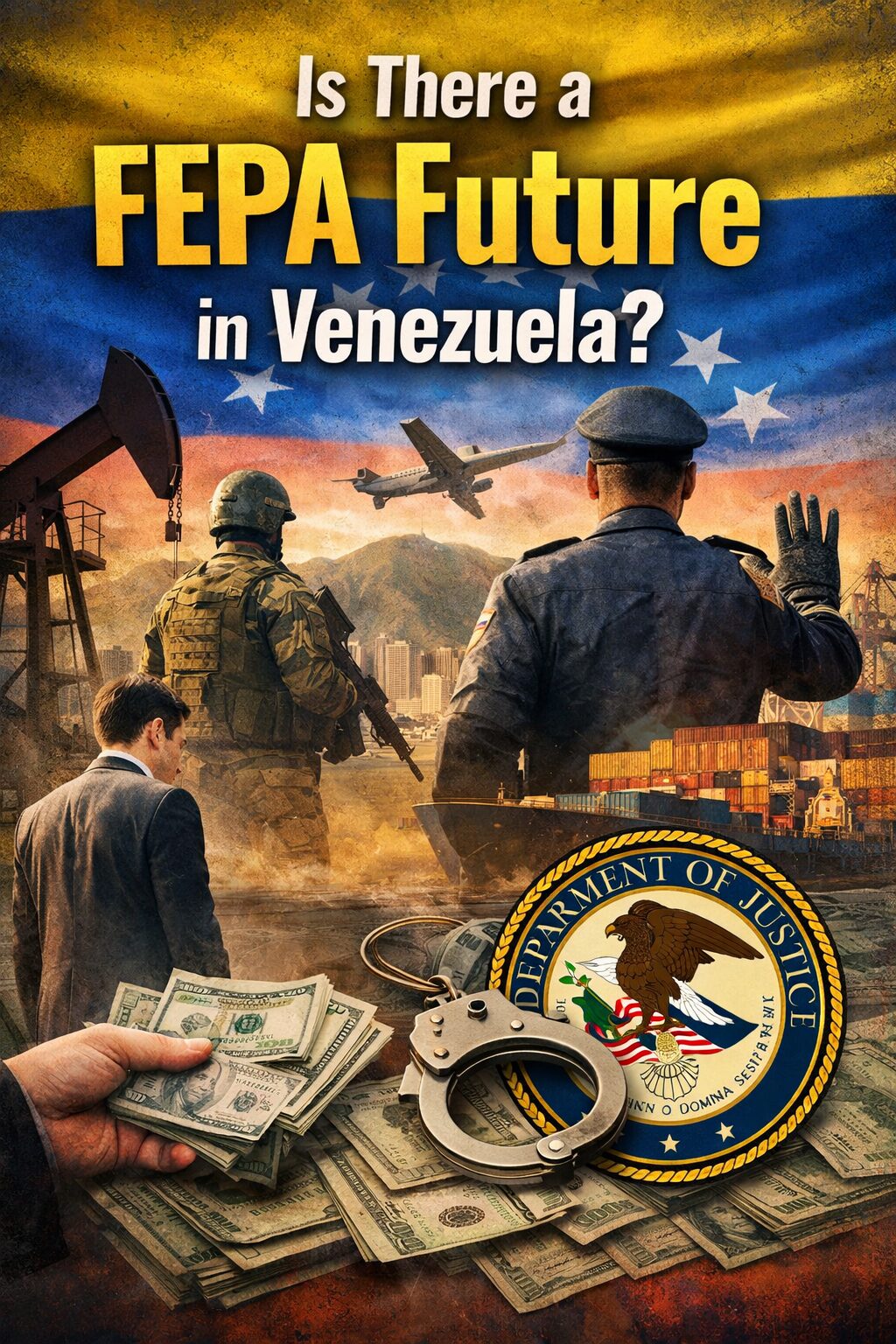
For U.S. compliance professionals, few jurisdictions raise as many red flags as Venezuela. Decades of entrenched corruption, state capture of key industries, economic collapse, weak rule of law, and the legacy of PdVSA have made the country a case study in what happens when corruption becomes systemic rather than episodic. Now that geopolitical and energy realities are shifting, some U.S. companies are again evaluating whether and how to reenter the Venezuelan market.
Against that backdrop, the passage of the Foreign Extortion Prevention Act (FEPA) represents one of the most significant developments in anti-corruption enforcement in nearly half a century. The question compliance officers are now asking is a practical one: can FEPA actually be used to prevent bribery and corruption for U.S. companies returning to Venezuela, or is it merely a symbolic addition to an already strained enforcement framework?
The answer, as with most compliance questions, is nuanced. FEPA is not a silver bullet. But when properly understood and operationalized, it can meaningfully change the risk calculus for companies operating in high-extortion environments like Venezuela.
The Historic Gap in the FCPA
For decades, the compliance community has lived with a fundamental asymmetry in U.S. anti-corruption law. The Foreign Corrupt Practices Act is a supply-side statute. It criminalizes the offering or payment of bribes by U.S. companies and individuals, but it does not criminalize the demand for those bribes by foreign officials. This gap has long distorted incentives on the ground.
In jurisdictions such as Venezuela, bribery is rarely framed as a voluntary transaction. It is far more often presented as a demand, a condition of doing business, or even a threat, as in the case of extortion. Officials do not ask politely. They delay permits, block shipments, threaten arrests, or endanger employee safety. Until FEPA, U.S. law largely treated this as background noise rather than a prosecutable offense.
FEPA directly addresses that gap by criminalizing the solicitation or acceptance of bribes by foreign officials from U.S. persons or companies. In doing so, it finally targets the demand side of corruption and aligns U.S. law more closely with how bribery actually operates in high-risk countries.
Why Venezuela Is the Ultimate Test Case
If FEPA can work anywhere, it should work in Venezuela. The country’s corruption ecosystem is characterized by pervasive extortion across customs, energy, transportation, security, immigration, and tax authorities. Payments are often demanded not to gain an advantage but to avoid harm. This distinction matters. In Venezuela, the compliance challenge is not simply rogue employees paying bribes. It is employees facing credible threats to liberty, safety, or health. FEPA explicitly recognizes this reality by treating extortion by a foreign official as a criminal act rather than merely a compliance failure by the company.
That framing gives compliance officers something they have long lacked: a legal backbone to support a firm refusal posture. Companies can now say, with credibility, that the demand itself is illegal under U.S. law and subject to DOJ enforcement, even if the official is located abroad.
Extortion, Facilitation, and the Compliance Trap
One of the most dangerous compliance traps in Venezuela has always been the mislabeling of extortion payments. Under the FCPA, facilitation payments occupy a narrow and controversial exception. Extortion payments, however, were never facilitation payments. They were survival payments. FEPA eliminates any lingering ambiguity. Extortion payments involving threats to life, liberty, or health are now clearly illegal, not merely discouraged. This forces compliance programs to confront uncomfortable operational realities.
Policies must explicitly distinguish facilitation from extortion. Employees must be trained that the company will support them if they are threatened, but that any such payment must be immediately documented, accurately recorded, and escalated. Book and record accuracy becomes critical. Mischaracterizing extortion as a routine expense is now a standalone risk under FEPA, not merely an FCPA accounting issue.
FEPA as a Deterrent Tool, Not Just an Enforcement Tool
One of the most overlooked aspects of FEPA is its potential deterrent effect. The statute introduces the possibility of DOJ investigations targeting foreign officials, including public naming and reporting requirements. For officials who interact with U.S. companies, this creates reputational and diplomatic risk that did not previously exist. In Venezuela, where many officials rely on international travel, financial access, and political legitimacy, even the threat of U.S. scrutiny can matter. FEPA does not require immediate extradition to have an impact. The mere existence of a credible enforcement pathway can alter behavior at the margins.
For compliance officers, this means FEPA can be used proactively. Risk assessments should explicitly incorporate FEPA exposure. Third-party due diligence should assess patterns of extortion, not just a history of bribery. Contractual language should reference the reporting obligations for extortion. Training should include scenario-based exercises where employees practice refusing demands and escalating threats.
The Limits of FEPA in Venezuela
None of this should be overstated. FEPA will not cleanse Venezuela of corruption. Extradition of Venezuelan officials is unlikely. Local enforcement cooperation will be minimal. Many officials operate with de facto immunity. But compliance effectiveness has never depended on perfect enforcement. It depends on shifting incentives, setting expectations, and protecting employees. FEPA strengthens all three. From a DOJ perspective, FEPA also changes cooperation dynamics. Companies that proactively document extortion demands, preserve evidence, and report credible threats may be viewed very differently from companies that quietly pay and rationalize. In a Venezuela reentry scenario, that distinction could be outcome-determinative.
What Compliance Officers Should Do Now
For companies considering Venezuela, FEPA must be embedded into program design from day one. This includes updating anti-corruption policies, revising travel and security protocols, enhancing incident reporting mechanisms, and briefing boards on the new enforcement landscape. Most importantly, compliance officers must be realistic. FEPA does not eliminate the need for robust internal controls. It heightens the consequences of getting them wrong. Venezuela will remain a high-risk jurisdiction regardless of statutory innovation.
Five Key Takeaways for the Compliance Professional
1. FEPA Changes the Risk Conversation, Not Just the Law
FEPA fundamentally alters how compliance officers should frame corruption risk in high-extortion jurisdictions like Venezuela. It is no longer only about preventing improper employee payments. It is now about recognizing, documenting, and escalating illegal demands by foreign officials. This allows compliance to move from a defensive posture to a principled refusal backed by U.S. law.
2. Extortion Must Be Explicitly Addressed in Policies and Training
Companies can no longer afford vague language that blurs the distinction between facilitation payments and extortion. Compliance programs must clearly define extortion as illegal, explain how it differs from facilitation payments, and provide step-by-step guidance for employees facing threats to health, safety, or liberty. Scenario-based training is no longer optional in Venezuela risk operations.
3. Books and Records Exposure Has Increased Under FEPA
Accurate documentation is now a frontline compliance control. Any payment made under duress must be recorded precisely and transparently. Mischaracterizing extortion payments as routine expenses or facilitation payments creates a separate and serious compliance failure. Accounting controls, escalation protocols, and audit reviews must be aligned accordingly.
4. FEPA Should Be Embedded in Risk Assessments and Third-Party Due Diligence
Venezuela reentry assessments should explicitly evaluate extortion risk, not merely bribery history. Third parties, customs brokers, security providers, and logistics partners are often the point of pressure. FEPA requires compliance officers to assess whether business partners operate in ways that expose the company to extortion demands and reporting failures.
5. FEPA Strengthens Compliance’s Role as a Strategic Advisor
FEPA gives compliance professionals a credible legal framework to advise management and the board on when and how business can be conducted safely. It reinforces the message that walking away from certain transactions is not risk aversion but risk management. In Venezuela, FEPA can help compliance professionals draw clearer red lines and protect both the company and its people.
The Bottom Line
So, could FEPA be used to prevent bribery and corruption for U.S. companies returning to Venezuela? Not entirely. But it can materially reduce risk, empower employees, and change how companies engage with corrupt systems. For the first time, U.S. law squarely acknowledges what compliance professionals have always known: bribery often begins with a demand. By criminalizing that demand, FEPA gives companies a stronger legal and ethical foundation to say no.
In a country like Venezuela, that may be the most important compliance tool of all.