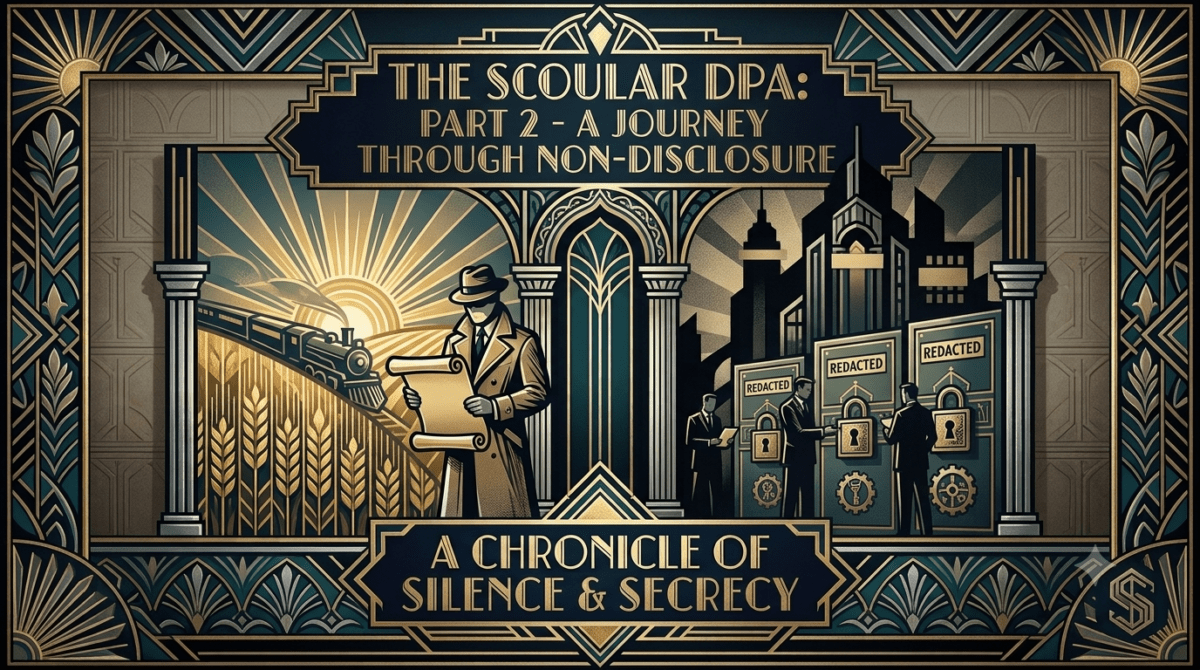
The Scoular Company Deferred Prosecution Agreement (DPA) presents a difficult but essential lesson for every Chief Compliance Officer and board: stopping misconduct is not the same as voluntarily disclosing it. This might seem as self-evident as anything in compliance, but it is a critical component of this case.
The Statement of Facts says that internal reports alleging improper business practices connected to the Mexican inspection fees arose in 2019. Scoular then changed its grain-shipment practices and terminated its direct engagement with the customs brokers involved. Those steps addressed the immediate conduct. They did not produce voluntary self-disclosure credit. That misstep cost Scoular Company millions, potentially leading to a full declination.
The DPA states that Scoular did not receive credit under the DOJ Corporate Enforcement and Voluntary Self-Disclosure Policy (VSP) because it did not “voluntarily and timely disclose” the conduct to the Fraud Section. That single sentence creates the central governance question in Blog Post Part 2: What must happen after a credible internal report reaches the company? An internal allegation starts an investigative clock. The company must preserve evidence, protect against retaliation, assess immediate risk, and establish enough facts to make responsible decisions. It also starts a disclosure clock.
The VSP encourages companies to report potential wrongdoing at the earliest possible time, even before an internal investigation is complete. To qualify as a voluntary self-disclosure, a report must be made in good faith to the appropriate DOJ component, concern misconduct not already known to the Department, occur without a preexisting disclosure obligation, precede an imminent threat of disclosure or government investigation, and be made within a reasonably prompt time after the company becomes aware of the misconduct.
The burden of demonstrating timeliness rests with the company. This does not mean a company must call the DOJ the moment an untested allegation enters the hotline. It does mean disclosure cannot wait until every interview, legal conclusion, and remediation project is complete. The investigation and disclosure analyses must proceed together.
The DPA Tells Us the Result, Not the Internal Debate
The agreement does not explain who received the 2019 reports, how the allegations were investigated, when senior management or the board learned of them, or why Scoular did not make a qualifying disclosure. It does not tell us whether the company made a deliberate decision not to report. What the DPA does establish is the outcome. Internal reports arose. The company changed its practices and terminated direct broker relationships. The company did not voluntarily and timely disclose the conduct to the Fraud Section and therefore received no voluntary disclosure credit.
That sequence is enough to demonstrate a control lesson. A company can remediate an operational problem and still leave the enforcement decision unresolved. The response requires four distinct workstreams:
- Stopping the conduct prevents additional harm.
- Investigating the conduct determines what happened and which controls failed.
- Remediating the controls reduces recurrence risk.
- Evaluating disclosure determines whether, when, where, and how the company should approach enforcement authorities. This fourth step is arguably the most important and must be reached with great speed, perhaps as little as two weeks after initial determination.
A Disclosure Needs a Decision Process
Disclosure decisions should not depend on one executive’s instinct or on the hope that remediation will close the matter. The company needs a defined escalation structure involving legal, compliance, internal audit, finance, and appropriate senior management. Depending on the seriousness of the facts, the audit committee or another independent board committee may need to oversee the decision.
For an FCPA matter involving customs brokers, repeated payments, government officials, inaccurate invoice descriptions, senior personnel, and multiple years of conduct, the disclosure analysis should address:
- What credible facts are known now?
- Is the misconduct continuing?
- Which individuals and third parties may be involved?
- Are the books and records inaccurate?
- Is there evidence of management participation, approval, condonation, or willful ignorance?
- Has a whistleblower, auditor, regulator, bank, business partner, or foreign authority already received the same information?
- Is there an imminent threat that the DOJ will learn of the conduct?
- What additional facts are necessary to make a disclosure decision?
- When will the decision be revisited?
- Who has authority to decide, and how will the reasoning be documented?
The objective is not to create a paper defense for a predetermined result. It is to establish a disciplined process that forces the company to confront timing, uncertainty, accountability, and enforcement exposure.
Disclosure Does Not Require a Finished Investigation
One reason companies may delay is the understandable fear of reporting facts that are incomplete or later prove wrong. The DOJ policy addresses that concern directly. It encourages early disclosure even when the company has not completed its internal investigation. The company can report the misconduct known at that stage, identify the limits of its current knowledge, preserve credibility by avoiding unsupported conclusions, and provide rolling updates as the investigation develops.
That approach requires discipline. The initial disclosure should distinguish facts from allegations, describe preservation and remediation steps, and explain the investigative plan. Later presentations should attribute facts to specific sources and identify individuals regardless of seniority.
Waiting for certainty can eliminate the benefit the company hoped to secure. A whistleblower may contact the government, a third party may cooperate, or the payment may surface in another investigation. Once the DOJ already knows or disclosure is imminent, the analysis changes. The business lesson is straightforward. Uncertainty calls for a staged disclosure strategy, not an indefinite pause.
Cooperation Still Mattered
Scoular Company lost the disclosure benefit, but the DPA demonstrates that the company could still earn meaningful credit. The DOJ credited Scoular with conducting an internal investigation, making detailed factual presentations, identifying individuals involved, producing and organizing requested materials, securing counsel for current employees, and providing all relevant facts known to it.
Voluntary self-disclosure, cooperation, and remediation are separate pillars. A company that misses the first can still create value through the other two. The DPA also notes “certain deficiencies in the early part of the investigation.” It does not identify those deficiencies, and they should not be guessed. Their inclusion nevertheless sends a message: cooperation is judged across the life of the investigation, not merely by the quality of the final presentation.
The current DOJ policy makes the standard explicit. A company starts at zero cooperation credit and earns credit through specific actions: scope, quality, impact, and timing matter. A failure to cooperate fully at the earliest opportunity may reduce the credit available later. For CCOs and boards, the lesson is that recovery remains possible, but delay has a price.
Remediation Changed How the Business Operated
Scoular also received credit for substantial remediation. The company increased compliance engagement with the business, used external compliance maturity and anti-corruption risk assessments, restructured the compliance function, and incorporated senior leadership oversight. It eliminated customs brokers associated with reinspection fees, strengthened risk-based review and monitoring with software tools, revised policies, enhanced third-party screening and approvals, added anti-corruption and audit-right provisions to contracts, improved financial controls for high-risk transactions, and delivered general and targeted training.
These measures went beyond terminating vendors. They addressed governance, third-party management, payment controls, monitoring, technology, policies, and training. That breadth matters because remediation must be tied to root cause. If the misconduct was enabled by commercial pressure, broker dependence, misleading invoices, weak transaction validation, and fragmented data, another annual training course will not solve the problem.
The Economic Difference Was Significant
Scoular entered into a three-year DPA and agreed to pay a $9,769,521 criminal penalty and $414,351 in forfeiture. The DPA states that the penalty reflected a 25 percent reduction from the applicable low-end amount. A footnote explains that the statutory alternative-fine cap, based on twice the approximately $6.513 million gross gain, constrained the otherwise higher Guidelines minimum.
The DPA does not say what disposition Scoular would have received after a qualifying disclosure. It would be improper to rewrite the resolution with hypothetical facts.
The current department-wide CEP nevertheless shows why the distinction matters. A company that voluntarily self-discloses, fully cooperates, timely remediates, and has no disqualifying aggravating circumstances is placed on a declination path. A good-faith self-report that narrowly misses the policy’s technical requirements can still lead to an NPA, a term shorter than three years, no monitor, and a reduction of 50 to 75 percent from the low end. Companies outside those paths remain subject to prosecutorial discretion, with a reduction capped at 50 percent.
Scoular received a DPA, a three-year term, and a 25 percent reduction. The numbers turn disclosure governance into a business issue. The decision affects resolution form, penalty exposure, duration, oversight, reputation, management time, and the company’s ability to move beyond the misconduct.
Questions for CCOs
CCOs should ask:
- Does every credible allegation involving government payments trigger a documented disclosure analysis?
- Who owns the disclosure clock while the investigation proceeds?
- Can legal and compliance make an early report without waiting for a completed investigation?
- Are facts, assumptions, open questions, and decision deadlines documented separately?
- Have we tested the process through a tabletop exercise involving a whistleblower, a third party, and an imminent government inquiry?
The Scoular DPA does not establish why the company missed voluntary disclosure credit. It does establish that internal reporting, operational remediation, and voluntary disclosure are not interchangeable. When a credible allegation arrives, the company must stop the conduct, investigate the facts, remediate the controls, and make a timely, documented disclosure decision. Doing three of those four things can still leave substantial value on the table.
Join us tomorrow for Part 3, where we will examine how a robust internal control system paired with a robust data analytics overview can help a company avoid a Scoular Company-type series of failures.