Categories
Adventures in Compliance

Adventures in Compliance: The Novels – The Valley of Fear, Sherlock Holmes’ Investigative Techniques for Today’s Challenges

In this new season of Adventures in Compliance, host Tom Fox takes a deep dive into the Sherlock Holmes novels. Over this season, Tom will take a deep dive into each novel over a four-part series. The four novels we will consider from the ethics and compliance perspective are A Study in Scarlet, The Sign of Four, The Hound of the Baskervilles, and The Valley of Fear. For the month of August, we conclude this Season with a deep dive into the least well-known of the Sherlock Holmes novels, The Valley of Fear.

In Part 2, Timothy and Fiona return to continue our exploration of The Valley of Fear, where we delve into five key investigative lessons from Sherlock Holmes. Discover how Holmes’ methods of questioning initial facts, emphasizing collaborative efforts, maintaining patience, keeping a big-picture perspective, and communicating findings effectively can be applied to modern corporate and personal challenges. Learn to approach information gathering with meticulous scrutiny and uncover bigger truths hidden in the details.

Key highlights:

  • Sherlock Holmes’ Relevance Today
  • Lesson 1: Question Everything
  • Lesson 2: Investigative Cooperation
  • Lesson 3: Patience and Persistence
  • Lesson 4: Big Picture Perspective
  • Lesson 5: Effective Communication

Resources:

The New Annotated Sherlock Holmes

Sherlock Holmes FAQ by Dave Thompson

Connect with Tom Fox

Instagram

Facebook

YouTube

Twitter

LinkedIn

Categories
Blog

Sherlock Holmes and Compliance: Investigative Insights from “The Valley of Fear”

Here’s a detailed, insightful article in the style of Tom Fox for a corporate compliance audience, highlighting investigative lessons from the Sherlock Holmes novel, “The Valley of Fear.”

For compliance professionals, investigations are the bedrock of effective compliance programs. Whether it’s tracking down evidence of bribery, uncovering fraud schemes, or rooting out systemic misconduct, the investigative methods you deploy can significantly impact your organization’s integrity, reputation, and bottom line.

“The Valley of Fear” offers a wealth of investigative wisdom. Its narrative of deception, undercover operations, secret societies, and surprising plot twists provides vivid lessons highly relevant to today’s corporate compliance landscape. Let’s unpack five key investigative lessons, each illustrated with memorable scenes from this timeless detective classic.

Lesson 1: Do Not Take Facts at Face Value

Illustrated By: Detailed Analysis of the Crime Scene. Upon arrival at Birlstone Manor, Holmes carefully examines the room where Douglas’s body was discovered, noting inconsistencies like the placement of furniture, window access, and unusual blood patterns.

The central narrative of “The Valley of Fear” revolves around the apparent murder of John Douglas at his Manor House in Birlstone. Initially, the crime scene appears straightforward: Douglas has seemingly been shot at close range, and the crime scene implicates an intruder. Yet Holmes immediately suspects deeper layers beneath the obvious evidence. His meticulous examination of the scene, blood patterns, room layout, and oddities like misplaced items reveals inconsistencies that others missed.

For compliance professionals, the lesson is clear: avoid jumping to conclusions based solely on initial evidence. It is tempting and human to embrace straightforward narratives quickly. But like Holmes, investigators must resist that impulse, digging deeper, questioning assumptions, and rigorously testing evidence for hidden contradictions or overlooked facts. By refusing to accept surface-level interpretations, compliance teams protect organizations from premature and potentially misguided conclusions.

Compliance Takeaway: Always scrutinize initial evidence meticulously and objectively. Never accept evidence without question or assume that initial appearances represent complete facts.

Lesson 2: Investigative Cooperation is Essential

Illustrated By: Collaboration between Holmes and MacDonald. Holmes and Inspector MacDonald openly discuss theories, evidence, and ideas, working cooperatively rather than competitively. Holmes shares insights freely, establishing mutual trust and respect that propel the investigation forward. 

Throughout the novel, Holmes collaborates closely with Scotland Yard’s Inspector MacDonald, who initially struggles to make sense of the complex scenario. Rather than competing, Holmes works cooperatively with MacDonald, openly sharing insights, theories, and information. Their mutual respect, dialogue, and professional cooperation ultimately contribute to solving the intricate puzzle.

Corporate compliance investigations similarly require effective internal and external cooperation. Compliance departments must partner seamlessly with Legal, HR, Audit, and IT functions, as well as outside counsel or forensic experts when necessary. Effective cooperation and collaboration across departments ensure thoroughness and objectivity, minimize blind spots, and enhance investigative outcomes. Holmes demonstrates that strong investigative results rely on teamwork rather than isolation or internal competition.

Compliance Takeaway: Foster collaborative relationships across organizational functions, aligning investigative efforts with Legal, HR, IT, and other stakeholders to produce effective outcomes.

Lesson 3: Patience and Persistence Yield Results

Illustrated By: Patient Uncovering of Douglas’s Background. Holmes painstakingly reconstructs Douglas’s past life in America, gradually identifying him as a Pinkerton detective who infiltrated the Scowrers. This meticulous work takes time, patience, and sustained investigative discipline.

Holmes painstakingly pieces together the clues surrounding John Douglas, ultimately revealing Douglas’s true identity as Birdy Edwards, a former Pinkerton detective who infiltrated a dangerous criminal organization, the Scowrers, in the United States. This revelation is not instantaneous; Holmes’ success comes from persistence, incremental discovery, and careful analysis of evidence collected over time.

In corporate compliance investigations, patience and persistence are equally critical. Compliance officers must frequently manage complex, multi-faceted investigations spanning weeks, months, or even years. Instant resolutions are rare; critical information often emerges slowly and incrementally. Holmes’s deliberate and patient approach to unraveling Douglas’s identity highlights the importance of tenacity, emphasizing that thoroughness and sustained attention invariably produce the clearest investigative outcomes.

Compliance Takeaway: Recognize and embrace that thorough investigative efforts are often incremental, requiring sustained attention and patience to understand complex compliance issues fully.

Lesson 4: Maintain a Big-Picture Perspective

Illustrated By: Contextual Awareness of Moriarty’s Influence. Holmes keeps Moriarty’s potential involvement clearly in mind throughout, maintaining awareness that individual incidents might connect to larger criminal patterns.

In the novel, Holmes repeatedly emphasizes that the apparent Birlstone murder is merely one small part of a larger, sinister picture orchestrated by the infamous Professor Moriarty. Though Moriarty never physically appears, his influence permeates the narrative, connecting seemingly unrelated events and adding deeper context to the investigation. Holmes maintains a sharp awareness of this broader context throughout, ensuring he does not lose sight of underlying motivations and interconnected plots.

This lesson resonates powerfully for compliance professionals. Frequently, investigations initially perceived as isolated incidents reveal systemic compliance or ethical weaknesses within an organization. Investigators must always remain cognizant of the broader organizational, cultural, or regulatory contexts influencing misconduct. By keeping this “big picture” perspective, compliance teams ensure investigations are holistic, not narrowly focused, enabling effective systemic remediation rather than piecemeal solutions.

Compliance Takeaway: Maintain holistic awareness in compliance investigations, ensuring isolated incidents are analyzed within broader organizational, regulatory, or ethical contexts to uncover deeper systemic issues.

Lesson 5: Effective Communication is Crucial 

Illustrated By: Contextual Awareness of Moriarty’s Influence. Holmes keeps Moriarty’s potential involvement clearly in mind throughout, maintaining awareness that individual incidents might connect to larger criminal patterns.

At key points throughout the novel, Holmes carefully explains his deductions, processes, and conclusions to Inspector MacDonald, Dr. Watson, and other key players. His ability to clearly articulate reasoning and insights, especially when conclusions appear counterintuitive or complex, is essential to maintaining credibility, building consensus, and driving effective outcomes.

Corporate compliance investigators must also master clear, effective communication. It’s insufficient merely to uncover misconduct; the true skill lies in effectively communicating findings to stakeholders, management, regulators, and even potentially implicated employees. Holmes shows us that investigative brilliance must be matched by communicative clarity. In corporate settings, investigative reports must clearly explain methodology, facts, assumptions, and conclusions, ensuring decisions based on investigations are informed, justified, and actionable.

Compliance Takeaway: Maintain holistic awareness in compliance investigations, ensuring isolated incidents are analyzed within broader organizational, regulatory, or ethical contexts to uncover deeper systemic issues.

Sherlock Holmes as Compliance Inspiration

Sherlock Holmes remains an enduring inspiration to corporate compliance professionals precisely because effective investigations are foundational to compliance success. Holmes’s methods, including detailed scrutiny of evidence, a collaborative approach, patient and persistent inquiry, a holistic perspective, and clear communication, are not merely fictional flourishes; they represent essential best practices.

“The Valley of Fear” offers compliance officers vivid, relatable insights, underscoring that successful investigations require disciplined methodology, sustained inquiry, careful analysis, cross-functional cooperation, and effective stakeholder communication. As Sherlock Holmes memorably states, “It is, of course, a trifle, but there is nothing so important as trifles.” For compliance professionals today, Holmes’s wisdom is more relevant than ever, reminding us that attention to detail, disciplined process, and communicative clarity are never trivial.

By embracing Holmes’s investigative rigor and lessons from this classic novel, compliance professionals equip themselves and their organizations to meet today’s complex challenges effectively. After all, just like Holmes himself, the compliance investigator’s role is fundamentally about uncovering truth; patiently, methodically, and tirelessly ensuring organizational integrity and ethical clarity amidst a complex corporate landscape.

Categories
Trekking Through Compliance

Trekking Through Compliance: Episode 33 – Investigative Lessons from Star Trek’s “Mirror, Mirror”

In the episode titled “Mirror, Mirror,” Captain Kirk, Dr. McCoy, Uhura, and Scotty encounter a transporter accident that thrusts them into a parallel universe. This alternate reality is a distorted mirror image of their universe, familiar yet different, governed by violence, suspicion, and fear rather than trust and mutual respect. Drawing directly from this episode, we examine five investigative lessons that compliance professionals can apply in their roles to ensure ethical resilience and organizational integrity.

Lesson 1: Quickly Recognize the Unexpected

Illustrated by: In the opening sequence, Kirk and his team are transported into the Mirror Universe.

Compliance Lesson: Compliance professionals must maintain heightened situational awareness during investigations, promptly identifying unexpected deviations, whether subtle discrepancies in financial reports, irregularities in third-party behaviors, or suspicious communications.

Lesson 2: Adapt and Blend into the Environment

Illustrated By: Realizing their perilous situation, Kirk instructs his crew to blend into the mirror universe’s ruthless culture.

Compliance Lesson: Compliance officers often operate within organizational cultures that vary significantly in terms of transparency, openness, and ethical climate.

Lesson 3: Secure Critical Information Discreetly

Illustrated By: A pivotal moment occurs when Kirk and Scotty clandestinely access the computer system in the mirror Enterprise to gather data discreetly.

Compliance Lesson: Compliance investigations frequently require discretion, confidentiality, and careful handling of sensitive data.

Lesson 4: Leverage Allies Within Complex Environments

Illustrated By: One crucial decision Kirk makes is trusting the mirror universe’s Spock enough to appeal to his logic and inherent sense of reason subtly.

Compliance Lesson: Building strategic relationships and leveraging internal allies can significantly improve investigation outcomes.

Lesson 5: Provide Actionable Guidance Based on Investigative Outcomes

Illustrated By: At the climax, Kirk directly confronts Mirror-Spock, presenting him with evidence and logical arguments to inspire long-term change within the oppressive Empire.

Compliance Lesson: Compliance officers are responsible for translating investigative findings into practical actions, guidance, process improvements, controls enhancements, or training recommendations that meaningfully mitigate future risk and promote an ethical organizational culture.

Final ComplianceLog reflections

The investigative narrative depicted in “Mirror, Mirror” presents powerful lessons for compliance professionals committed to conducting thorough, ethical, and effective investigations. Kirk and his crew were thrust into an environment of distorted realities, facing the daunting task of discerning truths within complex and dangerous situations. The strategies they adopted — early recognition, swift adaptation, discreet information gathering, strategic alliances, and actionable recommendations — mirror precisely the skills compliance officers require in navigating investigations.

Resources:

Excruciatingly Detailed Plot Summary by Eric W. Weisstein

MissionLogPodcast.com

Memory Alpha

Categories
Blog

Investigative Lessons from Sherlock Holmes: The Sign of Four

Corporate compliance and Sherlock Holmes may seem worlds apart, but compliance professionals and Sir Arthur Conan Doyle’s legendary detective share a core responsibility: uncovering truths hidden behind complex webs of evidence. “The Sign of Four,” one of Doyle’s most gripping Sherlock Holmes tales, offers powerful investigative insights directly applicable to the realm of compliance. Here are five key lessons compliance professionals can draw from Holmes’s investigative methods in this classic novel.

1. Precise Documentation: “Methodical Observation”

In The Sign of Four, Sherlock Holmes emphasizes the importance of methodical and precise documentation as crucial to solving complex mysteries. Early in the narrative, Holmes carefully examines a mysterious note received by Miss Mary Morstan. His meticulous observation of handwriting, paper quality, and ink composition enables him to deduce the note’s origin and purpose, thereby setting the course of the investigation.

Compliance professionals should emulate Holmes by rigorously documenting every aspect of an investigation to ensure thoroughness and accuracy. Precise records of evidence, witness statements, and procedures ensure accuracy, accountability, and transparency, significantly reducing risks of oversight or misinterpretation. Proper documentation also strengthens the organization’s ability to respond effectively during audits or regulatory inquiries.

2. Logical Analysis: “Eliminating the Impossible”

Holmes famously asserts in The Sign of Four, “When you have eliminated the impossible, whatever remains, however improbable, must be the truth.” This principle guides his pursuit of justice throughout the novel. Holmes methodically rules out improbable scenarios in investigating the disappearance of Captain Morstan and the subsequent quest for hidden treasure, ultimately unveiling Jonathan Small’s elaborate revenge-driven plot.

Compliance officers should similarly use structured analytical frameworks to eliminate false assumptions and unsubstantiated theories during investigations. Adopting logical, disciplined analysis reduces biases, prevents costly mistakes, and fosters more accurate and actionable outcomes. Holmes’s deductive approach encourages compliance professionals to remain vigilant against assumptions that may cloud judgment.

3. Embrace Collaboration: “Leveraging Complementary Strengths”

In The Sign of Four, Sherlock Holmes frequently relies on Dr. Watson’s support and complementary skills. Watson’s medical knowledge and practical insights greatly assisted Holmes during the investigation, notably during examinations of crime scenes and understanding the emotional motivations of suspects and victims.

For compliance professionals, this illustrates the importance of multidisciplinary collaboration. Effective compliance investigations often require collaboration with professionals from diverse specialties, including auditors, forensic accountants, legal advisors, human resources specialists, and IT experts. Embracing a collaborative approach ensures a comprehensive investigation, as each discipline brings unique insights that enhance the overall effectiveness and credibility of the compliance function.

4. Attention to Subtle Indicators: “Noticing Small Clues”

Holmes’s brilliance often lies in noticing seemingly insignificant details overlooked by others. In The Sign of Four, Holmes carefully notes tiny footprints, peculiar scents, and minor discrepancies in testimonies, each subtly directing the investigation toward its resolution. For instance, Holmes’s keen attention to Toby, the trained bloodhound, and his reaction to specific scents help locate key evidence pivotal to unraveling the mystery.

Compliance professionals must likewise sharpen their observational skills to detect subtle indicators of wrongdoing, such as minor financial discrepancies, slight variations in employee behaviors, or seemingly inconsequential procedural anomalies. Often, the most significant compliance breaches initially manifest as minor irregularities. Developing Holmes-like attentiveness can significantly enhance the detection and early resolution of compliance issues.

5. Managing Bias and Assumptions: “Maintaining Objective Judgment”

Throughout, Holmes maintains rigorous objectivity, avoiding emotional biases or ungrounded assumptions. Even when emotionally involved characters, including Watson and Miss Mary Morstan, draw emotional or intuitive conclusions, Holmes insists on relying exclusively on factual evidence and logic. His disciplined approach ensures accuracy and fairness in the investigation’s outcome.

Compliance officers frequently confront emotionally charged scenarios or influential stakeholders, which can pressure outcomes. Maintaining an objective and unbiased judgment is crucial to upholding fairness and integrity during compliance investigations. Holmes’s unwavering dedication to evidence-based analysis exemplifies the importance of unbiased fact-finding in safeguarding organizational ethics and compliance integrity.

Final Thoughts: Integrating Sherlock Holmes’s Methods into Compliance

The Sign of Four offers rich investigative wisdom that is directly applicable to corporate compliance. Sherlock Holmes’s meticulous documentation, disciplined logical reasoning, strategic collaboration, precise attention to detail, and uncompromising objectivity represent invaluable investigative methodologies for today’s compliance professionals.

As compliance continues evolving in complexity and significance, adopting Holmesian investigative rigor enhances our ability to protect organizational integrity, mitigate risks, and ensure regulatory compliance. Compliance professionals who master these investigative practices not only improve their effectiveness but also significantly contribute to their organization’s overall resilience and ethical standing.

In the dynamic landscape of corporate compliance, Sherlock Holmes’s timeless investigative lessons remain as relevant today as in Victorian London, reminding us that excellence in investigation demands continual refinement, unwavering diligence, and precise analytical clarity.

Categories
Blog

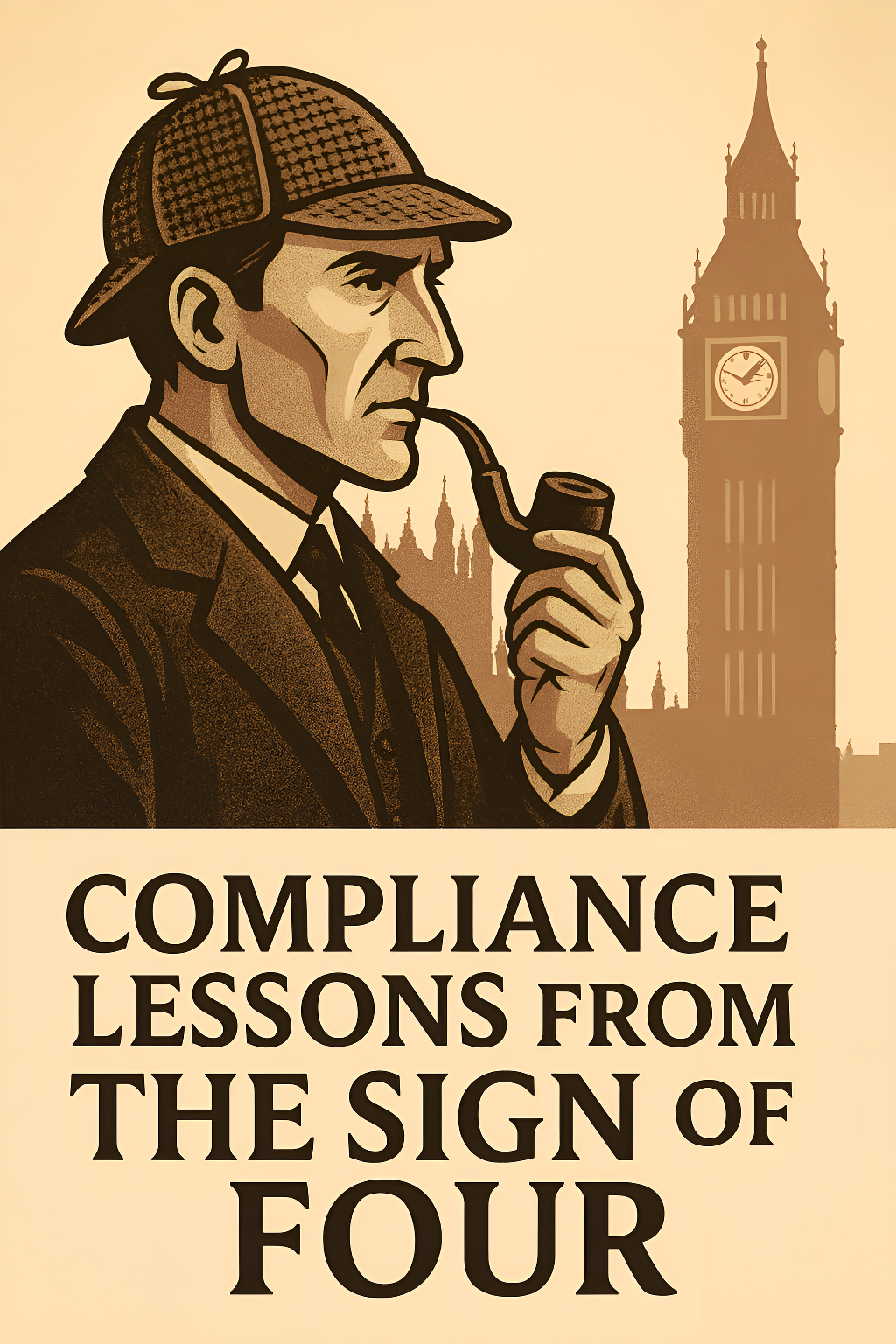
Compliance Lessons From The Sign of Four

The master detective Sherlock Holmes continues to inspire many, including corporate compliance professionals, with his relentless pursuit of truth, meticulous attention to detail, and unyielding ethical stance. In Sir Arthur Conan Doyle’s classic tale The Sign of Four, Holmes demonstrates how systematic inquiry and rigorous ethical standards ultimately unveil truth and justice. Compliance professionals can also greatly benefit from applying these Holmesian techniques to their daily practices. This month, in the award-winning podcast series Adventures in Compliance, we will take a deep dive into the Holmes novel, The Sign of Four. Today, we consider the five key compliance lessons from The Sign of Four for the compliance professional:

1. Methodical Investigation and Attention to Detail

Sherlock Holmes famously notes, “When you have eliminated the impossible, whatever remains, however improbable, must be the truth.” This systematic approach, prominently featured in “The Sign of Four,” is crucial for compliance professionals conducting internal investigations. Holmes’s method of observation, documentation, and logical deduction underscores the importance of meticulous attention to detail in compliance audits and investigations. By systematically eliminating irrelevant or impossible scenarios, compliance professionals can pinpoint the root cause of issues, identify gaps in controls, and implement effective remedial steps.

Compliance Lesson Learned: Foster a methodical investigative process that emphasizes documentation, evidence collection, and rigorous analysis to pinpoint accurate conclusions and drive compliance effectiveness. Sherlock Holmes demonstrates through meticulous examination that every small detail can have a significant impact on a case’s resolution. Compliance professionals must similarly maintain rigorous discipline in their investigations. This involves thorough documentation, the systematic collection of evidence, and careful analysis to clearly distinguish facts from assumptions. In corporate compliance, overlooking minor details could allow critical issues to go unnoticed, escalating into larger organizational risks. By consistently applying a structured and disciplined investigative methodology, compliance officers can confidently identify root causes, validate the integrity of their findings, and implement practical solutions, thereby safeguarding their organizations against financial, reputational, and regulatory threats.

2. Clear and Open Communication

Throughout The Sign of Four, the relationship between Holmes and Watson highlights the necessity of clear communication and transparency. Watson’s careful documentation and Holmes’s candid explanations demonstrate that open communication is vital in unraveling complex situations. In corporate compliance, transparency is equally crucial. Clear, effective communication channels must be established between compliance officers, management, and employees to ensure that issues are reported promptly and accurately. Fostering a culture of transparency reduces risk, facilitates early detection of problems, and promotes trust throughout the organization.

Compliance Lesson Learned: Establish clear and effective communication channels within the organization to ensure transparency and facilitate the early detection and resolution of compliance issues. In The Sign of Four, Holmes and Watson emphasize the importance of clarity and transparency, qualities essential in unraveling complex problems. Compliance professionals must likewise advocate and foster clear communication channels within their organizations. This transparency encourages employees to voice concerns promptly, enhancing the detection and management of risks before they escalate into more serious incidents. Clear and open dialogue between compliance teams, leadership, and the broader workforce not only helps address issues swiftly but also fosters organizational trust and strengthens the culture of compliance. Ultimately, effective communication ensures that compliance objectives and expectations are understood and consistently met across all organizational levels.

3. Understanding Human Behavior

Sherlock Holmes’s success often stems from his deep understanding of human behavior and motivations, as showcased in The Sign of Four. Holmes meticulously analyzes the characters’ backgrounds, behaviors, and potential motivations to piece together the puzzle. Similarly, compliance professionals must understand the human element within their organizations. By recognizing what drives employee behavior — whether it is financial incentives, personal pressures, or corporate culture — compliance teams can more effectively identify and mitigate risks associated with unethical behavior and fraud.

Compliance Lesson Learned: Compliance professionals should invest time in understanding human motivations and organizational behavior to more effectively predict, identify, and prevent compliance issues. Holmes achieves success partly because he profoundly understands human motivations and actions, recognizing how personal incentives drive behaviors. Compliance professionals must similarly deepen their understanding of employee psychology and organizational dynamics. Recognizing motivations, whether driven by ambition, fear, greed, or a desire to conform to corporate expectations, enables compliance officers to proactively manage and mitigate risk. By cultivating this empathetic awareness, compliance professionals become better equipped to design targeted training programs, refine policies to influence behavior, and identify subtle red flags more effectively. Ultimately, understanding human behavior facilitates more effective compliance interventions, which help prevent misconduct and foster a resilient, ethical culture.

4. Vigilance Against Complacency

In The Sign of Four, Holmes repeatedly emphasizes vigilance. His awareness of even minor details and inconsistencies prevents complacency and ensures constant preparedness. Likewise, compliance professionals must maintain vigilance, avoiding the trap of complacency, even when processes seem effective and issues appear scarce. Risks evolve continuously, and compliance practices must proactively adapt to emerging threats, regulatory changes, and shifting business landscapes. Ongoing training, regular audits, and continuous improvement strategies are essential to staying ahead of compliance threats.

Compliance Lesson Learned: Maintain constant vigilance and proactively adapt compliance measures to meet evolving risks and regulatory landscapes. Holmes’s sharp vigilance throughout The Sign of Four is instrumental in solving the case, underscoring the detrimental effects of complacency. Compliance professionals, similarly, must never allow successful past outcomes or a lull in incidents to diminish their alertness. The landscape of compliance continually evolves, with new regulations, threats, and business risks emerging constantly. Compliance officers must regularly review processes, maintain ongoing training initiatives, and perform frequent, proactive audits to anticipate and effectively manage emerging challenges. Maintaining this vigilant approach protects organizations from hidden risks and ensures preparedness, thereby preserving integrity, trust, and regulatory compliance in the long term.

5. Integrity and Ethical Fortitude

Sherlock Holmes is defined by his unwavering ethical stance and commitment to justice, clearly demonstrated in The Sign of Four. Despite personal danger or pressure, Holmes remains steadfast in his pursuit of truth and fairness. For compliance professionals, integrity and ethical courage are equally critical. Ethical fortitude ensures compliance officers hold firm to their principles, advocating for transparency, accountability, and ethical practices, even when facing resistance from higher-ups or challenging organizational cultures. Upholding these ethical standards sets a powerful example and reinforces a robust ethical culture within the organization.

Compliance Lesson Learned: Cultivate and embody unwavering ethical integrity, setting clear expectations and standards for ethical behavior within the organization. Throughout “The Sign of Four,” Sherlock Holmes embodies an uncompromising ethical stance, steadfastly seeking truth and justice irrespective of personal risk or inconvenience. Compliance professionals similarly must exhibit unwavering ethical fortitude, often standing firm against organizational pressures or ethical dilemmas. Integrity serves as the foundation of effective compliance practice, enabling compliance officers to advocate strongly for transparency, accountability, and ethical decision-making within their companies. By consistently demonstrating ethical leadership, compliance professionals not only reinforce expectations but also establish a powerful model for all employees, thereby nurturing a robust organizational culture where integrity and ethical conduct are paramount values respected by all.

In conclusion, Sherlock Holmes’s The Sign of Four offers valuable lessons for today’s corporate compliance professionals. By adopting Holmes’s rigorous investigative methods, clear communication practices, deep understanding of human behavior, vigilance against complacency, and ethical fortitude, compliance teams can enhance their organizations’ resilience against misconduct and regulatory risk. Just as Holmes relentlessly pursued truth and justice, compliance professionals must continuously strive for excellence, integrity, and transparency to protect and advance their organizational values and reputation.

Lastly, Holmes emphasizes the importance of integrity and ethical fortitude, which are essential for fostering a robust ethical culture. Adopting these Holmesian principles can significantly strengthen organizational compliance frameworks, ensuring transparency, accountability, and proactive risk management, ultimately protecting and enhancing the organization’s reputation and ethical standards.

Categories
Adventures in Compliance

Adventures in Compliance: The Novels – The Sign of Four, Introduction and Compliance Lessons Learned

In this new season of Adventures in Compliance, host Tom Fox takes a deep dive into the Sherlock Holmes novels. Throughout this season, Tom will explore each novel in a four-part series. The four novels we will consider from the ethics and compliance perspective are A Study in Scarlet, The Sign of Four, The Hound of the Baskervilles, and The Valley of Fear. 

For our second offering this season, we begin with The Sign of Four. In this Part 1 of our four-part exploration, we dive into the synopsis of the story and extract five key compliance lessons: (1) Methodical investigation and attention to detail, (2) The importance of clear and open communication, (3) Understanding human behavior, (4) Vigilance against complacency, and (5) Integrity and ethical fortitude. These lessons underline the timeless relevance of Sherlock Holmes’ methods for modern compliance professionals. Tune in for an engaging blend of classic literature and practical compliance insights. 

Highlights include:

  • Deep Dive into ‘The Sign of Four’
  • Key Compliance Lessons from ‘The Sign of Four’
  • Methodical Investigation and Attention to Detail
  • Clear and Open Communication
  • Understanding Human Behavior
  • Vigilance Against Complacency
  • Integrity and Ethical Fortitude

Resources:

The New Annotated Sherlock Holmes

Sherlock Holmes FAQ by Dave Thompson

Connect with Tom Fox

Instagram

Facebook

YouTube

Twitter

LinkedIn

Categories
Adventures in Compliance

Adventures in Compliance: Investigate Lessons from A Study in Scarlet

In this new season of Adventures in Compliance, host Tom Fox takes a deep dive into the Sherlock Holmes novels. Throughout this season, Tom will thoroughly explore each novel in a four-part series. The four novels we will consider from the ethics and compliance perspective are A Study in Scarlet, The Sign of Four, The Hound of the Baskervilles, and The Valley of Fear. We begin with A Study in Scarlet for our new season’s first offering. In Part 3, Tom deeply dives into the investigative lessons learned from the story.

When Sir Arthur Conan Doyle introduced the world to Sherlock Holmes in A Study in Scarlet, he didn’t just give us the greatest fictional detective of all time—he gave compliance professionals a master class in investigative methods. Through his cool logic, careful observation, and constant search for the truth, Holmes modeled what every corporate investigator should aspire to emulate. From his crime scene analysis to using deceptive tactics to expose a suspect, Holmes’s first published case offers lessons relevant to modern compliance programs, especially when dealing with internal investigations, whistleblower reports, and root cause analysis. Here are five enduring investigative lessons, grounded in the facts of A Study in Scarlet, that today’s compliance professionals can apply in their work.

Highlights include:

  • Let the Evidence Speak First—Not the Theory
  • Small Clues Are Often the Most Telling
  • Reconstruct the Incident with Logic and Imagination
  • Use Deception Strategically to Draw Out the Truth
  • Motive Often Lies in the Past—Not Just in the Present Crime

Resources:

The New Annotated Sherlock Holmes

Sherlock Holmes FAQ by Dave Thompson

Connect with Tom Fox

Instagram

Facebook

YouTube

Twitter

LinkedIn

Categories
Adventures in Compliance

Adventures in Compliance – Institutional Justice and Institutional Fairness Lessons from The Adventure of the Veiled Lodger

In this new season of Adventures in Compliance, host Tom Fox takes a deep dive into Arthur Conan Doyle’s Sherlock Holmes collection, The Case-Book of Sherlock Holmes. It is the final set of twelve Sherlock Holmes short stories, first published in the Strand Magazine between October 1921 and April 1927. In this episode, we consider the story The Adventure of the Veiled Lodger.

Tom emphasizes the importance of fairness and transparency in compliance investigations, accountability without retaliation, encouraging whistleblowers, and addressing systemic failures. The episode also highlights how ethics and compliance must be ingrained in corporate culture, reflecting principles from the Department of Justice’s 2020 and 2024 updates to the Evaluation of Corporate Compliance Programs. Through Holmes’ empathetic approach, compliance professionals can learn the importance of contextual investigations and the pursuit of institutional justice. Tom invites Sherlock Holmes enthusiasts to engage in discussions about the stories and underscores the role of compliance in fostering a fair and ethical workplace.

Highlights include:

  • The Story of the Veiled Lodger
  • Lessons on Institutional Justice and Fairness
  • Lessons for CCOs

Resources:

The New Annotated Sherlock Holmes

Sherlock Holmes FAQ by Dave Thompson

For more information on the Ethico Toolkit for Middle Managers, available at no charge, click here.

 Connect with Tom Fox

Instagram

Facebook

YouTube

Twitter

LinkedIn

Categories
FCPA Compliance Report

FCPA Compliance Report – Workplace Culture and Compliance with Alejandra Almonte and Ann Sultan

Welcome to the award-winning FCPA Compliance Report, the longest-running podcast on compliance. In this episode, Tom welcomes Alejandra Almonte and Ann Sultan, both Members of Miller & Chevalier, and uses the EEOC’s release in 2024 of its Enforcement Guidance on Harassment in the Workplace as an introduction to considering compliance and the workplace under the new Trump Administration.

Ann and Alejandra dive deep into the EEOC’s 2024 enforcement guidance on harassment and explore the implications of recent Executive Orders from the Trump administration. The conversation extends to the necessity of risk assessments in the current climate, focusing on how companies can maintain safe and compliant workplaces amidst shifting policies. Ann and Alejandra share valuable perspectives on conflicts of interest, the intersection of workplace safety and emotional well-being, and strategies for fostering a positive organizational culture even in uncertain times. Do not miss this expert advice on navigating the complexities of workplace conduct and compliance in the evolving legal landscape.

Key highlights:

  • EEOC’s 2024 Enforcement Guidance on Harassment
  • Impact of Policy Changes on Workplace Conduct
  • Ensuring a Safe and Inclusive Workplace
  • Risk Assessments and Workplace Misconduct
  • Conflicts of Interest in the Workplace

Resources:

Miller & Chevalier

Ann Sultan

Ann Sultan on LinkedIn

Alejandra Almonte

Alejandra Almonte on LinkedIn

Culture@Work: Fall 2024

Tom Fox

Instagram

Facebook

YouTube

Twitter

LinkedIn

Categories
Blog

Lessons on Conducting Internal Investigations from Brazil

It is always gratifying when a reader calls you out for your podcasts and postings. It is even more so when your work inspires them to join in the conversation with a pod or post of their own. I was, therefore, very intrigued by Priscila Copi, who recently wrote on LinkedIn, “Inspired by an episode of Thomas Fox’s podcast and my own experience, I share best practices in internal investigations and the importance of well-structured protocols to strengthen organizational integrity.” In her piece, Internal Investigations Financial Market, she related that effective internal investigations are not just a cornerstone of a robust compliance program but a testament to an organization’s commitment to transparency, integrity, and ethical behavior. Today, I write about her thoughts on the key components of an investigative protocol, the importance of maintaining consistency across global operations, and some lessons we in the United States can draw from Brazilian regulatory frameworks and enforcement cases.

The Importance of Confidentiality, Transparency, and Impartiality

Copi reminds us that at the heart of every internal investigation lies a delicate balance: ensuring confidentiality for all parties involved while maintaining transparency and impartiality. This balancing act is vital for building trust within your organization and with regulators. Confidentiality ensures whistleblowers and witnesses feel safe to come forward without fearing retaliation. Transparency guarantees stakeholders, including employees and regulators, trust the investigation process. Impartiality ensures that the findings of the investigation will withstand scrutiny both internally and externally. These principles are not just ethical imperatives but essential for mitigating legal risks and protecting corporate reputation.

The Components of an Effective Investigative Protocol

It is no secret that well-structured investigative protocol is the backbone of a credible compliance program. Copi is kind enough to cite my five-step process that should form the foundation of any investigation:

  • Opening and Categorizing the Case

The process begins by identifying and categorizing the alleged violation. This step involves notifying relevant stakeholders, including senior management and the investigative team. Categorization determines the course of the investigation, helping allocate resources and ensuring alignment with regulatory requirements.

  • Planning the Investigation

In this phase, the investigative team develops a comprehensive plan, which may involve reviewing documents, quarantining data, and identifying individuals for interviews. Each step must adhere to strict evidentiary standards to ensure findings are admissible and defensible if challenged.

  • Executing the Investigative Plan

Execution should follow a logical sequence. For instance, document reviews should precede interviews, ensuring that interviewers are well-informed and can ask meaningful questions. This phase also requires meticulous documentation to create a clear audit trail.

  • Monitoring the Investigation

Monitoring ensures that the investigation stays on track and addresses all relevant questions. Preliminary findings should be reviewed to identify gaps or areas needing further clarification. Proper storage of evidence is critical to maintaining its integrity.

  • Closing the Case

The investigation concludes with the communication of findings to relevant stakeholders and the preparation of a final report. This report should include detailed documentation of all steps taken, ensuring consistency and materiality, especially if the findings are presented to regulators or used in litigation.

(Ed. Note: This original formulation came from a speech by Jacki Trevino and Jay Martin.)

Why Uniform Protocols Matter 

Copi reminds multinational American organizations that maintaining uniformity in investigative protocols is critical. A documented and standardized approach minimizes the risk of inconsistent findings, which can undermine the credibility of your compliance program. However, uniformity must be balanced with local adaptation. For instance, what works at headquarters may not be workable or appropriate for subsidiaries in jurisdictions with different cultural or legal norms. In such cases, close collaboration with local legal teams and alignment with headquarters is essential to maintain consistency and compliance with local laws.

Lessons from Brazil’s Regulatory Framework 

After setting the stage, Copi offers real guidance to North American compliance professionals by reviewing Brazilian anti-corruption law, key enforcement actions, and company responses. Brazil offers a compelling case study on the importance of robust investigative protocols, given its strong regulatory frameworks like the Anti-Corruption Law and sector-specific regulations enforced by entities such as the Central Bank of Brazil (Bacen), the Securities and Exchange Commission (CVM), and the Superintendence of Private Insurance (SUSEP).

1. Brazilian Anti-Corruption Law

This landmark legislation, the Clean Companies Act, emphasizes the importance of corporate integrity programs, which must include whistleblowing channels, investigative protocols, and employee training. Companies that show robust compliance measures may see reduced penalties in enforcement actions. Odebrecht entered into a leniency agreement under this law, which involved repaying embezzled funds and implementing stringent compliance measures. The case highlights how transparency and cooperation can mitigate reputational and financial damage.

2. Bacen’s Circular

The Central Bank’s regulations focus on preventing money laundering and terrorist financing. Financial institutions must implement detailed investigative protocols and ensure comprehensive documentation to identify and report suspicious activities.

Bacen’s intrusive inspections exemplify how regulators scrutinize compliance. Recent cases involving credit market fraud, misuse of foreign exchange transactions, and FinTech-related fraud underscore the importance of a robust investigative framework.

3. CVM and SUSEP Regulations

The CVM’s Instruction 607/2019 and SUSEP’s CNSP Resolution 382/2020 emphasize transparency, good governance, and whistleblower protections. Recent enforcement actions against XP Investimentos and ModalMais demonstrate the CVM’s commitment to holding companies accountable for infractions, such as front-running and inadequate disclosures.

Practical Takeaways for Compliance Professionals

What lessons can the American compliance professional draw from Copi’s experience and overview?

1. Invest in Investigative Training

Investigative protocols are only as effective as the people implementing them. Regular training for compliance teams, internal auditors, and other stakeholders ensures they understand their roles and responsibilities.

2. Leverage Technology

Technology can streamline investigations by automating document review and data analysis tasks. Advanced analytics can also identify patterns that may indicate misconduct.

3. Build a Culture of Integrity

An effective investigative process starts with a strong corporate culture. Encourage employees to speak up by fostering trust in whistleblowing channels and demonstrating that reports are taken seriously.

4. Document Document Document

Always remember, even in the international context, it never happens if it is not documented in a regulator’s eyes. This translates to detailed documentation that ensures consistency and serves as critical evidence in enforcement actions or litigation.

5. Adapt to Local Contexts

Tailor investigative protocols to align with local legal and cultural norms while maintaining overall consistency with global standards.

The Role of Leadership in Investigations

Leadership buy-in is essential for the success of any investigative process. Senior executives must set the tone from the top, demonstrating a commitment to transparency and accountability. This commitment ensures that investigations are adequately resourced and findings are acted upon regardless of the individuals or departments involved.

Internal investigations are more than just a compliance requirement; they reflect an organization’s ethical backbone. By adhering to best practices and learning from regulatory frameworks like those in Brazil, companies can ensure that their investigative processes address misconduct and foster a culture of trust and integrity.

Copi reminds us that a strong investigative protocol is not just about compliance but about building a sustainable and ethical business. By embedding these principles into your compliance program, you can confidently navigate the complexities of internal investigations, ensuring regulatory compliance and organizational resilience.