Categories
Blog

The Galileo Seven and a Guide to Flexible Compliance Leadership

Show Summary

In the rich tapestry of leadership parables woven by Star Trek: The Original Series, the episode “The Galileo Seven” offers an extraordinary case study in adaptive leadership for compliance professionals. Set against a backdrop of crisis and uncertainty, this iconic episode offers invaluable insights into how compliance officers can adapt their leadership styles and strategic approaches to effectively meet diverse challenges.

Captain Kirk dispatches the shuttlecraft Galileo, commanded by Mr. Spock, to investigate a mysterious spatial phenomenon known as the Murasaki 312 quasar-like formation. Things quickly escalate when Galileo crash-lands on Taurus II, a hostile and primitive planet. Faced with limited resources, dwindling time, and escalating internal conflicts among the shuttlecraft crew, Spock must navigate his first significant command crisis without the immediate guidance of Captain Kirk.

As compliance professionals, we often encounter scenarios that require swift adaptation, nuanced leadership, and strategic flexibility. Drawing parallels from “The Galileo Seven,” we next explore critical leadership lessons and their practical implications for compliance professionals.

1. Logic vs. Emotional Intelligence—Know When to Adjust

Illustrated by: Spock’s initial adherence strictly to logic, which causes friction among his crew.

Initially, Spock applies logic rigidly, prioritizing scientific analysis and efficiency above all else. However, his lack of emotional awareness and inability to adapt to crew concerns cause resentment and weaken morale. As tensions rise, Spock learns that logic alone isn’t sufficient; understanding human emotions and addressing them effectively is equally critical.

For compliance officers, this highlights the importance of emotional intelligence in leadership. While compliance processes and risk assessments depend heavily on structured logic and rigorous analysis, successful compliance leaders understand that emotions, fears, and motivations drive people. Balancing logical policy enforcement with emotional intelligence ensures your team remains engaged, cooperative, and responsive.

In practical terms, adapting your style may involve taking extra time to explain why certain compliance measures are important, demonstrating empathy when implementing changes, and offering reassurance during stressful regulatory situations. Compliance professionals should cultivate active listening skills, emotional awareness, and compassion to foster trust and collaboration within their teams.

2. Collaborative Decision-Making—Recognize the Power of the Team

Illustrated by: Spock’s initial refusal to accept team input, followed by his eventual realization of its value.

Initially, Spock resisted input from his team, confident his logic alone would lead them to safety. However, after multiple setbacks, including the loss of crew members and mounting internal pressure, Spock recognizes the need for collaborative input. By listening to the experiences, ideas, and even fears of his crew, Spock refines his strategy and ultimately makes better decisions.

In compliance, unilateral decision-making can often lead to resistance or compliance failures. Encouraging team participation fosters diverse perspectives, enriches problem-solving, and enhances the success of implementation. Whether facing a regulatory inquiry, adjusting internal policies, or conducting investigations, actively soliciting and integrating feedback from stakeholders, legal, HR, audit, and operations can lead to stronger, more sustainable compliance solutions. A compliance officer skilled in collaborative leadership builds cross-functional coalitions and leverages collective insights to refine strategies, fostering a sense of shared responsibility and buy-in. 

3. Adaptive Communication—Tailor Your Message

Illustrated by: Spock learning to communicate more effectively under crisis conditions.

Initially, Spock’s communication style was overly technical, direct, and unemotional. This approach alienates crew members who need reassurance, context, and encouragement. Only when Spock learns to adjust his communication, becoming more direct yet compassionate, does he rally his team to cooperate effectively in their pursuit of survival.

For compliance professionals, transparent, adaptable communication is paramount. Compliance officers frequently interact with diverse audiences, including frontline employees, senior executives, regulatory authorities, and external stakeholders. Each group requires a tailored approach—employees need practical, understandable instructions, senior executives seek strategic implications and bottom-line impacts, and regulators require precise, factual responses.

Effective compliance communication demands flexibility: the ability to modulate tone, simplify complex concepts, and inspire confidence. Building skills in adaptive communication can turn a compliance officer from an overseer into an influential leader who can motivate compliance ownership across an organization.

4. Strategic Flexibility—Be Prepared to Shift Tactics

Illustrated by: Spock’s decision to jettison shuttle fuel as a distress signal.

Facing imminent disaster and running out of conventional options, Spock makes an unconventional decision to ignite Galileo’s remaining fuel to create a distress signal. This act is a decisive departure from his logic-based strategy, demonstrating Spock’s ability to pivot rapidly under pressure.

Compliance leadership requires similar strategic flexibility. Regulations evolve, new risks emerge, and organizational dynamics shift rapidly. Compliance officers must be agile, ready to abandon approaches that are not working, and pivot to new strategies that address changing landscapes. This may involve revising compliance programs, innovating training methods, or rapidly adapting investigation techniques in response to emerging risks.

The willingness to adopt novel solutions, even at the last minute, exemplifies adaptive leadership in compliance. Embracing this flexibility enables compliance officers to navigate crises effectively, ensuring organizational resilience and integrity. 

5. Crisis Leadership—Maintain Composure and Provide Clarity

Illustrated by: Spock’s calm demeanor under extreme pressure.

Throughout the escalating crisis, Spock maintains remarkable composure, never allowing panic or emotional strain to overtly influence his behavior. Despite his initial rigid approach, Spock’s consistent composure eventually provides a steadying influence on the crew, reassuring them even in the face of uncertainty.

Compliance officers, frequently on the front lines of organizational crises, fraud allegations, ethical breaches, and regulatory actions, must similarly project steadiness and clarity. Employees and executives alike look to compliance professionals for clear-headed leadership during turmoil. Maintaining calm under pressure, communicating transparently, and methodically addressing problems are hallmarks of effective leadership in crisis management, particularly in compliance-related situations.

Training in crisis management, practicing scenario planning, and developing robust crisis communication strategies enable compliance officers to remain poised under pressure, ensuring they can provide clear direction and maintain organizational stability during challenging times.

6. Continuous Learning—Grow Through Experience

Illustrated by: Spock’s reflection on the mission’s challenges and outcomes.

By the end of the episode, Spock demonstrates meaningful growth as a leader, reflecting on the lessons learned from the crisis and acknowledging his initial shortcomings. His willingness to learn from experience positions him as a stronger, more effective leader moving forward.

Compliance officers should adopt this same mindset of continuous learning. Every compliance incident, audit finding, or policy failure offers valuable lessons. Rather than viewing mistakes as purely negative, compliance professionals can treat them as opportunities to refine their approach, enhance their strategic perspective, and improve compliance practices. A reflective practice—regularly reviewing compliance outcomes, conducting “lessons learned” sessions, and integrating feedback into training and policies—helps compliance officers grow into wiser, more effective leaders.

Final ComplianceLog Reflections

The Galileo Seven” is not just a thrilling adventure; it is a masterclass in adaptive leadership that compliance professionals can emulate. Spock’s journey from rigid logic to adaptive, compassionate leadership underscores that effective compliance officers must be dynamic, empathetic, collaborative, flexible, composed, and continuously learning.

By embracing the leadership lessons from the crew of Galileo, compliance professionals can cultivate resilient and adaptable compliance programs capable of navigating any regulatory, ethical, or organizational challenge. Compliance officers who master these adaptive leadership principles will not only ensure regulatory compliance but also foster cultures of integrity, resilience, and lasting organizational success.

Resources:
Excruciatingly Detailed Plot Summary by Eric W. Weisstein

MissionLogPodcast.com

Memory Alpha

Categories
Trekking Through Compliance

Trekking Through Compliance – Episode 14 – Investigative Lessons from Balance of Terror

In this episode of Trekking Through Compliance, we consider the episode Balance of Terror, which aired on December 15, 1966, Star Date 1709.1.

In this episode of Trekking Through Compliance, we analyze “Balance of Terror,” the tense, submarine-style showdown between the Enterprise and a Romulan Bird-of-Prey, which introduces one of Star Trek’s most enduring adversaries. The story unfolds as a mystery: Who attacked the Earth outposts? What is this new weapon? Who are the Romulans? And what do their sudden appearances mean for the Federation?

We review the critical investigative lessons this episode offers for compliance professionals: the importance of situational analysis, managing internal bias, respecting operational security, and knowing when to act and when to wait. In this cat-and-mouse episode, we find the foundations of modern investigative best practices.

Key highlights:

1. Situational Awareness and Evidence Gathering—Don’t Jump to Conclusions

🖖Illustrated by: The destruction of Outposts 2 and 3 and the cryptic communication from Outpost 4.

Captain Kirk begins his investigation without clear evidence, gathering fragmented data from the surviving outpost’s transmissions and assessing the damage patterns. For compliance professionals, this illustrates the importance of establishing a clear fact pattern before concluding. Investigations must be driven by objective evidence, not assumptions.

2. Managing Internal Bias—Appearance Is Not Proof

🖖Illustrated by: Lieutenant Stiles’ suspicion of Mr. Spock based on the physical resemblance between Romulans and Vulcans.

Stiles immediately targets Spock as a potential traitor, despite a complete lack of evidence, simply because Romulans and Vulcans share a similar appearance. This moment serves as a cautionary tale in terms of compliance: biases, whether conscious or unconscious, can derail investigations and damage team morale.

3. Strategic Surveillance—Investigate Without Provoking Retaliation

🖖Illustrated by: Kirk shadowing the Romulan ship to determine intent and capabilities before engaging.

Rather than charging into conflict, Kirk chooses to observe the Romulan ship’s behavior. In compliance investigations, particularly those involving fraud or misconduct, covert observation and the secure handling of information are crucial to preventing tip-offs or escalation.

4. Chain of Custody and Documentation—Recording and Communicating the Facts

🖖Illustrated by: The tactical logs Kirk reviews and Spock’s technical input during the confrontation.

Throughout the engagement, Kirk relies on detailed sensor data, eyewitness accounts, and Spock’s analysis to make decisions. Compliance professionals must ensure the proper documentation of interviews, timelines, and data sources for both internal review and external audit.

5. Ethical Leadership During Investigations—Calm in the Face of Conflict

🖖Illustrated by: Kirk’s balance between decisiveness and restraint, even when provoked by Romulan attacks.

Kirk refuses to act out of fear or anger—even as tensions rise. He models ethical leadership: protecting lives, preserving treaty obligations, and maintaining moral clarity. In high-stakes compliance investigations, emotional discipline and ethical consistency are vital.

Final Starlog Reflections

Balance of Terror is a masterclass in investigative poise, procedural discipline, and ethical clarity under pressure. As the Enterprise crew faces a new adversary cloaked in invisibility, we see what real leadership looks like when facts are scarce and risks are high.

For compliance professionals, this episode is a reminder that investigations require patience, vigilance, and integrity. Bias must be checked, facts must be verified, and trust must be earned. The threat may be hidden, but your investigative principles must always remain visible.

Resources:

Excruciatingly Detailed Plot Summary by Eric W. Weisstein

MissionLogPodcast.com

Memory Alpha

Categories
Trekking Through Compliance

Trekking Through Compliance – Episode 13 – The Conscience of the King

In this episode of Trekking Through Compliance, we consider the episode The Conscience of the King, which aired on December 8, 1966, with a Star Date of 2817.6.

In this episode of Trekking Through Compliance, we turn our attention to The Conscience of the King, a Shakespeare-infused Star Trek story that challenges Captain Kirk—and us—to grapple with the ethics of justice, mercy, and leadership responsibility. When Kirk suspects that the famed actor Anton Karidian is Kodos the Executioner—a governor responsible for ordering the deaths of 4,000 colonists years earlier—he must weigh vengeance, truth, and the costs of reopening old wounds.

As we unpack this episode, we connect Kirk’s internal struggle and ethical decision-making to the real-world challenges compliance professionals face when confronting legacy misconduct, institutional cover-ups, and questions of redemption in corporate culture.

Story Synopsis

Dr. Thomas Leighton calls the Enterprise Planet Q. Leighton suspects Anton Karidian, the leader of a Shakespearean acting troupe currently on the planet, is Kodos the Executioner, the former governor of the Earth colony of Tarsus IV. Kodos ordered that half the population of 8,000 be put to death during a food shortage. Both Leighton and Kirk were eyewitnesses.

Kirk arranges to ferry the acting troupe to its next destination. Spock learns the history of the massacre, Kirk’s connection to it, and that seven of the nine witnesses had died in each case when Karidian’s troupe was nearby. Kirk confronts Karidian with his suspicions. Karidian does not admit to being Kodos.

Karidian, overhearing, is disturbed, and Lenore tries to reassure him by revealing that she has been killing the witnesses to his crimes. Kirk moves to arrest them both. Lenore snatches a phaser and accidentally kills Karidian.

Key highlights:

1. The Weight of Past Decisions—Leadership Never Forgets

🖖Illustrated by: Kirk’s memory of witnessing the atrocities of Tarsus IV as a young man.

Great leaders never leave their past behind—they carry it forward as context and compass. When legacy issues, such as old FCPA violations or dormant discrimination claims, resurface, leaders must face them directly rather than bury them under corporate amnesia.

2. Silent Complicity and Ethical Courage—Speak Up, Even Years Later

🖖Illustrated by: Dr. Leighton’s insistence that Karidian is Kodos, despite the passage of time.

Leighton models the whistleblower’s dilemma: does the pursuit of truth justify disrupting someone’s life decades later? The answer, in compliance, is yes; when lives are harmed or injustice is committed, silence is complicity.

3. Leadership and Doubt—Action Without Certainty

🖖Illustrated by: Kirk’s internal struggle over whether Karidian is truly Kodos and whether justice still matters.

Kirk wrestles with doubt, a hallmark of responsible leadership. Unlike the rigid commander stereotype, Kirk shows us that great leaders pause, reflect, and sometimes hesitate before acting.

4. When the Next Generation Fails—Managing Succession and Oversight

🖖Illustrated by: Lenore Karidian’s vigilante campaign to eliminate witnesses to her father’s past.

Lenore’s misguided sense of loyalty and justice highlights the risks of leadership failure in succession. In a corporate setting, this highlights the importance of mentoring future leaders, integrating ethics into the culture, and establishing oversight during transitions.

5. Justice vs. Mercy—Leadership Must Balance the Two

🖖Illustrated by: Kirk’s decision not to kill Karidian but to hold him accountable through due process.

Ultimately, Kirk refuses to exact revenge. He chooses lawful action over vigilante justice. This restraint is perhaps the greatest leadership lesson of the episode: compliance is not about punishment; it is about principled action.

Final Starlog Reflections

The Conscience of the King is more than a mystery; it is a meditation on the responsibilities of leadership and the ethics of remembrance. Compliance professionals often find themselves at the intersection of institutional memory and moral action. Whether addressing legacy misconduct, evaluating redemptive narratives, or confronting cover-ups, we must carry the same conscience Kirk bears: one rooted in justice, tempered by mercy, and guided by truth.

As we say in the world of compliance, investigate when others ignore the issue. Act when others hesitate. Lead when others bury the past.

Resources:

Excruciatingly Detailed Plot Summary by Eric W. Weisstein

MissionLogPodcast.com

Memory Alpha

Categories
Blog

The Corbomite Maneuver: Strategic Bluff, Ethical Clarity, and Compliance Under Pressure

Show Summary

Today, we explore The Corbomite Maneuver, which is an early and foundational entry in the Star Trek canon that delivers timeless lessons in leadership, ethics, and composure in the face of unknown threats. When the Enterprise encounters a mysterious cube in space and later faces what appears to be certain destruction from the intimidating alien Balok, Captain Kirk employs a calculated risk, a fictitious counter-threat called the “Corbomite Device,” to de-escalate the situation.

This high-stakes bluff reveals more than Kirk’s cunning. It is a masterclass in compliance risk management, ethical leadership in complex situations, and the importance of making calm, informed decisions. We unpack how compliance professionals can apply the same principles to navigate regulatory scrutiny, third-party threats, and stakeholder tension.

Key Highlights and Compliance Case Illustrations

1. Managing Crisis with Composure—Don’t Panic, Analyze 

Illustrated by: The crew’s first reaction to the mysterious cube blocking their path.

When the Enterprise is stopped cold in space, Sulu and Bailey urge immediate action. But Kirk, demonstrating leadership, keeps his cool and gathers intel. Compliance professionals often face sudden regulatory inquiries, whistleblower complaints, or media attention. Like Kirk, your first move should be to assess, not react impulsively.

2. Strategic Communication—The Power of a Thoughtful Bluff

Illustrated by: Kirk inventing the Corbomite Device to convince Balok that attacking the Enterprise would be suicidal.

This moment underscores the importance of narrative control. While outright deception isn’t a compliance tool, shaping how risks are framed internally and externally is critical. Kirk’s bluff is a metaphor for utilizing reputational capital, a strong legal posture, and clear communication to deter bad actors and de-escalate threats.

3. Leveraging Limited Resources—Your Compliance Program Doesn’t Have to Be Perfect to Be Effective

Illustrated by: Kirk making decisions with only seconds to act, minimal data, and no superior officers available.

Compliance professionals rarely have perfect information, an infinite budget, or full executive buy-in. However, by utilizing existing tools creatively, such as incident response protocols or audit data, they can establish credible defenses and deliver timely interventions. As Kirk demonstrates, resourcefulness always beats paralysis.

4. Team Dynamics and Empowerment—Trusting Expertise Under Pressure

Illustrated by: Kirk pushing Bailey to grow, even as he struggles with the stress of command decisions.

Bailey’s emotional reactions highlight the stress compliance officers and mid-level managers face. But Kirk doesn’t bench him. Instead, he coaches him. For compliance leaders, developing team readiness through cross-training, scenario planning, and communication drills pays off when real crises hit.

5. Ethics in Action—Showing Mercy When You Have the Upper Hand

Illustrated by: Kirk choosing to rescue Balok after disarming the threat, rather than leaving him stranded.

After bluffing their way out of danger, the Enterprise crew discovers Balok is testing them. Instead of retaliation, Kirk chooses diplomacy and assistance. Compliance programs must not just prevent misconduct. They should also model ethical leadership. Whether dealing with a whistleblower, a supplier in breach, or a competitor in distress, taking the high road builds long-term trust.

Final ComplianceLog Reflections

The Corbomite Maneuver reminds us that, at heart, compliance professionals are explorers—charting the unknown, managing reputational risk, and resolving tension through intellect, strategy, and ethics. The strongest programs aren’t built on fear—they’re built on leadership under pressure.

So next time you are in the regulatory crosshairs or facing a third-party threat, remember Kirk’s example: steady the ship, evaluate the odds, and trust your training. Sometimes, the best defense is confidence backed by credibility.

Resources:

Excruciatingly Detailed Plot Summary by Eric W. Weisstein

MissionLogPodcast.com

Memory Alpha

Categories
Trekking Through Compliance

Trekking Through Compliance: Episode 10 – The Corbomite Maneuver

In this episode of Trekking Through Compliance, we consider the episode The Corbomite Maneuver, which aired on November 10, 1966, with a Star Date of 1512.2.

Novice navigator Lt. Dave Bailey spots a giant spinning multi-colored cube floating in space. He advocates attacking it with phasers. Kirk instead orders the ship to back away from the object. The cube pursues them, emitting harmful radiation, and Kirk reluctantly destroys it. After that, a gigantic glowing sphere approaches the Enterprise, explaining that the destroyed cube was a border marker and that the First Federation will destroy the Enterprise for trespassing into their territory. Kirk tries to bluff Balok, telling him that the Enterprise contains “corbomite,” which automatically destroys any attacker.

Kirk, McCoy, and Bailey form a boarding party to render assistance. They beam over and discover that the “Balok” on their monitor is an effigy. The real Balok, looking like a hyperintelligent human child, enthusiastically welcomes them aboard. He explains that he was merely testing the Enterprise and its crew to discover their true intentions. As Kirk and his crew relax, Balok expresses his desire to learn more about humans and their culture, suggesting that they allow a crew member to remain on his ship as an emissary of the Federation. Bailey happily volunteers, and Balok gives them a tour of his ship.

Key highlights:

1. Managing Crisis with Composure—Don’t Panic, Analyze

🖖 Illustrated by: The crew’s first reaction to the mysterious cube blocking their path. When the Enterprise is stopped cold in space, Sulu and Bailey urge immediate action. Like Kirk, your first move should be to assess, not react impulsively.

2. Strategic Communication—The Power of a Thoughtful Bluff

🖖 Illustrated by: Kirk inventing the Corbomite Device to convince Balok that attacking the Enterprise would be suicidal. This moment underscores the importance of narrative control. Kirk’s bluff is a metaphor for utilizing reputational capital, a strong legal posture, and clear communication to deter bad actors and de-escalate threats.

3. Leveraging Limited Resources—Your Compliance Program Doesn’t Have to Be Perfect to Be Effective

🖖 Illustrated by: Kirk making decisions with only seconds to act, minimal data, and no superior officers available. Compliance professionals rarely have perfect information, an infinite budget, or full executive buy-in. As Kirk demonstrates, resourcefulness always beats paralysis.

4. Team Dynamics and Empowerment—Trusting Expertise Under Pressure

🖖 Illustrated by: Kirk pushing Bailey to grow, even as he struggles with the stress of command decisions. Bailey’s emotional reactions highlight the stress compliance officers and mid-level managers face. For compliance leaders, developing team readiness through cross-training, scenario planning, and communication drills pays off when real crises hit.

5. Ethics in Action—Showing Mercy When You Have the Upper Hand

🖖 Illustrated by: Kirk chooses to rescue Balok after disarming the threat rather than leaving him stranded. After bluffing their way out of danger, the Enterprise crew discovers Balok is testing them. Instead of retaliation, Kirk chooses diplomacy and assistance. Compliance programs must not just prevent misconduct—they should also model ethical leadership.

Final Starlog Reflections

The Corbomite Maneuver reminds us that, at heart, compliance professionals are explorers, charting the unknown, managing reputational risk, and resolving tension through intellect, strategy, and ethics. The strongest programs are not built on fear of violating the law but instead are built on leadership under pressure.

So next time you are in the regulatory crosshairs or facing a third-party threat, remember Kirk’s example: steady the ship, evaluate the odds, and trust your training. Sometimes, the best defense is confidence backed by credibility.

Resources:

Excruciatingly Detailed Plot Summary by Eric W. Weisstein

MissionLogPodcast.com

Memory Alpha

Categories
Trekking Through Compliance

Trekking Through Compliance: Episode 9 – Dagger of the Mind

In this episode of Trekking Through Compliance, we consider the episode Dagger of the Mind, which aired on November 3, 1966, with a Star Date of 2715.1.

In this episode, we journey to Tantalus V, home to a facility for the criminally insane, where a celebrated doctor, a controversial device, and a desperate escapee converge into a chilling tale of manipulation, unethical experimentation, and failed oversight. Dagger of the Mind is more than a story about a rogue psychiatrist; it’s a cautionary tale for every compliance professional navigating the complexities of ethics, whistleblower protections, and corporate accountability. We unpack the key lessons for today’s compliance landscape, using this Star Trek episode to explore the human rights implications of innovation, the importance of informed consent, and the non-negotiable need for robust oversight mechanisms.

Story

The Enterprise makes a supply run to planet Tantalus V, a colony where the criminally insane are confined for treatment. The facility’s director is Dr. Tristan Adams, a psychiatrist famous for advocating more humane treatment of such patients. After the Enterprise delivers supplies and receives cargo from Tantalus, a man emerges from the container taken aboard and assaults a technician. Reaching the bridge, the intruder demands asylum, but Spock subdues him with a Vulcan nerve pinch. In Sickbay, the intruder identifies himself as Simon van Gelder, and a computer check reveals that he is not a patient but Dr. Adams’ assistant.

Gelder becomes increasingly frantic on the Enterprise van, warning that the landing party is in danger. Spock learns that the neural neutralizer can empty a mind of thoughts, leaving only an unbearable feeling of loneliness, and that Adams has been using it on inmates and staff to regain control of their minds.

Kirk tests the neutralizer on himself, with Noel as the control. Adams appears, overpowers Noel, seizes the controls, increases the neutralizer’s intensity, and convinces Kirk that he has been madly in love with Noel for years. Adams inadvertently reactivates the neural neutralizer, emptying his mind and killing him. On the Enterprise, Kirk is informed that van Gelder has destroyed the neural neutralizer. McCoy is surprised that loneliness could be lethal, but Kirk, after his experience, is not.

Key highlights:

1. Whistleblower Protection—Listen When Someone Escapes the Box

🖖Illustrated by: Simon van Gelder, smuggling himself aboard the Enterprise to escape the abuse at Tantalus V.

Van Gelder risks everything to report misconduct, yet he’s initially treated as a threat, not a truth-teller. His trauma and desperation illustrate what happens when whistleblowers are ignored or presumed unstable. Compliance officers must establish safe and credible pathways for internal reporting, and leaders must be trained to respond with empathy, not disbelief.

2. Oversight and Accountability—Who Guards the Guardians?

🖖Illustrated by: Dr. Tristan Adams using the neural neutralizer to control and silence dissent.

Adams is a textbook example of what happens when powerful individuals operate without meaningful oversight. His esteemed reputation masks his abuse of power. Every organization must implement regular audits, anonymous feedback loops, and third-party evaluations to ensure that even the “untouchables” remain accountable.

3. Human Rights and Ethical Treatment—Compliance Begins with Humanity

🖖Illustrated by: The neural neutralizer erasing minds and reducing patients to emotional voids.

The weaponization of mental health treatment in this episode is a stark warning about the technology used without ethical restraint. Whether it’s surveillance, AI, or employee monitoring tools, companies must evaluate the human impact of every system. Dignity and consent are the foundation of all ethical compliance frameworks.

4. Informed Consent—Misuse of Technology Without Disclosure

🖖Illustrated by: Kirk unknowingly subjected to memory manipulation through the neural neutralizer.

Kirk’s experience under the device demonstrates the risk of deploying tools without informed consent. In modern terms, this equates to unethical data collection, misleading contractual clauses, or hidden surveillance programs. Compliance programs must ensure transparency and fairness in every tech-enabled interaction.

5. Due Process and Fair Trials—Don’t Assume Guilt Without Review

🖖Illustrated by: Van Gelder’s deteriorated condition and absence of any formal grievance process.

Once van Gelder begins to unravel, no formal process is in place to evaluate his claims or provide medical advocacy. In today’s corporate environment, this underscores the importance of due process during internal investigations, including access to counsel, neutral adjudication, and mental health accommodations when necessary.

6. Corporate Social Responsibility—Reputation is No Substitute for Integrity

🖖Illustrated by: Dr. Adams’ public image as a reformer, masking his private abuses.

Adams is held up as a pioneer, but beneath the surface lies a profound history of misconduct. This serves as a reminder that a shiny ESG report or CSR campaign cannot substitute for real operational integrity. Compliance officers must look beyond external branding and delve into actual practices and their impact.

Final Starlog Reflections

Dagger of the Mind is not just a metaphor for the dangers of unethical control—it’s a manual for why compliance must protect the vulnerable, investigate the credible, and challenge authority when necessary. Dr. Adams built a system that silenced his critics. Compliance must create systems that amplify them.

Resources:

Excruciatingly Detailed Plot Summary by Eric W. Weisstein

MissionLogPodcast.com

Memory Alpha

Categories
Blog

Miri: Biohazards, Blind Spots, and Building a Culture of Preparedness

Show Summary

Today, we explore one of the eeriest and most profound cautionary tales in the Star Trek canon—Miri. When the crew responds to a distress signal from a planet that’s an exact duplicate of Earth, they find a society ravaged by a failed experiment in human longevity. Only children remain, while the adult “grups” have all died from a virulent disease.

This haunting story is not science fiction. It’s a case study of what happens when risk management is treated as an afterthought. We draw parallels between the biohazard breakdowns on the planet and the kinds of failures that modern compliance officers must guard against, whether in public health readiness, supply chain risk, or workforce welfare.

Key Highlights and Risk Management Case Illustrations

1. Disaster Preparedness—A Cure Without a Contingency Plan

Illustrated by: The civilization’s experiment to extend life, which instead wipes out all adults.

This central failure underscores the risks associated with scientific advancement that lacks proper risk assessment. The developers had no fallback, no regulatory oversight, and no crisis management framework in place. For compliance professionals, this serves as a reminder that innovation must be paired with effective scenario planning and disaster recovery protocols.

2. Environmental and Public Health Compliance—Invisible Risks Become Existential Threats

Illustrated by: The crew’s infection with the disease upon beaming down, with lesions appearing days later.

This serves as a metaphor for health and safety non-compliance. Enterprises must be vigilant about how workplace conditions, unseen hazards, and biological risks can impact staff and operations. Proactive monitoring and rapid-response mechanisms are essential components of any risk management strategy.

3. Data Governance and Early Warning Systems—Responding Too Late

Illustrated by: The automated distress signal continued even though no adult survivors remained.

The signal was still active, but no one was listening until it was far too late. In modern organizations, this is equivalent to ignoring audit logs, internal control alerts, or whistleblower reports that go unread. A culture of attentiveness to data and signals is crucial to catching issues before they cascade.

4. Supply Chain Risk—Critical Resource Shortages in the Field

Illustrated by: The crew’s struggle to develop a cure with limited time, no labs, and deteriorating conditions.

Kirk and McCoy were caught without adequate resources. This scenario mirrors the real-world risks companies face when they lack redundancy in their supply chains, fail to audit vendor health, or fail to plan for logistical disruptions. A robust compliance framework includes stress-testing the supply chain for resilience under duress.

5. Employee Welfare and Isolation—Psychological and Ethical Concerns in Hazard Zones 

Illustrated by: Spock’s decision not to return to the Enterprise due to the risk of contamination.

Spock’s sacrifice is a model of ethical risk containment. In any risk environment, whether it is a pandemic, data breach, or financial misconduct, companies must empower employees to make ethically sound decisions while providing mental health support for those isolated by crisis response roles.

Final ComplianceLog Reflections

Miri is a chilling illustration of what happens when ambition outpaces ethics and planning. The children left behind are the victims of a society that prioritizes progress over protection. For compliance professionals, this episode serves as a vivid reminder that a well-crafted compliance program is not just about preventing misconduct; rather, it is about preparing for the unknown.

Resources:

Excruciatingly Detailed Plot Summary by Eric W. Weisstein

MissionLogPodcast.com

Memory Alpha

Categories
Blog

What Are Little Girls Made Of: Androids, Ethics, and the Limits of Compliance Programming

Show Summary

Today, we descend into the icy caverns of Exo III in the Star Trek classic What Are Little Girls Made Of?, where Dr. Roger Corby has gone far beyond the boundaries of ethical science. His discovery of an ancient technology for creating androids opens a chilling debate on artificial intelligence, identity duplication, and the ethics of replication.

We explore how Corby’s desire to replace flawed humans with perfect androids reflects modern dilemmas surrounding automation, transparency, data integrity, and the compliance risks that arise from technology run amok. As we watch Kirk’s doppelgänger roam the Enterprise, the question becomes clear: when does innovation cross the ethical line?

Key Highlights and Compliance Lessons

1. Transparency and Disclosure—Trust Dies in the Shadows

Illustrated by: Corby failing to disclose that he is no longer human—and is, in fact, an android.

This fundamental breach of transparency is at the heart of the compliance risk. Corby’s hidden identity violates the trust of those he engages with. Just as companies hide material facts or fail to disclose conflicts of interest, his omission threatens not only ethical standards but also operational integrity. For compliance professionals, transparency must always be a first principle.

2. Data Privacy and Identity Misuse—The Ethics of Replication

Illustrated by: The creation of a perfect android duplicate of Captain Kirk.

This raises a powerful metaphor for today’s concerns about biometric data and identity cloning. What happens when your digital or physical likeness is copied without consent? Compliance teams must ensure privacy protections are in place for employee, consumer, and partner data, particularly when AI and automation are involved.

3. Risk Assessment and Program Governance—The Fallacy of ‘Perfect Control’

Illustrated by: Corby’s belief that androids can eliminate human error and thus build a better civilization.

Corby’s fatal flaw is the assumption that perfection through programming eliminates the need for oversight. In corporate compliance, this mirrors the belief that strong policies alone prevent misconduct. As Corby and Rok demonstrate, even perfectly programmed systems break down when values clash with situational complexity.

4. Third-Party Risk—The Vendor You Don’t Know Is the One That Destroys You

Illustrated by: The lethal android Ruk, a legacy remnant of a prior civilization Corby could not fully control.

Ruk represents an inherited third-party vendor, which is technologically capable but poorly understood. This highlights the risk of using legacy systems or foreign vendors without adequate due diligence. Compliance programs must have protocols for onboarding, monitoring, and retiring high-risk third parties.

5. Ethical Limits of Innovation—Because You Can Doesn’t Mean You Should Illustrated by: Corby’s vision of a galaxy populated by androids, with human flaws “corrected” by machine logic.

Compliance professionals must always ask, What is the ethical boundary of our innovation? Whether it’s in AI, product safety, or marketing tactics, organizations that pursue progress without ethical guardrails are just one bad decision away from crisis. Corby’s demise is a cautionary tale of ambition eclipsing accountability.

Final ComplianceLog Reflections

“What Are Little Girls Made Of?” teaches us that replication without reflection is a road to ruin. Dr. Corby wanted control, certainty, and a frictionless future, but he lost sight of the ethical foundation that gives those goals meaning. In a world where technology is evolving faster than regulation, compliance professionals must stand as the stewards of ethical innovation.

Resources:

Excruciatingly Detailed Plot Summary by Eric W. Weisstein

MissionLogPodcast.com

Memory Alpha

Categories
Blog

Mudd’s Women: Illusions of Consent and the Ethics of Exploitation

In this eye-opening episode of Trekking Through Compliance, we examine Mudd’s Women, one of the earliest and most ethically provocative episodes of Star Trek. While Harcourt Fenton Mudd provides his usual comic bluster, the underlying story is a disturbing metaphor for human trafficking. The three women he transports appear glamorous, but they are victims of manipulation, economic coercion, and chemical dependency, all tactics that mirror modern trafficking schemes.

I review the key compliance lessons by breaking down how this episode reflects red flags in trafficking risk. From the illusion of choice to abusive power dynamics and the responsibility of organizations to prevent exploitation in their supply chains, Mudd’s Women provides a surprisingly timely framework for modern compliance professionals.

Key Highlights and Human Trafficking Case Illustrations

1. Illusion of Consent—When “Choice” is Conditioned by Coercion

Illustrated by: The women believing they must take the Venus drug to be desirable and accepted.

The women in this episode appear to be making choices, but those choices are shaped by manipulation, desperation, and dependency. The Venus drug becomes a stand-in for traffickers’ tools: debt bondage, false promises, or immigration threats. Compliance officers must recognize that surface-level consent does not equal genuine autonomy when coercion lurks beneath.

2. Economic Exploitation—Vulnerability Creates Risk

Illustrated by: The miners’ willingness to trade vital resources for the women, commodifying human beings.

The deal Mudd brokers—exchanging women for lithium crystals—lays bare the dynamics of commodification. In today’s terms, this is a form of transactional trafficking. Vulnerable individuals are offered to influential economic players in exchange for profit. Companies operating in high-risk jurisdictions or industries must vet third-party recruiters and labor brokers with exceptional diligence

3. Deception and Misrepresentation—The Role of Fraud in Trafficking 

Illustrated by: Mudd’s concealment of the Venus drug and misrepresentation of the women’s condition to both the women and the miners.

Human trafficking often begins with lies. Whether it’s a promise of employment, education, or escape, traffickers rely on fraud to lure victims. Mudd’s entire operation is built on deceit. A strong compliance program includes rigorous due diligence processes to detect falsified credentials, labor contract inconsistencies, and red flags in vendor onboarding.

4. Victim Support and Recognition—Beyond Enforcement to Empathy

Illustrated by: Kirk’s ultimate compassion toward Evie and her rediscovery of her inner strength without the drug.

While the episode ends with Mudd in custody, the more powerful moment is Evie realizing her self-worth independent of manipulation. This reflects a crucial compliance principle: anti-trafficking programs must prioritize survivor-centered support. This entails creating ethical exit strategies, ensuring access to justice and care, and cultivating environments where individuals are not reliant on exploitative systems to survive.

5. The Responsibility to Intervene—Compliance Can’t Be a Bystander 

Illustrated by: Kirk’s decision to arrest Mudd and expose the drug deception despite the miners’ interest in continuing the transaction.

Kirk could have turned a blind eye, but he doesn’t. This is the model for corporate action: when exploitation is found, the response must be swift and straightforward. Compliance programs must include escalation pathways and partnerships with law enforcement and NGOs to act decisively when trafficking risks emerge.

Final ComplianceLog Reflections

Mudd’s Women may begin with lighthearted charm, but it ends with one of the most haunting portraits of exploitation in Star Trek. Beneath the fantasy is a cautionary tale of deception, dependency, and commodification, the core ingredients of human trafficking today. For compliance professionals, this episode serves as a call to action: look deeper, build proactive detection systems, and empower vulnerable individuals throughout your value chain.

Resources:

Excruciatingly Detailed Plot Summary by Eric W. Weisstein

MissionLogPodcast.com

Memory Alpha

Categories
Blog

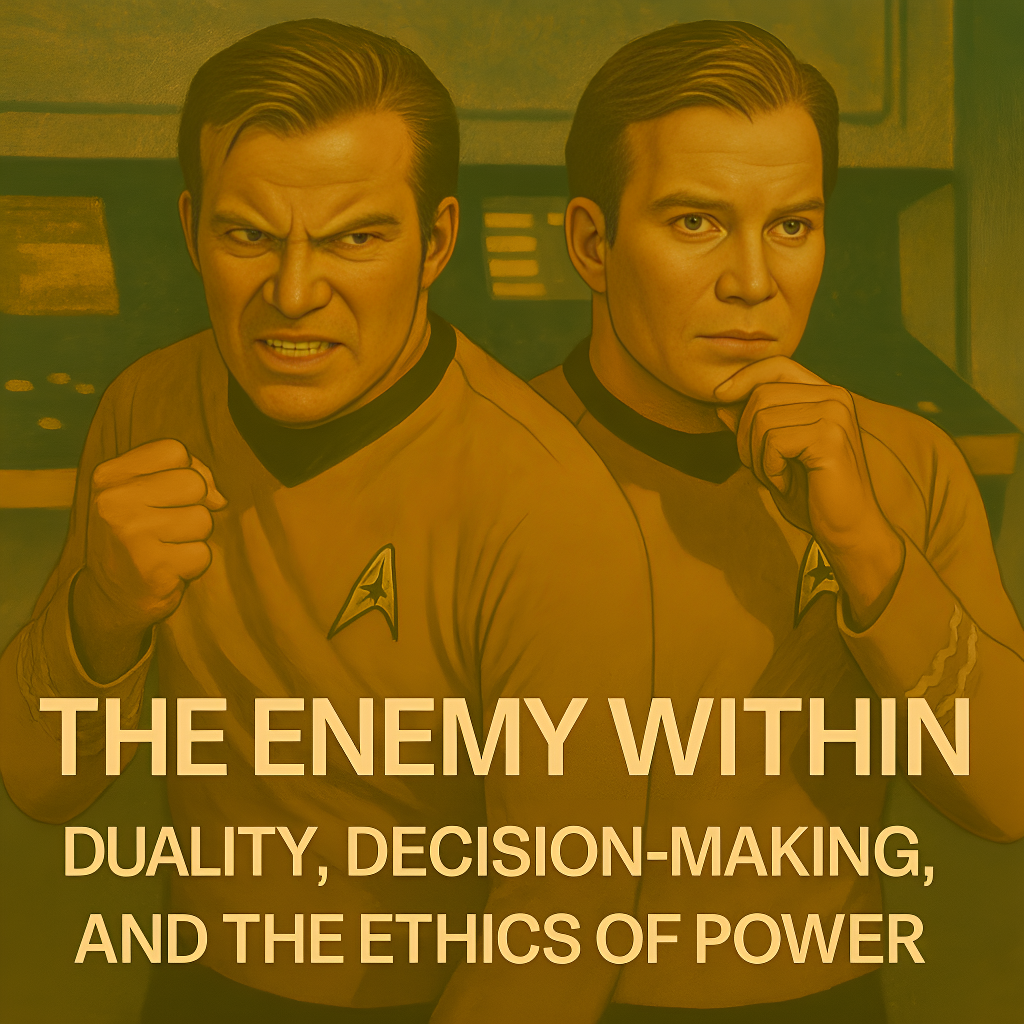
The Enemy Within: Duality, Decision-Making, and the Ethics of Power

Show Summary

Today, we examine one of the most psychologically compelling Star Trek episodes to date: The Enemy Within. A transporter malfunction splits Captain Kirk into two versions of himself: one good and one evil. Each represents different aspects of leadership, impulse, and integrity. As the crew struggles to respond to the fractured captain, we’re given a front-row seat to the ethical breakdowns and Me Too-era lessons still resonant today. I explore five key compliance takeaways from this tale of divided identity, linking them directly to scenes aboard the Enterprise that show what happens when power is unmoored from principle and when control systems, both technical and ethical, fail.

Key Highlights and Star Trek Case Studies

1. The Dangers of Unchecked Power—When ‘Authority’ Becomes Assault

Illustrated by: Evil Kirk attacking Yeoman Janice Rand in her quarters.

One of the most disturbing moments in early Trek canon, this assault serves as a stark warning about the abuse of power. Evil Kirk resembles the captain and carries his authority, but lacks a conscience. It’s a Me Too moment that reveals the need for every organization to install guardrails, even around its most powerful figures. Compliance must include mechanisms to protect the vulnerable from those who misuse rank or influence.

2. Ethical Decision-Making Requires Wholeness—The Fragmented Leader Can’t Lead 

Illustrated by: Good Kirk losing decisiveness, compassion becoming indecision.

As “good” Kirk weakens, Spock and McCoy realize that without the aggressive, assertive part of his personality, the captain cannot lead. This reinforces the idea that ethical leadership is not about being soft; it is rather about striking a balance. Compliance leaders need the courage to act and the heart to guide. Ethical strength is integrative, not binary.

3. Crisis Response and Chain of Command—When Leadership Wavers, Chaos Breeds

Illustrated by: Evil Kirk taking the bridge and ordering the ship away from orbit.

With no one certain which Kirk is in control, the crew becomes vulnerable to manipulation. This episode serves as a cautionary tale about the importance of clarity in the chain of command and protocols for handling leadership incapacitation. In corporate compliance, crisis scenarios must anticipate rogue actors with access to decision-making tools.

4. Investigating Allegations—Belief, Process, and Support Matter

Illustrated by: Spock and McCoy interviewing Rand after her assault.

Their interview is subtle but painful. The tension in believing victims, navigating hierarchical power, and confronting uncomfortable truths is deeply relevant today. A strong compliance program ensures that all allegations are taken seriously, investigated professionally, and addressed with empathy and integrity.

5. Reintegration and Remediation—Restoring What Was Broken

Illustrated by: The merging of good and evil Kirk through a restored transporter.

Rebuilding trust and a unified identity requires technology, trust, and time. Just as Kirk must reabsorb the parts of himself to lead again, organizations recovering from misconduct must integrate the lessons learned into their culture, policies, and leadership. The ultimate goal is not punishment alone but rather to restore the organization’s ethical function.

Final Compliance Log Thoughts

The Enemy Within is more than a science fiction tale. It’s a mirror to every compliance program, showing us how quickly things unravel when power is unrestrained, when voices are ignored, and when organizations fail to integrate strength with morality. It is also a hopeful reminder that even fractured systems can be repaired if we face the truth with clarity and courage.

Resources:

Excruciatingly Detailed Plot Summary by Eric W. Weisstein

MissionLogPodcast.com

Memory Alpha