


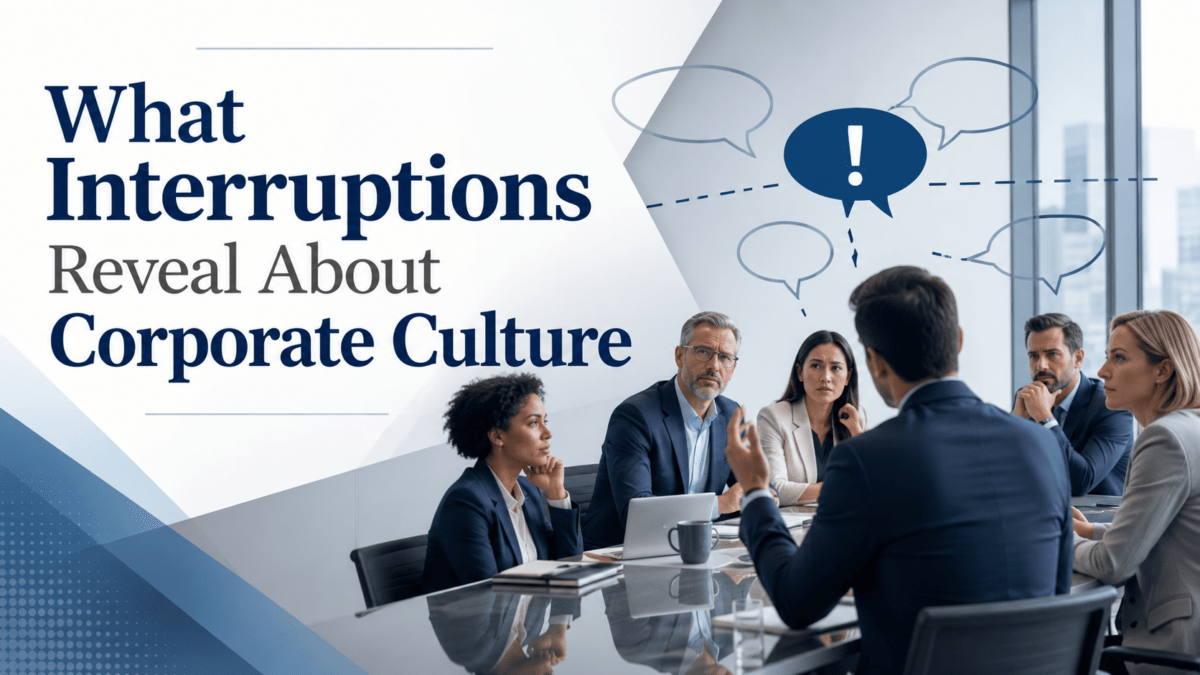
Every Chief Compliance Officer talks about culture. Every company claims to value ethics, integrity, respect, inclusion, and speak-up behavior. Those words appear in codes of conduct, CEO messages, training decks, town halls, leadership offsites, and annual ethics campaigns. Yet culture is not built into the code of conduct. It is revealed in the meeting.
That is the central lesson of Research: What Interruptions Reveal About Company Culture by William Degbey, Benjamin Laker, Baniyelme Zoogah, Sanjay Kumar Singh, and Ghulam Murtaza. The authors argue that workplace culture is shaped less by formal statements and engagement programs than by everyday interaction patterns, especially interruptions in meetings. Their research found that interruptions, redirections, and moments where employees were spoken over were not merely interpersonal annoyances. They were signals of whose voice carried weight in the room.
For the CCO, that finding should land with force. A company can have a beautifully written value of “speak up.” Still, if employees learn in ordinary meetings that certain people are cut off, ignored, or not credited for their ideas, the real culture is not to speak up. It is speak-only-if-you-have-power. That is a compliance issue.
Culture Is What Happens Before the Hotline
Compliance professionals often think about speak-up culture in terms of hotline reports, investigation data, employee surveys, and anti-retaliation policies. Those are important. The DOJ’s Evaluation of Corporate Compliance Programs (ECCP) asks whether a company has a trusted reporting mechanism, whether employees feel comfortable using it, whether reporting is encouraged or chilled, and whether employees can raise concerns without fear of retaliation.
But by the time an employee reaches the hotline, the culture has already taught that person a great deal. It has taught them that if management listens. It has taught them whether disagreement is welcome. It has taught them whether bad news is punished. It has taught them whether junior employees can challenge senior leaders. It has taught them whether women, employees from underrepresented groups, remote employees, finance staff, compliance staff, or local market employees are taken seriously.
The author’s most important compliance lesson is that interruptions are cultural data. They are small, repeated, observable signals that show whether the company’s stated values are protected in daily business interactions or suspended when authority, speed, revenue, or hierarchy enters the room.
Why This Matters to Ethics and Integrity
Ethics and integrity depend on voice. Employees must be willing to raise concerns, ask questions, challenge assumptions, and slow down decisions when something does not look right. If the organization’s meeting culture teaches employees that unfinished concerns can be interrupted, redirected, or appropriated, then the company is training people not to speak.
The authors found that many senior leaders interpreted interruptions as signs of efficiency and engagement. They saw energetic cross-talk as evidence of a productive culture. Yet the follow-up study found that others experienced the same conduct as exclusionary and predictable. Interruptions were disproportionately directed at women and employees from underrepresented racial and ethnic groups. In the follow-up study, 19 of 27 interviewees described women being interrupted more frequently than men; all seven Black women interviewed described early-stage interruptions, and five said others later resurfaced their ideas without attribution.
For compliance, that is not simply an inclusion issue, though it certainly is. It is also a risk-detection issue. If certain voices are routinely cut off, then certain risks will be underreported. If certain employees must speak faster, more defensively, or only when explicitly invited, the company loses early warning signals. If some ideas are accepted only when repeated by someone with greater status, then the company is not evaluating risk on its merits. It is evaluating risk through hierarchy. That is how ethical blind spots form.
The Silent Cost of Being Interrupted
One of the most powerful findings in the article is that interruptions changed employee behavior. Twenty-one of the 27 participants in the follow-up study said they changed how they contributed to meetings. Some spoke faster or more defensively. Some pre-structured arguments to avoid being cut off. Some waited for explicit permission to speak. Others stopped contributing unless necessary. That is exactly what a CCO should worry about.
A healthy compliance culture does not require employees to perform perfectly polished courage. It gives employees room to raise half-formed concerns, ask awkward questions, and test whether something feels wrong before they have built a legal brief around it. Many compliance issues begin as fragments: “Something about this consultant does not feel right.” “The customer is asking for unusual documentation.” “The timing of this payment seems odd.” “Why are we routing this through that entity? ”I am not sure the data use matches what we told customers.” Those are early-stage compliance signals. They need space.
If the meeting culture rewards only fast, polished, confident speech, then employees who need time to frame a concern may never get the chance. The authors note that faster and more confident-sounding speech was often treated as more authoritative. In comparison, slower or less forceful speech was treated as incomplete and therefore easier to interrupt. For a CCO, the lesson is clear: do not build a compliance program that only works for the loudest person in the room.
From Tone at the Top to Conduct in the Room
Compliance professionals have long emphasized “tone at the top.” That remains important. But this article reminds us that tone at the top is incomplete unless it becomes conduct in the room.
The DOJ expects companies to demonstrate that compliance policies and procedures are integrated into operations and that a culture of compliance is embedded in day-to-day activities. That is precisely where meeting behavior matters. Meetings are where risk appetite becomes real. They are where employees learn whether the company actually values integrity when there is a deal to close, a target to hit, or a senior executive to satisfy.
A CCO should, therefore, ask:
What happens when ethics enters the meeting?
Does the room slow down?
Does the leader protect the person raising the concern?
Does someone capture the issue and assign a follow-up?
Does the business discuss controls and alternatives?
Or does the concern get interrupted, minimized, joked away, or pushed offline?
The answers will tell you more about culture than a slogan.
Reading Interruptions as Compliance Data
The authors recommend that leaders stop treating interruptions as isolated incidents and begin reading them as data. It suggests observing who gets interrupted, when the interruption occurs, and what happens to the idea afterward. Is the idea acknowledged? Is it dropped? Is it later picked up without credit? That framework can be directly adapted into a compliance culture assessment.
A CCO can ask compliance, internal audit, HR, or an outside facilitator to observe selected meetings where risk decisions are made. These might include third-party approval committees, deal review meetings, product governance meetings, investigations triage meetings, M&A diligence sessions, safety committees, privacy reviews, or regional leadership calls.
The observer should not simply count who speaks. This is not about policing manners. It is about understanding whether the company’s ethical culture allows risk information to travel upward and across the organization.
Slow the Meeting to Surface the Risk
The article warns that speed and forced momentum can amplify inequality. Faster conversations often favor those who already feel entitled to the floor. Those who anticipate interruption compress their thinking, hesitate, or wait for a clear opening. The authors recommend slowing the interaction: let people finish, pause before responding, reinforce the norm when someone is cut off, and rotate facilitation. This is deeply relevant to compliance.
Many corporate failures occur not because no one saw the risk, but because the organization moved past it too quickly. The payment had to go out. The distributor had to be approved. The quarter had to close. The launch date had to be met. The customer had to be retained. In that environment, “speed” can become a cultural value that overwhelms integrity. A CCO should help leaders build an “integrity pause” into decision-making.
Protect the Contribution, Not the Ego
The article also makes an important distinction. Calling out interrupters or turning every interruption into a lesson on etiquette often does not work. It can escalate the moment and personalize the issue. The better approach is to protect the contribution directly. The authors suggest short interventions such as “Let them finish,” “I want to hear the rest of that point,” and “Let’s come back to the idea that was just interrupted.” This is practical guidance for CCOs and compliance professionals.
When someone raises a compliance concern and is interrupted, the compliance professional does not need to accuse anyone of bad intent. This helps to create psychological safety around risk information. They tell the room that compliance concerns are not interruptions to business. They are part of doing business properly.
The CCO as Culture Observer
A CCO cannot improve culture solely by issuing policies. Policies matter, but culture is reinforced through repeated behavior. The DOJ guidance recognizes that policies and procedures must give effect to ethical norms and be integrated into day-to-day operations. That means the CCO must look beyond policy architecture and ask how people actually behave when decisions are being made.
Not every interruption is retaliation. Not every fast-paced meeting is unethical. Not every dominant speaker is a compliance risk. But patterns matter. Repeated interruption of certain people, functions, geographies, or types of concerns is cultural data. A CCO should treat it as such.
Turning the Article into a Compliance Playbook
A practical CCO response could include five steps.
- Add meeting behavior to the culture assessment. Ask employees whether they can finish raising concerns in meetings, whether leaders invite dissent, whether objections to risk are credited, and whether certain voices are routinely ignored.
- Observe high-risk meetings. Select a sample of decision-making forums and map interruptions, credit, follow-up, and closure. The goal is not surveillance. The goal is to understand whether the company’s values show up when risk is discussed.
- Train leaders on protecting concerns. Leadership training should include simple phrases or the preservation of unfinished risk points. A manager does not need to become a compliance expert to say, “Let’s hear the rest of that concern.”
- Build structured dissent into key decisions. For high-risk approvals, require a final risk round before the decision. Ask compliance, finance, legal, HR, internal audit, cybersecurity, or local-market leaders whether they see an unresolved issue.
- Report cultural signals to the board. Boards should hear more than hotline statistics. They should understand whether the organization’s meeting culture supports candor, dissent, and ethical escalation.
Improving Corporate Culture Around Ethics and Integrity
The broader message for compliance professionals is that ethics and integrity must become observable behaviors. Employees should see integrity in how meetings are run, how concerns are handled, how dissent is credited, how leaders respond to uncertainty, and how the company treats people who slow down a decision for the right reason.
The bottom line is straightforward. The words on the wall do not prove a culture of ethics and integrity. It is proven by who gets to speak, who gets heard, and what happens when someone raises a concern that slows the room down. For the CCO, the lesson from this article is powerful: look at the meetings. That is where the culture is already speaking.