Show Summary
As a corporate compliance professional, I often say that sometimes the most profound lessons in ethics, culture, and communication don’t come from law books or boardroom memos—they come from Star Trek. One of the most underrated and allegorically rich episodes from The Original Series is “Return of the Archons.” On its face, it’s a tale about a mind-controlling computer and a seemingly idyllic society. But dig deeper, and you’ll find rich insights about what happens when training fails, communication becomes dogma, and critical thinking is suppressed. In short, it’s a compliance case study in a sci-fi wrapper.
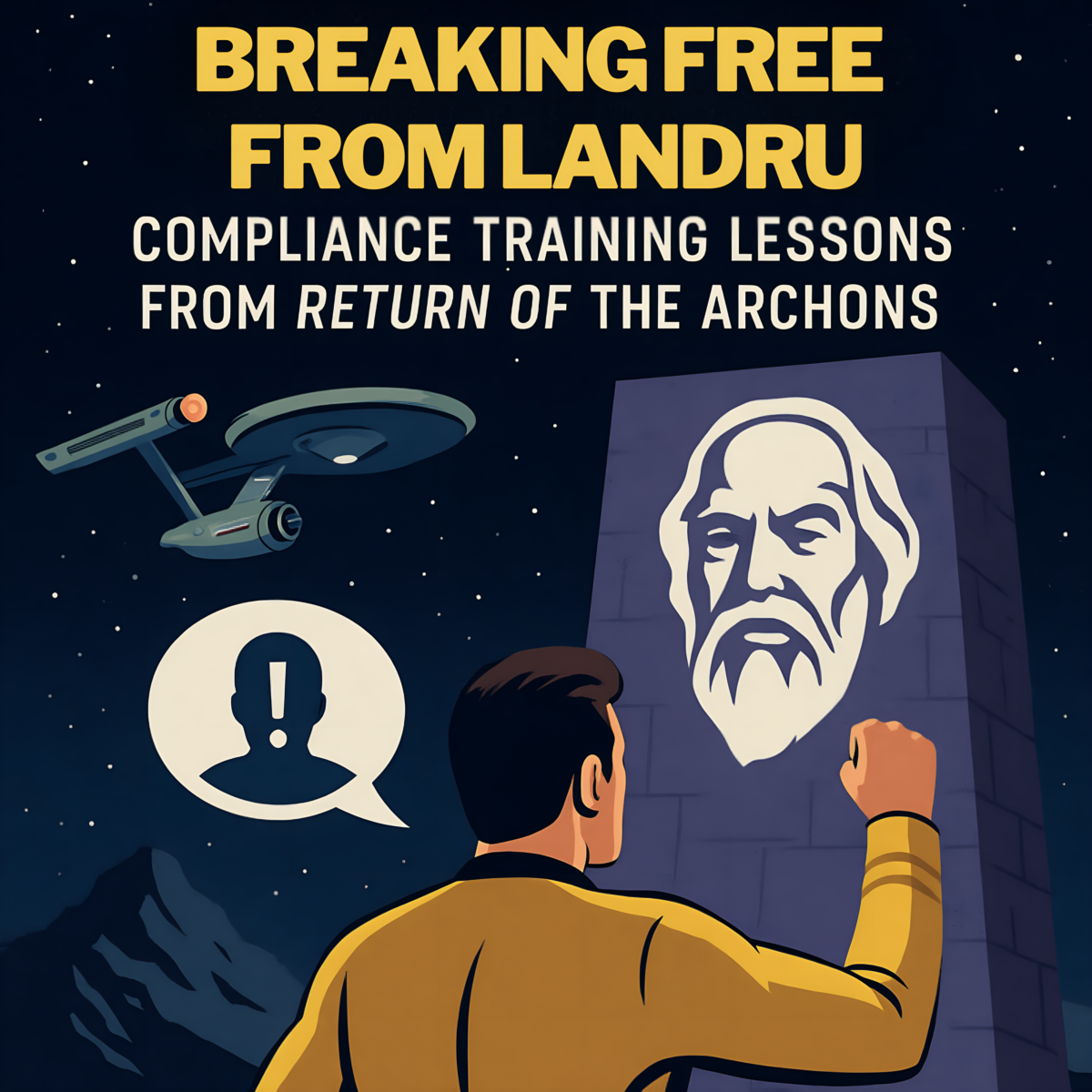
In “Return of the Archons,” the crew of the Enterprise visits Beta III, a planet where the population is under the control of a mysterious figure named Landru. Society there values “peace, tranquility, and the good of the body,” but at the cost of individuality, freedom, and inquiry. The result? A dangerously complacent culture where questioning authority is considered a crime and blind obedience is rewarded. Sound familiar? For compliance professionals, this episode offers a cautionary tale about the dangers of compliance in form but not in spirit. Let’s unpack the key lessons, each grounded in a scene from the show, followed by a compliance communication or training takeaway.
Lesson 1: Beware of a Culture of Blind Obedience
Illustrated By: As Captain Kirk and Mr. Spock observe the citizens of Beta III, they are struck by the eerie passivity of the people. Everyone is polite, deferential, and expressionless. When asked about Landru, they recite phrases like “It is the will of Landru” or “You are not of the body.” No one can explain what these phrases mean—they repeat them unthinkingly.
Compliance Lesson:
This is what happens when employees are trained to follow the rules but are never taught why the rules matter. Compliance training that relies on rote memorization or check-the-box methodologies may ensure short-term adherence, but it builds a culture of passive compliance. Employees may be able to recite the Code of Conduct, but they often fail to recognize a genuine ethical dilemma when it arises.
Effective compliance training must go beyond slogans. It must teach critical thinking, situational awareness, and ethical reasoning. Employees should be empowered to ask questions, raise concerns, and challenge improper behavior, rather than simply following procedures blindly.
Lesson 2: Suppressing Dissent Undermines a Speak-Up Culture
Illustrated By: When Kirk and his team attempt to discuss their concerns with the townspeople, they are met with horror. One man panics and calls the lawgivers, who arrive to silence and “absorb” those who question Landru. Dissent is not only discouraged—it’s physically erased from society.
Compliance Lesson:
This is a culture of compliance where whistleblowing is viewed as heresy. If employees believe that speaking up will result in retaliation, social ostracization, or career harm, they will stay silent. And when that happens, misconduct festers.
Compliance training must make clear that the company values openness and will protect those who raise concerns. That message should be communicated consistently, reinforced in tone from the top, and modeled by leadership. Reporting mechanisms must be well publicized, easily accessible, and regularly tested for usability and effectiveness. Moreover, training must frame speaking up as not just permissible but essential to ethical corporate citizenship.
Lesson 3: Over-Automation Can Lead to Ethical Stagnation
Illustrated By: It’s eventually revealed that Landru is not a man but a computer programmed centuries earlier to maintain peace and harmony. Over time, the machine’s rigid logic has smothered innovation, growth, and individuality, enforcing compliance through force and fear rather than moral reasoning.
Compliance Lesson:
Automated compliance tools, such as monitoring software, AI risk scoring, and e-learning modules, are powerful and necessary. But they must not replace human judgment. When compliance becomes entirely algorithmic, it loses context, nuance, and moral intent. Worse, it risks becoming a machine-driven bureaucracy where the letter of the law is followed, but the spirit of the law is forgotten.
To avoid this, compliance communication must emphasize the rationale behind certain rules and procedures. Training should include real-world scenarios and dilemmas, encouraging discussion about the gray areas. Compliance professionals should foster spaces where ethics are debated, not dictated. Technology should be a support tool, not the enforcer of unquestioning obedience.
Lesson 4: Training Must Be Periodic, Relevant, and Culturally Engaging
Illustrated By: Beta III’s citizens haven’t had new information in generations. Their understanding of Landru and the laws is based on repetitive, ritualistic reinforcement. There’s no evolution, no adaptation, just the same messages over and over.
Compliance Lesson:
If your training materials have not changed since 2017, or if your annual code-of-conduct course is a 60-minute video with the same five questions at the end, you are simply Beta III. Stale training is ineffective training.
Modern compliance training must be dynamic. Use fresh content, current case studies, and engaging delivery methods (e.g., gamification, short videos, mobile-friendly platforms). Tailor training to employee roles and geographies. Include cultural context and industry-specific risks. Training should reflect not only what the law says but also what the business does. And most importantly, revisit it periodically; compliance culture must be a living conversation, not a forgotten file.
Lesson 5: Effective Communication Is Two-Way, Not Top-Down
Illustrated By: The citizens of Beta III receive messages from Landru through lawgivers who deliver proclamations but never answer questions. There is no dialogue, no exchange of ideas—just declarations from on high.
Compliance Lesson:
This is a textbook example of failed compliance communication. A top-down, one-way communication strategy might check disclosure boxes, but it does not build understanding. Effective compliance communication is a dialogue. It includes listening as much as it includes talking.
Compliance professionals should build feedback loops, whether through employee surveys, town hall Q&As, or informal listening sessions. Allow employees to ask questions, share concerns, and help shape compliance messaging. Communicate often, transparently, and in plain language. Avoid legalese. Speak to people, not to them.
Lesson 6: Culture Is the Foundation of Ethical Behavior
Illustrated By: Kirk and Spock recognize that Beta III is not simply a society with a malfunctioning leader; it is a society built on fear and conformity. Their solution isn’t just to turn off Landru. It’s to encourage the people to reclaim their humanity, their voices, and their ability to choose.
Compliance Lesson:
This is the ultimate lesson of “Return of the Archons”: Compliance cannot be imposed from above. It must be cultivated from within. Training and communication are essential tools for building a deeper culture, one where employees genuinely embrace compliance because they believe in it, not because they’re forced to.
Culture-building requires sustained effort. It involves reinforcing values through leadership examples, recognizing ethical behavior, correcting missteps transparently, and integrating ethics into the daily workflow. Culture is the soil from which compliance grows. Without it, your program is just window dressing.
Final ComplianceLog Reflections: You Are of the Body (of Compliance)
“Return of the Archons” may seem like an abstract sci-fi tale, but it carries vital messages for compliance officers. It shows what happens when a society stops asking questions, stops thinking critically, and stops caring about why the rules exist. It warns us of a world where compliance is no longer about ethics but about fear, automation, and suppression.
As compliance professionals, we must ensure that our training and communication efforts do not replicate the world of Landru. Instead, we must foster curiosity, encourage questions, empower whistleblowers, refresh our content, and build culture from the ground up. So the next time you hear a compliance slogan repeated like a mantra, ask yourself: Are we creating engaged, ethical employees, or are we just building another Beta III? Let’s boldly go where no training program has gone before and bring our people with us.
Resources:
Excruciatingly Detailed Plot Summary by Eric W. Weisstein
MissionLogPodcast.com
Memory Alpha