For years, compliance leaders have worked under a simple reality: if the government learns about a problem from someone else first, you have already lost leverage. The Southern District of New York (SDNY) just sharpened that reality into a clear, public framework. Its Corporate Enforcement and Voluntary Self-Disclosure Program for Financial Crimes, effective February 24, 2026, is not subtle. It is designed to force an earlier decision and reward companies that make it; this means making it fast, transparent, and with meaningful remediation and restitution.
This is not just a fraud prevention or reporting program. It reaches conduct that can show up in any company: accounting games, deceptive disclosures, market-facing misconduct, and the broader universe of financial crime risks that sit adjacent to bribery-and-corruption controls. If you are running a compliance program, you should read this initiative as a warning: even when the underlying misconduct is not charged as “bribery,” the financial-crimes hook is often where prosecutors live. You may think you are managing “corruption risk.” SDNY is telling you it is also “market integrity” and “victim harm” risk.
And SDNY is pairing that message with something rare in enforcement policy: speed. SDNY says qualifying companies “can expect to receive a conditional declination letter within two to three weeks of self-reporting”. That is a flashing sign for CCOs: the window for decision-making just got smaller.
The SDNY is pushing fiduciary duty and stewardship.
Business executives usually talk about self-disclosure as a tactical choice. Compliance professionals have long known better, and now the SDNY frames it as something deeper: governance and duty. The program states that corporate leaders are “fiduciaries” with a “fundamental duty” to ensure integrity and transparency, and it positions voluntary self-disclosure as a core act of good corporate citizenship and stewardship. It will be interesting to see whether this “fundamental duty” to ensure integrity and transparency, and the corporate leaders as ‘fiduciaries’, bring a new level of Caremark scrutiny to Delaware.
That language matters. It is not only prosecutors describing a pathway to leniency. It is prosecutors telling boards and executives what they believe ethical leadership requires when the company discovers misconduct that harms markets, counterparties, customers, or investors. In other words, SDNY is trying to turn self-disclosure into a leadership test.
The Carrot is Real and Designed to Change Behavior
SDNY’s incentives are intentionally strong. If a company meets the program requirements, including timely voluntary self-disclosure, full cooperation, and timely remediation, the SDNY says it will issue a declination and will not prosecute the company. It also states that there will be no criminal fine and that, if the company pays appropriate restitution to victims, SDNY will not require forfeiture. Even more significant for compliance leaders is the following: SDNY says it “generally will not require” an independent compliance monitor for a qualifying company.
Those are meaningful benefits. They are the kind of benefits that can change what a board is willing to authorize in the first two weeks of a crisis. But the benefits only matter if you can move fast enough, gather credible facts, and maintain control of the narrative.
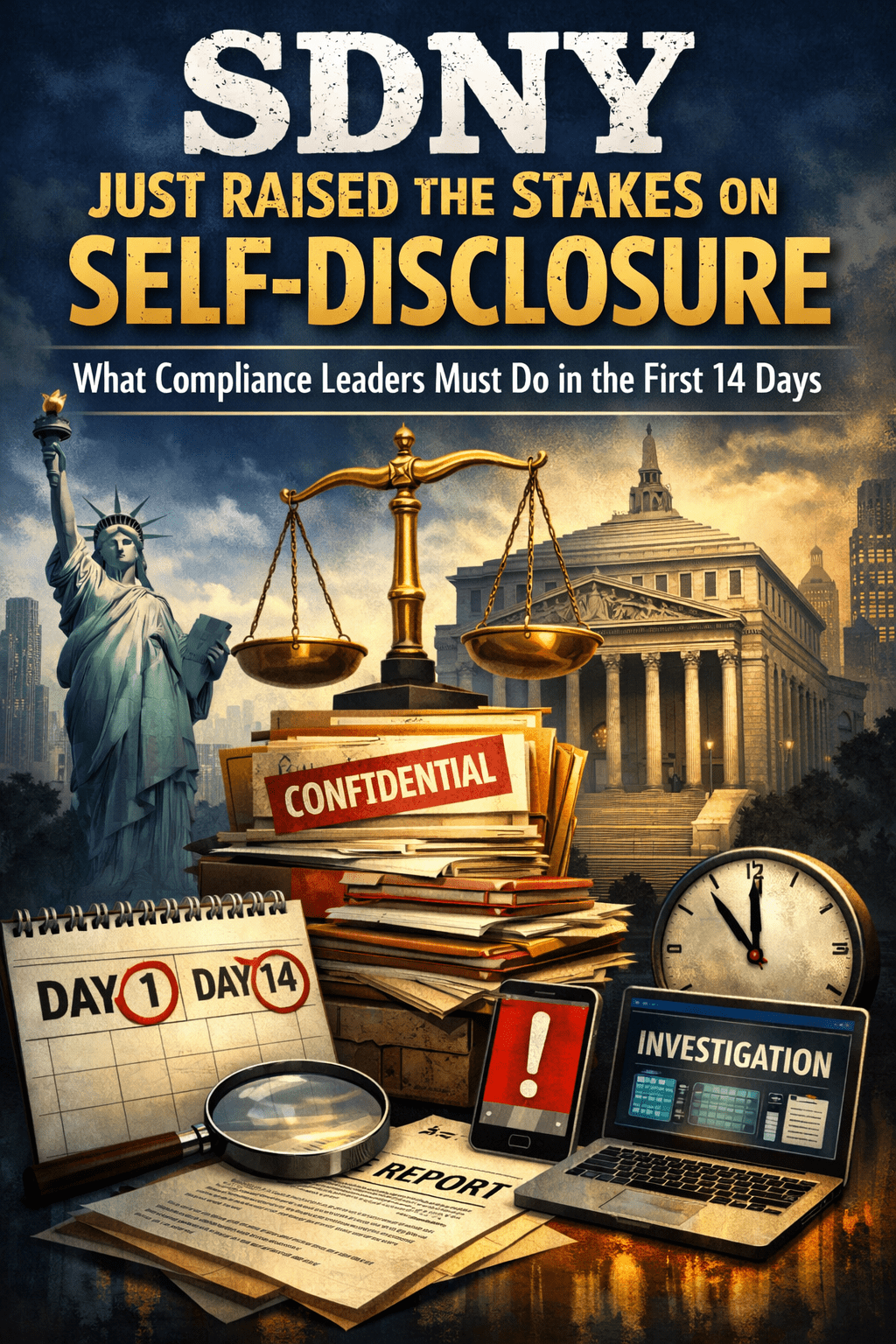
The First 14 Days: what compliance leaders should do now, not later
If SDNY is telling you it can issue a conditional declination letter in “two to three weeks”, then your internal process cannot take three weeks to decide whether you even have a problem. The ethical governance move is to treat the first 14 days as a disciplined sprint, one that protects truth, protects victims, and protects the integrity of your program.
Days 1–2: Triage without spinning
Your first obligation is to stop the bleeding and preserve facts. That means:
- immediate escalation into a controlled response team (Compliance, Legal, Finance, Internal Audit, IT/security, and, if needed, HR),
- an evidence preservation hold that includes chat platforms, mobile devices, third-party messaging, deal rooms, and personal email, where permitted, and
- a decision to ring-fence relevant individuals, accounts, and transactions so you do not create new harm.
Ethically, this is where senior leadership proves it wants the truth, not just a version of it.
Days 3–5: Board notice and decision rights
If you are waiting for “certainty” before you brief the board or a board committee, you are already behind the SDNY clock. The goal is not to accuse. The goal is to establish governance: decision rights, cadence, and oversight. SDNY’s fiduciary framing means this cannot be treated as a management-only event. The board must be positioned to make an informed decision on disclosure, remediation, and restitution as facts develop.
Days 6–10: Outside counsel, scoped investigation, and credibility building
This is when you decide whether to engage outside counsel and forensic support to ensure independence and speed. For SDNY purposes, credibility is currency. The company needs to show it can:
- Identify the misconduct,
- identify who was involved,
- quantify harm, including victims and losses,
- explain control failures, and
- demonstrate remediation beyond “we are reviewing policies.”
Remember: SDNY’s program is built around concrete action, self-reporting, cooperation, remediation, and restitution. If your internal processes create delays and ambiguity, you are squandering the very benefits SDNY offers.
Days 11–14: Regulator strategy and the self-disclosure decision
This is the moment of ethical leadership. You will not know everything. You will know enough to determine whether misconduct occurred and whether it falls into a category SDNY will view as market-harming or integrity-compromising. SDNY is offering a structured benefit for early self-reporting, but it is also signaling that waiting for a subpoena is not a strategy.
Five Lessons for the Compliance Professional
Lesson 1: SDNY is reframing self-disclosure as a fiduciary duty rather than optional crisis PR.
The program’s emphasis on leaders as “fiduciaries” with a “fundamental duty” of integrity and transparency is a direct ethical challenge to boards and executives. If your organization treats disclosure solely as a legal risk calculation, SDNY is telling you that you have already missed the governance point.
Lesson 2: Speed is now a moral and operational requirement.
The “two to three weeks” commitment to a conditional declination letter is SDNY saying: “Do not slow-walk the truth.” In compliance terms, timeliness is not merely a matter of efficiency. It is ethical stewardship. Delay increases harm, increases victim loss, and increases the chance that someone else tells your story first.
Lesson 3: Restitution is not a side issue; it is a core ethical outcome.
SDNY’s program explicitly states that paying “appropriate restitution to victims” is central, and it links that to the decision not to pursue forfeiture. Compliance leaders should read this as a directional signal: the government is measuring corporate ethics by whether the company makes harmed parties whole, not merely by whether it updates a policy.
Lesson 4: The benefits are real, but they are earned through cooperation and remediation that changes behavior.
No prosecution, no fine, and generally no monitor are extraordinary incentives. But SDNY is also telling you what it values: companies that step forward, cooperate fully, remediate quickly, and do not play games with facts. Ethically, this is “clean hands” enforcement: if you want mercy, show you deserve it.
Lesson 5: Some conduct is simply disqualifying, and compliance must stop pretending every risk is manageable with process.
SDNY calls out aggravating circumstances that can make a company ineligible for a declination under the program. The list includes conduct tied to terrorism, sanctions evasion, foreign corruption, trafficking, cartels, forced labor, violence, and related financing or laundering. That matters because it draws an ethical boundary: there are categories of wrongdoing so corrosive that the “cooperate and remediate” story is not enough. For CCOs, the lesson is to build escalation protocols that treat these risks as existential and non-negotiable.
A Blunt Wake-up Call: The Cost of Not Self-Reporting is Going Up
SDNY is trying to end the era of corporate hesitation. The program signals that a company’s decision not to self-report will weigh heavily against it when prosecutors later assess resolutions. This is the part compliance leaders must say out loud internally: the old playbook of “let us wait and see” is increasingly incompatible with how prosecutors say they will exercise discretion. If your organization has not pre-built a rapid disclosure decision tree, you are asking to miss the window SDNY is dangling in front of you. You will not get the benefit of a program you were not prepared to use.
Conclusion: Compliance and Ethics that Move at Prosecutorial Speed
The SDNY initiative is not merely a new memo. It is a redefinition of what “responsible corporate conduct” looks like in real time. It asks boards and senior executives to behave like fiduciaries: to choose integrity and transparency early, to protect victims through restitution, and to treat cooperation and remediation as proof that the company is worthy of trust. For the compliance professional, the message is simple and uncomfortable: your program will not be judged by the elegance of your policies. It will be judged by whether your leadership can tell the truth quickly, act with stewardship, and make hard decisions when the facts are incomplete but the duty is clear.