Show Summary
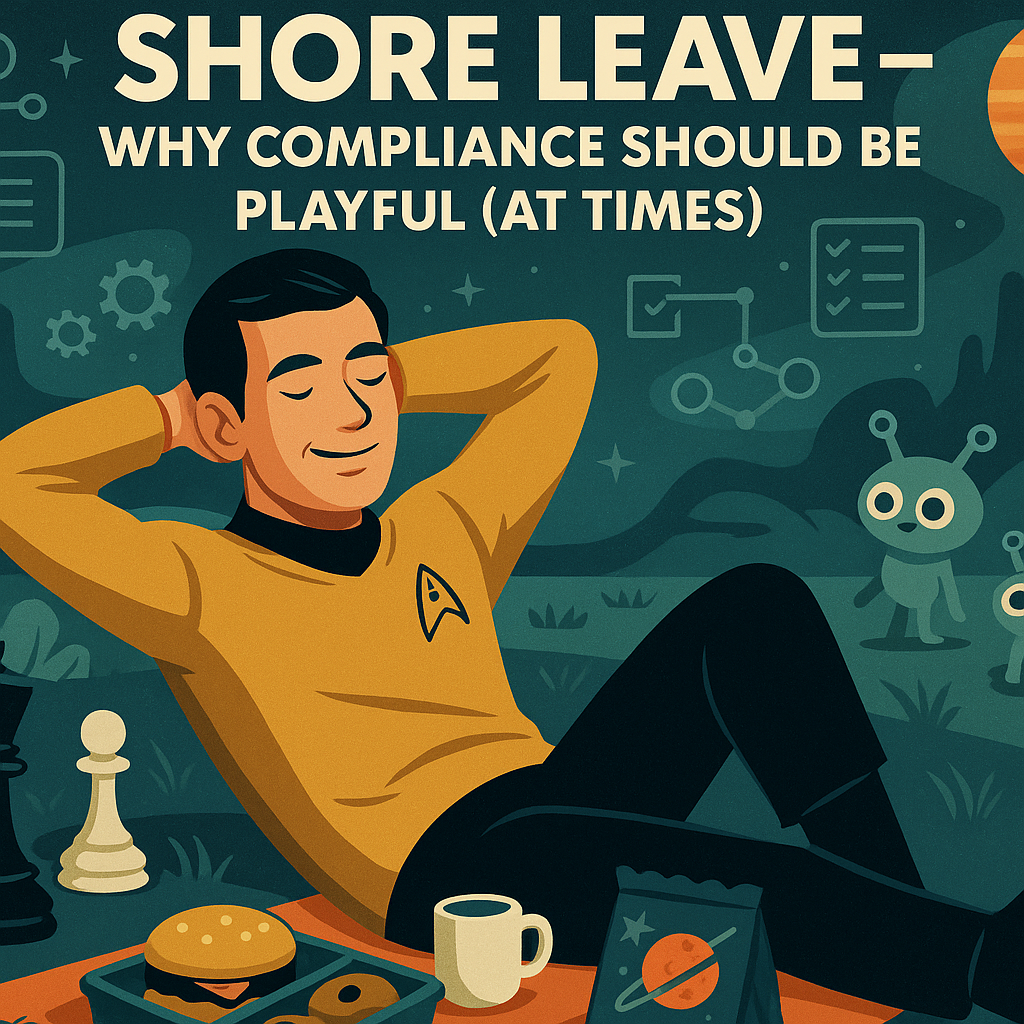
What does the episode “Shore Leave” have to do with compliance? Quite a bit, it turns out. Intended as a respite for the fatigued crew of the Enterprise, the planet soon becomes a living playground of the imagination where thoughts turn instantly into reality. Fantasies (and nightmares) from the subconscious materialize: White Rabbits, medieval knights, lost lovers, and even Kirk’s old academy rival, Finnegan.
At first glance, “Shore Leave” may not seem like fertile ground for compliance lessons. But in fact, it offers a powerful metaphor for an often-overlooked truth in corporate ethics and compliance programs: compliance does not always have to be serious to be effective. Sometimes, as Carsten Tams reminds us, it should be playful. In today’s episode, we explore how compliance professionals can make training, communications, and culture-building engaging, interactive, and even fun without ever compromising on rigor or integrity. So join me as we unpack six key lessons from “Shore Leave” that illustrate how playfulness can be a surprisingly powerful tool in your compliance toolkit.
1. People Learn More When They’re Not Stressed
Illustrated by: The Enterprise crew’s need for R&R after exhausting missions.
Captain Kirk initially resists the idea of shore leave, arguing that there’s too much work to be done. But Dr. McCoy, supported by Spock’s logical assessment, insists the crew is showing signs of physical and mental exhaustion. Rest is not a luxury, and it is a necessity for operational effectiveness. When the crew beams down, they begin to laugh, explore, and decompress. For a moment, morale is restored.
Compliance Lesson:
Think of your employees the same way you’d think of the Enterprise crew: trained professionals under pressure. If you deliver compliance training in a joyless, legalistic tone, monotone webinars, lengthy policy PDFs, and punishment-driven messaging, instead of creating cognitive overload, you are hindering learning. Neuroscience confirms what “Shore Leave” dramatizes: people learn best when they’re relaxed, open, and stimulated by novelty.
So inject levity. Use storytelling. Create gamified challenges. Host “compliance scavenger hunts” or “ethics escape rooms.” A light touch does not dilute the message. It makes the message stick.
2. Make It Personal, Make It Stick
Illustrated by: The planet’s ability to tailor experiences to each crew member’s thoughts.
The so-called “amusement park planet” adapts its landscape in real-time to reflect each visitor’s thoughts. McCoy sees characters from fairy tales. Sulu finds himself with a samurai. Kirk confronts Finnegan, his mischievous nemesis from the Academy. The planet’s strength lies in its personalization, and each experience is unique, vivid, and relevant to the individual.
Compliance Lesson:
This is precisely what compliance communications should strive to be. People engage with content when it reflects their context, whether that is their role, region, risk exposure, or personal values. A generic, one-size-fits-all compliance email about anti-bribery laws won’t have nearly the impact of a short, animated video showing a sales manager navigating a tricky interaction with a government official in Brazil.
Use personas in your training. Build case studies based on real-life departmental challenges. Include localized content for global audiences. When people see themselves in the message, they remember the lesson.
3. Surprise Can Be a Teaching Tool
Illustrated by: The sudden appearance of surreal figures, from tigers to Alice in Wonderland.
“Shore Leave” keeps the crew and viewers on their toes. When things feel calm, something unexpected occurs. A knight skewers McCoy. A WW2 fighter plane swoops overhead. And Kirk is ambushed by his old nemesis in a fistfight. These surprises grab attention, trigger curiosity, and break the monotony. The episode feels whimsical, but it delivers deeper insights about stress, psychology, and perception.
Compliance Lesson:
In your compliance training program, don’t underestimate the value of surprise. Unexpected storytelling, clever twists, and humorous “wrong way” examples can all disarm your audience and make learning more memorable. Consider starting a training session with a scene from a movie, a meme, or even a parody of a compliance mistake. Then, pivot into serious learning.
Surprise doesn’t mean gimmickry. It means creating moments that catch attention, challenge assumptions, and open up space for meaningful engagement. Your goal is not simply to inform; rather, as Hui Chin told us many years ago, it is to make people think.
4. Let People Engage on Their Terms
Illustrated by: Different crew members experience the planet in different ways.
While the planet remains the same physical space, everyone interacts with it differently. McCoy goes on a fantasy adventure. Sulu finds joy in weapons. Yeoman Barrows imagines herself in a medieval gown. No one is forced into a particular experience; instead, each crew member chooses their path through the environment, making the experience more personal and fulfilling.
Compliance Lesson:
Apply this principle to your compliance communications strategy. Offer multiple modalities. Some people prefer videos; others prefer articles or podcasts. Some individuals may enjoy scenario-based learning games, while others may prefer simulations or role-playing exercises. Design your training architecture like a multi-lane road: different entry points, same destination.
Consider offering voluntary “bonus” compliance events, lunch-and-learns with guest speakers, ethical film screenings, or cross-functional “spot the risk” challenges. When people have choices, they feel a sense of ownership. And ownership increases buy-in.
5. Even Fantasy Has Rules—Define the Boundaries
Illustrated by: The discovery that the planet’s illusions, while playful, can cause real harm.
Initially, the planet seems harmless. But soon, McCoy is seriously injured, and other experiences become increasingly intense. Kirk and his crew learn that while the Earth is designed for recreation, it can become dangerous if participants do not understand the boundaries or rules. The solution is not to avoid play but to clarify the framework.
Compliance Lesson:
This is one of the most important parallels to corporate compliance. Creating engaging, playful content doesn’t mean abandoning standards or structure; it means embracing them freshly and innovatively. The opposite is true. Clear guardrails, defined objectives, code alignment, and measurable outcomes underpin the best compliance engagement programs.
If you host a gamified compliance tournament, ensure that the scoring mechanisms reinforce ethical behavior, not just speed. If you allow user-generated content, ensure review protocols are in place. Structured play can be just as effective and far safer than unsupervised learning. Fun is not the enemy of accountability.
6. Debriefing Deepens Learning
Illustrated by Kirk’s reflection with McCoy and Spock at the end of the episode.
At the end of “Shore Leave,” Kirk pauses to process what happened. He discusses the nature of the planet, its risks, and its benefits. He reflects on his emotional response to Finnegan, his sense of guilt and nostalgia, and what he learned about himself. This moment transforms the experience from play into one of growth and development.
Compliance Lesson:
Never end a training without a debrief. Whether your program was fun, serious, or somewhere in between, reflection is what turns experience into understanding. After a game-based simulation, send out discussion questions. After a role-play session, ask participants to share lessons learned or “What would you do differently?”
Even something as simple as a brief email summary, a leaderboard shoutout, or a team wrap-up call can reinforce key takeaways and prompt their practical application. The brain needs repetition and connection to consolidate learning. Give your audience the chance to process.
Final ComplianceLog Reflections:
Compliance Doesn’t Have to Be a “No-Fun Zone”
Sometimes, you need to channel your inner Ronnie Feldman, for if there is one thing Shore Leave teaches us, it is that even the most disciplined teams need room for release, exploration, and imagination. The same is true in compliance. You’re not just teaching policies; you’re influencing behavior, shaping culture, and earning trust. And if playfulness, humor, and surprise can help you do that more effectively, then beam those strategies aboard.
Compliance has its profound moments, no doubt. But if your entire program is built on fear, formality, and fatigue, you are missing out on one of the most powerful motivators we have: joy.
Resources: