Categories
Blog

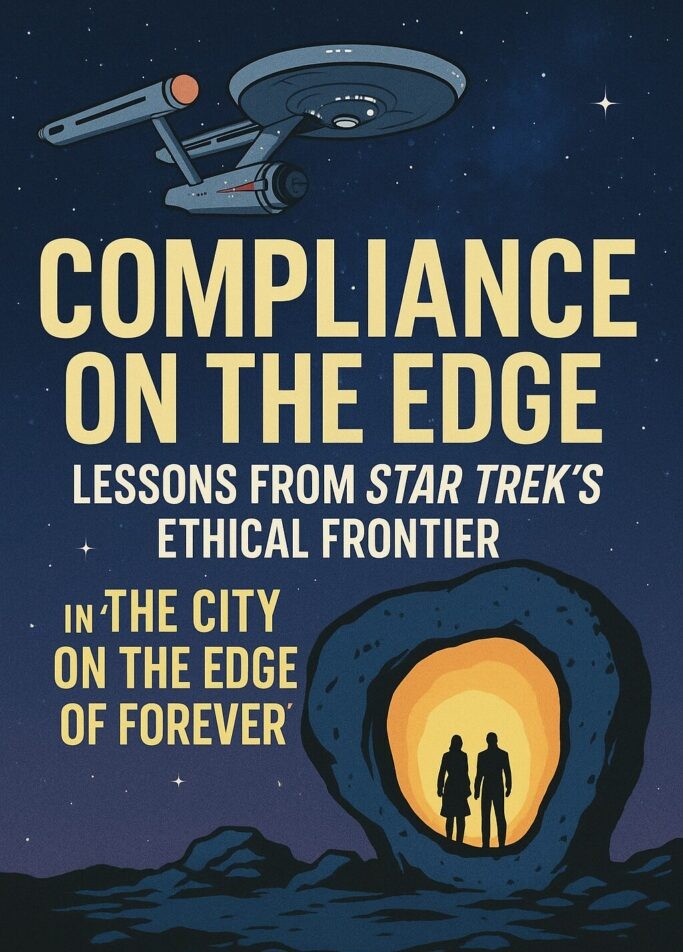
Compliance on the Edge: Lessons from Star Trek’s Ethical Frontier in City from the Edge of Forever

Today, we delve into perhaps the most iconic Star Trek: The Original Series episode, “The City on the Edge of Forever.” Doubling as my favorite Star Trek episode of all time (not just TOS), the episode not only represents a pinnacle in science fiction storytelling but also provides timeless lessons for corporate compliance professionals.

In this episode, the USS Enterprise crew encounters the Guardian of Forever, a mysterious gateway to the past. A temporarily insane Dr. McCoy alters history, and Captain Kirk and Mr. Spock must follow him to restore the timeline, ultimately facing profound moral dilemmas. Let’s dive into five compliance lessons from this episode, using scenes to illuminate essential insights into corporate ethics and compliance.

Lesson 1: The Importance of Immediate Response

Illustrated By: Dr. McCoy leaps through the Guardian of Forever, drastically altering history, and Captain Kirk immediately decides to follow him.

Compliance Lesson. One of the first critical lessons from the episode is the importance of a prompt response in crisis management. When Dr. McCoy leaps through the Guardian of Forever, drastically altering history, Captain Kirk immediately decides to follow him. Kirk recognizes that swift action is required to mitigate and correct the risk that McCoy’s actions pose to the timeline.

In compliance, the ability to react swiftly and decisively can prevent minor compliance issues from becoming significant crises. Compliance officers must cultivate readiness and decisive leadership, ensuring teams are prepared to act promptly and effectively when compliance risks emerge.

Lesson 2: Understanding the Root Cause

Illustrated By: Mr. Spock constructs a rudimentary device using primitive 1930s technology to identify the critical historical alteration that would have led to Edith Keeler’s survival.

Compliance Lesson. Mr. Spock, utilizing a rudimentary yet effective device constructed from primitive 1930s technology, painstakingly investigates and identifies the critical historical alteration—Edith Keeler’s survival, which inadvertently allows a catastrophic global conflict to occur. By clearly identifying the root cause, Kirk and Spock can effectively focus their remediation strategy.

Root cause analysis remains central in compliance programs. Without accurately identifying the source of compliance issues, organizations risk implementing ineffective solutions that fail to address the root cause of the problem. Compliance teams must rigorously investigate incidents, understand underlying causes, and ensure that corrective actions address the genuine drivers of non-compliance.

Lesson 3: Ethical Decision-Making

Illustrated By: Kirk realizes that Edith Keeler, a compassionate woman with whom he has fallen in love, must die to restore the timeline.

Compliance Lesson. Arguably, the most poignant compliance lesson emerges when Kirk realizes that Edith Keeler, a compassionate and visionary woman with whom he has fallen in love, must die to restore the timeline. Kirk’s agonizing decision underscores a critical ethical compliance lesson: adherence to principles must transcend personal emotions and relationships.

Compliance officers frequently face challenging ethical dilemmas that require difficult decisions. Upholding integrity might sometimes mean making unpopular choices. Like Kirk, compliance professionals must prioritize ethical commitments, understanding that integrity and moral responsibility are paramount.

Lesson 4: Clear Communication and Collaboration

Illustrated By: Kirk and Spock demonstrate teamwork and clear communication, effectively navigating their challenging environment and limited resources.

Compliance Lesson. Throughout the episode, Kirk and Spock demonstrate extraordinary teamwork and clear communication. Despite their challenging environment and limited resources, their consistent collaboration ensures effective decision-making and the implementation of strategic plans. Their communication is concise, targeted, and based on mutual understanding and respect.

Effective compliance programs similarly depend on transparent communication and seamless collaboration across departments. Compliance officers must foster a culture where team members communicate openly, share vital information promptly, and collaborate cohesively to uphold compliance standards.

Lesson 5: Proactive Monitoring and Preventive Measures

Illustrated By: The Enterprise first encounters the Guardian of Forever, which provides glimpses into historical events, illustrating its monitoring capabilities.

Compliance Lesson. When the Enterprise first encounters the Guardian of Forever, it provides glimpses into various historical events, demonstrating its ability to monitor and foresee critical junctures in history. This scene symbolizes the value of proactive monitoring and preventive measures.

Compliance professionals must adopt proactive monitoring strategies, leveraging technology and analytics to anticipate and mitigate risks before they materialize. Compliance programs should include continuous monitoring mechanisms to ensure the early identification of potential issues and swift corrective actions.

Final ComplianceLog Reflections

The City on the Edge of Forever” delivers profound insights into ethical dilemmas, crisis response, communication, root cause analysis, and proactive monitoring. Captain Kirk’s heart-wrenching decision to prioritize the greater good, despite the personal cost, epitomizes the ethical resolve compliance professionals must emulate.

By integrating these lessons from Star Trek into your compliance program, you can strengthen your organization’s ability to navigate complex ethical landscapes and maintain robust compliance standards. After all, as the Guardian of Forever reminds us, understanding and respecting history and ethics help shape a more stable and compliant future.

Resources:
Excruciatingly Detailed Plot Summary by Eric W. Weisstein

MissionLogPodcast.com

Memory Alpha

Categories
Trekking Through Compliance

Trekking Through Compliance: Episode 28 – Compliance on the Edge: Lessons from Star Trek’s Ethical Frontier in City from the Edge of Forever

Today, we delve into perhaps the most iconic Star Trek: The Original Series episode, “The City on the Edge of Forever.” Doubling as my favorite Star Trek episode of all time (not just TOS), the episode not only represents a pinnacle in science fiction storytelling but also provides timeless lessons for corporate compliance professionals.

In this episode, the USS Enterprise crew encounters the Guardian of Forever, a mysterious gateway to the past. A temporarily insane Dr. McCoy alters history, and Captain Kirk and Mr. Spock must follow him to restore the timeline, ultimately facing profound moral dilemmas. Let’s explore five key compliance lessons from this episode, using scenes to illuminate essential insights into corporate ethics and compliance.

Lesson 1: The Importance of Immediate Response

Illustrated By: Dr. McCoy leaps through the Guardian of Forever, drastically altering history, and Captain Kirk immediately decides to follow him.

Compliance Lesson. In compliance, the ability to react swiftly and decisively can prevent minor compliance issues from becoming significant crises.

Lesson 2: Understanding the Root Cause

Illustrated By: Mr. Spock constructs a rudimentary device using primitive 1930s technology to identify the critical historical alteration that would have led to Edith Keeler’s survival.

Compliance Lesson. Root cause analysis remains central in compliance programs. Without accurately identifying the source of compliance issues, organizations risk implementing ineffective solutions that fail to address the root cause of the problem.

Lesson 3: Ethical Decision-Making

Illustrated By: Kirk realizes that Edith Keeler, a compassionate woman with whom he has fallen in love, must die to restore the timeline.

Compliance Lesson. Compliance officers frequently face challenging ethical dilemmas that require difficult decisions. Upholding integrity sometimes means making unpopular choices.

Lesson 4: Clear Communication and Collaboration

Illustrated By: Kirk and Spock demonstrate teamwork and clear communication, effectively navigating their challenging environment and limited resources.

Compliance Lesson. Effective compliance programs similarly depend on transparent communication and seamless collaboration across departments.

Lesson 5: Proactive Monitoring and Preventive Measures

Illustrated by: The Enterprise first encounters the Guardian of Forever, which provides glimpses into historical events, illustrating its monitoring capabilities.

Compliance Lesson. Compliance professionals must adopt proactive monitoring strategies, leveraging technology and analytics to anticipate and mitigate risks before they materialize.

Final ComplianceLog Reflections

The City on the Edge of Forever” delivers profound insights into ethical dilemmas, crisis response, communication, root cause analysis, and proactive monitoring. Captain Kirk’s heart-wrenching decision to prioritize the greater good, despite the personal cost, epitomizes the ethical resolve compliance professionals must emulate.

By integrating these lessons from Star Trek into your compliance program, you can strengthen your organization’s ability to navigate complex ethical landscapes and maintain robust compliance standards. After all, as the Guardian of Forever reminds us, understanding and respecting history and ethics all help to shape a more stable and compliant future.

Resources:
Excruciatingly Detailed Plot Summary by Eric W. Weisstein

MissionLogPodcast.com

Memory Alpha

Categories
Trekking Through Compliance

Trekking Through Compliance: Episode 27 – The Alternative Factor: Navigating Compliance Through Pattern Recognition Across Realities

Today, let’s boldly delve into “The Alternative Factor,” a peculiar episode from the original Star Trek series (TOS), to extract valuable lessons on pattern recognition and compliance. This often-overlooked episode presents a compelling study of chaos, confusion, and dual realities. The crew faces Lazarus, a mysterious character embroiled in a battle with his counterpart from an alternate universe. The crew initially struggles to recognize and interpret patterns of events, highlighting the critical role of clarity and vigilance in compliance processes. For the compliance professional, this provides lessons in pattern recognition for identifying and resolving anomalies.

Lesson 1: Recognize the Anomalies Early

Illustrated by: Early in the episode, the Enterprise experiences unexplained phenomena, a sudden disruption of reality described as a “blinking” of the universe. This early anomaly, quickly dismissed as sensor errors, turns out to be a crucial indicator of a deeper problem.

Compliance Lesson: Small discrepancies in financial reports, unusual behavior patterns in email communications, or irregularities in procurement data could indicate significant underlying compliance issues.

Lesson 2: Clarify Data and Information Sources

Illustrated By: Captain Kirk and Spock encounter difficulty obtaining clear information from Lazarus. His inconsistent and confusing explanations led to further uncertainty and wasted resources.

Compliance Lesson: Compliance programs rely heavily on clear, accurate, and consistent data. A pattern recognition issue emerges when compliance professionals depend on ambiguous or unreliable information sources.

Lesson 3: Understand Context to Identify Patterns

Illustrated By: Spock eventually recognizes a key pattern—that Lazarus seems to exist as two distinct entities, each from a parallel universe. Only when the Enterprise crew understands the context can they effectively respond.

Compliance Lesson: Compliance professionals must understand the broader context of their operational environments to manage compliance effectively.

Lesson 4: Clear Communication Amidst Confusion

Illustrated By: During moments of intense confusion, effective communication becomes challenging. Captain Kirk’s decisive actions and clear communication ultimately helped resolve the crisis despite initial confusion.

Compliance Lesson: Clear and effective communication is vital, especially during compliance incidents or investigations. A pattern recognition breakdown often occurs in environments with poor communication, leading to misunderstandings and exacerbating the problem. Encourage regular, clear, and transparent communication practices within your compliance program to ensure alignment and swift action.

Lesson 5: Proactive Risk Mitigation

Illustrated by: Once understanding the threat Lazarus poses, Kirk proactively acts, sealing the passage between the two universes, preventing further catastrophic disruptions.

Compliance Lesson: Compliance programs should aim for proactive rather than reactive approaches. Recognizing patterns early and responding proactively to risks protects your organization from severe compliance breaches.

Final ComplianceLog Reflections

The Alternative Factor” presents an intriguing allegory for the complex world of compliance, highlighting the importance of pattern recognition. In compliance, as aboard the Enterprise, early recognition of unusual patterns, accurate data interpretation, contextual awareness, clear communication, and proactive response strategies are vital.

Compliance professionals must remain vigilant and responsive, continuously refining their ability to identify and interpret emerging patterns. Adopting these strategies ensures not just organizational integrity and adherence to regulations but also equips compliance teams to navigate uncertain and challenging scenarios effectively. Just as Captain Kirk steered his crew safely through the chaotic Alternative Factor, compliance professionals can lead their organizations confidently through compliance uncertainties by mastering these crucial lessons.

Resources:

Excruciatingly Detailed Plot Summary by Eric W. Weisstein

MissionLogPodcast.com

Memory Alpha

Categories
Blog

The Alternative Factor: Navigating Compliance Through Pattern Recognition Across Realities

Today, let’s boldly delve into “The Alternative Factor,” a peculiar episode from the original Star Trek series (TOS), to extract valuable lessons on pattern recognition and compliance. This often-overlooked episode presents a compelling study of chaos, confusion, and dual realities. The crew faces Lazarus, a mysterious character embroiled in a battle with his counterpart from an alternate universe. The crew initially struggles to recognize and interpret patterns of events, highlighting the critical role of clarity and vigilance in compliance processes. For the compliance professional, this provides lessons in pattern recognition for identifying and resolving anomalies.

Lesson 1: Recognize the Anomalies Early

Illustrated by: Early in the episode, the Enterprise experiences unexplained phenomena, a sudden disruption of reality described as a “blinking” of the universe. This early anomaly, quickly dismissed as sensor errors, turns out to be a crucial indicator of a deeper problem.

Compliance Lesson: Compliance teams must be vigilant for anomalies, regardless of how minor or easily dismissed they may initially appear. Small discrepancies in financial reports, unusual behavior patterns in email communications, or irregularities in procurement data could indicate significant underlying compliance issues. Encourage your team to trust instincts, verify anomalies, and treat each irregularity seriously.

Lesson 2: Clarify Data and Information Sources

Illustrated By: Captain Kirk and Spock encounter difficulty obtaining clear information from Lazarus. His inconsistent and confusing explanations led to further uncertainty and wasted resources.

Compliance Lesson: Compliance programs rely heavily on clear, accurate, and consistent data. A pattern recognition issue emerges when compliance professionals depend on ambiguous or unreliable information sources. It is essential to verify the integrity and accuracy of data sources. Establish rigorous protocols for validating data to avoid confusion and misdirected resources.

Lesson 3: Understand Context to Identify Patterns

Illustrated By: Spock eventually recognizes a key pattern—that Lazarus seems to exist as two distinct entities, each from a parallel universe. Only when the Enterprise crew understands the context can they effectively respond.

Compliance Lesson: Compliance professionals must understand the broader context of their operational environments to manage compliance effectively. For instance, unusual financial transactions might only appear suspicious when viewed in the context of recent organizational changes, geopolitical shifts, or evolving regulations. Without context, patterns can be misleading. Educate your compliance teams to understand and evaluate patterns within the broader organizational and industry context.

Lesson 4: Clear Communication Amidst Confusion

Illustrated By: During moments of intense confusion, effective communication becomes challenging. Captain Kirk’s decisive actions and clear communication ultimately helped resolve the crisis despite initial confusion.

Compliance Lesson: Clear and effective communication is vital, especially during compliance incidents or investigations. A pattern recognition breakdown often occurs in environments with poor communication, leading to misunderstandings and exacerbating the problem. Encourage regular, clear, and transparent communication practices within your compliance program to ensure alignment and swift action.

Lesson 5: Proactive Risk Mitigation

Illustrated By: Once understanding the threat Lazarus poses, Kirk proactively acts, sealing the passage between the two universes and preventing further catastrophic disruptions.

Compliance Lesson: Compliance programs should aim for proactive rather than reactive approaches. Recognizing patterns early and responding proactively to risks protects your organization from severe compliance breaches. Establish a robust system for continuous monitoring, regular audits, and proactive risk assessments to ensure effective management of risks. Training employees to identify and report early-stage anomalies effectively can prevent larger compliance disasters.

Final ComplianceLog Reflections

The Alternative Factor” presents an intriguing allegory for the complex world of compliance, highlighting the importance of pattern recognition. In compliance, as aboard the Enterprise, early recognition of unusual patterns, accurate data interpretation, contextual awareness, clear communication, and proactive response strategies are vital.

Compliance professionals must remain vigilant and responsive, continuously refining their ability to identify and interpret emerging patterns. Adopting these strategies ensures not just organizational integrity and adherence to regulations but also equips compliance teams to navigate uncertain and challenging scenarios effectively. Just as Captain Kirk steered his crew safely through the chaotic Alternative Factor, compliance professionals can lead their organizations confidently through compliance uncertainties by mastering these crucial lessons.

Resources:

Excruciatingly Detailed Plot Summary by Eric W. Weisstein

MissionLogPodcast.com

Memory Alpha

Categories
Trekking Through Compliance

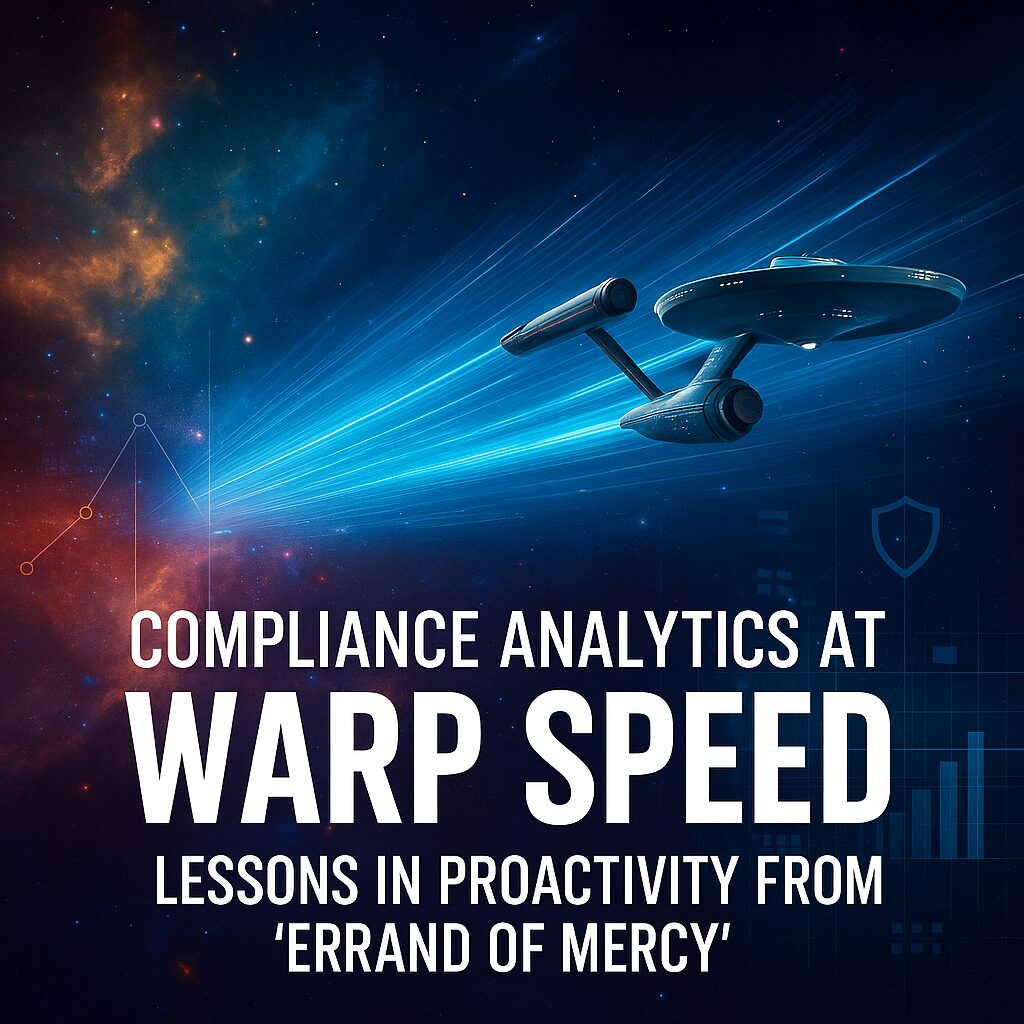
Trekking Through Compliance: Episode 26 – Lessons in Data Analytics from Errand of Mercy

Star Trek’s “Errand of Mercy” has long captivated viewers with its profound examination of conflict, diplomacy, and the limitations of perception. While it might not seem immediately apparent, this episode is rich with insightful lessons for the corporate compliance community, particularly regarding data analytics. Let’s delve into five key data analytics lessons derived from this timeless story, specifically tailored for today’s compliance professionals.

Lesson 1: Data-Driven Awareness Prevents Miscalculations

Illustrated by Captain Kirk and Mr. Spock, they initially underestimate the Organians, perceiving them as primitive due to surface-level observations. Only later do they realize that Organians possess profound power and knowledge far beyond initial assessments.

Compliance Lesson: Compliance professionals must avoid superficial analyses and surface-level assessments. Utilizing comprehensive data analytics enables organizations to understand deeper patterns, accurately predict potential risks, and make informed strategic decisions.

Lesson 2: Real-Time Analytics Facilitate Prompt Intervention

Illustrated By: During their initial stay, the Organians repeatedly attempt to deflect the Federation and Klingon aggression, subtly and promptly intervening as conflicts arise.

Compliance Lesson: Effective compliance management increasingly depends on real-time data analytics to facilitate rapid intervention and corrective actions. Organizations require systems that can deliver real-time or near-real-time insights into compliance violations or risks, enabling them to respond effectively and promptly to these issues.

Lesson 3: Predictive Analytics Enhance Proactive Compliance

Illustrated By: Ultimately, the Organians demonstrate foresight and predictive awareness, recognizing the likely outcomes of Federation and Klingon hostilities and intervening proactively to avoid widespread disaster.

Compliance Lesson: Predictive analytics significantly strengthens proactive compliance initiatives. Leveraging historical data, machine learning algorithms, and risk modeling allows compliance teams to anticipate potential compliance issues before they become significant problems.

Lesson 4: The Value of Integrating Diverse Data Sources

Illustrated by Kirk and Spock initially relying primarily on their direct observations and Federation reports, neglecting potentially valuable alternative perspectives and data points that might have informed a more nuanced understanding of the Organians.

Compliance Lesson: Integrating diverse data sources into compliance analytics significantly enhances the accuracy and effectiveness of decision-making. Organizations should draw on a wide array of data, including internal audit reports, third-party risk assessments, whistleblower reports, and industry-wide compliance trends, to inform their decision-making.

Lesson 5: Ethical Data Use and Transparency Build Trust

Illustrated By: In the episode’s resolution, the Organians reveal their true nature transparently, clearly communicating their intentions and reasons for their actions, which ultimately earns the trust and respect of both Federation and Klingon representatives.

Compliance Lesson: The ethical and transparent use of data is fundamental in maintaining stakeholder trust and ensuring regulatory compliance. Organizations must ensure that their data analytics practices align with privacy regulations, data ethics standards, and transparency principles.

Final ComplianceLog Reflections

“Errand of Mercy” offers a valuable allegory for contemporary compliance professionals, highlighting the importance of in-depth analysis, real-time intervention capabilities, predictive insights, diverse data integration, and ethical transparency. By embracing these data analytics lessons, compliance teams can significantly enhance their organization’s ability to manage and mitigate risks proactively. In today’s complex regulatory landscape, harnessing sophisticated analytics capabilities is not merely advantageous; it is essential. Like Kirk and Spock’s ultimate realization in “Errand of Mercy,” understanding beyond surface appearances and leveraging deep analytical insights can make all the difference in effectively navigating compliance challenges.

Resources:

Excruciatingly Detailed Plot Summary by Eric W. Weisstein

MissionLogPodcast.com

Memory Alpha

Categories
Blog

Compliance Analytics at Warp Speed: Lessons in Proactivity from Errand of Mercy

Star Trek’s “Errand of Mercy” has long captivated viewers with its profound examination of conflict, diplomacy, and the limitations of perception. While it might not seem immediately apparent, this episode is rich with insightful lessons for the corporate compliance community, particularly regarding data analytics. Let’s delve into five key data analytics lessons derived from this timeless story, specifically tailored for today’s compliance professionals.

Lesson 1: Data-Driven Awareness Prevents Miscalculations

Illustrated by: Captain Kirk and Mr. Spock initially underestimate the Organians, perceiving them as primitive due to surface-level observations. Only later do they realize that Organians possess profound power and knowledge far beyond initial assessments.

Compliance Lesson: Compliance professionals must avoid superficial analyses and surface-level assessments, just as Kirk and Spock learned not to judge the Organians by outward appearances. Too often, organizations base critical decisions on incomplete or surface-level information. In compliance, this can lead to overlooking systemic risks, misjudging third-party partners, or misunderstanding evolving regulatory threats.

Data-driven awareness is the antidote to this danger. Leveraging advanced analytics, compliance teams can dig deeper into transactional data, employee behavior, vendor histories, and external market signals. Analytics allow organizations to uncover patterns and anomalies that the naked eye might miss, providing early warnings of compliance gaps, fraud, or ethical blind spots. Importantly, robust analytics mitigate the impact of human bias, reducing over-reliance on gut instinct or anecdotal evidence.

By developing dashboards, risk heatmaps, and tailored reporting tools, compliance professionals empower themselves and business leaders to make better, evidence-based decisions. The ultimate lesson: Only through continuous data-driven vigilance can organizations prevent costly miscalculations and ensure their compliance posture is based on reality, not perception.

Lesson 2: Real-Time Analytics Facilitate Prompt Intervention

Illustrated By: During their initial stay, the Organians repeatedly attempt to deflect the Federation and Klingon aggression, subtly and promptly intervening as conflicts arise.

Compliance Lesson: In an era of rapid digital transactions and globalized operations, waiting for quarterly or annual compliance reviews is no longer sufficient. Real-time data analytics is transforming the compliance function from a reactive, after-the-fact process to a dynamic, proactive engine for risk prevention. By monitoring financial transactions, communication patterns, and operational workflows in real time, compliance teams can identify red flags, policy breaches, or suspicious activity as soon as they arise.

This enables immediate investigation, escalation, or remediation long before minor issues escalate into major violations or regulatory crises. Advanced alert systems and AI-powered monitoring platforms now allow the simultaneous tracking of thousands of compliance data points, prioritizing high-risk incidents for human review. Furthermore, real-time analytics support a culture of ongoing accountability, where employees and leaders understand that compliance is not just a box to check but a living, breathing part of business operations. The lesson from the Organians: Subtle, timely intervention can often prevent conflict, just as prompt, real-time analytics can avert disaster in the compliance landscape.

Lesson 3: Predictive Analytics Enhance Proactive Compliance

Illustrated By: Ultimately, the Organians demonstrate foresight and predictive awareness, recognizing the likely outcomes of Federation and Klingon hostilities and intervening proactively to avoid widespread disaster.

Compliance Lesson: The best compliance programs don’t just react to problems—they anticipate them. Predictive analytics is the frontier of proactive compliance, empowering teams to leverage historical data, risk modeling, and machine learning to forecast future threats. By analyzing trends in internal investigations, audit findings, whistleblower reports, and external regulatory actions, compliance professionals can identify emerging patterns of risk before they fully materialize. This capability allows organizations to adjust controls, update training, and allocate resources with maximum impact.

For example, predictive models can highlight geographic regions or business units with an elevated risk profile, enabling preemptive audits or targeted messaging. Predictive analytics also supports dynamic risk scoring, enabling compliance teams to reassess exposure as new data becomes available continually. In the same way that the Organians foresaw and diffused conflict before it erupted, compliance professionals equipped with predictive analytics can guide their organizations around regulatory minefields, reducing both the likelihood and the impact of violations. The key takeaway: In compliance, as in diplomacy, foresight is a powerful tool.

Lesson 4: The Value of Integrating Diverse Data Sources

Illustrated by Kirk and Spock initially relying primarily on their direct observations and Federation reports, neglecting potentially valuable alternative perspectives and data points that might have informed a more nuanced understanding of the Organians.

Compliance Lesson: Siloed data is the enemy of effective compliance. In a world of complex operations, no single data source can provide the complete picture of an organization’s compliance risk. Integrating diverse data streams, including financial records, employee activity logs, whistleblower submissions, market intelligence, third-party assessments, and even social media, enables compliance teams to connect the dots that might otherwise remain isolated. Modern compliance analytics platforms are designed to ingest, normalize, and cross-reference multiple data types, revealing relationships and outliers that static spreadsheets cannot.

By triangulating information from various internal and external sources, organizations enhance the accuracy of their risk assessments, refine investigative outcomes, and identify root causes more quickly. Integration also breaks down barriers between business units, legal, audit, and compliance, fostering a culture of transparency and shared responsibility. The failure to consider alternative perspectives, as demonstrated by Kirk and Spock, is a cautionary tale: Only by synthesizing the broadest possible range of data can compliance leaders ensure that their risk management strategies are as robust and adaptive as the business environment demands.

Lesson 5: Ethical Data Use and Transparency Build Trust

Illustrated By: In the episode’s resolution, the Organians reveal their true nature transparently, clearly communicating their intentions and reasons for their actions, which ultimately earns the trust and respect of both Federation and Klingon representatives.

Compliance Lesson: In an age of big data, artificial intelligence, and heightened regulatory scrutiny, ethical stewardship of data is both a legal requirement and a business imperative. Compliance teams must ensure that their use of data analytics adheres to the highest standards of privacy, security, and fairness. This includes not only complying with applicable regulations (such as GDPR, CCPA, and others) but also establishing clear policies around consent, data retention, and access controls.

Transparency is key; organizations should be open with employees, customers, and regulators about what data is collected, how it is analyzed, and for what purposes. Regular communication and training reinforce trust and demonstrate a commitment to responsible data governance. When stakeholders understand and believe in the integrity of an organization’s data practices, the credibility of the compliance program is strengthened. The Organians’ transparent reveal is a reminder: Trust is earned through clarity and honesty, both in science fiction and in today’s data-driven compliance world.

Final ComplianceLog Reflections

“Errand of Mercy” offers a valuable allegory for contemporary compliance professionals, highlighting the importance of thorough analysis, real-time intervention capabilities, predictive insights, diverse data integration, and ethical transparency. By embracing these data analytics lessons, compliance teams can significantly enhance their organization’s ability to manage and mitigate risks proactively. In today’s complex regulatory landscape, harnessing sophisticated analytics capabilities is not merely advantageous; it is essential. Like Kirk and Spock’s ultimate realization in “Errand of Mercy,” understanding beyond surface appearances and leveraging deep analytical insights can make all the difference in effectively navigating compliance challenges.

Resources:

Excruciatingly Detailed Plot Summary by Eric W. Weisstein

MissionLogPodcast.com

Memory Alpha

Categories
Trekking Through Compliance

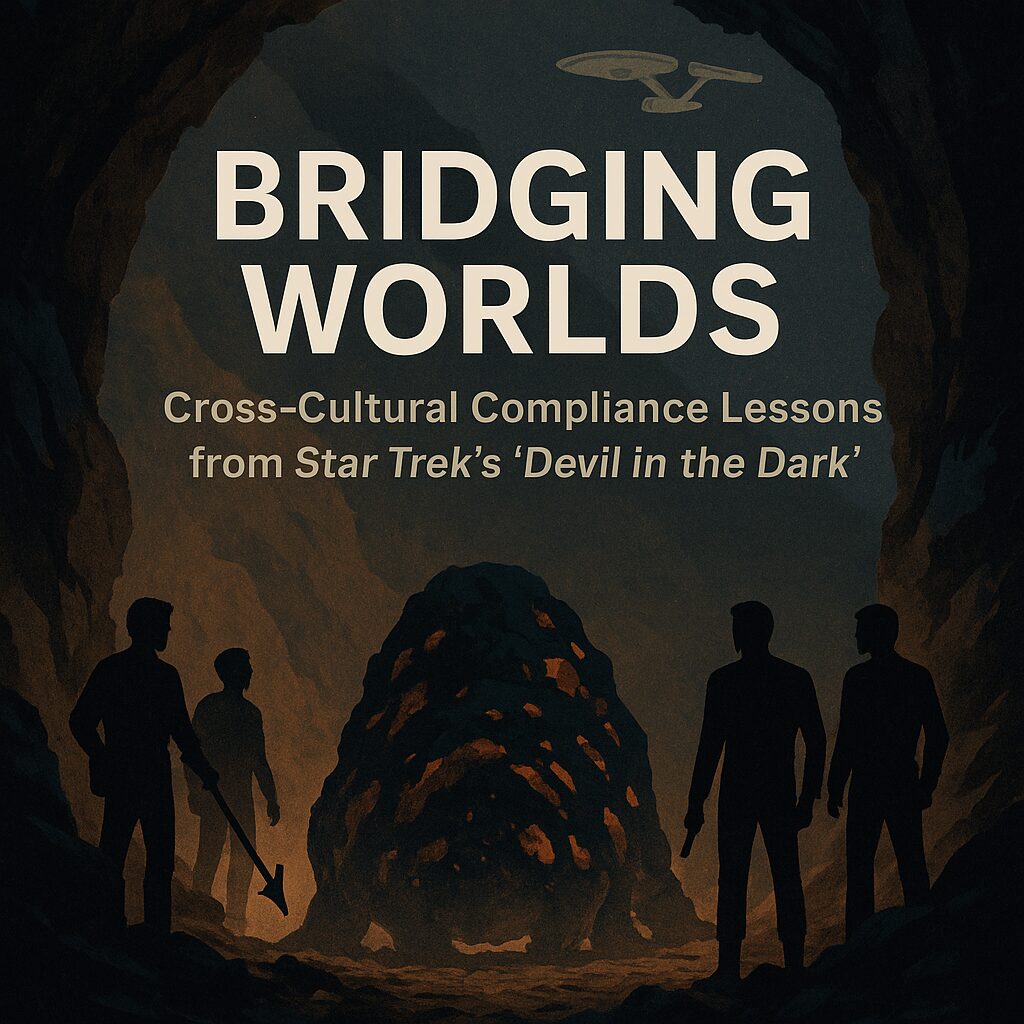
Trekking Through Compliance: Episode 25 – Cross-Cultural Lessons from Devil in the Dark

Show Summary

The classic episode, “Devil in the Dark,” is a compelling exploration of misunderstandings, communication breakdowns, and reconciliation between drastically different cultures—lessons that resonate strongly for corporate compliance officers navigating today’s global marketplace.

In “Devil in the Dark,” the USS Enterprise is dispatched to investigate mysterious deaths in a mining colony. What initially seems like straightforward monster attacks turns out to be a profound misunderstanding between humans and an alien creature called the Horta. Today, we will examine five key compliance lessons that corporate professionals can learn from the iconic Star Trek episode.

Lesson 1: Recognize and Challenge Your Own Biases

Illustrated By: When the Enterprise crew arrives, the miners describe a monstrous creature attacking and killing miners, labeling it simply as a dangerous beast to be eliminated. Their preconceived notions blinded them to the possibility of understanding the creature.

Compliance Lesson: Compliance professionals must actively recognize and challenge their assumptions and biases.

Lesson 2: Effective Communication Requires Genuine Effort and Empathy

Illustrated By: The turning point of the episode comes when Spock mind-melds with the Horta. Through genuine empathy and effort, he discovers that the Horta is not malevolent but is protecting its offspring, the silicon nodules that the miners had inadvertently been destroying.

Compliance Lesson: Corporate compliance teams operating in multinational contexts must make a genuine effort to communicate effectively with global partners, subsidiaries, and stakeholders.

Lesson 3: Cultural Awareness as a Risk Mitigation Strategy

Illustrated By: The miners’ failure to recognize the silicon nodules as living offspring stems from ignorance about the Horta’s culture and biology. This ignorance creates hostility and unnecessary conflict.

Compliance Lesson: Understanding local cultural norms, regulatory landscapes, and business ethics is vital for operating ethically and legally across jurisdictions.

Lesson 4: Embrace Diversity to Foster Innovation and Solutions

Illustrated By: The Enterprise crew’s diverse backgrounds and experiences enable them to devise innovative solutions. Spock’s unique Vulcan abilities allow communication with the Horta, transforming a volatile situation into a collaborative one.

Compliance Lesson: Diverse compliance teams bring varied experiences, perspectives, and problem-solving approaches essential for effectively managing complex compliance challenges.

Lesson 5: Seek Win-Win Solutions through Collaboration

Illustrated By: Ultimately, Captain Kirk brokers a cooperative agreement between the miners and the Horta, allowing peaceful coexistence and mutual benefit. The miners extracting resources and the Horta species continue unharmed.

Compliance Lesson: Compliance professionals should adopt a win-win mindset, working collaboratively with regulatory authorities, local communities, employees, and third-party partners to align compliance objectives with mutual benefits.

Final ComplianceLog Reflections

Star Trek’s “Devil in the Dark” vividly illustrates the consequences of cross-cultural misunderstandings and the immense benefits of cultural empathy, clear communication, diversity, and collaborative problem-solving. For corporate compliance professionals, this episode serves as a powerful reminder that effective compliance programs necessitate intentional cross-cultural engagement, ongoing education, and empathy-driven interactions.

Resources:

Excruciatingly Detailed Plot Summary by Eric W. Weisstein

MissionLogPodcast.com

Memory Alpha

Categories
Blog

Bridging Worlds: Cross-Cultural Compliance Lessons from Devil in the Dark

Show Summary

Star Trek has always served as a powerful lens through which to view not just the potential future of humanity but the contemporary complexities we face today. The classic episode, “Devil in the Dark,” is a compelling exploration of misunderstandings, communication breakdowns, and reconciliation between drastically different cultures—lessons that resonate strongly for corporate compliance officers navigating today’s global marketplace.

In “Devil in the Dark,” the USS Enterprise is dispatched to investigate mysterious deaths in a mining colony. What initially seems like straightforward monster attacks turns out to be a profound misunderstanding between humans and an alien creature called the Horta. Today, we will examine five key compliance lessons that corporate professionals can learn from the iconic Star Trek episode.

Lesson 1: Recognize and Challenge Your Own Biases

Illustrated By: When the Enterprise crew arrives, the miners describe a monstrous creature attacking and killing miners, labeling it simply as a dangerous beast to be eliminated. Their preconceived notions blinded them to the possibility of understanding the creature.

Compliance Lesson: Like the miners’ initial response, corporate biases can obscure critical perspectives and valuable information. Compliance professionals must actively recognize and challenge their assumptions and biases. It’s critical to maintain impartiality, especially during investigations, risk assessments, or due diligence processes involving diverse international markets. Conducting training sessions on unconscious bias and regularly revisiting corporate procedures helps organizations maintain objectivity and fairness.

Lesson 2: Effective Communication Requires Genuine Effort and Empathy

Illustrated By: The turning point of the episode comes when Spock mind-melds with the Horta. Through genuine empathy and effort, he discovers that the Horta is not malevolent but is protecting its offspring, the silicon nodules that the miners had inadvertently been destroying.

Compliance Lesson: Effective communication across cultural boundaries requires empathy, openness, and genuine effort. Corporate compliance teams operating in multinational contexts must make sincere efforts to communicate effectively with global partners, subsidiaries, and stakeholders. Language barriers, differing business practices, and cultural nuances can lead to costly misunderstandings. Investing in cross-cultural training, employing bilingual staff, and engaging empathetically with diverse perspectives strengthens communication and helps prevent costly compliance failures.

Lesson 3: Cultural Awareness as a Risk Mitigation Strategy

Illustrated by: The miners’ failure to recognize the silicon nodules as living offspring stems from ignorance about the Horta’s culture and biology. This ignorance creates hostility and unnecessary conflict.

Compliance Lesson: Cultural ignorance significantly increases compliance risk, especially in international operations. Understanding local cultural norms, regulatory landscapes, and business ethics is vital for operating ethically and legally across jurisdictions. Companies must integrate cultural intelligence training into their compliance programs, conduct thorough risk assessments, and cultivate local relationships to enhance awareness and understanding. This proactive approach mitigates misunderstandings and ethical lapses, fostering respectful and legally compliant international operations.

Lesson 4: Embrace Diversity to Foster Innovation and Solutions

Illustrated By: The Enterprise crew’s diverse backgrounds and experiences enable them to devise innovative solutions. Spock’s unique Vulcan abilities allow communication with the Horta, transforming a volatile situation into a collaborative one.

Compliance Lesson: Diversity is not only ethically commendable but also strategically vital. Diverse compliance teams bring a range of varied experiences, perspectives, and problem-solving approaches, which are essential for effectively managing complex compliance challenges. Organizations should proactively recruit and empower diverse talent in compliance roles, ensuring comprehensive perspectives in assessing risks and solving compliance-related issues. Embracing diversity fosters innovation and resilience in managing compliance across various markets.

Lesson 5: Seek Win-Win Solutions through Collaboration

Illustrated By: Ultimately, Captain Kirk brokers a cooperative agreement between the miners and the Horta, allowing peaceful coexistence and mutual benefit. The miners extracting resources and the Horta species continue unharmed.

Compliance Lesson: Effective compliance strategies often involve creative, collaborative solutions that benefit multiple stakeholders. Compliance professionals should adopt a win-win mindset, working collaboratively with regulatory authorities, local communities, employees, and third-party partners to align compliance objectives with mutual benefits. Encouraging collaborative dialogues rather than adversarial stances with stakeholders reduces friction, ensures sustainability, and promotes ethical business practices that benefit everyone involved.

Final ComplianceLog Reflections

Star Trek’s “Devil in the Dark” vividly illustrates the consequences of cross-cultural misunderstandings and the immense benefits of cultural empathy, clear communication, diversity, and collaborative problem-solving. For corporate compliance professionals, this episode serves as a powerful reminder that effective compliance programs necessitate intentional cross-cultural engagement, ongoing education, and empathy-driven interactions.

Navigating the global compliance landscape involves bridging cultural divides with sensitivity, understanding, and respect. Companies that prioritize cultural intelligence, diversity, and collaborative solutions not only minimize compliance risks—they also cultivate resilient, ethical, and respected global brands. Like the Enterprise crew, compliance professionals must boldly reach across cultural divides, ensuring business integrity thrives on mutual respect, innovation, and cooperative achievement.

Resources:

Excruciatingly Detailed Plot Summary by Eric W. Weisstein

MissionLogPodcast.com

Memory Alpha

Categories
Trekking Through Compliance

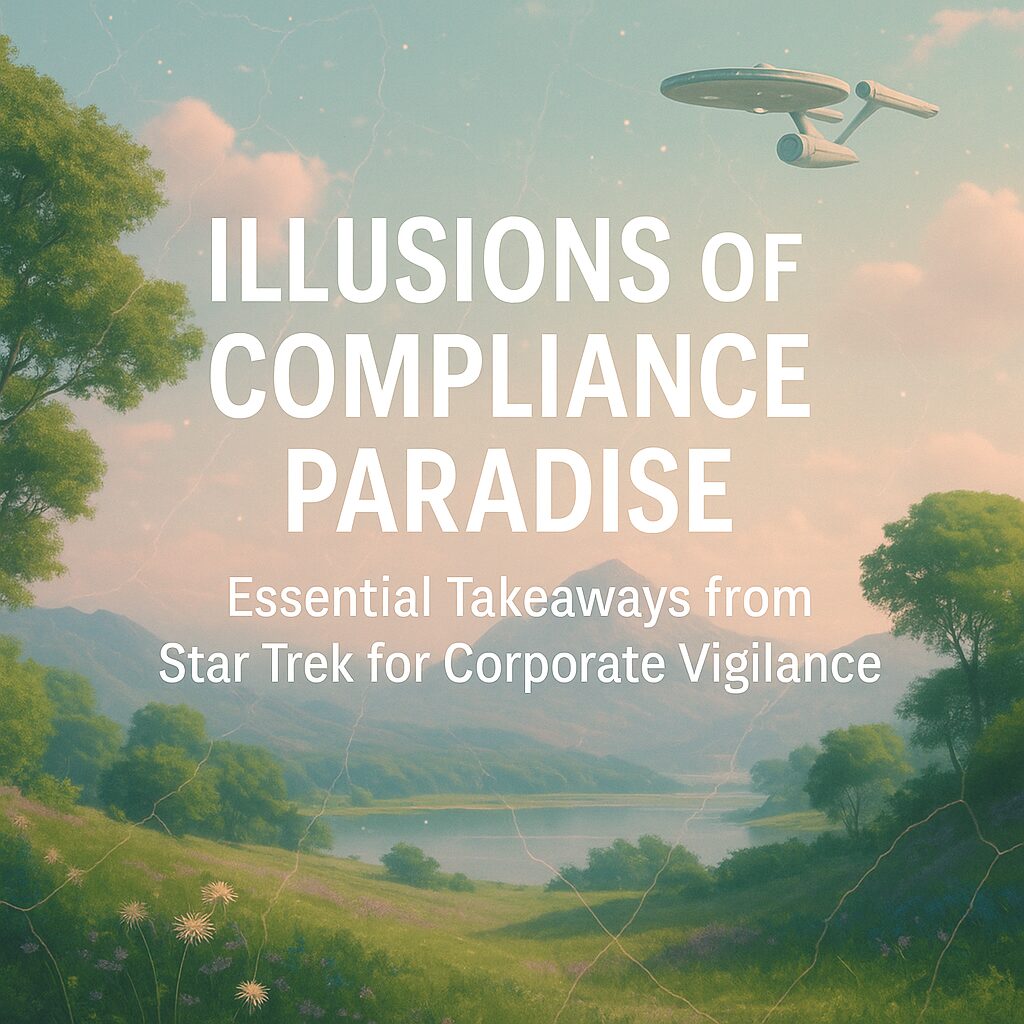
Trekking Through Compliance: Episode 24 – This Side of Paradise: Essential Takeaways for Compliance Vigilance

Show Summary

Star Trek has consistently excelled at blending imaginative storytelling with deeply reflective, ethical, and compliance lessons. In the episode “This Side of Paradise,” Captain Kirk and the crew of the USS Enterprise visit a colony thought to be lost, only to discover colonists who appear unnaturally happy and content due to the influence of strange alien spores. These spores eliminate negative emotions and ambition, creating an illusion of paradise. However, beneath the serene surface lies an unsettling truth, one that reveals significant lessons for corporate compliance professionals.

Lesson 1: The Danger of Complacency

Illustrated By: Upon their arrival, Captain Kirk and his crew are astonished at how content and relaxed the colonists appear, lacking any sense of urgency or purpose beyond their immediate happiness. The spores create an environment devoid of ambition or challenge.

Compliance Lesson: Complacency is a significant risk in corporate compliance. When companies become too comfortable, essential controls can slip, leaving vulnerabilities unnoticed.

Lesson 2: Understanding the Real Nature of Risks

Illustrated by Spock, affected by the spores, embracing an emotional side long repressed, initially finding joy and peace. Yet, Kirk soon realizes that beneath the artificial happiness lies a dangerous stagnation and lack of progress.

Compliance Lesson: Compliance officers must develop comprehensive risk assessment processes that look beneath surface-level compliance indicators.

Lesson 3: The Critical Importance of Culture

Illustrated By: Despite being seduced by the spores’ false paradise, Captain Kirk resists their influence due to his strong commitment to duty and mission, illustrating his deeply embedded professional and personal integrity.

Compliance Lesson: Organizations that foster strong ethical values and clearly defined principles are better equipped to withstand pressures and challenges.

Lesson 4: The Necessity of Clear and Effective Communication

Illustrated by: Kirk ultimately defeats the spores by broadcasting an emotionally charged message that disrupts their tranquilizing effects, restoring awareness and rational thinking to the affected crew.

Compliance Lesson: Compliance officers must clearly articulate expectations, rules, and regulations through targeted and impactful messaging.

Lesson 5: Resilience in the Face of Adversity

Illustrated By: After breaking the spores’ influence, the crew members realize the illusory nature of their paradise and recommit themselves to their mission and responsibilities, emerging stronger and more focused.

Compliance Lesson: Encouraging resilience involves preparing for potential compliance breaches with robust response plans, clear accountability structures, and lessons-learned reviews.

Final ComplianceLog Reflections

This Side of Paradise offers a vivid metaphor for corporate compliance professionals, illustrating the dangers lurking within complacency, the hidden nature of certain risks, and the powerful influence of a well-embedded compliance culture. By emphasizing proactive vigilance, thorough risk assessments, robust communication, and organizational resilience, compliance leaders can steer their companies clear of deceptively comfortable but ultimately harmful situations. Like Captain Kirk, compliance professionals must boldly confront challenges, keeping the integrity and commitment central to their mission and ensuring sustainable and ethical organizational success.

Resources:

Excruciatingly Detailed Plot Summary by Eric W. Weisstein

MissionLogPodcast.com

Memory Alpha

Categories
Blog

Illusions of Compliance Paradise: Essential Takeaways from Star Trek for Corporate Vigilance

Show Summary

Star Trek has consistently excelled at blending imaginative storytelling with deeply reflective, ethical, and compliance lessons. In the episode “This Side of Paradise,” Captain Kirk and the crew of the USS Enterprise visit a colony thought to be lost, only to discover colonists who appear unnaturally happy and content due to the influence of strange alien spores. These spores eliminate negative emotions and ambition, creating an illusion of paradise. However, beneath the serene surface lies an unsettling truth, one that reveals significant lessons for corporate compliance professionals. Here are five key lessons.

Lesson 1: The Danger of Complacency

Illustrated By: Upon their arrival, Captain Kirk and his crew are astonished at how content and relaxed the colonists appear, lacking any sense of urgency or purpose beyond their immediate happiness. The spores create an environment devoid of ambition or challenge.

Compliance Lesson: Complacency is a significant risk in corporate compliance. When companies become too comfortable, essential controls can slip, leaving vulnerabilities unnoticed. Regularly scheduled compliance audits and continual education programs keep organizations vigilant, proactive, and adaptable to regulatory shifts and evolving risks. Compliance professionals must foster an environment that constantly challenges complacency, encouraging active questioning and continual improvement.

Lesson 2: Understanding the Real Nature of Risks

Illustrated by Spock, affected by the spores, embracing an emotional side long repressed, initially finding joy and peace. Yet, Kirk soon realizes that beneath the artificial happiness lies a dangerous stagnation and lack of progress.

Compliance Lesson: Not all risks are immediately apparent. Compliance officers must develop comprehensive risk assessment processes that look beneath surface-level compliance indicators. In-depth analyses should consider potential indirect impacts and hidden dangers within seemingly benign situations. Organizations benefit significantly from continuously evolving their risk management strategies, remaining alert to subtler, systemic issues that can be more damaging than obvious violations.

Lesson 3: The Critical Importance of Culture

Illustrated By: Despite being seduced by the spores’ false paradise, Captain Kirk resists their influence due to his strong commitment to duty and mission, illustrating his deeply embedded professional and personal integrity.

Compliance Lesson: A robust compliance culture is vital in resisting unethical temptations. Organizations that foster strong ethical values and clearly defined principles are better equipped to withstand pressures and challenges. Compliance officers should promote integrity as a foundational corporate value, embedding it deeply within organizational practices. Culture-building initiatives, training programs, and leadership modeling are instrumental in cultivating resilient and ethical business environments.

Lesson 4: The Necessity of Clear and Effective Communication

Illustrated by: Kirk ultimately defeats the spores by broadcasting an emotionally charged message that disrupts their tranquilizing effects, restoring awareness and rational thinking to the affected crew.

Compliance Lesson: Effective communication is fundamental to a successful compliance program. Compliance officers must clearly articulate expectations, rules, and regulations through targeted and impactful messaging. Open, transparent, and frequent communication helps ensure that all team members clearly understand their roles and responsibilities. Regular updates, engaging training materials, and accessible compliance resources enhance the effectiveness of compliance communication, reducing misunderstandings and promoting transparency.

Lesson 5: Resilience in the Face of Adversity

Illustrated By: After breaking the spores’ influence, the crew members realize the illusory nature of their paradise and recommit themselves to their mission and responsibilities, emerging stronger and more focused.

Compliance Lesson: Organizations must develop resilience to respond effectively to compliance setbacks and regulatory challenges. Encouraging resilience involves preparing for potential compliance breaches with robust response plans, clear accountability structures, and lessons-learned reviews. Compliance officers play a pivotal role in guiding organizations through crises, ensuring that lessons are integrated into future operations, and strengthening the company’s overall compliance posture.

Final ComplianceLog Reflections

Star Trek’s “This Side of Paradise” offers a vivid metaphor for corporate compliance professionals, illustrating the dangers lurking within complacency, the hidden nature of certain risks, and the powerful influence of a well-embedded compliance culture. By emphasizing proactive vigilance, thorough risk assessments, robust communication, and organizational resilience, compliance leaders can steer their companies clear of deceptively comfortable but ultimately harmful situations. Like Captain Kirk, compliance professionals must boldly confront challenges, keeping the integrity and commitment central to their mission and ensuring sustainable and ethical organizational success.

Resources:

Excruciatingly Detailed Plot Summary by Eric W. Weisstein

MissionLogPodcast.com

Memory Alpha