

Categories
Trekking Through Compliance

Trekking Through Compliance: Episode 25 – Cross-Cultural Lessons from Devil in the Dark

Show Summary

The classic episode, “Devil in the Dark,” is a compelling exploration of misunderstandings, communication breakdowns, and reconciliation between drastically different cultures—lessons that resonate strongly for corporate compliance officers navigating today’s global marketplace.

In “Devil in the Dark,” the USS Enterprise is dispatched to investigate mysterious deaths in a mining colony. What initially seems like straightforward monster attacks turns out to be a profound misunderstanding between humans and an alien creature called the Horta. Today, we will examine five key compliance lessons that corporate professionals can learn from the iconic Star Trek episode.

Lesson 1: Recognize and Challenge Your Own Biases

Illustrated By: When the Enterprise crew arrives, the miners describe a monstrous creature attacking and killing miners, labeling it simply as a dangerous beast to be eliminated. Their preconceived notions blinded them to the possibility of understanding the creature.

Compliance Lesson: Compliance professionals must actively recognize and challenge their assumptions and biases.

Lesson 2: Effective Communication Requires Genuine Effort and Empathy

Illustrated By: The turning point of the episode comes when Spock mind-melds with the Horta. Through genuine empathy and effort, he discovers that the Horta is not malevolent but is protecting its offspring, the silicon nodules that the miners had inadvertently been destroying.

Compliance Lesson: Corporate compliance teams operating in multinational contexts must make a genuine effort to communicate effectively with global partners, subsidiaries, and stakeholders.

Lesson 3: Cultural Awareness as a Risk Mitigation Strategy

Illustrated By: The miners’ failure to recognize the silicon nodules as living offspring stems from ignorance about the Horta’s culture and biology. This ignorance creates hostility and unnecessary conflict.

Compliance Lesson: Understanding local cultural norms, regulatory landscapes, and business ethics is vital for operating ethically and legally across jurisdictions.

Lesson 4: Embrace Diversity to Foster Innovation and Solutions

Illustrated By: The Enterprise crew’s diverse backgrounds and experiences enable them to devise innovative solutions. Spock’s unique Vulcan abilities allow communication with the Horta, transforming a volatile situation into a collaborative one.

Compliance Lesson: Diverse compliance teams bring varied experiences, perspectives, and problem-solving approaches essential for effectively managing complex compliance challenges.

Lesson 5: Seek Win-Win Solutions through Collaboration

Illustrated By: Ultimately, Captain Kirk brokers a cooperative agreement between the miners and the Horta, allowing peaceful coexistence and mutual benefit. The miners extracting resources and the Horta species continue unharmed.

Compliance Lesson: Compliance professionals should adopt a win-win mindset, working collaboratively with regulatory authorities, local communities, employees, and third-party partners to align compliance objectives with mutual benefits.

Final ComplianceLog Reflections

Star Trek’s “Devil in the Dark” vividly illustrates the consequences of cross-cultural misunderstandings and the immense benefits of cultural empathy, clear communication, diversity, and collaborative problem-solving. For corporate compliance professionals, this episode serves as a powerful reminder that effective compliance programs necessitate intentional cross-cultural engagement, ongoing education, and empathy-driven interactions.

Resources:

Excruciatingly Detailed Plot Summary by Eric W. Weisstein
MissionLogPodcast.com

Memory Alpha

Categories
Blog

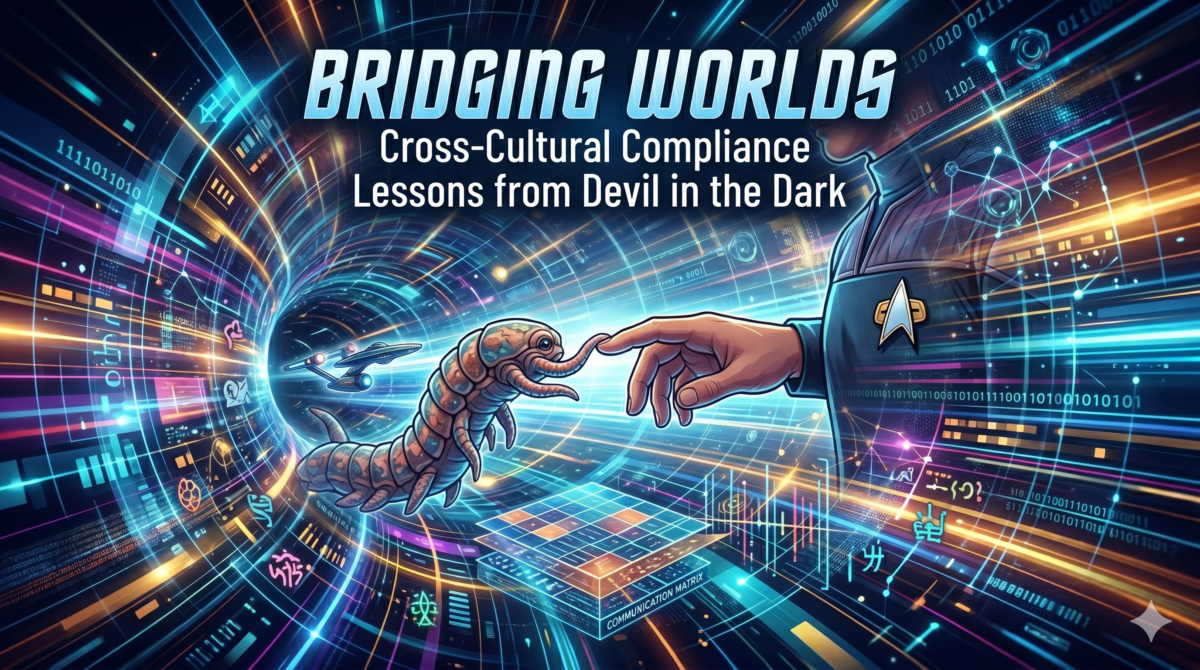
Bridging Worlds: Cross-Cultural Compliance Lessons from Devil in the Dark

Show Summary

Star Trek has always served as a powerful lens through which to view not just the potential future of humanity but the contemporary complexities we face today. The classic episode, “Devil in the Dark,” is a compelling exploration of misunderstandings, communication breakdowns, and reconciliation between drastically different cultures—lessons that resonate strongly for corporate compliance officers navigating today’s global marketplace.

In “Devil in the Dark,” the USS Enterprise is dispatched to investigate mysterious deaths in a mining colony. What initially seems like straightforward monster attacks turns out to be a profound misunderstanding between humans and an alien creature called the Horta. Today, we will examine five key compliance lessons that corporate professionals can learn from the iconic Star Trek episode.

Lesson 1: Recognize and Challenge Your Own Biases

Illustrated By: When the Enterprise crew arrives, the miners describe a monstrous creature attacking and killing miners, labeling it simply as a dangerous beast to be eliminated. Their preconceived notions blinded them to the possibility of understanding the creature.

Compliance Lesson: Like the miners’ initial response, corporate biases can obscure critical perspectives and valuable information. Compliance professionals must actively recognize and challenge their assumptions and biases. It’s critical to maintain impartiality, especially during investigations, risk assessments, or due diligence processes involving diverse international markets. Conducting training sessions on unconscious bias and regularly revisiting corporate procedures helps organizations maintain objectivity and fairness.

Lesson 2: Effective Communication Requires Genuine Effort and Empathy

Illustrated By: The turning point of the episode comes when Spock mind-melds with the Horta. Through genuine empathy and effort, he discovers that the Horta is not malevolent but is protecting its offspring, the silicon nodules that the miners had inadvertently been destroying.

Compliance Lesson: Effective communication across cultural boundaries requires empathy, openness, and genuine effort. Corporate compliance teams operating in multinational contexts must make sincere efforts to communicate effectively with global partners, subsidiaries, and stakeholders. Language barriers, differing business practices, and cultural nuances can lead to costly misunderstandings. Investing in cross-cultural training, employing bilingual staff, and engaging empathetically with diverse perspectives strengthens communication and helps prevent costly compliance failures.

Lesson 3: Cultural Awareness as a Risk Mitigation Strategy

Illustrated by: The miners’ failure to recognize the silicon nodules as living offspring stems from ignorance about the Horta’s culture and biology. This ignorance creates hostility and unnecessary conflict.

Compliance Lesson: Cultural ignorance significantly increases compliance risk, especially in international operations. Understanding local cultural norms, regulatory landscapes, and business ethics is vital for operating ethically and legally across jurisdictions. Companies must integrate cultural intelligence training into their compliance programs, conduct thorough risk assessments, and cultivate local relationships to enhance awareness and understanding. This proactive approach mitigates misunderstandings and ethical lapses, fostering respectful and legally compliant international operations.

Lesson 4: Embrace Diversity to Foster Innovation and Solutions

Illustrated By: The Enterprise crew’s diverse backgrounds and experiences enable them to devise innovative solutions. Spock’s unique Vulcan abilities allow communication with the Horta, transforming a volatile situation into a collaborative one.

Compliance Lesson: Diversity is not only ethically commendable but also strategically vital. Diverse compliance teams bring a range of varied experiences, perspectives, and problem-solving approaches, which are essential for effectively managing complex compliance challenges. Organizations should proactively recruit and empower diverse talent in compliance roles, ensuring comprehensive perspectives in assessing risks and solving compliance-related issues. Embracing diversity fosters innovation and resilience in managing compliance across various markets.

Lesson 5: Seek Win-Win Solutions through Collaboration

Illustrated By: Ultimately, Captain Kirk brokers a cooperative agreement between the miners and the Horta, allowing peaceful coexistence and mutual benefit. The miners extracting resources and the Horta species continue unharmed.

Compliance Lesson: Effective compliance strategies often involve creative, collaborative solutions that benefit multiple stakeholders. Compliance professionals should adopt a win-win mindset, working collaboratively with regulatory authorities, local communities, employees, and third-party partners to align compliance objectives with mutual benefits. Encouraging collaborative dialogues rather than adversarial stances with stakeholders reduces friction, ensures sustainability, and promotes ethical business practices that benefit everyone involved.

Final ComplianceLog Reflections

Star Trek’s “Devil in the Dark” vividly illustrates the consequences of cross-cultural misunderstandings and the immense benefits of cultural empathy, clear communication, diversity, and collaborative problem-solving. For corporate compliance professionals, this episode serves as a powerful reminder that effective compliance programs necessitate intentional cross-cultural engagement, ongoing education, and empathy-driven interactions.

Navigating the global compliance landscape involves bridging cultural divides with sensitivity, understanding, and respect. Companies that prioritize cultural intelligence, diversity, and collaborative solutions not only minimize compliance risks—they also cultivate resilient, ethical, and respected global brands. Like the Enterprise crew, compliance professionals must boldly reach across cultural divides, ensuring business integrity thrives on mutual respect, innovation, and cooperative achievement.

Resources:

Excruciatingly Detailed Plot Summary by Eric W. Weisstein
MissionLogPodcast.com

Memory Alpha

Categories
Trekking Through Compliance

Trekking Through Compliance: Episode 24 – This Side of Paradise: Essential Takeaways for Compliance Vigilance

Show Summary

Star Trek has consistently excelled at blending imaginative storytelling with deeply reflective, ethical, and compliance lessons. In the episode “This Side of Paradise,” Captain Kirk and the crew of the USS Enterprise visit a colony thought to be lost, only to discover colonists who appear unnaturally happy and content due to the influence of strange alien spores. These spores eliminate negative emotions and ambition, creating an illusion of paradise. However, beneath the serene surface lies an unsettling truth, one that reveals significant lessons for corporate compliance professionals.

Lesson 1: The Danger of Complacency

Illustrated By: Upon their arrival, Captain Kirk and his crew are astonished at how content and relaxed the colonists appear, lacking any sense of urgency or purpose beyond their immediate happiness. The spores create an environment devoid of ambition or challenge.

Compliance Lesson: Complacency is a significant risk in corporate compliance. When companies become too comfortable, essential controls can slip, leaving vulnerabilities unnoticed.

Lesson 2: Understanding the Real Nature of Risks

Illustrated by Spock, affected by the spores, embracing an emotional side long repressed, initially finding joy and peace. Yet, Kirk soon realizes that beneath the artificial happiness lies a dangerous stagnation and lack of progress.

Compliance Lesson: Compliance officers must develop comprehensive risk assessment processes that look beneath surface-level compliance indicators.

Lesson 3: The Critical Importance of Culture

Illustrated By: Despite being seduced by the spores’ false paradise, Captain Kirk resists their influence due to his strong commitment to duty and mission, illustrating his deeply embedded professional and personal integrity.

Compliance Lesson: Organizations that foster strong ethical values and clearly defined principles are better equipped to withstand pressures and challenges.

Lesson 4: The Necessity of Clear and Effective Communication

Illustrated by: Kirk ultimately defeats the spores by broadcasting an emotionally charged message that disrupts their tranquilizing effects, restoring awareness and rational thinking to the affected crew.

Compliance Lesson: Compliance officers must clearly articulate expectations, rules, and regulations through targeted and impactful messaging.

Lesson 5: Resilience in the Face of Adversity

Illustrated By: After breaking the spores’ influence, the crew members realize the illusory nature of their paradise and recommit themselves to their mission and responsibilities, emerging stronger and more focused.

Compliance Lesson: Encouraging resilience involves preparing for potential compliance breaches with robust response plans, clear accountability structures, and lessons-learned reviews.

Final ComplianceLog Reflections

This Side of Paradise offers a vivid metaphor for corporate compliance professionals, illustrating the dangers lurking within complacency, the hidden nature of certain risks, and the powerful influence of a well-embedded compliance culture. By emphasizing proactive vigilance, thorough risk assessments, robust communication, and organizational resilience, compliance leaders can steer their companies clear of deceptively comfortable but ultimately harmful situations. Like Captain Kirk, compliance professionals must boldly confront challenges, keeping the integrity and commitment central to their mission and ensuring sustainable and ethical organizational success.

Resources:

Excruciatingly Detailed Plot Summary by Eric W. Weisstein
MissionLogPodcast.com

Memory Alpha

Categories
Blog

Illusions of Compliance Paradise: Essential Takeaways from Star Trek for Corporate Vigilance

Show Summary

Star Trek has consistently excelled at blending imaginative storytelling with deeply reflective, ethical, and compliance lessons. In the episode “This Side of Paradise,” Captain Kirk and the crew of the USS Enterprise visit a colony thought to be lost, only to discover colonists who appear unnaturally happy and content due to the influence of strange alien spores. These spores eliminate negative emotions and ambition, creating an illusion of paradise. However, beneath the serene surface lies an unsettling truth, one that reveals significant lessons for corporate compliance professionals. Here are five key lessons.

Lesson 1: The Danger of Complacency

Illustrated By: Upon their arrival, Captain Kirk and his crew are astonished at how content and relaxed the colonists appear, lacking any sense of urgency or purpose beyond their immediate happiness. The spores create an environment devoid of ambition or challenge.

Compliance Lesson: Complacency is a significant risk in corporate compliance. When companies become too comfortable, essential controls can slip, leaving vulnerabilities unnoticed. Regularly scheduled compliance audits and continual education programs keep organizations vigilant, proactive, and adaptable to regulatory shifts and evolving risks. Compliance professionals must foster an environment that constantly challenges complacency, encouraging active questioning and continual improvement.

Lesson 2: Understanding the Real Nature of Risks

Illustrated by Spock, affected by the spores, embracing an emotional side long repressed, initially finding joy and peace. Yet, Kirk soon realizes that beneath the artificial happiness lies a dangerous stagnation and lack of progress.

Compliance Lesson: Not all risks are immediately apparent. Compliance officers must develop comprehensive risk assessment processes that look beneath surface-level compliance indicators. In-depth analyses should consider potential indirect impacts and hidden dangers within seemingly benign situations. Organizations benefit significantly from continuously evolving their risk management strategies, remaining alert to subtler, systemic issues that can be more damaging than obvious violations.

Lesson 3: The Critical Importance of Culture

Illustrated By: Despite being seduced by the spores’ false paradise, Captain Kirk resists their influence due to his strong commitment to duty and mission, illustrating his deeply embedded professional and personal integrity.

Compliance Lesson: A robust compliance culture is vital in resisting unethical temptations. Organizations that foster strong ethical values and clearly defined principles are better equipped to withstand pressures and challenges. Compliance officers should promote integrity as a foundational corporate value, embedding it deeply within organizational practices. Culture-building initiatives, training programs, and leadership modeling are instrumental in cultivating resilient and ethical business environments.

Lesson 4: The Necessity of Clear and Effective Communication

Illustrated by: Kirk ultimately defeats the spores by broadcasting an emotionally charged message that disrupts their tranquilizing effects, restoring awareness and rational thinking to the affected crew.

Compliance Lesson: Effective communication is fundamental to a successful compliance program. Compliance officers must clearly articulate expectations, rules, and regulations through targeted and impactful messaging. Open, transparent, and frequent communication helps ensure that all team members clearly understand their roles and responsibilities. Regular updates, engaging training materials, and accessible compliance resources enhance the effectiveness of compliance communication, reducing misunderstandings and promoting transparency.

Lesson 5: Resilience in the Face of Adversity

Illustrated By: After breaking the spores’ influence, the crew members realize the illusory nature of their paradise and recommit themselves to their mission and responsibilities, emerging stronger and more focused.

Compliance Lesson: Organizations must develop resilience to respond effectively to compliance setbacks and regulatory challenges. Encouraging resilience involves preparing for potential compliance breaches with robust response plans, clear accountability structures, and lessons-learned reviews. Compliance officers play a pivotal role in guiding organizations through crises, ensuring that lessons are integrated into future operations, and strengthening the company’s overall compliance posture.

Final ComplianceLog Reflections

Star Trek’s “This Side of Paradise” offers a vivid metaphor for corporate compliance professionals, illustrating the dangers lurking within complacency, the hidden nature of certain risks, and the powerful influence of a well-embedded compliance culture. By emphasizing proactive vigilance, thorough risk assessments, robust communication, and organizational resilience, compliance leaders can steer their companies clear of deceptively comfortable but ultimately harmful situations. Like Captain Kirk, compliance professionals must boldly confront challenges, keeping the integrity and commitment central to their mission and ensuring sustainable and ethical organizational success.

Resources:

Excruciatingly Detailed Plot Summary by Eric W. Weisstein
MissionLogPodcast.com

Memory Alpha

Categories
Trekking Through Compliance

Trekking Through Compliance: Episode 23 – Investigative Lessons from A Taste of Armageddon for Compliance Professionals

The episode “A Taste of Armageddon” offers a gripping narrative about two planets waging a computerized war, where casualties are “virtual” until real people are targeted for destruction by assassination teams. Beyond its science fiction thrills, this episode offers a rich canvas for compliance investigators to glean valuable insights into corporate investigations, risk management, and ethical decision-making. Today, we explore five investigative lessons drawn from “A Taste of Armageddon” that every compliance professional can apply in today’s complex corporate environment.

Lesson 1: Don’t Accept the Surface Narrative—Dig Deeper

Illustrated By: Captain Kirk and the Enterprise crew arrive at the planet Eminiar VII and are briefed on a bizarre ongoing “war” with their neighboring planet, Vendikar. They’re told the conflict is conducted entirely through computer simulations, with casualties happening only because of computer-generated attack orders. The officials claim that this system prevents physical destruction and loss of infrastructure.

Compliance Lesson: Compliance must have robust evidence-gathering protocols, document reviews, interviews, digital forensics, and whistleblower input that go beyond the polished explanations offered by senior management or external parties.

Lesson 2: Recognize When Systems Are Manipulated to Conceal Real Harm

Illustrated By: As Kirk digs deeper, he discovers that the “war” computer directs citizens of Eminiar VII to “self-destruct” (die) to simulate casualties, a brutal reality masked by the sanitized computer war facade. The computerized system is essentially a tool to hide the true human cost of conflict under the guise of civility.

Compliance Lesson: Investigators must be vigilant in identifying situations where systems, reports, or data are manipulated to conceal wrongdoing or minimize apparent risk.

Lesson 3: Challenge Institutionalized Norms When They Violate Ethics

Illustrated by: The people of Eminiar VII believe their system is rational and ethical because it avoids the destruction of infrastructure and reduces collateral damage. Yet, the human toll is real and horrific. Kirk challenges this “civilized” war system, calling out the moral bankruptcy of a process that sanctions systematic killing under bureaucratic rules.

Compliance Lesson: Investigators should be empowered to raise red flags about practices that may be “business as usual” internally but are fundamentally unethical or illegal.

Lesson 4: Collaborate Across Teams to Confront Complex Issues

Illustrated By: To expose the truth and disrupt the false war, Kirk and his crew collaborate with disillusioned Eminian officials and civilians. This cooperation allows them to understand the deeper reality and develop strategies to end the deceptive conflict.

Compliance Lesson: Investigative collaboration fosters comprehensive fact-finding, more accurate risk assessments, and the development of effective remediation strategies.

Lesson 5: Be Prepared to Disrupt Business as Usual for the Sake of Ethics

Illustrated By: Kirk’s ultimate act is to disable Eminiar VII’s computer war system, forcing the planet’s leaders to face the harsh realities of war without the illusion of sanitized casualty reports. This disrupts their entire way of life, but is necessary to restore true peace and ethical accountability.

Compliance Lesson: Compliance leaders must be prepared to recommend and implement significant changes, even if they are disruptive, to address systemic issues.

Final ComplianceLog Reflections

Star Trek’s “A Taste of Armageddon” is a compelling allegory about the dangers of complacency, obfuscation, and ethical compromise. For corporate compliance professionals, the episode provides a blueprint for rigorous, courageous, and collaborative investigations that delve beyond polished narratives to uncover uncomfortable truths.

In a business universe full of hidden risks and “virtual wars,” compliance investigations serve as a beacon guiding companies toward ethical and sustainable success. Like the crew of the Enterprise, compliance professionals must be prepared to boldly go where few dare to look and make a tangible difference in their organizations.

Resources:

Excruciatingly Detailed Plot Summary by Eric W. Weisstein
MissionLogPodcast.com

Memory Alpha

Categories
Blog

Breaking Through the Digital Veil: Star Trek’s ‘A Taste of Armageddon’ and the Art of Compliance Investigation

Show Summary

Star Trek’s original series has long been a treasure trove of timeless lessons for leaders, ethicists, and compliance professionals. The episode “A Taste of Armageddon” offers a gripping narrative about two planets waging a computerized war, where casualties are “virtual” until real people are targeted for destruction by assassination teams. Beyond its science fiction thrills, this episode offers a rich canvas for compliance investigators to glean valuable insights into corporate investigations, risk management, and ethical decision-making.

In this blog post, we will consider five investigative lessons drawn from “A Taste of Armageddon” that every compliance professional can apply in today’s complex corporate environment.

Lesson 1: Don’t Accept the Surface Narrative—Dig Deeper

Illustrated By: Captain Kirk and the Enterprise crew arrive at the planet Eminiar VII and are briefed on a bizarre ongoing “war” with their neighboring planet, Vendikar. They’re told the conflict is conducted entirely through computer simulations, with casualties happening only because of computer-generated attack orders. The officials claim that this system prevents physical destruction and loss of infrastructure.

Compliance Lesson: In investigations, the official story is rarely the whole story. Compliance professionals must cultivate a mindset of healthy skepticism. Just as Kirk refused to accept the “virtual war” explanation at face value, investigators must dig beneath surface narratives. This involves gathering multiple sources of information, cross-checking the data, and probing for inconsistencies.

In practice, this requires robust evidence-gathering protocols, document reviews, interviews, digital forensics, and whistleblower input that go beyond the polished explanations offered by senior management or external parties. Accepting surface-level assurances can leave hidden risks and unethical practices undetected, leading to severe consequences down the line.

Lesson 2: Recognize When Systems Are Manipulated to Conceal Real Harm

Illustrated By: As Kirk digs deeper, he discovers that the “war” computer directs citizens of Eminiar VII to “self-destruct” (die) to simulate casualties, a brutal reality masked by the sanitized computer war facade. The computerized system is essentially a tool to hide the actual human cost of conflict under the guise of civility.

Compliance Lesson: Investigators must be vigilant in identifying situations where systems, reports, or data are manipulated to conceal wrongdoing or minimize apparent risk. In the corporate world, this can take the form of falsified compliance reports, selective data presentation, or over-reliance on automated controls that obscure unethical behavior.

Effective compliance investigations require not only technical acumen to uncover data manipulation but also ethical insight to understand why and how such manipulation occurs. A “computerized war” can be a metaphor for any process designed to obscure real damage; investigators must find ways to penetrate these obfuscations to reveal the truth.

Lesson 3: Challenge Institutionalized Norms When They Violate Ethics

Illustrated by: The people of Eminiar VII believe their system is rational and ethical because it avoids the destruction of infrastructure and reduces collateral damage. Yet, the human toll is real and horrific. Kirk challenges this “civilized” war system, calling out the moral bankruptcy of a process that sanctions systematic killing under bureaucratic rules.

Compliance Lesson: Investigators frequently confront institutionalized norms or entrenched practices that are accepted internally but violate ethical standards or laws. Just as Kirk refuses to tolerate a “war” that hides killing behind a computer screen, compliance professionals must question and challenge these normalized behaviors.

This lesson emphasizes the importance of independence and courage in investigative work. Investigators should be empowered to raise red flags about practices that may be “business as usual” internally but are fundamentally unethical or illegal. Compliance programs must support investigators in pushing back against such norms to protect the organization’s integrity.

Lesson 4: Collaborate Across Teams to Confront Complex Issues

Illustrated By: To expose the truth and disrupt the false war, Kirk and his crew collaborate with disillusioned Eminian officials and civilians. This cooperation allows them to understand the deeper reality and develop strategies to end the deceptive conflict.

Compliance Lesson: Modern compliance investigations are often complex and multifaceted, involving legal, financial, operational, and cultural dimensions. Successful investigations depend on collaboration across various departments, including legal counsel, internal audit, HR, IT, and external advisors.

This lesson emphasizes the importance of multidisciplinary teams sharing their expertise and perspectives. No single investigator can carry the burden alone. Collaboration fosters comprehensive fact-finding, more accurate risk assessments, and the development of effective remediation strategies. It also signals to the organization that compliance is a shared responsibility, enhancing the culture of integrity.

Lesson 5: Be Prepared to Disrupt Business as Usual for the Sake of Ethics

Illustrated By: Kirk’s ultimate act is to disable Eminiar VII’s computer war system, forcing the planet’s leaders to face the harsh realities of war without the illusion of sanitized casualty reports. This disrupts their entire way of life, but it is necessary to restore genuine peace and ethical accountability.

Compliance Lesson: Sometimes investigations reveal practices so flawed or unethical that business-as-usual cannot continue. Compliance leaders must be prepared to recommend and implement significant changes, even if they are disruptive, to address systemic issues.

This lesson emphasizes the investigator’s role in not only uncovering wrongdoing but also advocating for meaningful reform. Compliance professionals should prepare to challenge leadership and stakeholders with uncomfortable truths and advocate for corrective actions that may necessitate changes to established processes. Ethical integrity and long-term sustainability must outweigh short-term convenience or complacency.

Final ComplianceLog Reflections

Star Trek’s “A Taste of Armageddon” is a compelling allegory about the dangers of complacency, obfuscation, and ethical compromise. For corporate compliance professionals, the episode provides a blueprint for rigorous, courageous, and collaborative investigations that delve beyond polished narratives to uncover uncomfortable truths.

When compliance investigators channel Captain Kirk’s relentless curiosity, moral courage, and collaborative spirit, organizations can better navigate today’s complex ethical challenges. They can ensure transparency, accountability, and integrity prevail even when it means disrupting entrenched systems or exposing inconvenient realities.

In a business universe full of hidden risks and “virtual wars,” compliance investigations serve as a beacon guiding companies toward ethical and sustainable success. Like the crew of the Enterprise, compliance professionals must be prepared to boldly go where few dare to look and make a tangible difference in their organizations.

Resources:

Excruciatingly Detailed Plot Summary by Eric W. Weisstein
MissionLogPodcast.com

Memory Alpha

Categories
Blog

Boldly Navigating Ethical Boundaries: Corporate Compliance Lessons from Star Trek’s “Space Seed”

Show Summary

In the legendary Star Trek episode “Space Seed,” Captain Kirk and the crew of the USS Enterprise encounter a drifting vessel, the SS Botany Bay, which houses cryogenically frozen survivors from Earth’s Eugenics Wars. Among these survivors is Khan Noonien Singh, a charismatic and genetically superior figure with ambitious plans to dominate those around him. “Space Seed” is not merely compelling science fiction but also an illuminating parable about ethics, leadership, and compliance within organizations. Let’s examine four key ethical lessons from this iconic episode and explore how they apply to the context of corporate compliance.

Lesson 1: Beware Charisma Without Ethics

Illustrated By: Khan awakens from centuries of cryogenic sleep. Charismatic, brilliant, and imposing, he quickly gains the trust and admiration of historian Lieutenant Marla McGivers. However, Khan’s charm conceals his ruthless ambition, ultimately leading McGivers to compromise her principles.

Compliance Lesson: In the corporate world, charisma and charm can similarly mask unethical intentions. Compliance officers must instill a culture that evaluates leaders and decision-makers on their ethical conduct and actions rather than relying on superficial charisma or immediate performance. Organizations need to develop robust procedures that clearly define ethical expectations and provide mechanisms for questioning or challenging actions that might appear superficially attractive but ethically problematic. Vigilance against charismatic but ethically deficient leaders can help avoid significant organizational and reputational risks.

Lesson 2: Transparency and Trust Are Pillars of Integrity

Illustrated By: Khan, upon awakening, he refuses to disclose his past or intentions fully. This lack of transparency breeds mistrust among Kirk’s crew despite Khan’s superficially appealing characteristics. The withholding of critical information ultimately undermines his position, signaling to the crew the presence of hidden motives.

Compliance Lesson: Transparency and trust are foundational to a robust compliance culture. Organizations should foster an environment where transparency is rewarded and obscurity discouraged. Compliance programs must emphasize open communication channels where employees feel safe disclosing potential issues or risks without fear of retaliation. Communicated policies and procedures combined with transparent management practices reinforce trust and integrity, protecting the organization from the corrosive effects of suspicion and deceit.

Lesson 3: Ethical Leadership Requires Courageous Accountability

Illustrated By: Captain Kirk ultimately confronts Khan directly, taking decisive and courageous action to protect the crew and uphold the integrity of the Enterprise. Kirk’s willingness to confront difficult situations head-on demonstrates courageous leadership grounded in strong ethical principles.

Compliance Lesson: Ethical leadership entails proactive accountability, particularly when confronting challenging or uncomfortable issues. Compliance professionals must support leaders in fostering a culture of courageous accountability, where unethical behavior is addressed openly and promptly, irrespective of rank or status. Training and communication programs that emphasize ethical decision-making empower employees at all levels to speak up and act responsibly. Such courage in confronting ethical issues ensures the long-term health and sustainability of the organization.

Lesson 4: History Teaches Valuable Compliance Lessons

Illustrated By: Lieutenant McGivers is initially enamored with Khan due to her fascination with historical figures of power and dominance. However, her romanticized view of history blinds her to the true nature and consequences of Khan’s leadership style, resulting in serious ethical lapses.

Compliance Lesson: History Offers Powerful Lessons for Compliance Professionals. Organizations must actively engage with past compliance failures—both internal and external—to glean critical insights that prevent a repetition of ethical breaches. Compliance training should include case studies of historical compliance and ethical failures, encouraging thoughtful analysis and critical thinking. By objectively examining past mistakes, organizations can reinforce ethical frameworks and strengthen their compliance posture.

Final ComplianceLog Reflections

“Space Seed” vividly illustrates how charisma divorced from ethics, opacity over transparency, leadership without courageous accountability, and ignorance of historical lessons can lead to organizational harm. For compliance professionals, these lessons serve as potent reminders of the importance of ethical vigilance and proactive leadership in safeguarding corporate integrity.

In an ever-evolving corporate landscape fraught with risks and opportunities, maintaining ethical standards is not merely advisable—it is imperative. Let us boldly apply these Star Trek-inspired ethical lessons, ensuring our organizations prosper not just through profit but through principled and trustworthy conduct. Remember, as Captain Kirk demonstrated, ethical vigilance is not just logical; it is essential for sustainable success.

Resources:

Excruciatingly Detailed Plot Summary by Eric W. Weisstein

MissionLogPodcast.com

Memory Alpha

Categories
Trekking Through Compliance

Trekking Through Compliance – Episode 21: Compliance Lessons from Tomorrow is Yesterday

Show Summary

As compliance professionals, we often deal with risks not just of what is known but of what could happen: the unknown impact of an overlooked third-party relationship, a lack of controls in an emerging market, or a cultural blind spot that results in reputational fallout. In “Tomorrow Is Yesterday,” the crew must tread carefully to avoid disrupting the timeline, and in doing so, they offer lessons on ethics, documentation, information handling, and more. Let’s break it down: each lesson begins with a scene from the episode, followed by a compliance insight that today’s professionals can apply.

Lesson 1: Every Action Has Ripple Effects

Illustrated By: When the Enterprise accidentally enters Earth’s atmosphere in the 1960s, it is detected by U.S. military radar. An Air Force pilot, Captain Christopher, is scrambled to intercept. The crew beams him aboard to save his life when his aircraft is destroyed—but now, they’ve interfered with the timeline.

Lesson 2: Don’t Underestimate the Importance of Containment

Illustrated By: Captain Christopher now knows too much. He’s seen a starship, spoken with its crew, and witnessed 23rd-century technology. Spock warns that releasing him could change the course of Earth’s future. The crew must now decide whether to detain him, erase his memory, or seek an alternative solution.

Lesson 3: Documentation and Traceability Are Critical

Illustrated by: As the crew works to reverse their time jump, they must carefully reconstruct a plan to erase all evidence of their presence in the past. They go so far as to recover physical recordings and tamper with computer logs to restore the timeline to its original state.

Lesson 4: Ethics Must Guide Decision-Making Under Uncertainty

Illustrated By: Faced with conflicting outcomes—if they return Captain Christopher to Earth, he may reveal classified knowledge; if they don’t, they alter his family line—Kirk and Spock must weigh ethical considerations against practical risks. Ultimately, they learn that Christopher’s unborn son will play a pivotal role in Earth’s future space exploration, so they must return him.

Lesson 5: Cross-Functional Collaboration Enhances Compliance Outcomes

Illustrated By: To return to their time and restore the timeline, the crew must coordinate multiple systems across engineering, science, navigation, and command. Mr. Scott recalibrates the engines, Spock calculates gravitational trajectories, and Sulu pilots the ship at precisely the right moment.

Lesson 6: Time Is of the Essence

Illustrated By: As the Earth’s gravitational pull begins to reassert itself, the Enterprise must execute its time-warp escape with split-second precision. A single delay could strand them in the 20th century or, worse, destroy the ship.

Compliance Lesson:

Conclusion: Compliance for the Future—Rooted in Responsibility

“Tomorrow Is Yesterday” reminds us that ethical conduct isn’t just about navigating today’s rules but also about understanding the impact of our actions on tomorrow. For the crew of the Enterprise, that meant carefully extracting themselves from history without doing damage. For compliance professionals, it means building systems and cultures that consider not only legal obligations but also ethical consequences, unintended impacts, and the interconnectedness of our global environment.

Let’s not just manage compliance; let’s lead it ethically, collaboratively, and with a focus on the future.

Resources:

Excruciatingly Detailed Plot Summary by Eric W. Weisstein

MissionLogPodcast.com

Memory Alpha

Categories
Blog

Compliance in a Time Warp: Lessons from Star Trek’s Tomorrow Is Yesterday

Show Summary

In the ever-expanding universe of Star Trek: The Original Series, the episode “Tomorrow Is Yesterday” offers an unexpected bounty of compliance insights. On its surface, the story is a classic time-travel romp: the USS Enterprise is accidentally flung back to 1960s Earth, intercepted by a U.S. Air Force jet, and must find a way to return to the 23rd century without altering the course of history. But below the sci-fi action lies a deeper commentary on responsibility, decision-making, and the unforeseen consequences of even well-intentioned actions, making it a surprising compliance masterclass in disguise.

As compliance professionals, we often deal with risks not just of what is known but of what could happen: the unknown impact of an overlooked third-party relationship, a lack of controls in an emerging market, or a cultural blind spot that results in reputational fallout. In “Tomorrow Is Yesterday,” the crew must tread carefully to avoid disrupting the timeline, and in doing so, they offer lessons on ethics, documentation, information handling, and more. Let’s break it down: each lesson begins with a scene from the episode, followed by a compliance insight that today’s professionals can apply.

Lesson 1: Every Action Has Ripple Effects

Illustrated By: When the Enterprise accidentally ends up in the Earth’s atmosphere in the 1960s, it is detected by U.S. military radar. An Air Force pilot, Captain Christopher, is scrambled to intercept. The crew beams him aboard to save his life when his aircraft is destroyed—but now, they’ve interfered with the timeline.

Compliance Lesson:

This scene serves as a powerful reminder that even minor actions can have significant consequences when not carefully considered. In compliance, well-meaning decisions made under pressure, such as rushing a vendor through onboarding or bypassing standard procedures to hit a deadline, can trigger cascading problems. A missing due diligence step today might become tomorrow’s enforcement action.

The key takeaway is that compliance must always be mindful of unintended consequences. Strong controls and decision-making frameworks help teams slow down just enough to assess risks before acting. Preventing compliance failures often comes down to building in that pause, the moment of reflection before action.

Lesson 2: Do not Underestimate the Importance of Containment

Illustrated By: Captain Christopher now knows too much. He’s seen a starship, spoken with its crew, and witnessed 23rd-century technology. Spock warns that releasing him could change the course of Earth’s future. The crew must now decide whether to detain him, erase his memory, or seek an alternative solution.

Compliance Lesson:

When sensitive information is accidentally exposed, whether it is confidential business data, personal employee details, or insider information, containment becomes the first and most crucial response step. Like the Enterprise crew managing the fallout of their accidental encounter, compliance professionals must act quickly and decisively to limit exposure.

This lesson is especially critical in the era of data privacy regulations, such as GDPR and CCPA. Companies must have protocols in place to isolate breaches, report them within the required timeframes, and prevent further spread. Your compliance team should conduct tabletop exercises that simulate this kind of scenario, where exposure has already occurred, and now it is about mitigating the damage.

Lesson 3: Documentation and Traceability Are Critical

Illustrated by: As the crew works to reverse their time jump, they must carefully reconstruct a plan to erase all evidence of their presence in the past. They go so far as to recover physical recordings and tamper with computer logs to restore the timeline to its original state.

Compliance Lesson:

This scene underscores the importance of meticulous recordkeeping. While the Enterprise crew is in a rare situation of removing data for the good of the universe, in the corporate world, proper documentation is essential to ensure traceability, accountability, and auditability. Without documentation, there is no proof of process, no evidence of decisions, and no way to defend against accusations or demonstrate compliance.

Whether you are conducting due diligence, implementing a policy, or investigating a report, thorough documentation serves as the foundation of defensible compliance. Ensure that every step is captured, from the decision to engage a third party to the delivery and recording of employee training.

Lesson 4: Ethics Must Guide Decision-Making Under Uncertainty

Illustrated By: Faced with conflicting outcomes, if they return Captain Christopher to Earth, he may reveal classified knowledge; if they don’t, they alter his family line. Kirk and Spock must weigh ethical considerations against practical risks. Ultimately, they learn that Christopher’s unborn son will become pivotal to Earth’s future space exploration, so they must return him.

Compliance Lesson:

When policies do not offer a clear answer, ethical judgment must guide your decision-making. In many situations, especially those involving gray areas or new technologies, compliance teams are left to interpret principles rather than rules. That’s where a well-structured code of ethics becomes essential.

Training should teach employees not only what the law says but also how to apply ethical reasoning when there is no perfect option. Ethical leadership, modeled by those at the top, also reinforces that it’s not just about staying within bounds but rather about doing the right thing even when the stakes are high.

Lesson 5: Cross-Functional Collaboration Enhances Compliance Outcomes

Illustrated By: To return to their time and restore the timeline, the crew must coordinate multiple systems across engineering, science, navigation, and command. Mr. Scott recalibrates the engines, Spock calculates gravitational trajectories, and Sulu pilots the ship at precisely the right moment.

Compliance Lesson:

Compliance cannot operate in a silo. Like the crew of the Enterprise, compliance teams must work across various departments—such as legal, IT, HR, operations, and more—to execute effective risk mitigation. Whether you’re launching a third-party review process, addressing a whistleblower complaint, or updating privacy policies, your success depends on collaboration.

This involves building trust, facilitating effective communication, and aligning incentives across various functions. Consider forming cross-functional compliance working groups to stay informed about emerging risks and ensure shared ownership of compliance outcomes.

Lesson 6: Time Is of the Essence

Illustrated By: As the Earth’s gravitational pull begins to reassert itself, the Enterprise must execute its time-warp escape with split-second precision. A single delay could strand them in the 20th century or, worse, destroy the ship.

Compliance Lesson:

Timing can be the difference between a manageable issue and a full-blown crisis. Regulatory deadlines, investigation windows, and breach notification requirements all operate on strict timelines. Compliance professionals must be equipped to respond swiftly and decisively, particularly in crises.

Establishing a rapid-response protocol with clearly defined roles and pre-approved escalation paths is critical. Regularly review these protocols through simulated drills and update them based on lessons learned from real-world experiences. Like the crew navigating their return through time, your team must be prepared to act quickly when risk strikes.

Conclusion: Compliance for the Future—Rooted in Responsibility

“Tomorrow Is Yesterday” reminds us that ethical conduct isn’t just about navigating today’s rules but also about understanding the impact of our actions on tomorrow. For the crew of the Enterprise, that meant carefully extracting themselves from history without doing damage. For compliance professionals, it means building systems and cultures that consider not only legal obligations but also ethical consequences, unintended impacts, and the interconnectedness of our global environment.

In an era of accelerating technology, geopolitical shifts, and complex regulatory changes, these lessons are more relevant than ever. Whether it’s responding to a data breach, managing an FCPA risk, or updating your training protocols, ask yourself, “What ripple effects could this create? Are we prepared? Are we acting with integrity? ”

To boldly go where no compliance program has gone before, we must learn from the past, act responsibly in the present, and remain ever-mindful of the future. So, let’s not just manage compliance—let’s lead it ethically, collaboratively, and with a focus on the future.

Resources:

Excruciatingly Detailed Plot Summary by Eric W. Weisstein

MissionLogPodcast.com

Memory Alpha

Categories
Trekking Through Compliance

Trekking Through Compliance – Episode 20: Compliance Training Lessons from Return of the Archons

Show Summary

One of the most underrated and allegorically rich episodes from The Original Series is “Return of the Archons.” On its face, it’s a tale about a mind-controlling computer and a seemingly idyllic society. But dig deeper, and you’ll find rich insights about what happens when training fails, communication becomes dogma, and critical thinking is suppressed. In short, it’s a compliance case study in a sci-fi wrapper.

In “Return of the Archons,” the crew of the Enterprise visits Beta III, a planet where the population is under the control of a mysterious figure named Landru. Society there values “peace, tranquility, and the good of the body,” but at the cost of individuality, freedom, and inquiry. The result? A culture of complacency that tolerates no questioning of authority and rewards blind obedience. Sound familiar? For compliance professionals, this episode offers a cautionary tale about the dangers of compliance in form but not in spirit. Let’s unpack the key lessons, each grounded in a scene from the show, followed by a compliance communication or training takeaway.

Lesson 1: Beware of a Culture of Blind Obedience

Illustrated By: As Captain Kirk and Mr. Spock observe the citizens of Beta III, they are struck by the eerie passivity of the people. Everyone is polite, deferential, and expressionless. When asked about Landru, they recite phrases like “It is the will of Landru” or “You are not of the body.” No one can explain what these phrases mean—they repeat them unthinkingly.

Lesson 2: Suppressing Dissent Undermines a Speak-Up Culture

Illustrated By: When Kirk and his team attempt to discuss their concerns with the townspeople, they are met with horror. One man panics and calls the lawgivers, who arrive to silence and “absorb” those who question Landru. Dissent is not only discouraged—it’s physically erased from society.

Lesson 3: Over-Automation Can Lead to Ethical Stagnation

Illustrated By: It’s eventually revealed that Landru is not a man but a computer programmed centuries earlier to maintain peace and harmony. Over time, the machine’s rigid logic has smothered innovation, growth, and individuality, enforcing compliance through force and fear rather than moral reasoning.

Lesson 4: Training Must Be Periodic, Relevant, and Culturally Engaging

Illustrated By: Beta III’s citizens haven’t had new information in generations. Their understanding of Landru and the laws is based on repetitive, ritualistic reinforcement. There’s no evolution, no adaptation—just the same messages, over and over.

Lesson 5: Effective Communication Is Two-Way, Not Top-Down

Illustrated By: The citizens of Beta III receive messages from Landru through lawgivers who deliver proclamations but never answer questions. There is no dialogue, no exchange of ideas—just declarations from on high.

Lesson 6: Culture Is the Foundation of Ethical Behavior

Illustrated By: Kirk and Spock recognize that Beta III is not simply a society with a malfunctioning leader; it is a society built on fear and conformity. Their solution isn’t just to turn off Landru. It’s to encourage the people to reclaim their humanity, their voices, and their ability to choose.


Final ComplianceLog Reflections: You Are of the Body (of Compliance)

As compliance professionals, we must ensure that our training and communication efforts do not replicate the world of Landru. Instead, we must foster curiosity, encourage questions, empower whistleblowers, refresh our content, and build culture from the ground up. So the next time you hear a compliance slogan repeated like a mantra, ask yourself: Are we creating engaged, ethical employees, or are we just building another Beta III? Let’s boldly go where no training program has gone before and bring our people with us.

Resources:

Excruciatingly Detailed Plot Summary by Eric W. Weisstein

MissionLogPodcast.com

Memory Alpha