

Categories
Trekking Through Compliance

Trekking Through Compliance: Episode 52 – Five Cross-Cultural Compliance Lessons from “The Omega Glory”

As compliance professionals, we often talk about global organizations “boldly going” where few have gone before, into new markets, unfamiliar territories, and diverse cultures. But what happens when the culture you find is fundamentally different, yet disturbingly familiar? Star Trek’s “The Omega Glory” is one of the original series’ most controversial and fascinating explorations of cross-cultural misunderstanding, bias, and the search for common ground.

For the modern compliance officer, “The Omega Glory” is more than just a Star Trek curiosity. It’s a primer on the perils and potential of cross-cultural communication and a reminder that misunderstanding and ethnocentrism can undermine even the most well-intentioned mission.

Lesson 1: Don’t Assume Your Culture’s Symbols or Values Are Universal

Illustrated By: The Yangs hold these objects sacred but have lost the original meaning, reciting “freedom” and “justice” without understanding them.

Compliance Lesson: In global business, it is all too easy to assume that your organization’s symbols, policies, and values are understood the same way everywhere. What feels like common sense or “best practice” at headquarters may mean something entirely different or nothing across cultures.

Lesson 2: Recognize and Overcome Ethnocentrism—Your Way Is Not the Only Way

Illustrated By: Captain Tracey rationalizes his betrayal by viewing the Comms through his biased lens and refuses to see value in the Yangs’ ways.

Compliance Lesson: Ethnocentrism, the belief that one’s own culture is superior or “normal,” is a common barrier to cross-cultural compliance. Like Tracey, corporate leaders may favor one culture’s approach to ethics, risk, or problem-solving, dismissing others as backward or inefficient.

Lesson 3: Find the Universal, but Honor the Local

Illustrated by: Kirk translates a seemingly parochial value into a universal principle, bridging the cultural gap.

Compliance Lesson: While symbols, language, and rituals may differ across cultures, there are often shared ethical aspirations—fairness, trust, respect, and justice—that can unite global teams. The challenge is to articulate these universals in a way that honors local realities.

Lesson 4: Listen Actively and Engage with Curiosity

Illustrated By: Kirk doesn’t just lecture; he listens, observes, and asks questions—even when the answers are uncomfortable or surprising.

Compliance Lesson: Effective cross-cultural communication begins with active listening and curiosity, rather than assumptions or pronouncements.

Lesson 5: Bridge Divides with Shared Purpose, Not Just Rules

Illustrated By: In the episode’s climax, Kirk reframes the “rules” as a call to unity and understanding.

Compliance Lesson: Policies and procedures are essential, but they’re not enough to build absolute alignment across cultures. What endures is shared purpose: a vision that transcends division and speaks to the aspirations of every group in your organization.

To Truly Go Boldly, Build Cross-Cultural Bridges

The Omega Glory” is a sometimes messy, always provocative meditation on the risks and rewards of cross-cultural engagement. For compliance professionals, it serves as a reminder that communication isn’t just about translation or policy deployment; it is about building bridges.

Resources:

Excruciatingly Detailed Plot Summary by Eric W. Weisstein

MissionLogPodcast.com

Memory Alpha

Categories
Blog

Crossing the Cultural Divide: Five Compliance Lessons from Star Trek’s “The Omega Glory”

As compliance professionals, we often talk about global organizations “boldly going” where few have gone before, into new markets, unfamiliar territories, and diverse cultures. But what happens when the culture you find is fundamentally different, yet disturbingly familiar? Star Trek’s “The Omega Glory” is one of the original series’ most controversial and fascinating explorations of cross-cultural misunderstanding, bias, and the search for common ground.

When Captain Kirk and the Enterprise crew encounter a planet locked in a centuries-long war between two factions, the Yangs and the Comms, they discover not only echoes of Earth’s past but also a profound challenge: how to understand, engage, and communicate across seemingly insurmountable cultural divides.

For the modern compliance officer, “The Omega Glory” is more than just a Star Trek curiosity. It’s a primer on the perils and potential of cross-cultural communication, and a reminder that misunderstanding and ethnocentrism can undermine even the most well-intentioned mission.

Today, we explore five cross-cultural compliance lessons, backed by memorable scenes, that resonate for today’s global organizations.

Lesson 1: Don’t Assume Your Culture’s Symbols or Values Are Universal

Illustrated By: When Kirk and company finally realize that the Yangs are a “parallel” of Earth’s Yankees, complete with a tattered American flag and a distorted version of the U.S. Constitution, the moment is both poignant and unsettling. The Yangs hold these objects sacred, but they have lost the original meaning, reciting “freedom” and “justice” without understanding their true significance.

Compliance Lesson: In global business, it is all too easy to assume that your organization’s symbols, policies, and values are understood the same way everywhere. What feels like common sense or “best practice” at headquarters may mean something entirely different or nothing across cultures.

Effective cross-cultural communication starts with humility. Don’t take for granted that core values, codes of conduct, or even compliance “hot words” will be universally understood. They may be recited back, as the Yangs do with the Pledge of Allegiance, but without real comprehension or application. Translate, not just in terms of, but conceptually, your compliance values and policies for each culture. Use local examples and context. Verify understanding through discussion, rather than just distributing documents.

Lesson 2: Recognize and Overcome Ethnocentrism—Your Way Is Not the Only Way

Illustrated By: Captain Tracey, the stranded Federation captain, throws in his lot with the Comms, convinced their culture’s “discipline” and “order” make them superior. He rationalizes his betrayal by viewing the Comms through his biased lens and refuses to see value in the Yangs’ ways.

Compliance Lesson: Ethnocentrism, the belief that one’s own culture is superior or “normal,” is a common barrier to cross-cultural compliance. Like Tracey, corporate leaders may favor one culture’s approach to ethics, risk, or problem-solving, dismissing others as backward or inefficient.

Such bias blinds organizations to local realities, breeds resentment, and undermines buy-in for compliance programs. Actual cross-cultural effectiveness requires cultural intelligence: the ability to recognize, adapt to, and respect differences. Provide cross-cultural training to compliance teams and business leaders. Encourage self-reflection on cultural biases and challenge assumptions about what constitutes the “right” and “wrong” ways of operating.

Lesson 3: Find the Universal, but Honor the Local

Illustrated By: Kirk’s breakthrough comes when he helps the Yangs recognize that the Constitution’s words—“We the People”—apply to everyone, not just their tribe. He translates a seemingly parochial value into a universal principle, bridging the gap between cultures.

Compliance Lesson: While symbols, language, and rituals may differ across cultures, there are often shared ethical aspirations —fairness, trust, respect, and justice —that can unite global teams. The challenge is to articulate these universals in a way that honors local realities.

Compliance communication should strike a balance between global standards and local flexibility. It’s not enough to declare “one policy, everywhere.” Instead, ask: How do our core principles show up in this culture? How can we adapt while staying true to our values? Co-create codes of conduct, training modules, and communications with local input. Make space for culturally relevant examples, stories, and illustrations that bring compliance to life.

Lesson 4: Listen Actively and Engage with Curiosity

Illustrated By: Throughout the episode, the Enterprise crew must decode the Yangs’ language, symbols, and intentions. Kirk doesn’t just lecture; he listens, observes, and asks questions—even when the answers are uncomfortable or surprising.

Compliance Lesson: Effective cross-cultural communication begins with active listening and curiosity, rather than assumptions or pronouncements. Before launching new policies or investigating potential misconduct, take time to learn local perspectives. Listen for what’s not being said. Recognize when confusion or resistance may mask deeper concerns.

In a compliance context, this means building trust, asking open-ended questions, and showing respect for cultural differences even when it challenges your assumptions. Use listening tours, focus groups, and confidential interviews to gather local insights before implementing global compliance initiatives. Train compliance professionals in active listening and culturally sensitive questioning.

Lesson 5: Bridge Divides with Shared Purpose, Not Just Rules

Illustrated By: In the episode’s climax, Kirk calls both the Yangs and the Coms to embrace the true meaning behind their sacred words, not as tribal weapons, but as a foundation for peace and shared future. He reframes the “rules” as a call to unity and understanding.

Compliance Lesson: Policies and procedures are essential, but they’re not enough to build absolute alignment across cultures. What endures is shared purpose: a vision that transcends division and speaks to the aspirations of every group in your organization.

When compliance is positioned as a partner in building something greater – a fair workplace, a sustainable business, and a respected global brand – it resonates beyond checklists and codes. People will rally around shared meaning, not just mandates. In your cross-cultural compliance communications, highlight stories of global teamwork, shared victories, and how living your values advances business and personal success. Move from “you must” to “we can, together.”

To Truly Go Boldly, Build Cross-Cultural Bridges

The Omega Glory” is a sometimes messy, always provocative meditation on the risks and rewards of cross-cultural engagement. For compliance professionals, it’s a reminder that communication isn’t just about translation or policy deployment; it is about bridge-building.

As your organization grows, diversifies, and explores new frontiers, remember: the actual test of your compliance program is not how well it works at headquarters, but how deeply it connects across every culture you serve. The Enterprise crew learned that words matter only when lived out by all people. For compliance, that’s the only path to lasting, meaningful impact.

Resources:

Excruciatingly Detailed Plot Summary by Eric W. Weisstein

MissionLogPodcast.com

Memory Alpha

Categories
Trekking Through Compliance

Trekking Trough Compliance: Episode 51 – Breaking Barriers: Five Compliance Communication Strategies from ‘By Any Other Name’

There may be no better pop culture exploration of compliance communication under pressure than Star Trek’s “By Any Other Name.” This episode, from Star Trek: The Original Series, places the crew of the Enterprise under the control of the Kelvans, alien beings with immense power, cold logic, and a total misunderstanding of what it means to be human. To survive, Kirk and his crew must out-communicate and outwit their captors, relying on every tool in their communication toolkit.

For the compliance professional, “By Any Other Name” offers a master class in the nuances of compliance communications, what works, what fails, and why the human element can never be discounted. Today, we explore five compliance communication lessons from this Star Trek classic.

Lesson 1: Know Your Audience—Tailor Your Message

Illustrated By: The Kelvans initially communicate only through blunt, logical directives. Their attempts at control falter because they don’t understand human motivation.

Compliance Lesson: Compliance messages cannot be one-size-fits-all. The Kelvans’ failure to adapt to their audience is a mistake compliance professionals should avoid.

Lesson 2: Use Storytelling and Emotion—Facts Alone Don’t Move People

Illustrated By: Kirk and his crew realize the Kelvans, now in human form, are struggling with unfamiliar emotions and senses.

Compliance Lesson: Compliance is not just about rules and policies; it is rather about influencing behavior.

Lesson 3: Active Listening and Feedback Loops—It’s Not Just About Talking

Illustrated By: While under Kelvan control, the Enterprise crew quietly listens, observes, and learns. They pay attention to subtle cues, the Kelvans’ confusion, discomfort, and shifting attitudes.

Compliance Takeaway:

Too often, compliance communication is a one-way street: policies are announced, emails are sent, training is assigned. But honest communication is two-way. Kirk’s ability to adapt is rooted in active listening, a skill compliance teams must master.

Lesson 4: Adapt Communication Styles Under Pressure—Agility Matters

Illustrated By: Kirk and company adapt rapidly, sometimes using humor, occasionally confrontation, sometimes empathy, to keep lines of communication open and exploit cracks in Kelvan unity.

Compliance Lesson: The best compliance communicators are agile: they adjust tone, content, and delivery to fit the moment.

Lesson 5: Build Trust and Relationships—Compliance is Ultimately Human

Illustrated By: In the end, the crew’s success comes not from outgunning or outwitting the Kelvans through brute force, but from forging relationships.

Compliance Takeaway:

All the policies and training in the world are ineffective without trust.

Final ComplianceLog Reflections

By Any Other Name” is a Star Trek episode about boundaries—between worlds, cultures, and even species. For the compliance professional, it’s a reminder that communication is our own Universal Translator: it connects people, overcomes obstacles, and paves the way for shared understanding.

Resources:

Excruciatingly Detailed Plot Summary by Eric W. Weisstein
MissionLogPodcast.com

Memory Alpha

Categories
Blog

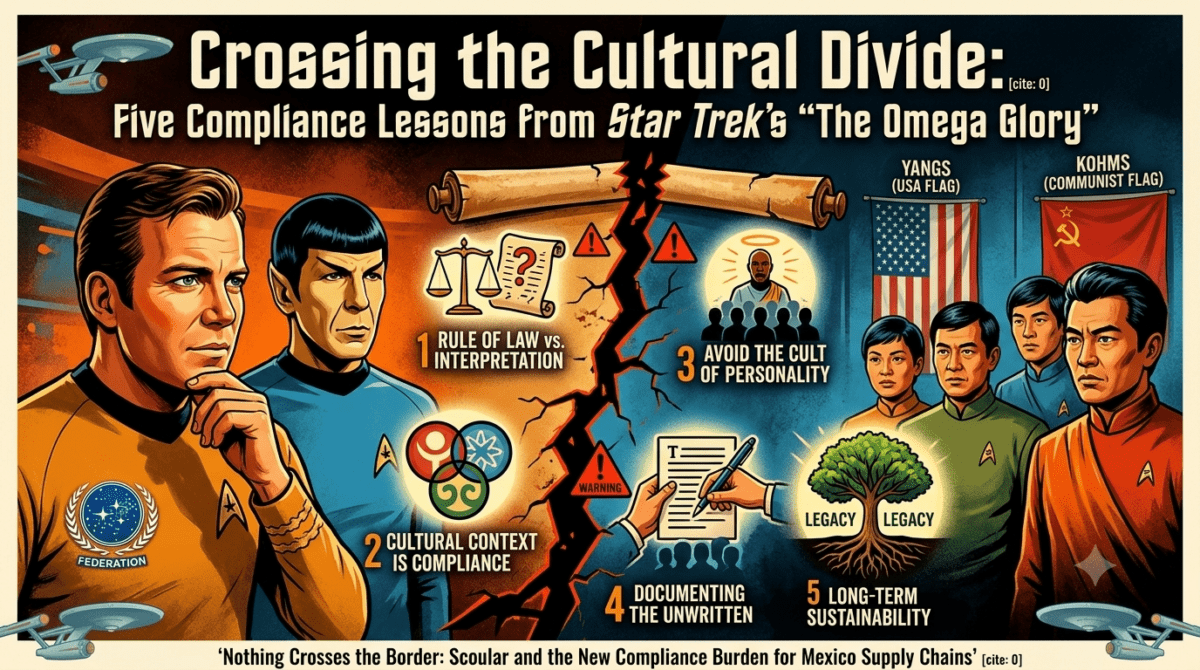
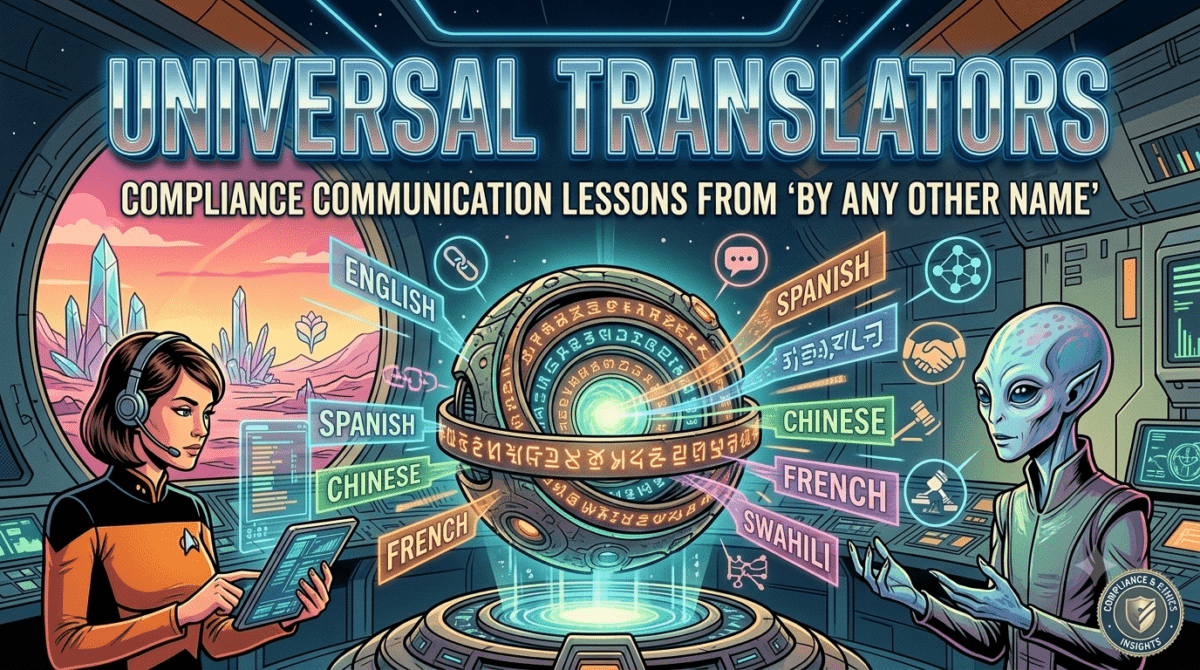
Universal Translators: Compliance Communication Lessons from ‘By Any Other Name’

If you have been around the compliance world long enough, you have heard the refrain: “It all comes down to communication.” Whether you are launching a new code of conduct, rolling out an anti-bribery initiative, or navigating the choppy waters of a compliance investigation, your message, how it is crafted, delivered, and received, often determines your success.

There may be no better pop culture exploration of communication under pressure than Star Trek’s “By Any Other Name.” This episode, from Star Trek: The Original Series, places the crew of the Enterprise under the control of the Kelvans, alien beings with immense power, cold logic, and a total misunderstanding of what it means to be human. To survive, Kirk and his crew must out-communicate and outwit their captors, relying on every tool in their communication toolkit.

For the compliance professional, “By Any Other Name” offers a master class in the nuances of compliance communications, what works, what fails, and why the human element can never be discounted. Today, we explore five compliance communication lessons from this Star Trek classic.

Lesson 1: Know Your Audience—Tailor Your Message

Illustrated By: The Kelvans, led by Rojan, initially communicate only through blunt, logical directives. They expect total obedience from the Enterprise crew, failing to appreciate the crew’s emotional and cultural complexity. Their attempts at control falter because they don’t understand (or even attempt to understand) human motivation.

Compliance Lesson: Compliance messages cannot be one-size-fits-all. The Kelvans’ failure to adapt to their audience is a mistake compliance professionals should avoid. Employees come from diverse backgrounds, cultures, and generations; each absorbs messages differently. What motivates a finance executive in London may not resonate with a front-line worker in Houston or a vendor in Mumbai.

Effective compliance communication requires deep knowledge of your audience, their roles, their pressures, and their “language.” Avoid legalese and boilerplate. Instead, translate compliance requirements into practical, relevant, and relatable guidance. Segment your compliance communications. Use examples, languages, and platforms tailored for different employee groups and geographies. Regularly solicit feedback to ensure your message is landing as intended.

Lesson 2: Use Storytelling and Emotion—Facts Alone Don’t Move People

Illustrated By: Kirk and his crew realize the Kelvans, now in human form, are struggling with unfamiliar emotions and senses. Scotty, McCoy, and Kirk use humor, stories, and emotional appeals—not just facts—to disrupt the Kelvans’ cold logic. Scotty, famously, distracts one by sharing stories over drinks; McCoy pushes another to experience irritability and frustration.

Compliance Lesson: Compliance isn’t just about rules and policies; it’s about influencing behavior. Facts and regulations are essential, but they rarely inspire change on their own. Human beings respond to stories, emotions, and narratives. Scotty doesn’t just explain; he engages. Kirk doesn’t just threaten; he empathizes.

For compliance professionals, this means using storytelling, scenarios, and case studies in your communications. Connect compliance to employees’ values, experiences, and aspirations.

Incorporate real-world examples, ethical dilemmas, and stories, successes, and failures into your training and communications. Show how compliance makes a positive impact, not just what rules to follow.

Lesson 3: Active Listening and Feedback Loops—It’s Not Just About Talking

Illustrated By: While under Kelvan control, the Enterprise crew quietly listens, observes, and learns. They pay attention to subtle cues—the Kelvans’ confusion, discomfort, and shifting attitudes. Kirk’s plan only succeeds because he listens actively and adapts his approach based on feedback and changes in the Kelvans’ behavior.

Compliance Lesson: Too often, compliance communication is a one-way street, where policies are announced, emails are sent, and training is assigned without follow-up. But honest communication is two-way. Kirk’s ability to adapt is rooted in active listening, a skill compliance teams must master.

Effective compliance programs create channels for feedback and respond to what they learn. This can be achieved through hotlines, surveys, focus groups, or informal conversations when employees see that their input leads to change, they become more engaged and are more likely to trust the compliance function. Establishing feedback loops for every major compliance communication is also crucial. Track participation, collect questions, and respond publicly to common concerns. Use what you learn to refine your message and program continually.

Lesson 4: Adapt Communication Styles Under Pressure—Agility Matters

Illustrated By: Throughout the episode, the crew is under intense stress. Their regular routines are disrupted, and the stakes are existential. Yet Kirk and company adapt rapidly, sometimes using humor, occasionally confrontation, sometimes empathy, to keep lines of communication open and exploit cracks in Kelvan unity.

Compliance Lesson: In crises, such as investigations, enforcement actions, or cyber incidents, your standard communications playbook may not be practical. Employees will be anxious, distracted, or fearful. The best compliance communicators are agile: they adjust tone, content, and delivery to fit the moment.

This may involve more frequent updates, simpler language, or a more empathetic tone. It may also require new channels such as video messages from leadership, town halls, or direct conversations with affected teams. Develop a crisis communication plan as part of your compliance program. Practice scenario planning: How will you communicate if the unexpected happens? Build templates and train your team in flexible, adaptive messaging.

Lesson 5: Build Trust and Relationships—Compliance is Ultimately Human

Illustrated By: In the end, the crew’s success comes not from outgunning or outwitting the Kelvans through brute force, but from forging relationships. They appeal to the Kelvans’ newly awakened humanity, earning trust, and ultimately persuading Rojan to abandon conquest in favor of collaboration.

Compliance Takeaway:

All the policies and training in the world are ineffective without trust. Compliance communication is not just about transmitting information; it’s about building relationships, credibility, and psychological safety. Employees must believe that compliance is there to help them succeed, not to police or punish.

Trust is built over time, through transparency, consistency, and authenticity. It is maintained by owning up to mistakes, sharing “the why” behind decisions, and treating employees as partners in compliance. Empower compliance champions in every business unit. Provide them with the tools and support they need to model ethical behavior, answer questions, and cultivate a culture of trust. Regularly spotlight these champions and celebrate examples of “doing the right thing.”

Final ComplianceLog Reflections

By Any Other Name” is a Star Trek episode that explores boundaries between worlds, cultures, and even species. For the compliance professional, it’s a reminder that communication is our own Universal Translator: it connects people, overcomes obstacles, and paves the way for shared understanding.

In our world, the stakes are just as high. The “aliens” we face may not come from Andromeda, but from new markets, new regulations, or emerging technologies. To navigate these challenges, compliance professionals must master the art and science of communication.

So, as you chart your course through your organization’s next compliance initiative, remember that it is not just what you say, but also how you say it, who you say it to, and how you listen, that makes all the difference.

Resources:

Excruciatingly Detailed Plot Summary by Eric W. Weisstein
MissionLogPodcast.com

Memory Alpha

Categories
Trekking Through Compliance

Trekking Through Compliance: Episode 50 – Five Ethics Lessons from ‘Patterns of Force’ for the Modern Compliance Professional

One of the defining strengths of Star Trek: The Original Series (TOS) is its willingness to confront the thorniest questions of morality, leadership, and power. Few episodes tackle these issues as directly, or as provocatively, as “Patterns of Force.” For compliance professionals, “Patterns of Force” offers a cautionary tale about the dangers of compromising ethical principles, even for seemingly pragmatic reasons. The story serves as a powerful reminder that organizations cannot pursue “efficiency” or “success” at the expense of their core values. The lessons are as relevant for today’s boardrooms and C-suites as they are for starships in the 23rd century.

Lesson 1: The Danger of Ethical Shortcuts—The Ends Never Justify the Means

Illustrated By: John Gill, the Federation historian, justifies the creation of a Nazi-like regime on Ekos by arguing that it is the “most efficient state Earth ever knew.”

Compliance Lesson: One of the oldest ethical traps is believing that good intentions justify unethical means. John Gill’s fatal error is to separate efficiency from morality, imagining that a “system” can be controlled and its inherent evils contained.

Lesson 2: Leadership Responsibility—Ethics Must Flow from the Top

Illustrated By: Throughout the episode, the regime’s horror is magnified by the passivity and silence of John Gill, who, under the manipulation of his subordinate Melakon, allows atrocities to proceed. Gill’s abdication of responsibility is a direct contributor to the disaster.

Compliance Lesson: Tone at the top is not a cliché; it is a living, breathing necessity. Leaders who abdicate their ethical responsibilities or look the other way empower bad actors and create environments where misconduct flourishes.

Lesson 3: Unintended Consequences—Control Over Ethical Outcomes is an Illusion

Illustrated By: Gill’s initial plan is to use the Nazi system “without the hate.” But he is quickly manipulated by Melakon, who exploits the machinery of power for his ends.

Compliance Lesson: Rationalizing minor code of conduct violations or tolerating small acts of corruption can quickly escalate beyond your ability to contain them.

Lesson 4: The Importance of Speaking Up—Silence Enables Unethical Behavior

Illustrated By: On Ekos, many citizens and officials are complicit in the regime’s crimes, not through malice but through silence and inaction.

Compliance Lesson: A culture of silence is fertile ground for ethical misconduct. If employees feel they cannot speak up or if whistleblowers are punished or ignored, misconduct becomes normalized.

Lesson 5: Vigilance Against Ethical Blind Spots—History Repeats if We Forget

Illustrated By: The episode closes with a pointed warning that “the price of liberty is eternal vigilance.”

Compliance Lesson: Patterns of Force” reminds us that even the best intentions can lead to disaster if we forget the lessons of the past.

Final ComplianceLog Reflections

Patterns of Force” remains a chilling, relevant parable for compliance professionals. It warns us that even the noblest intentions can go awry when ethical principles are sacrificed for expedience or efficiency. The lessons are clear. As compliance officers, our mission is to ensure that our organizations stay true to their core values, never allowing expediency, pressure, or misguided reasoning to compromise our ethical bearings. In the words of Captain Kirk, “The first duty of every Starfleet officer is to the truth.” For us, the first duty of every compliance professional is to ethics, no matter the circumstances.

Resources:

Excruciatingly Detailed Plot Summary by Eric W. Weisstein
MissionLogPodcast.com

Memory Alpha

Categories
Trekking Through Compliance

Trekking Through Compliance: Episode 49 – Compliance, Controls, and Cosmic Risks: What Return to Tomorrow Teaches About Risk Assessments

Few episodes of Star Trek TOS capture the perils and promise of risk assessments like “Return to Tomorrow,” the classic second-season adventure where Kirk and his crew face a literal mind-bending dilemma. For compliance professionals, “Return to Tomorrow” offers more than sci-fi drama. It serves as a blueprint for effective risk assessment, rich with lessons for every organization navigating uncertainty.

Lesson 1: Identify and Understand the Full Scope of Risks—Don’t Let Opportunity Blind You

Illustrated By: The crew is awestruck by the possibility of contacting one of the galaxy’s oldest civilizations. Sa

Compliance Lesson: Risk assessments often begin with an exciting opportunity, such as expansion, innovation, new markets, or partnerships. However, in the excitement of the moment, organizations may overlook hidden dangers. Just as the Enterprise crew is dazzled by the promise of ancient knowledge, compliance teams can be swept up by the potential upside of a new venture.

Lesson 2: Involve All Stakeholders in Risk Analysis—Don’t Go It Alone

Illustrated By: Sargon asks for the voluntary use of Kirk, Spock, and Dr. Mulhall’s bodies for his species’ survival. Spock, McCoy, and Mulhall debate the risks, with McCoy especially vocal about the potential dangers to the hosts.

Compliance Lesson: Risk assessments cannot be conducted in a vacuum. Kirk’s leadership shines as he brings together key stakeholders for honest discussion, each bringing their unique expertise, biases, and concerns.

Lesson 3: Evaluate Controls and Safeguards—Trust, but Verify

Illustrated By: The process of transferring Sargon and his companions into human hosts is carefully orchestrated, but Spock, ever the scientist, insists on “fail-safes.

Compliance Lesson: Risk assessment without strong controls is little more than wishful thinking. The Enterprise crew is willing to take calculated risks, but only after establishing controls.

Lesson 4: Beware the Human Element—Risk Changes When Emotions Run High

Illustrated By: Henoch quickly abuses his power, attempting to make the arrangement permanent and manipulating others to his advantage.

Compliance Lesson: Risk assessments that focus solely on systems, processes, or technical controls ignore the most volatile variable of all: people. Henoch’s deception is a vivid reminder that intentions can change, and personal incentives can undermine even the best-laid plans.

Lesson 5: Prepare for Rapid Escalation—Build Resilience into Your Risk Response

Illustrated By: As Henoch’s true motives become clear and the threat to the crew escalates, Kirk, McCoy, and Nurse Chapel must rapidly adapt their strategy.

Compliance Lesson: Even the best risk assessment cannot predict every twist and turn. The ability to respond with agility is what separates organizations that survive crises from those that they undone.

Final ComplianceLog Reflections

Return to Tomorrow” is more than a sci-fi adventure. It is a parable for today’s risk-conscious enterprise. The Enterprise crew faces the unknown not with blind optimism, but with rigor, transparency, and a willingness to confront hard truths. They model a process every compliance professional can adopt:

So, the next time you’re charting your organization’s course through risk, remember: as Captain Kirk once intoned early in this episode, “Risk is our business.” For the compliance

Resources:

Excruciatingly Detailed Plot Summary by Eric W. Weisstein

MissionLogPodcast.com

Memory Alpha

Categories
Blog

Compliance, Controls, and Cosmic Risks: What Star Trek Teaches About Assessing the Unknown

If you have spent any time in the world of corporate compliance, you know risk assessment is not just a box-ticking exercise. It is the navigational star by which a company charts its course, whether through deep space or the turbulent markets of the 21st century. No single pop culture franchise has more vividly illuminated the challenges of risk, trust, and decision-making than Star Trek. And few episodes capture the perils and promise of risk assessment like “Return to Tomorrow,” the classic second-season adventure where Kirk and his crew face a literal mind-bending dilemma.

In this episode, the USS Enterprise responds to a mysterious signal from a long-dead planet, only to encounter the disembodied consciousness of Sargon, an ancient being with a desperate request: the use of human bodies to restore his species. What unfolds is a master class in risk identification, stakeholder analysis, and the timeless tension between opportunity and threat.

For compliance professionals, “Return to Tomorrow” offers more than sci-fi drama. It serves as a blueprint for effective risk assessment, rich with lessons for every organization navigating uncertainty.

Lesson 1: Identify and Understand the Full Scope of Risks—Don’t Let Opportunity Blind You

Illustrated By: The crew is awestruck by the possibility of contacting one of the galaxy’s oldest civilizations. Sargon promises the advancement of knowledge beyond their wildest dreams. Kirk, Spock, and McCoy are quick to consider the benefits, but it’s Nurse Chapel who voices a warning about the dangers of the unknown.

Compliance Lesson: Risk assessments often begin with an exciting opportunity, such as expansion, innovation, new markets, or partnerships. However, in the excitement of the moment, organizations may overlook hidden dangers. Just as the Enterprise crew is dazzled by the promise of ancient knowledge, compliance teams can be swept up by the potential upside of a new venture.

Effective risk assessment demands a disciplined approach: you must methodically identify not only the obvious but also the hidden and long-tail risks. Map out all the possible threats, including those that seem remote or are easily overshadowed by the “upside.” This is especially crucial in mergers, acquisitions, third-party partnerships, and areas of technological innovation, where excitement and FOMO can cloud judgment. Build a “devil’s advocate” review into your risk assessment process, empowering someone who, like Chapel, is authorized to surface uncomfortable questions.

Lesson 2: Involve All Stakeholders in Risk Analysis—Don’t Go It Alone

Illustrated By: Sargon asks for the voluntary use of Kirk, Spock, and Dr. Mulhall’s bodies for his species’ survival. Kirk consults with the senior staff to seek consensus. Spock, McCoy, and Mulhall debate the risks, with McCoy especially vocal about the potential dangers to the hosts.

Compliance Lesson: Risk assessments cannot be conducted in a vacuum. Kirk’s leadership shines as he brings together key stakeholders for honest discussion, each bringing their unique expertise, biases, and concerns. McCoy’s medical knowledge, Spock’s logic, Mulhall’s scientific insight, and Kirk’s command perspective combine to create a robust risk dialogue.

For compliance professionals, this is a timeless reminder: Risk identification is strengthened by the diversity of thought and cross-functional input. Compliance, legal, operations, HR, IT, and, crucially, the front-line business must all have a seat at the table. What one group misses, another may spot. Formalize cross-functional risk assessment teams and ensure that every key function is empowered to raise and discuss risks, particularly those that others might overlook.

Lesson 3: Evaluate Controls and Safeguards—Trust, but Verify

Illustrated By: The process of transferring Sargon and his companions into human hosts is carefully orchestrated, but Spock, ever the scientist, insists on “fail-safes”; specifically, the ability to reverse the process and safeguards against permanent takeover.

Compliance Lesson: Risk assessment without strong controls is little more than wishful thinking. The Enterprise crew is willing to take calculated risks, but only after establishing controls. Those are mechanisms to monitor, reverse, or mitigate unintended consequences. Their trust in Sargon is tempered by clear boundaries and “kill switches.”

This is a core compliance principle: don’t simply trust that partners, vendors, or new technologies will behave as expected. Build robust controls, including due diligence, contracts with clear exit clauses, real-time monitoring, and escalation procedures. In high-stakes scenarios, you need the compliance equivalent of Spock’s “fail-safe.” After every risk assessment, conduct a controls gap analysis. What mechanisms are in place to detect and address emerging risks if things go wrong? Are escalation and reversal options clear, documented, and tested?

Lesson 4: Beware the Human Element—Risk Changes When Emotions Run High

Illustrated By: Henoch, one of the disembodied beings, is transferred into Spock’s body. Unlike the others, he quickly abuses his power, attempting to make the arrangement permanent and manipulating others to his advantage. The risk profile shifts dramatically, not due to process failure, but human (or in this case, alien) ambition.

Compliance Lesson: Risk assessments that focus solely on systems, processes, or technical controls ignore the most volatile variable of all: people. Henoch’s deception is a vivid reminder that intentions can change, and personal incentives can undermine even the best-laid plans.

For compliance professionals, this is the heart of behavioral risk. Tone at the top, ethical culture, personal motivations, and pressures are critical factors in every risk scenario. A well-documented process means nothing if people are incentivized or tempted to circumvent it. Include behavioral and ethical risk in every assessment. Use scenario analysis to stress-test your controls against “rogue actor” scenarios, both internal and external. Periodically re-evaluate as people and incentives change.

Lesson 5: Prepare for Rapid Escalation—Build Resilience into Your Risk Response

Illustrated By: As Henoch’s true motives become clear and the threat to the crew escalates, Kirk, McCoy, and Nurse Chapel must rapidly adapt their strategy. The team moves from negotiation to containment, leveraging every resource, including unexpected alliances, to regain control.

Compliance Lesson: Even the best risk assessment cannot predict every twist and turn. The ability to respond with agility is what separates organizations that survive crises from those that they undone. The Enterprise crew’s resilience, quickly shifting tactics, and marshalling resources mirror what is needed in the corporate world when new risks or fraud schemes emerge.

For compliance teams, this means robust incident response plans, clear escalation paths, and regular crisis simulations. Don’t just document risks; stress-test your organization’s capacity to respond. Schedule regular tabletop exercises and simulations that test not only your risk assessment but also your organization’s response and resilience.

Final ComplianceLog Reflections

Return to Tomorrow” is more than a sci-fi adventure. It is a parable for today’s risk-conscious enterprise. The Enterprise crew faces the unknown not with blind optimism, but with rigor, transparency, and a willingness to confront hard truths. They model a process every compliance professional can adopt:

As we voyage into new business frontiers, whether through AI, new markets, or digital transformation, these lessons remain as relevant as ever. In a universe of uncertainty, let your risk assessment process be your Enterprise: equipped for adventure, but always with a careful eye on what lies ahead.

So, the next time you’re charting your organization’s course through risk, remember: as Captain Kirk once intoned early in this episode, “Risk is our business.” For the compliance professional, this means being prepared for what’s out there, beyond tomorrow.

Resources:

Excruciatingly Detailed Plot Summary by Eric W. Weisstein

MissionLogPodcast.com

Memory Alpha

Categories
Trekking Through Compliance

Trekking Through Compliance: Episode 48 – When Compliance Gets Complicated: Navigating the ‘Should We’ Question with Captain Kirk

There comes a time in every compliance professional’s journey when the rules and the regulations alone cannot answer the central ethical question at hand. In the fast-moving, high-stakes world of business, it’s easy to focus on what is permissible and whether we can do something. But the actual test of leadership, integrity, and organizational culture is found in those moments when we pause and ask, “Should we? ”

Today, we journey back to the planet Neural and see what Kirk’s struggle can teach us about the central ethical challenge of our time.

Lesson 1: When External Pressures Push, Ethics Must Anchor Us

Illustrated By: Kirk discovers that the Klingons are arming one side of Neural’s primitive society with flintlock rifles, violating the natural development of the culture.

Compliance Lesson: Business pressures, from competition, regulatory ambiguity, or market demands, often tempt us to respond in kind, rationalizing that “everyone else is doing it.”

Lesson 2: Slippery Slopes Begin with Small Steps

Illustrated By: Despite his misgivings, Kirk ultimately agrees to supply flintlocks to the peaceful villagers so that they can defend themselves.

Compliance Lesson:

Ethical lapses rarely begin with headline-grabbing misconduct. More often, they start with small, “necessary” exceptions just this once, just for now. But these exceptions lay the groundwork for systemic problems. Beware the “just this once” rationale.

Lesson 3: The Limits of Policy—When Rules Don’t Fit the Situation

Illustrated By: The Prime Directive prohibits interference in the natural development of alien societies.

Compliance Lesson: Understand the spirit behind the rule. The Prime Directive’s intent is non-interference, but its strict application could enable greater harm.

Lesson 4: Leaders Bear the Burden of Ethical Choices

Illustrated By: In the episode’s climax, Kirk must make the final call: whether to arm the villagers, risking an escalation he cannot control, or refuse, likely dooming them to subjugation.

Compliance Lesson: Ethical dilemmas often land on the shoulders of compliance leaders, general counsel, or executive management. These moments are defined not by easy answers, but by courage, humility, and accountability.

Lesson 5: Every Ethical Decision Has Ripple Effects

Illustrated By: As Kirk arms the villagers, Dr. McCoy questions the long-term consequences.

Compliance Lesson:

No ethical decision occurs in a vacuum. Actions taken under pressure today set precedents, influence culture, and shape stakeholder expectations for years to come.

Final ComplianceLog Reflections

A Private Little War” reminds us that the most consequential decisions in compliance and ethics aren’t about whether something is allowed but whether it is right. Kirk’s journey is ours: to grapple with ambiguity, resist the seduction of expediency, and own the responsibility for the choices we make.

For today’s compliance professionals, the lesson is clear. The real work begins where the rulebook ends, in those gray areas where business, culture, and humanity intersect. Lead with integrity. Question not just what is possible, but what is just. Because in compliance, as in the universe of Star Trek, our future depends not only on what we can do but on the courage to do what we should do.

Resources:

Excruciatingly Detailed Plot Summary by Eric W. Weisstein

MissionLogPodcast.com

Memory Alpha

Categories
Blog

Beyond “Can We?” – Ethical Lessons for Compliance Professionals from Star Trek’s “A Private Little War”

There comes a time in every compliance professional’s journey when the rules and the regulations alone cannot answer the central ethical question at hand. In the fast-moving, high-stakes world of business, it’s easy to focus on what is permissible and whether we can do something. But the actual test of leadership, integrity, and organizational culture is found in those moments when we pause and ask, “Should we? ”

No episode of Star Trek: The Original Series better dramatizes this ethical crossroads than “A Private Little War.” Here, Captain Kirk is confronted with a situation that blurs the boundaries between what is allowed and what is right, between the technicalities of Federation policy and the broader demands of moral responsibility.

For compliance professionals facing similar dilemmas, whether in the boardroom, emerging markets, or product development, “A Private Little War” offers powerful and relevant lessons. Today, we journey back to the planet Neural and see what Kirk’s struggle can teach us about the central ethical challenge of our time.

Lesson 1: When External Pressures Push, Ethics Must Anchor Us

Illustrated By: Kirk discovers that the Klingons are arming one side of Neural’s primitive society with flintlock rifles, violating the natural development of the culture. Dr. McCoy and Spock debate whether the Enterprise should intervene by arming the opposing side, thus escalating the arms race.

Compliance Lesson: Business pressures, from competition, regulatory ambiguity, or market demands, often tempt us to respond in kind, rationalizing that “everyone else is doing it.” But ethics demand a different calculus. Just because you can match or outdo a competitor’s questionable practice doesn’t mean you should.

Remember to pause before mirroring bad behavior. The fact that a competitor is bending the rules is not justification for lowering your standards. Ethical anchoring, knowing your organization’s “North Star,” matters most when external pressure mounts. Kirk listens to Spock’s cold logic and McCoy’s moral pleas. True compliance leadership means allowing for dissent and critical ethical discussion.

Lesson 2: Slippery Slopes Begin with Small Steps

Illustrated By: Despite his misgivings, Kirk ultimately agrees to supply flintlocks to the peaceful villagers so that they can defend themselves, justifying it as a necessary evil to preserve balance, yet he is visibly haunted by the decision’s potential consequences.

Compliance Lesson:

Ethical lapses rarely begin with headline-grabbing misconduct. More often, they start with small, “necessary” exceptions just this once, just for now. But these exceptions lay the groundwork for systemic problems. Beware the “just this once” rationale. Any deviation from ethical standards needs to be scrutinized, debated, and justified with transparency. Document decisions and rationales. If you must make an exception, create a record that can withstand later review and scrutiny. Finally, assess long-term impact. Kirk’s haunted expression signals what every compliance pro knows: today’s “necessary evil” is tomorrow’s policy norm.

Lesson 3: The Limits of Policy—When Rules Don’t Fit the Situation

Illustrated By: The Prime Directive prohibits interference in the natural development of alien societies. Yet Kirk faces a no-win scenario: intervene and escalate violence or do nothing and watch an entire people be conquered.

Compliance Lesson: Regulations and policies are essential, but they cannot anticipate every situation that may arise. Sometimes, doing the right thing means going beyond the letter of the law, considering the broader impact on people and communities. Understand the spirit behind the rule. The Prime Directive’s intent is non-interference, but its strict application could enable greater harm. Promote a culture of ethical escalation. Encourage employees to seek guidance rather than relying solely on a policy manual. Empower ethical decision-making. Equip teams with frameworks and training to evaluate ambiguous situations, rather than relying exclusively on clear-cut rules.

Lesson 4: Leaders Bear the Burden of Ethical Choices

Illustrated By: In the episode’s climax, Kirk must make the final call: whether to arm the villagers, risking an escalation he cannot control, or refuse, likely dooming them to subjugation. The choice weighs heavily, and Kirk’s solitary decision reflects the isolation that often comes with leadership.

Compliance Lesson: Ethical dilemmas often land on the shoulders of compliance leaders, general counsel, or executive management. These moments are defined not by easy answers, but by courage, humility, and accountability. Acknowledge the weight of ethical decisions. Let your teams see the seriousness with which you consider the “should we” question. Seek collective wisdom but accept ultimate responsibility. Like Kirk, gather perspectives, but be prepared to make a decision. Communicate your reasoning. Explain not just what was decided, but why and what values guided your decision.

Lesson 5: Every Ethical Decision Has Ripple Effects

Illustrated By: As Kirk arms the villagers, Dr. McCoy questions the long-term consequences: “Do you know what you’re doing? ”Kirk can only reply, “No. But if the Klingons give their side even one more gun…” The episode closes with an uneasy truce and the awareness that the future is uncertain.

Compliance Lesson:

No ethical decision occurs in a vacuum. Actions taken under pressure today set precedents, influence culture, and shape stakeholder expectations for years to come. Think beyond the immediate outcome. Consider the secondary and tertiary effects of major ethical choices. Review and revisit as appropriate. Monitor the results of tough calls and be willing to make adjustments as needed. Foster a culture of reflection. Make it safe for your organization to revisit, debate, and learn from past ethical crossroads.

Final ComplianceLog Reflections

“A Private Little War” reminds us that the most consequential decisions in compliance and ethics aren’t about whether something is allowed but whether it is right. Kirk’s journey is ours: to grapple with ambiguity, resist the seduction of expediency, and own the responsibility for the choices we make.

For today’s compliance professionals, the lesson is clear. The real work begins where the rulebook ends, in those gray areas where business, culture, and humanity intersect. Lead with integrity. Question not just what is possible, but what is just. Because in compliance, as in the universe of Star Trek, our future depends not only on what we can do but on the courage to do what we should do.

Resources:

Excruciatingly Detailed Plot Summary by Eric W. Weisstein

MissionLogPodcast.com

Memory Alpha

Categories
Trekking Through Compliance

Trekking Through Compliance: Episode 47 – Charting Unseen Risks: Investigative Strategies from ‘The Immunity Syndrome

There is a moment in every compliance professional’s career when you must venture into the unknown: a new country, a new business line, or a merger with a company whose culture, controls, and risks you only dimly perceive. In many ways, this is the compliance professional’s dilemma when launching operations in a new jurisdiction or business venture. Old assumptions may no longer apply—hidden dangers lurk where we least expect. And survival, not just success, depends on investigative skills, adaptability, and a willingness to challenge everything we think we know. Today, we examine the investigative lessons from “The Immunity Syndrome” that every compliance professional should heed when boldly going where their organization has never gone before.

Lesson 1: Question Your Assumptions—The Risks May Be Invisible

Illustrated By: The Enterprise receives a distress call and learns that the Intrepid, a ship crewed entirely by Vulcans, has been destroyed by an unknown force.

Investigative Takeaways:

  • Do not assume that past success in other markets guarantees future safety.
  • Leverage local knowledge just as Spock’s unique connection gave the Enterprise vital early warning.
  • Use multiple investigative approaches: don’t rely solely on established data or processes.

Lesson 2: Conduct a Deep Diagnostic—Surface Scans Are Never Enough

Illustrated By: The Enterprise finds a “zone of darkness” in space. It is a void with no energy, no light, and no readings at all. Standard scans and probes reveal nothing.

Investigative Takeaways:

  • Supplement traditional due diligence with on-the-ground investigations and “boots on the ground” audits.
  • Look for the absence of evidence as well as the presence—missing records, unusual silence, or gaps in documentation can be just as telling as a smoking gun.
  • Enlist specialists (just as Kirk uses Spock and McCoy’s unique skills) to delve into complex risks, whether legal, cultural, or operational.

Lesson 3: Trust but Verify—Local Expertise Is Essential, But Not Infallible

Illustrated By: Kirk is forced to choose between Spock and McCoy for a dangerous reconnaissance mission into the organism’s interior.

Investigative Takeaways:

  • Respect local expertise, but always cross-check against independent sources.
  • Build diverse investigative teams, including insiders and outsiders, as well as headquarters and field personnel, such as lawyers and auditors.
  • Establish clear escalation protocols when local advice contradicts global standards.

Lesson 4: Monitor for Emerging Risks—What Starts as a Small Threat Can Escalate Rapidly

Illustrated By: Once inside the organism, the Enterprise is quickly overwhelmed.

Investigative Takeaways:

  • Establish early-warning systems for compliance and operational risks.
  • Monitor not just for violations but for near misses, rumors, and signs of stress within the local business.
  • Use “pulse checks”—quick, frequent assessments—to catch emerging issues before they escalate.

Lesson 5: Have an Exit Strategy—Sometimes the Best Move Is to Retreat and Reassess

Illustrated By: As the Enterprise is nearly destroyed, Kirk orders a desperate gambit.

Investigative Takeaways:

  • Continually assess the risk/reward calculus of continuing versus exiting.
  • Prepare senior management for “no-go” recommendations, supported by clear evidence and risk assessments.
  • Document your investigations, findings, and decision rationale thoroughly, especially when choosing to walk away.

Final ComplianceLog Reflections

In every new venture, there is a “zone of darkness.” It is a realm of unknown risks and unexpected threats. The only way to navigate it is through rigorous investigation, humility in the face of uncertainty, and the courage to act, whether that means pushing forward or pulling back.

Resources:

Excruciatingly Detailed Plot Summary by Eric W. Weisstein

MissionLogPodcast.com

Memory Alpha