Categories
Blog

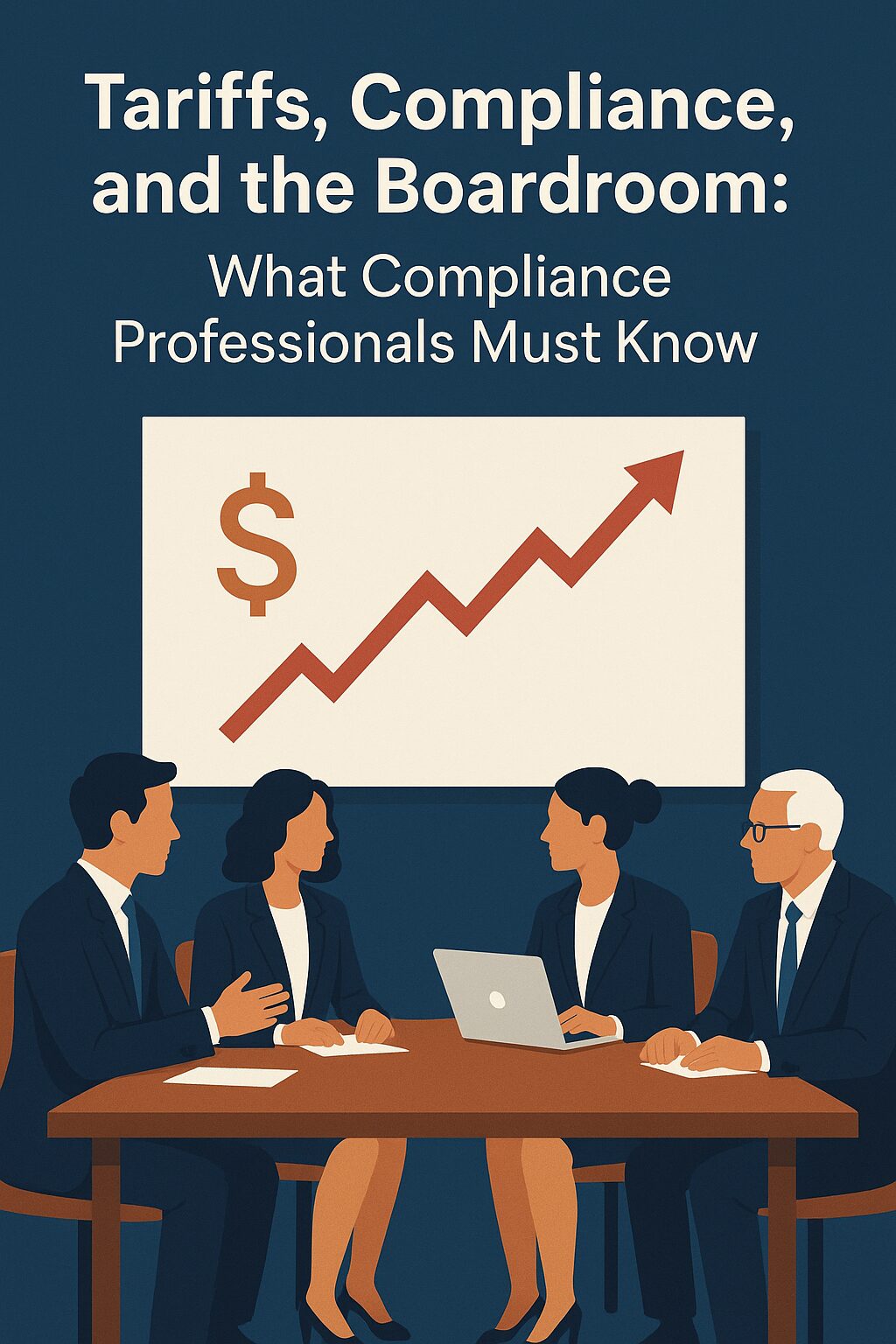
Tariffs, Compliance, and the Boardroom: What Compliance Professionals Must Know

Tariffs rarely capture the same headlines as sanctions or anti-bribery enforcement, but they present an equally dynamic and increasingly risky compliance landscape. In a recent episode of All Things Investigation, I had the opportunity to sit down with Sean Reilly to discuss tariffs, compliance risks, and what boards and compliance officers should be doing to prepare for a volatile environment.

Our conversation underscored a simple truth: tariffs are no longer an abstract trade issue reserved for economists. They pose a compliance risk that spans supply chains, financial disclosures, and boardroom oversight. For companies that import, export, or rely on global supply chains, tariffs are now at the forefront.

The Tariff Landscape: Constantly Moving Targets

One of the defining characteristics of today’s tariff regime is its unpredictability. Rates fluctuate, exemptions appear and disappear, and the scope of covered countries can shift almost overnight. Compliance officers cannot afford to treat tariffs as a “set it and forget it” exercise.

The practical reality is that tariff compliance requires daily monitoring. Companies must track which tariff rates apply, how long they remain in place, and whether supply chains have been reconfigured in response. This requires a blend of vigilance and flexibility, monitoring trade flows in real-time while being prepared to adjust operations and compliance programs in response to policy changes.

Building the “Tariff Team”

So, who within the company should be responsible for tariff compliance? Sean and I discussed the importance of cross-functional collaboration. Tariff issues are not simply the province of legal or compliance. They touch finance, procurement, supply chain management, and government affairs.

A well-prepared company will assemble a “tariff team” composed of:

  • Compliance and legal to interpret rules and assess enforcement risks.
  • Supply chain and procurement to track sourcing shifts and supplier behavior.
  • Finance to model tariff costs and forecast bottom-line impacts.
  • The board is responsible for exercising oversight and ensuring risk-based governance.

Tariff compliance cannot be siloed. It requires coordination and clear lines of accountability across the enterprise.

The Risk of “Tariff Washing”

One of the most significant risks in the current environment is “tariff washing.” This occurs when suppliers attempt to re-route goods through third countries to take advantage of lower tariff rates. Sometimes these are legitimate supply chain shifts. At other times, they are cosmetic or fraudulent, designed solely to avoid higher tariff rates.

Compliance officers must apply a healthy degree of skepticism. Does the shift in sourcing make commercial sense? Has there been a genuine change in manufacturing capacity, or is this simply a repackaging exercise to disguise the true country of origin?

Here, compliance can borrow a tool from anti-corruption programs: the business justification test. Just as we require a legitimate rationale for engaging a third party in an FCPA context, we must demand that supplier shifts in response to tariffs be commercially rational and properly documented.

Documentation and Commercial Sense

Documentation remains the bedrock of compliance. If regulators come knocking, companies must be able to show not only what decisions were made, but why those decisions made sense at the time. That requires contemporaneous documentation of sourcing decisions, tariff classifications, and supplier relationships.

Equally important is the “commercial sense” analysis. As Sean noted, if a decision never made sense on its face, regulators will treat it with suspicion. The first line of defense is to scrutinize whether a supplier’s promise, price change, or sourcing shift is realistic or whether it seems too convenient.

Enforcement Is Coming

While tariff enforcement is still maturing, the writing is on the wall. In May 2025, the DOJ issued guidance, which, among other items, made tariff and customs fraud a high-priority enforcement area. The False Claims Act (FCA) is emerging as a powerful enforcement tool in this space. Indeed, the DOJ has recently announced the establishment of an entire tariff fraud task force.

Under the FCA, false paperwork designed to evade tariff payments can trigger treble damages and whistleblower claims. That means private individuals, including former employees and competitors, can bring lawsuits on behalf of the government. The financial incentives are significant: whistleblowers can recover 10–30% of the government’s final award.

This shift dramatically raises the stakes. Tariff fraud is not just a matter of customs penalties—it can also lead to multimillion-dollar FCA settlements. Competitors now have a financial incentive to blow the whistle if they suspect rivals are skirting tariffs.

The Board’s Role

Boards may not traditionally view tariffs as a governance priority, but that is changing. Directors have a duty of oversight under Caremark, and tariff exposure now falls squarely within that duty.

Boards should be asking management:

  • How are tariffs impacting the company’s cost structure?
  • What compliance processes are in place to monitor and document tariff compliance?
  • Are supplier shifts legitimate, commercially justified, and properly vetted?
  • What role does whistleblower risk play in the company’s compliance posture?

Boards are not meant to manage tariffs on a day-to-day basis, but they must oversee the risk and ensure that systems are in place to prevent abuse.

Looking Ahead

As we head into 2026, tariffs are unlikely to disappear. Even if legal challenges reduce the administration’s use of certain authorities, other tools will remain. Tariffs will continue to be used as instruments of economic policy, and compliance professionals must be ready.

That means strengthening tariff monitoring, reinforcing supplier due diligence, and documenting commercial rationales for key decisions. It also means educating boards and business units about the rising enforcement risks, particularly under the False Claims Act.

For compliance professionals, the tariff environment presents both challenges and opportunities. Those who master this space will not only protect their companies but also position themselves as indispensable advisors in the boardroom.

Five Key Takeaways for Compliance Professionals

1. Tariffs Are a Dynamic Risk. Tariffs are unlike many other regulatory obligations because they change with dizzying speed. Rates may rise or fall depending on diplomatic negotiations, trade disputes, or shifting political priorities. Compliance officers cannot rely solely on last quarter’s data or assumptions; they must be vigilant and monitor tariff developments daily. A product classified correctly yesterday could be noncompliant today if the rate changes or a new rule takes effect. Internal systems must be nimble enough to capture and update these changes, ensuring that procurement, logistics, and finance have accurate, real-time information. Failure to adapt exposes companies to both financial and legal risk.

2. Cross-Functional Tariff Teams Are Essential. Managing tariffs is not solely the responsibility of the compliance department. The risks span multiple functions, from procurement’s sourcing decisions to finance’s cost projections and the board’s oversight responsibilities. A cross-functional team ensures no blind spots exist in how tariffs affect the organization. Compliance provides regulatory interpretation, procurement evaluates supplier reliability, finance forecasts cost impacts, and leadership weighs strategic tradeoffs. When these perspectives are integrated, the company can respond quickly and coherently to tariff changes. Without collaboration, gaps emerge in due diligence, documentation, or reporting, which can leave the company vulnerable to enforcement actions or unanticipated costs.

3. Watch for Tariff Washing. One of the most pressing risks in global trade is the temptation to “wash” tariffs by re-routing goods through third countries with lower rates. On paper, this may appear to be a smart sourcing decision, but compliance officers must ask the hard question: Does it make commercial sense? If a supplier suddenly shifts production from China to a Southeast Asian country without evidence of new investment, it may be little more than cosmetic repackaging. Such schemes are red flags for regulators and can be construed as fraud. Companies must scrutinize supplier claims, demand documentation, and verify that supply chain changes are legitimate and accurate.

4. False Claims Act Enforcement Is Rising. The Department of Justice has elevated tariff fraud to a priority enforcement area, and the FCA is fast becoming the weapon of choice. Unlike traditional customs penalties, FCA cases allow treble damages and whistleblower suits, making the stakes far higher. Employees, competitors, and even third parties now have financial incentives to report suspected fraud, with rewards ranging from 10% to 30% of the government’s recovery. This dramatically increases exposure. Companies must prepare by documenting tariff decisions, validating supplier changes, and maintaining clear audit trails to ensure compliance with relevant regulations. Without robust controls, even an innocent mistake could be portrayed as reckless evasion under the FCA.

5. Boards Must Exercise Oversight. Directors cannot delegate tariff risk to management and assume it ends there. Oversight duties require boards to understand how tariffs impact the company’s cost structure, supply chain, and competitive position. This does not mean diving into paperwork, but it does mean asking probing questions: How are tariffs monitored? Are supplier shifts legitimate? What whistleblower risks exist? A board that demands clear answers demonstrates active oversight and helps shield the company from regulatory criticism. Conversely, a board that ignores tariffs may face liability under its duty of care. Documentation, escalation procedures, and ongoing dialogue with compliance are essential.

Conclusion

Tariffs may not dominate the compliance headlines, but they pose real, material risks to companies operating in today’s global economy. The volatility of tariff regimes, the threat of enforcement under the False Claims Act, and the boardroom’s duty of oversight all converge to create a complex challenge.

Compliance professionals who treat tariffs as a core risk, on par with sanctions, export controls, and anti-bribery, will help their organizations avoid costly missteps and strengthen their resilience. As Sean Reilly aptly put it, tariff compliance starts with asking whether a decision makes commercial sense. In today’s enforcement climate, that simple question may be the best protection a company has.


Categories
All Things Investigations

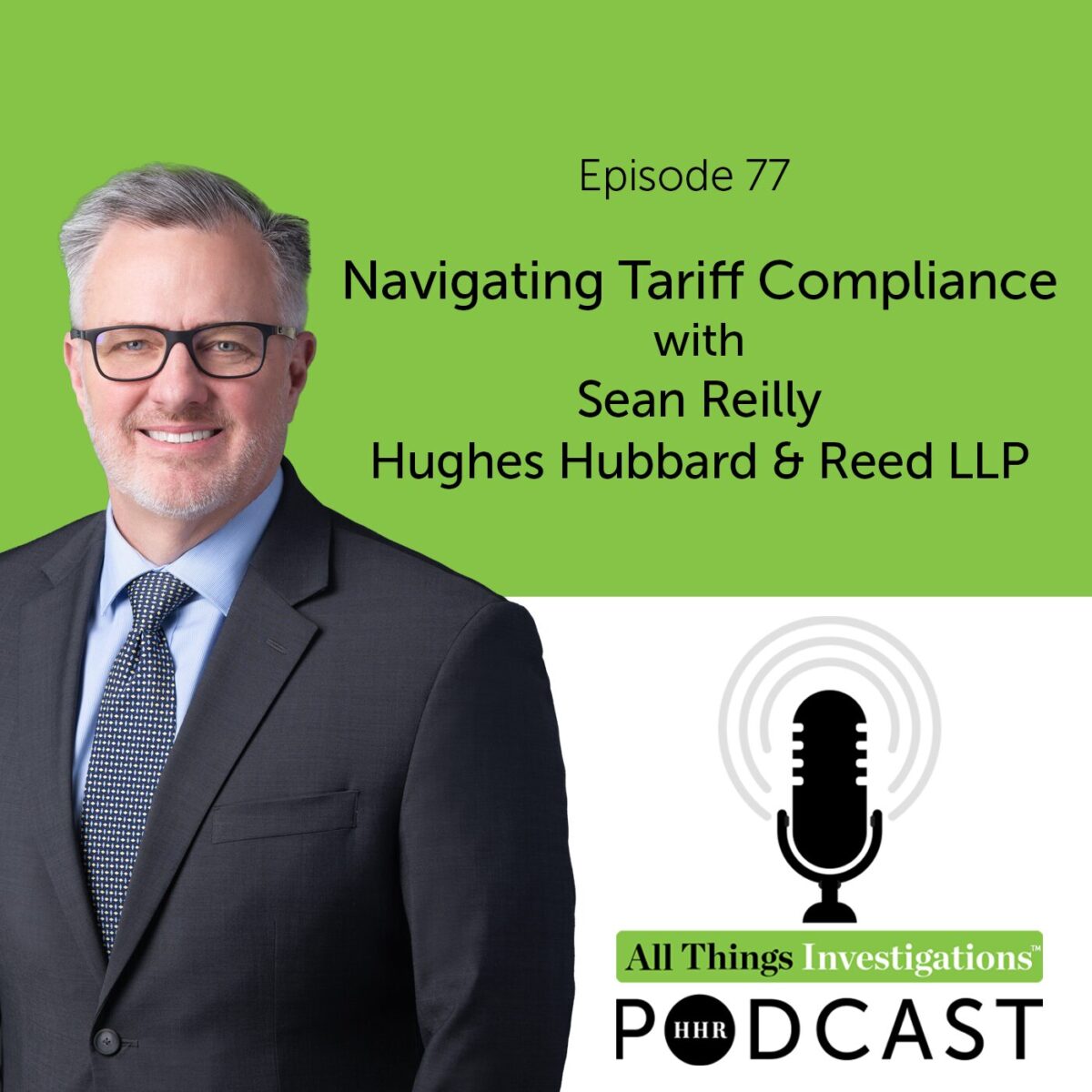
All Things Investigations – Navigating Tariff Compliance with Sean Reilly

Welcome to the Hughes Hubbard Anti-Corruption & Internal Investigations Practice Group’s podcast, All Things Investigation. In this podcast, host Tom Fox welcomes back Sean Reilly to discuss the complexities of tariffs under the current administration.

Their conversation highlights the dynamic nature of tariff regimes, the importance of maintaining compliance, and the risks of tariff evasion. Sean provides insights into creating effective tariff compliance programs, the potential for False Claims Act liabilities, and the critical role of commercial sense in assessing tariff changes. The episode also touches on enforcement priorities and the strategic importance for boards of directors to remain vigilant about tariff-related risks. As the discussion moves towards the evolving landscape leading into 2026, Sean emphasizes the importance of staying informed and prepared for ongoing tariff regulations.


Highlights include:

  • Compliance and Enforcement in Tariff Management
  • Commercial Sense in Tariff Decisions
  • Board Oversight and Tariff Compliance
  • Future of Tariffs and Compliance Going Forward

Resources:

Hughes Hubbard & Reed Website

Sean Reilly

Categories
Daily Compliance News

Daily Compliance News: September 8, 2025, The Using AI to Detect AI Edition

Welcome to the Daily Compliance News. Each day, Tom Fox, the Voice of Compliance, brings you compliance-related stories to start your day. Sit back, enjoy a cup of morning coffee, and listen in to the Daily Compliance News. All, from the Compliance Podcast Network. Each day, we consider four stories from the business world, compliance, ethics, risk management, leadership, or general interest that are relevant to the compliance professional.

Top stories include:

  • Clawing back illegal tariffs. (WSJ)
  • Using AI to detect AI-generated fake receipts. (NYT)
  • China launches corruption probe into top securities regulator. (FT)
  • Corrupt country leader, the US welcomes you. (PBS)
Categories
From the Editor's Desk

From the Editor’s Desk – Compliance Week’s Insights and Reflections from July to August 2025

In this episode of From the Editor’s Desk, co-hosts Tom Fox and Ian Sherr dive into key compliance stories from July, including differences in AI regulation between the U.S., EU, and UK, and shifts in regulatory approaches globally. They discuss notable cases, such as the DOJ’s $14 billion healthcare fraud prosecution tied to transnational crime, and T-Mobile’s acquisition of US Cellular amidst DEI program cuts. Upcoming initiatives in Compliance Week are also highlighted, including in-depth industry coverage and data-driven stories to aid compliance professionals in their roles. The episode concludes with insights into the recent acquisition of ECI by Compliance Week’s parent company, Verdian Insights, which aims to enhance resources available to the compliance community.

Highlights include:

  • Highlighting Key Stories from Compliance Week in July
  • Emerging Patterns in Compliance
  • Tariffs and Their Impact
  • SEC Whistleblower Claims Analysis
  • Upcoming Features and Data Stories
  • ECI Acquisition by Verdian Insights and Its Impact

Resources:

Ian Sherr on LinkedIn

Compliance Week

Categories
All Things Investigations

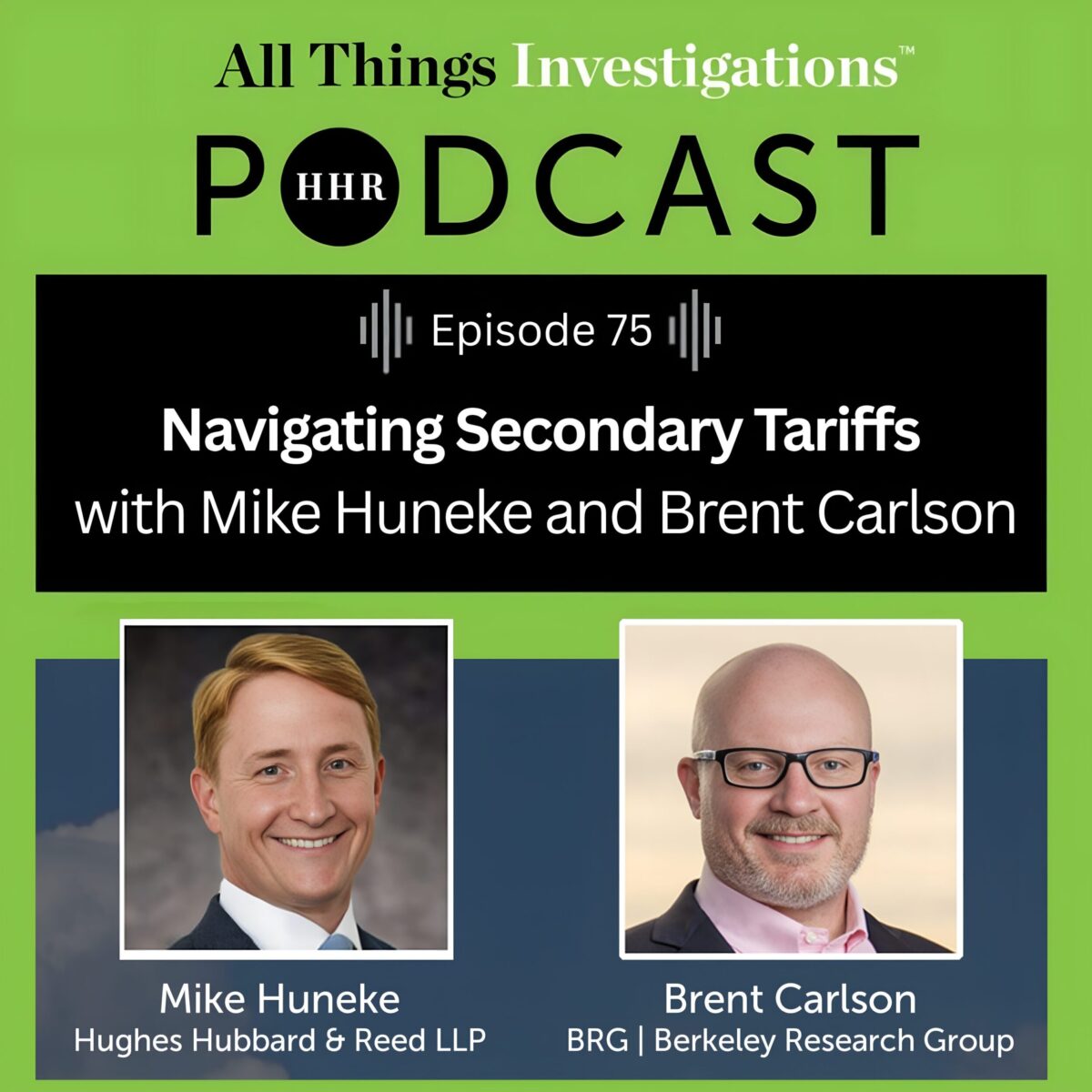
All Things Investigations – Navigating Secondary Tariffs with Mike Huneke and Brent Carlson

Welcome to the Hughes Hubbard Anti-Corruption & Internal Investigations Practice Group’s podcast, All Things Investigation. In this podcast, host Tom Fox is joined by HHR partner Mike Huneke and BRG Director Brent Carlson to discuss secondary tariffs.

Mike Huneke and Brent Carlson are leading experts in trade compliance, with a particular focus on the intricacies and impacts of tariffs and secondary tariffs within the global economic landscape. Huneke emphasizes the existential threats tariffs pose to businesses, stressing the importance of understanding their effects on countries with significant economic ties to Russia, such as China, and advising companies to reassess trade relationships with nations like China, Brazil, Russia, and Iran. Carlson emphasizes the need for trade compliance officers to adapt to the rapidly evolving geopolitical landscape, advising companies to assess their suppliers and consider potential indirect transactions through transshipment countries to navigate imposed tariffs effectively. Both experts emphasize the importance of businesses adopting a dynamic, risk-based approach to compliance, anticipating challenges, and making informed decisions to mitigate financial impacts and maintain shareholder value amid shifting trade patterns and geopolitical tensions.

Key highlights:

  • Geopolitical Impact of Secondary Tariffs
  • Global Trade Dynamics Amid Geopolitical Shifts
  • Trade Compliance Risks: False Claims & Tariff Evasion
  • Resilient Supply Chain Strategy Amid Global Trade Dynamics
  • Negotiating Tactics in Geopolitical Tariff Strategy

Resources:

Mike Huneke

Hughes Hubbard & Reed Website

Brent Carlson

BRG Website

Categories
Red Flags Rising

Red Flags Rising: S01 E21 – “Secondary Tariffs” with Tom Fox

Mike and Brent were honored guests on the FCPA Compliance Report podcast with their podfather, Tom Fox, the Voice of Compliance and founder of the Compliance Podcast Network. They discuss the concept of “secondary tariffs” recently threatened by the U.S. as to Russia’s trading partners (00:44), what would such secondary tariffs as to Russia mean, and for whom (03:21), how multinational companies should start thinking through the impact of these potential tariffs (04:37), the need to be very, very, very careful about schemes that seem too good to be true (because they are) (06:03), how risk-based compliance can help multinationals evaluate proposed reconfigurations of procurement flows (09:36), where self-certifications by suppliers might not be sufficient (10:22), and then conclude with a deep dive into what False Claims Act enforcement for tariff evasion might look like and how to mitigate enforcement risks by understanding and leveraging the False Claims Act’s “knowledge” element (13:52).

Resources:

Compliance Podcast Network

Tom Fox on LinkedIn

FCPA Compliance Report podcast

More about Tom Fox

Brent LinkedIn

Mike LinkedIn

Mike & Brent’s “Fresh Looks” Series

Categories
Daily Compliance News

Daily Compliance News: July 15, 2025, The Fighting Workplace Bullying Edition

Welcome to the Daily Compliance News. Each day, Tom Fox, the Voice of Compliance, brings you compliance-related stories to start your day. Sit back, enjoy a cup of morning coffee, and listen in to the Daily Compliance News. All, from the Compliance Podcast Network. Each day, we consider four stories from the business world, including compliance, ethics, risk management, leadership, or general interest, relevant to the compliance professional.

Top compliance stories:

  • When was the last time you checked your fuel switches? (Reuters)
  • FCA to take on workplace bullying. (FT)
  • Of tariff fraud and tipsters. (WSJ)
  • Ramaphosa opens corruption investigation. (NYT)

You can donate to flood relief for victims of the Kerr County flooding by going to the Hill Country Flood Relief here.

Categories
Regulatory Ramblings

Regulatory Ramblings: Episode 73 – Geopolitical Risk: Thai Tensions / Sanctions, Tariffs & FCPA Enforcement in Asia

This episode focuses on geopolitical risk. In the initial spotlight segment, we speak with veteran journalist and Asia-watcher Christopher Cottrell about the military tensions in Thailand and their implications for the viability of the country’s newly proposed gaming law.

Following that, we chat with AML veteran Richard Butler of Dow Jones and data scientist Haider Mannan of BigTXN about the enforcement of the US Foreign Corrupt Practices Act, sanctions, and tariffs in the wake of recent actions by the Trump administration and the recent airstrikes on Iran.

Christopher Cottrell 

Christopher Cottrell resides in Thailand and has been covering the Indo-Pacific region since 1997, contributing to publications such as The Boston GlobeChristian Science MonitorCNNThe GuardianMacau BusinessThe New York Times, and the South China Morning Post.

He spent 18 years in China and has been reporting on geopolitics in the Pacific Islands and Southeast Asia for the past four years, having edited UK-based Winna Media’s white papers on the Thai Entertainment Complex bill since 2024.


Richard Butler

Richard Butler is the vice president and APAC head of risk and research for Dow Jones & Co. Based in Sydney, Australia, he is responsible for helping businesses with risk and compliance strategies offsetting various forms of regulatory and commercial risk – such as the provision of high-quality, accurate and comprehensive data for identifying, evaluating and monitoring varying types of risk.

Before joining Dow Jones, Richard was the AVP for Treasury Services for Australia and New Zealand at JPMorgan Chase, where he was responsible for ensuring that JPMorgan’s financial institutional and non-bank financial institution clients in Australia and New Zealand adhered to JPMorgan’s best-in-class Know-Your-Customer, compliance, due diligence, and counter-terrorist financing standards. He began his career at ABN AMRO Bank, where he served as both the CAAML (Client Awareness and Anti-Money Laundering) officer and sales manager for the ABN AMRO Treasury Solutions Group in Dublin, Ireland.

Richard is skilled in governance, risk management, and compliance (GRC), as well as team management, direct sales, relationship building, and financial analysis, particularly in the APAC region.

Haider Mannan

Haider Mannan is the CEO and founder of BigTXN, a risk intelligence data provider. He is a data scientist and subject matter expert in investment screening, specializing in ESG controversies, global sanctions, and investment restrictions. He sits on the UK board of the Association of Certified Sanctions Specialists and the membership committee of the UK Sustainable Investment and Finance Association. Haider is also a member of PRMIA‘s advisory expert group on investment risk.

Discussion:

The conversation begins with Chris recounting the threats to Thailand’s security and stability, including the ongoing land border closure and standoff with Cambodia. He recounts with Regulatory Ramblings host Ajay Shamdasani that, notwithstanding its 22 prior coups, military rule, and reputation as a fragile democracy, Thailand has long been the darling of the global investment community, which has long touted its positive long-term economic fundamentals.

He adds the country has curried favor with the West by opening up in ways that many would regard as progressive, such as permitting the sale of cannabis products and paraphernalia, permitting same-sex unions, and seeking to liberalize its gaming sector by tendering a recent bill.

Yet, given the July 1 suspension by the country’s Constitutional Court of Prime Minister Paetongtarn Shinawatra over ethics violations and the weekslong border spat with Cambodia, which has been roiling fears of Thailand’s 23rd coup d’état, the implementation of the new gaming law has been scuttled.

The discussion then shifts to Haider, who shares his thoughts on how data can help investment screening. He and Richard comment on how recent changes in the sanctions landscape, given the current geopolitical climate under the second Trump administration, pose a challenge for compliance and legal staff at banking and financial institutions, as well as multinational corporations.

Related to this are concerns about the implications for Asia regarding the extraterritorial enforcement of the much-dreaded US Foreign Corrupt Practices Act (FCPA) and the prospect of tariff imposition by the White House, as well as the potential for regulatory retaliation by other countries.

It’s worth noting that on June 9, Matthew Galeotti, head of the US Department of Justice’s (DOJ) criminal division, said that under new FCPA guidelines now in place, it would enforce the Act Firmly but fairly.” The comments followed President Trump’s announcement earlier this year that the DOJ would hold off on FCPA enforcement following a review of current standards, as it was believed the existing regulatory regime put US businesses at a disadvantage when competing abroad.

Haider and Richard also discuss why geopolitics matter and the need for lawyers and risk managers to go beyond merely tracking financial news. The conversation concludes with a discussion of a recent case in which the US DOJ’s Office of Foreign Asset Control (OFAC) sanctioned entities/companies in Hong Kong and mainland China that were involved in transferring Iranian oil to China.

Regulatory Ramblings podcasts is brought to you by The University of Hong Kong – Reg/Tech Lab, HKU-SCF Fintech Academy, Asia Global Institute, and HKU-edX Professional Certificate in Fintech, with support from the HKU Faculty of Law.

Useful links in this episode:

You might also be interested in:

Connect with RR Podcast at:

LinkedIn: https://hk.linkedin.com/company/hkufintech 
Facebook: https://www.facebook.com/hkufintech.fb/
Instagram: https://www.instagram.com/hkufintech/ 
Twitter: https://twitter.com/HKUFinTech 
Threads: https://www.threads.net/@hkufintech
Website: https://www.hkufintech.com/regulatoryramblings 

Connect with the Compliance Podcast Network at:

LinkedIn: https://www.linkedin.com/company/compliance-podcast-network/
Facebook: https://www.facebook.com/compliancepodcastnetwork/
YouTube: https://www.youtube.com/@CompliancePodcastNetwork
Twitter: https://twitter.com/tfoxlaw
Instagram: https://www.instagram.com/voiceofcompliance/
Website: https://compliancepodcastnetwork.net

Categories
Daily Compliance News

Daily Compliance News: July 9, 2025, The TACO Don Caves Again Edition

Welcome to the Daily Compliance News. Each day, Tom Fox, the Voice of Compliance, brings you compliance-related stories to start your day. Sit back, enjoy a cup of morning coffee, and listen in to the Daily Compliance News. All, from the Compliance Podcast Network. Each day, we consider four stories from the business world, including compliance, ethics, risk management, leadership, or general interest, relevant to the compliance professional.

Top compliance stories:

  • What happens when your bot goes antisemitic? (⁠NYT⁠)
  • Spanish PM announces new ABC laws amid graft probe. (⁠Bloomberg)⁠
  • Trump pushes back on tariff dates yet again. (⁠WSJ⁠)
  • Vibe coding for compliance. (⁠WSJ⁠)

You can donate to flood relief for victims of the Kerr County flooding by going to the Hill Country Flood Relief ⁠here⁠

Categories
Daily Compliance News

Daily Compliance News: May 23, 2025, The Gutless Wonders Edition

Welcome to the Daily Compliance News. Each day, Tom Fox, the Voice of Compliance, brings you compliance-related stories to start your day. Sit back, enjoy a cup of morning coffee, and listen in to the Daily Compliance News—all from the Compliance Podcast Network. Each day, we consider four stories from the business world: compliance, ethics, risk management, leadership, or general interest for the compliance professional.

Top stories include:

  • UK freezes asset of son of former Bangladeshi PM. (FT)
  • Boeing’s compliance plan is to create a hotline. (WSJ)
  • EY is negligent in missing $3bn fraud, the court said. (Reuters)
  • CEOs are afraid to discuss tariffs and garner Trump’s ire. (NYT)