Ed. Note: I was finally able to see the movie The Odyssey. To say it blew me away was an understatement. Even though it didn’t follow Homer’s work precisely or use ancient Greek, I still thought it was great cinema. Anytime you get people talking about the Greek classics, that is a win in my book. So check out the movie and enjoy it. Anne Hathaway was great as Penelope.
Penelope does not get enough credit. Odysseus gets the monsters, the storms, the speeches, the disguises, and the dramatic return. He gets the action scenes. Penelope gets the waiting. If the movie version made one thing clear, such an interpretation sells her short—very short.
Penelope is not simply waiting. She is governing under pressure. Opportunists surround her. The suitors have occupied her home, consumed her resources, pressured her to choose one of them, and treated uncertainty as an invitation to abuse. Odysseus is gone. Authority is contested. Telemachus is young. The house is under stress.
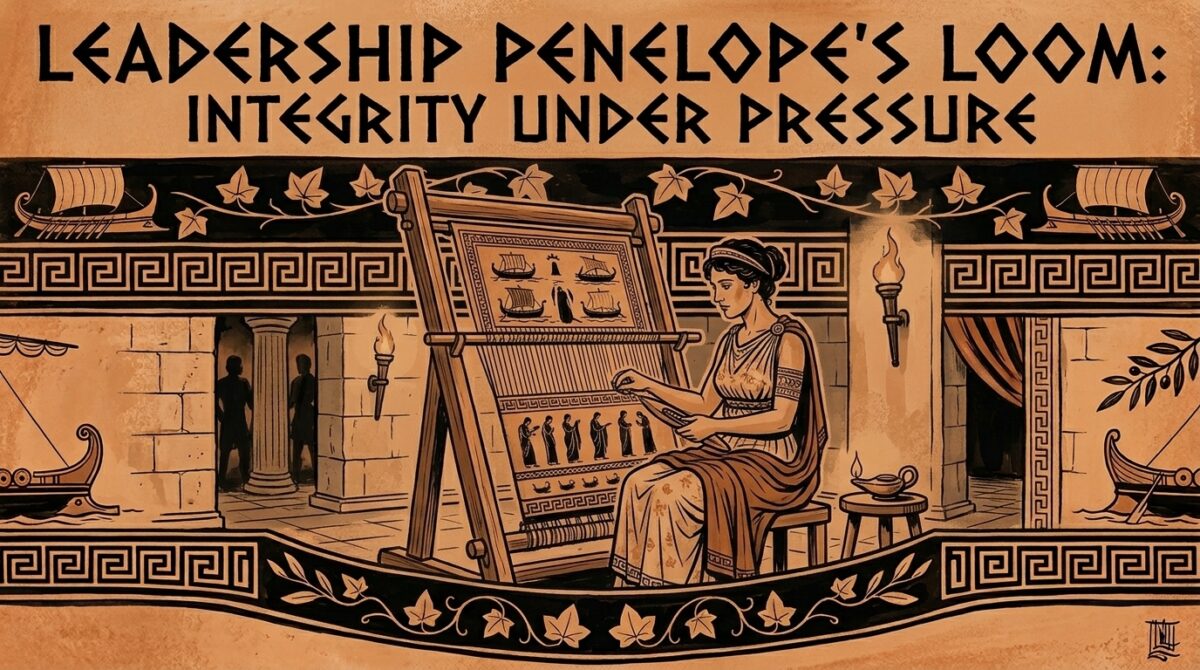
So Penelope does something quietly brilliant. She promises to choose a suitor after she finishes weaving a burial shroud for Laertes. By day, she weaves. By night, she unweaves. She buys time without surrendering the core issue. It is not flashy. It is not a thunderbolt. It is not a sword fight in the hall. It is disciplined patience under pressure.
That is why Penelope belongs in the leadership section of a compliance odyssey. She reminds us that integrity is not always dramatic. Sometimes it looks like refusing to sign the certification, approve the vendor, bless the transaction, release the report, close the investigation, or accept the explanation simply because everyone is tired of waiting.
The Corporate Translation
Penelope is the leader who understands that time pressure is not the same as good governance. Every organization has Penelope moments. The quarter is closing, and someone wants revenue recognized now. A third party has not cleared diligence, but the business sponsor says the relationship is too important to delay. A certification is due, but the control owner is not comfortable with the evidence. A board report needs to go out, but the investigation findings are still incomplete. A product launch is scheduled, but privacy, security, or regulatory concerns remain unresolved. A customer is demanding speed. A senior executive wants closure. The team is exhausted.
And then someone says the magic words: “Can we just move forward?” That is the sound of the loom beginning to tighten. Penelope’s lesson is not that delay is always virtuous. It is not. Delay can be passive, political, cowardly, or evasive. But some delay is not avoidance. It is governance. The question is whether the organization can tell the difference.
Defensible Delay Is Not Obstruction
In compliance, delay has a bad reputation. That is why compliance is known as The Land of No, populated by Dr. No. Sometimes it is the Department of Business (Non)Development. Whatever the moniker is, this is why business leaders often hear “we need more time” as “compliance is blocking the business.” Sometimes that criticism is fair. Compliance functions can be too slow, too opaque, too academic, or too disconnected from commercial reality. A policy review that disappears into a black hole is not governance. It is bureaucracy with a ticket number.
But there is another kind of delay: defensible delay. Defensible delay has a reason. It has an owner. It has a process. It has a timeline. It identifies the unresolved risk and the information needed to make a decision. It is communicated clearly. It is proportionate to the issue. It protects the company from making a false, rushed, or poorly documented commitment.
Penelope’s loom was not random. It had a purpose. It created time when the available choices were bad. That matters in corporate life. A leader who refuses to approve a questionable vendor is not “being difficult” if the due diligence is incomplete and red flags remain unresolved. A CFO who refuses to sign a certification without adequate support is not “overly cautious.” A compliance officer who asks for more facts before closing an investigation is not “dragging things out.” A privacy officer who pauses a product launch because sensitive data controls are not ready is not “anti-innovation.” Sometimes the most ethical sentence in business is “Not yet.”
Culture Is Built in the Waiting
Corporate culture is often revealed by what happens during delay. When a leader says, “We need more information,” does the organization respect the concern? Or does it start applying pressure?
Does the business provide the missing evidence, or does it complain that Legal is slowing things down? Does management support the control owner, or quietly ask for a more “practical” answer? Does the board ask why the delay is necessary or simply demand that the issue be resolved before the next meeting? Does compliance explain the path forward or hide behind process? These moments shape culture.
The DOJ’s Evaluation of Corporate Compliance Programs (ECCP) asks whether a compliance program works in practice, whether senior and middle management have encouraged or discouraged compliance through their words and actions, and whether compliance personnel have sufficient authority, resources, and access to function effectively. It also asks whether employees have practical guidance and know when to seek advice.
That is Penelope’s world. Culture is not only what the company says about integrity. It is whether the company protects people who slow down a decision for the right reasons. If every delay is treated as disloyalty, employees learn to approve first and worry later. That is not agility. That is ethical surrender in business casual.
Ethical Resilience Under Pressure
Penelope is not powerful in the obvious way. She does not command an army. She does not remove the suitors by force. Her resilience is quieter. She endures pressure without surrendering judgment. That kind of resilience is essential in compliance.
Ethical resilience is the capacity to hold the line when the organization is tired, when the facts are inconvenient, when the deadline is real, and when compromise would be easier. It is the controller who insists on evidence. The manager who escalates a concern before approving the payment. The compliance officer who says the investigation is not complete. The board member who asks whether management’s optimism is supported by testing. The executive who tells the team, “We will not do this the wrong way just because the right way takes longer.”
The DOJ Justice Manual states that prosecutors should evaluate a company’s commitment to fostering a strong culture of compliance at all levels, including how the company incentivizes employee, executive, and director behavior through discipline, complaint handling, and compensation plans. That means ethical resilience cannot depend on heroic individuals. The system must support it.
People must know they will not be punished for raising legitimate concerns. Performance goals must not make ethical delay impossible. Leaders must model patience when facts matter. Governance bodies must ask for evidence, not just reassurance. Compliance must help the business move responsibly, not merely tell it to wait. Penelope’s loom works because she has discipline. A company’s compliance program works because discipline is built into the system.
What a Better Compliance Program Does
A better compliance program helps the organization make disciplined decisions under pressure. It defines which approvals require evidence. It gives control owners authority to withhold certifications when support is inadequate. It builds escalation paths for unresolved risk. It documents exceptions and unresolved issues. It trains leaders on how to respond when employees raise concerns. It tracks aging remediation items. It distinguishes between acceptable risk, unresolved risk, and ignored risk. It also makes delay visible.
If a vendor approval is paused, document the reason. If leadership cannot sign a certification, they should know what evidence is missing. If an investigation remains open, there should be a plan. If a product launch is delayed, stakeholders should understand which control or risk issue must be resolved. That is not bureaucracy. That is governance with receipts.
The Compliance Takeaway
Penelope’s loom is a lesson in ethical leadership. She shows that integrity is not always a grand public stand. Sometimes it is a disciplined refusal to be rushed into a bad decision. Sometimes it is the courage to say, “The facts are not ready.” Sometimes it is the wisdom to buy time without losing the trust of those who are waiting.
For compliance officers and business leaders, the challenge is to build organizations where prudent delay is respected and avoidance is exposed. Do not approve the questionable vendor because everyone is tired. Do not sign the certification because the calendar is unforgiving. Do not close the investigation because the subject is influential. Do not bless the transaction because the business has already promised the outcome.
Weave if you must. Unweave if you must. But know why you are doing it, tell the truth about the risk, and make sure the delay serves integrity rather than fear. That is Penelope’s gift to corporate compliance. She reminds us that sometimes the strongest leader in the room is the one patient enough not to make the wrong decision.
Final Thoughts
Taken together, the leadership lessons from The Odyssey show that corporate compliance is not sustained by slogans, heroes, or good intentions alone. The Trojan Horse reminds us that cleverness without discipline can become a control failure; Athena shows that wise counsel must have real authority, resources, and access to challenge power; and Odysseus demonstrates that even brilliant, high-performing leaders can become compliance risks when success becomes a shield from scrutiny.
Telemachus then carries the lesson into succession, showing that governance must survive the absence of the indispensable leader, with authority, control, ownership, and escalation clearly embedded into the business. Penelope completes the leadership arc by reminding us that integrity under pressure is often quiet, patient, and disciplined: the willingness to say “not yet” when facts are incomplete, risks are unresolved, and everyone else wants to move forward. Together, these stories teach that ethical leadership is not simply about winning the battle or reaching Ithaca; it is about building a compliance culture strong enough to resist shortcuts, challenge heroes, survive transitions, and hold the line when pressure is highest.