Categories
Principled Podcast

Season 8 Episode 13 – Islands of Civility: A Special Edelman Report on Trust in the Workplace

What you’ll learn on this podcast episode

As today’s societal issues continue to mount, employees are turning to the workplace as one of the safer spaces for debate and a primary source of community. Data from a special edition of Edelman’s 2022 Trust Barometer—specifically analyzing Trust in the workplace—note that 78% of employees trust their employer over other established institutions and connections. So, how can companies leverage Trust and adapt their practices to address employee concerns better? In this episode of the Principled Podcast, host Emily Miner explores key findings from the Trust in the Workplace report with David M. Bersoff, the Head of Research at the Edelman Trust Institute. Listen in as the two discuss what drives Trust and how employers can strengthen Trust in—and beyond—the workplace. 

Get a copy of Edelman’s Trust in the Workplace special report. 

Read our blog post on takeaways from this report. 

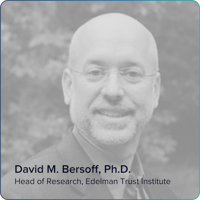
Guest: Dr. David M. Bersoff, Ph.D.

DavidBersoffGrayscalePicture1

Dr. David M. Bersoff

As the Head of Research for the Edelman Trust Institute, Dr. Bersoff is the lead researcher on all of Edelman’s trust-oriented thought leadership, including the Edelman Trust Barometer. He also leads the Institute’s research-based collaborations.

Before joining Edelman in 2016, David spent 18 years as consumer insights and marketing strategy consultant at The Futures Company. In his last 5 years with the organization, he served as its Chief Insights Officer and was a member of its global board of directors. In that role, he ran the Global Insights Group. He drove the research, data analysis, IP creation, and product development strategy for their syndicated consumer insights offers – Yankelovich MONITOR, Multicultural MONITOR, Global MONITOR, Health and Wellness MONITOR, Financial Services MONITOR, and the TRU Youth MONITOR.

In addition to his background in IP development and insights product management, David has also served as a trusted advisor and marketing/brand strategy consultant to major clients in industries as diverse as financial services, automotive, media, professional organizations, energy, and the military.

Before entering the consulting world, David spent 12 years engaged in social science research at various Ivy League institutions, including 4 years as an assistant professor of social psychology and research methodology at the University of Pennsylvania.

Host: Emily Miner

Emily_Miner_Principled_Podcast_S7_E5

Emily Miner is a director in LRN’s Ethics & Compliance Advisory practice. She counsels executive leadership teams on actively shaping and managing their ethical culture through deep quantitative and qualitative understanding and engagement. Emily is a skilled facilitator who emphasizes co-creative, bottom-up, and data-driven approaches to foster ethical behavior and inform program strategy. Emily has led engagements with healthcare, technology, manufacturing, energy, professional services, and education organizations. Emily co-leads LRN’s ongoing flagship research on E&C program effectiveness. She is a thought leader in organizational culture, leadership, and E&C program impact.

Before joining LRN, Emily applied her behavioral science expertise in the environmental sustainability sector, working with non-profits and several New England municipalities; facilitated earth science research in academia; and contributed to drafting and advancing international climate policy goals. Emily has a Master of Public Administration in Environmental Science and Policy from Columbia University and graduated summa cum laude from the University of Florida with a degree in Anthropology.

Categories
Blog

A Listening Tour for Compliance

A recent Inc.com article caught my eye about a series of events that returning Starbucks Chief Executive Officer (CEO) Howard Schultz has been engaging in. According to author Justin Bariso, Schultz has been engaging in a “listening tour” of Starbucks stores, literally across America. According to Schultz, he told employees “We are traveling the country, trying to, with great sensitivity, understand from you, how can we do better.” What are employees telling him? Bariso wrote, “he listens intently to one Starbucks employee after another, a pained look comes over Schultz’s face. Employees lament about the lack of training, increased turnover, and extreme pressure they’ve been forced to endure as company profits soared, but worker conditions plummeted.”
This listening tour has several goals for Schultz. The first is that even though the company has sustained record profits, morale at the company is at an all-time low. Witness the unionizing efforts that have been successful. Employees are simply fed up with not being listened to. This has eroded employee trust and management and driven down the once vibrant culture at the iconic institution. In order to rebuild that trust Starbucks, in the form of their CEO, “must first listen.” But it is more than simply listening to rebuild trust, it is rebuilding employee engagement by making them and their ideas part of the solution.
Obviously, there is still much work for Starbucks and Schultz to do. Yet these initial steps can lead to real change. Schultz is doing more than saying “We Care”; he is modeling that language in his behavior. This is action at the top. It is also communicating to other senior management they need to listen to re-engage and to build back employee trust. Now what if a Chief Compliance Officer (CCO) took that same approach for compliance? My belief is that a Schulz inspired listening tour can add multiple benefits to your compliance program.
Engagement
Start off by meeting as many compliance stakeholders as possible. You can use town hall settings, or go smaller, meeting with key employee leaders, key stakeholders and employees identified as high risk who you can meet with individually or in smaller groups. Listen to their compliance concerns and take their compliance ideas back to the home office. After returning to your office, winnow down their ideas and suggestions to form the basis of enhancements to your existing compliance program.
After you roll out your enhanced compliance program with new training, you can then give specific examples of how employee input led to the changes in the enhanced program. This engages the employees and makes them feel like they were a part of, and had a vested interest in, the company’s compliance program. This employee engagement will lead to greater stakeholder buy-in.
Education
But during the town hall meetings, and the smaller more informal group meetings, you can do more than simply listen, you can also train. This training is on overall ethics and how the employees could use compliance as a business tool. Most business’s ethical standards are not found in an existing compliance program, they are found in the general anti-discrimination guidelines and ethical business practices such anti-competitiveness and use of confidential information prohibitions. Often these general concepts can be found in a company’s overall Code of Conduct or similar statement of business ethics; workplace anti-discrimination and anti-harassment guidelines can be found in Human Resource (HR) policies and procedures. Concepts such as anti-competitiveness and use of customer and competitor’s illegally obtained confidential information may be found in anti-trust or other business practice focused guidelines.
All of this gets your employees and other stakeholders to start thinking about doing business the ethical way. It is ethical concept-based training in contrast to a rules-based approach. Moreover, this lays the groundwork for the enhancement of your compliance program and the training that will occur as the enhancement is rolled out.
Risk Assessment
Now think about this same approach from the risk assessment perspective. Listen to your employees concerns and listen to the compliance issues raised. From there you can begin to ask questions about what was done and why. This approach is not adversarial or an interrogation, but it is ferreting out the employees concerns while having the employees educate your compliance team on the actual procedures that are used. By listening, and gently questioning, you should be able to garner enough information to create a risk assessment profile which can inform and even become the basis of compliance program enhancements.
Bariso concluded his article by stating, “People lose motivation when they sense you don’t care. But the simple act of listening creates goodwill. When your people feel understood, they’ll be motivated to contribute and can help you discover insights you wouldn’t otherwise. So, when it comes to solving your company’s biggest problems, don’t ignore your most helpful resource: your people.” It all starts with listening. Let your employees and other stakeholders have the “chance to share their problems, as well as to propose solutions. Meetings like these will reveal key insights, and they will transform your people from employees to partners.”

Categories
This Week in FCPA

Episode 279 – the Happy Hanukkah Edition

Hanukkah comes early this year. As the Rosen household begins its annual celebration, Tom and Jay are back to look at some of the week’s top compliance and ethics stories this week in the Happy Hanukkah edition. 

Stories

1.     Preparing for dawn raid in the era of hybrid work? Andrew Reeves and Annie Birch in FCPA Blog.
2.     When you fight corruption, it fights back. Rick Messick in GAB.
3.     Why does Walmart want to keep an exec quiet about its compliance program? Dick Cassin explores in the FCPA Blog.
4.     Board effectiveness survey.  Paul DiNicola and Leah Malone in the Harvard Law School Forum on Corporate Governance.
5.     New OECD ABC suggestions. Nicola Bonucci and Nat Edmonds in the FCPA Blog.
6.     Graybeards and Youngbloods working together. Carrie Root in CCI.
7.     Trust in companies ‘shockingly’ low? Lawrence Heim in PracticalESG.
8.     Are senior level compliance positions becoming harder to find and fill? Matt Kelly explores in Radical Compliance.
9.     Role of PwC in Tesla/JPMorgan dispute. Francine McKenna explores in The Dig (sub req’d).
10.  How will tech change the work landscape in 2022? Check out this pod with Mrs. Monitor (AKA Rebecca Rosen) on Freshbrewed Tech. 

Podcasts and Events

11.  How can you show ROI from your internal investment in compliance? Nick and Gio Gallo join Tom Fox in the most unusual pod series, Mining the Gold in Compliance. Part 1 – ROI on Compliance. Purchase Decisions. Part 2 – Extending Compliance Value Across an Organization. Part 3 – Compliance and ESG Investments. Part 4 – Finance and Investing Models for Compliance. Part 5 – Investment Strategies for the Compliance Professional.
12.  Are you exasperated? Then check, F*ing Argentina. In this podcast series co-hosts Tom Fox and Gregg Greenberg, author of F*ing Argentina explore the current American psyche of being overworked, over leveraged, overtired and overwhelmed. Find out about modern America’s exasperation with well…exasperation. In Episode 11, a birthday party battle through text messages.
13.  In November on The Compliance Life, I visited with Wendy Badger, CCO at Tennant. In Part 1, she detailed her academic career and early professional life. In Part 2, changing ladders to advance your career. In Part 3, Wendy moved into the CCO Chair. In Part 4, Wendy talked about having courage in your career choices and compliance into the future. Next week, we begin the December series with Matt Silverman, Director of Trade Compliance at VIAVI.
14.  The Compliance Podcast Network welcomes Professor Karen Woody and her new podcast, Once Upon a Trading Law: The History of Insider Trading. In this most unique pod, Karen interviews some of her student to tell the history of insider trading. Check out Episode 1, which looks at the beginnings of insider trading.
15.  Join Tom, Mike Volkov, Carrie Penman, Dr. Pat Harned and Skip Lowney (an all-star panel if there ever was one) for the ECI webinar on the intersection of compliance and E&C programs. Wednesday, December 15, from 2-3:30 ET. Registration and information here.
Tom Fox is the Voice of Compliance and can be reached at tfox@tfoxlaw.com. Jay Rosen is Mr. Monitor and can be reached at jrosen@affiliatedmonitors.com.