One of the Department of Justice’s most consistent themes in its 2024 Update to the Evaluation of Corporate Compliance Programs (ECCP) is the need for companies to conduct effective root cause analysis following misconduct or control failures. It’s not enough to identify what went wrong; you must understand why it happened and implement measures to prevent it from happening again.
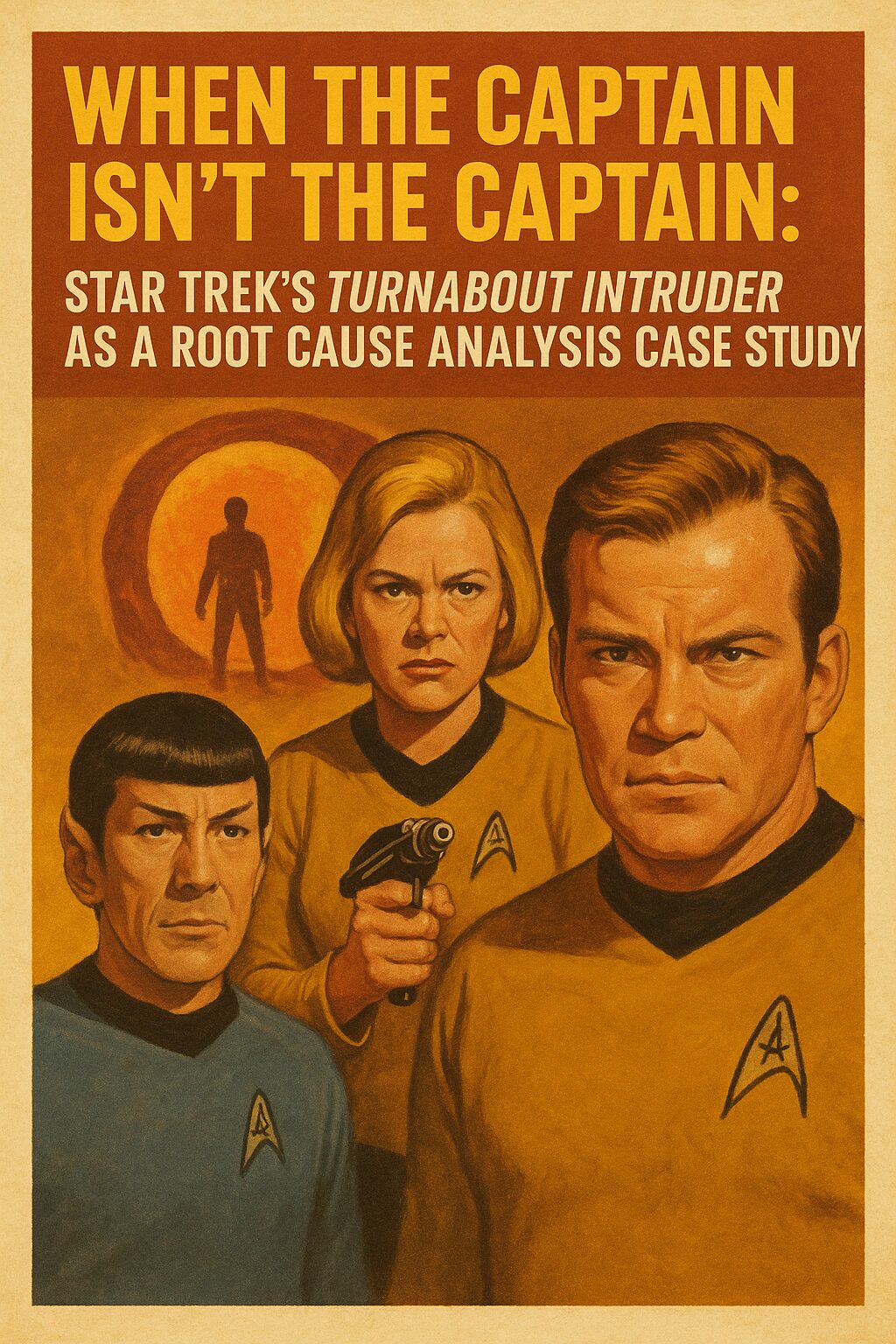
That principle is front and center in the Star Trek: The Original Series finale, Turnabout Intruder. In this episode, Captain Kirk is on an archaeological survey mission when he encounters Dr. Janice Lester, an old acquaintance from Starfleet Academy. Through a mysterious alien device, Lester transfers her consciousness into Kirk’s body, trapping his mind in her own body. What follows is a tense series of events in which “Kirk” behaves increasingly erratically, prompting suspicion among the crew.
For compliance professionals, the episode is a surprisingly apt case study in the perils of failing to dig past the surface when something seems off. Just as the crew needed to piece together the real cause of their captain’s strange behavior, compliance teams must be adept at peeling back layers to discover the true root cause of problems.
Here are five key root cause analysis lessons from Turnabout Intruder.
Lesson 1: Unusual Behavior Should Trigger an Investigation
Illustrated by: Shortly after the mind swap, “Kirk” begins making uncharacteristic decisions, belittling subordinates, ignoring Starfleet protocols, and punishing dissent in ways that are entirely out of character for the captain.
Compliance Lesson:
Behavior that deviates from established patterns should be a red flag. In corporate compliance, abrupt changes, whether in employee conduct, financial reporting patterns, or transaction activity, often indicate deeper issues.
Too often, organizations rationalize away early warning signs: “He’s under stress” or “That’s just her style.” But effective root cause analysis begins with the willingness to ask, Why is this happening now? Early detection is often the difference between a manageable problem and a full-blown crisis. Develop and maintain behavioral baselines for key personnel and functions. If something deviates sharply, investigate promptly rather than waiting for more evidence to emerge.
Lesson 2: Multiple Data Points Build a Stronger Case
Illustrated by: Several crew members—Spock, McCoy, Scotty—each notice something odd about “Kirk.” At first, their observations are anecdotal and separate. Only when they share information do they begin to see a pattern that suggests something is seriously wrong.
Compliance Lesson. Root cause analysis is stronger when it integrates multiple perspectives and sources of data. If you rely on a single source, one audit, one complaint, you risk drawing incomplete or biased conclusions.
In the episode, no single crew member had enough to prove that Kirk wasn’t himself. But when their observations were combined, the collective evidence pointed toward an anomaly that needed urgent action. Create processes that encourage information sharing across departments. Compliance, audit, HR, and operations should have mechanisms to cross-reference findings because the root cause may only emerge when different pieces are put together.
Lesson 3: Be Alert to Hidden Motives
Illustrated by: In Kirk’s body, Lester uses her new authority to sideline suspected opponents, reassigning or threatening crew who question her behavior. Her motive isn’t mission success; it’s consolidating her stolen command.
Compliance Lesson. The apparent cause of a problem may mask deeper personal or organizational motives. Misconduct often occurs because someone is pursuing goals that conflict with corporate policy, whether financial gain, personal vendettas, or reputational enhancement.
If your analysis stops at “This person violated policy,” you miss the opportunity to uncover why they were willing to risk consequences. In many cases, systemic issues, misaligned incentives, toxic culture, and weak oversight are the true drivers. In every investigation, ask “What’s in it for them?” Understanding incentives, pressures, and personal agendas can reveal root causes that process analysis alone won’t uncover.
Lesson 4: Authority Structures Can Delay Recognition of the Problem
Illustrated by: Even when evidence mounts, the crew is reluctant to challenge “Kirk” because of the chain of command. Starfleet discipline dictates deference to the captain, making it harder to act on suspicions.
Compliance Lesson. In organizations, hierarchy can be a barrier to identifying root causes. Employees may hesitate to report misconduct by senior leaders, or they may assume questionable directives are “above their pay grade” to question.
This dynamic often allows problems to persist far longer than they should. A compliance program must be designed to bypass those bottlenecks, giving employees safe, confidential, and credible ways to report concerns, even about top executives. Ensure that escalation procedures allow for independent review of senior management conduct. Whistleblower protections, ombuds functions, and anonymous hotlines can help surface issues that otherwise stay buried.
Lesson 5: Validate Assumptions Before Acting
Illustrated by: Spock eventually confronts “Kirk” and demands an explanation. Through logical analysis and a mind meld, he confirms the body-swap truth. Only then can the crew take decisive action to restore the captain to his rightful body.
Compliance Lesson. One of the biggest pitfalls in root cause analysis is acting on unverified assumptions. If you jump to conclusions too early, you may “fix” the wrong problem—or make it worse. Spock’s mind meld was the ultimate verification step. In compliance, your “mind meld” might be corroborating whistleblower claims with independent documentation, or testing an internal control in multiple scenarios before concluding it’s defective.
Build verification into your root cause analysis process. Don’t settle for the first plausible explanation; pressure-test your conclusions before implementing remediation.
Connecting Star Trek to DOJ Expectations
The DOJ’s ECCP explicitly asks:
- “What is the root cause of the misconduct?”
- “Were prior opportunities to detect the misconduct missed?”
- “What systemic failures contributed to the issue?”
Turnabout Intruder illustrates the importance of addressing these questions. If the crew had stopped at “the captain is acting oddly” and focused on damage control, they might never have uncovered the deeper truth of Lester’s body swap. Similarly, in corporate investigations, stopping at the surface level (“employee violated policy”) without probing the environment that allowed it to happen fails both the DOJ’s expectations and your prevention mandate.
Final ComplianceLog Reflections
In Turnabout Intruder, the crew’s slow realization of the true problem nearly cost them their captain and perhaps the Enterprise itself. In the compliance arena, a slow or shallow root cause analysis can allow misconduct to persist, control weaknesses to remain unaddressed, and systemic issues to metastasize.
Effective compliance leadership means not just spotting what’s wrong, but relentlessly pursuing why it went wrong. That’s how you fix the problem in a way that prevents recurrence.
Like Spock confronting “Kirk,” we must be willing to gather evidence methodically, test our conclusions, and take decisive action once the truth is clear. Root cause analysis isn’t about blame—it’s about ensuring your organization emerges stronger, more transparent, and more resilient than before.
Because in the end, just like the Enterprise, your mission depends on having the right people in the right roles, operating with integrity, and that’s a result only a thorough, well-executed root cause analysis can guarantee.
Resources:
Excruciatingly Detailed Plot Summary by Eric W. Weisstein