Categories
Word of the Week

Word of the Week with Kenneth O’Neal – The Challenges and Importance of Fatherhood

Each week, Kenneth O’Neal discusses a word that describes a principle or value of the Qualities of Success. We suggest that you use the Word of the Week in your thoughts, deeds, and actions. You might currently possess the quality and desire to develop it to a higher level. You could replace a bad habit with a good habit. Write an action step and use it daily to create the quality of your life. In this episode, in honor of Father’s Day, Kenneth discusses the word “fatherhood.

Rick and Kenneth explore the sacred role of a father, emphasizing responsibilities like love, leadership, integrity, and presence. Statistics from a 2024 study highlight the positive impacts and challenges faced by fathers, including societal expectations and economic pressures. The commentary emphasizes the importance of mentorship and community support for fathers. The episode concludes with a personal reflection on the host’s relationship with his father, underscoring the value of leading by example.

Key highlights:

  • The Meaning of Fatherhood
  • Challenges of Fatherhood
  • Temptations Father’s Face
  • Personal Reflection on Fatherhood

Resources:

KRONEAL Consulting

Categories
SBR - Authors' Podcast

SBR-Author’s Podcast: Upping Your (Compliance) Game

Welcome to the SBR-Authors Podcast! In this podcast series, host Tom Fox visits with authors in the compliance arena and beyond. Today, the tables are turned as Caitlyn Tobey and Ellen Hunt from The Seven Elements Compliance Book Club host Tom to talk about his most recent book, Upping Your Game.

They explore how AI and machine learning can transform compliance operations, turning them into strategic business functions. He discusses the operationalization of compliance, the importance of integrating ethics into business practices, and the role of AI in enhancing the effectiveness of compliance. Notable examples, such as Wells Fargo’s use of AI in compliance and the concept of compliance by design, demonstrate how technology can facilitate more efficient business processes and foster a proactive compliance culture.

Key highlights:

  • Reframing Compliance in the Trump Era
  • The Role of AI in Compliance
  • Ethics and Compliance: A Strategic Partnership
  • Challenges and Risks of AI in Compliance
  • AI Chatbots in Compliance

Resources:

Upping Your Game on Amazon.com

Tom Fox

Instagram

Facebook

YouTube

Twitter

LinkedIn

Categories
Innovation in Compliance

Innovation in Compliance: Real-Time Fraud Prevention Strategies for Financial Loss Prevention with Vince Walden

Innovation is present in many areas, and compliance professionals must not only be prepared for it but also actively embrace it. Join Tom Fox, the Voice of Compliance, as he visits with top innovative minds, thinkers, and creators in the award-winning Innovation in Compliance podcast. In this episode, Tom Fox cross-posts an episode from the BCG Podcast, where host Hanjo Siebert visits with KonaAI CEO Vince Walden.

Walden is a prominent advocate for interdepartmental collaboration, particularly in the realm of compliance and fraud risk management. With his company specializing in AI-driven compliance solutions across diverse industries, Walden emphasizes the importance of breaking down data silos to promote transparency and improve communication among internal auditors, compliance teams, and IT departments. He views collaboration as a strategic imperative driven by data and governance, emphasizing that data should be the ultimate equalizer, thereby promoting a culture of collaboration that effectively achieves organizational goals. By leveraging shared data sources and advanced technology, Walden believes organizations can enhance their oversight, detect potential fraud, and address data privacy issues, ultimately improving their ability to prevent financial losses and maintain regulatory compliance.

Key highlights:

  • Breaking Down Data Silos for Collaboration
  • Enhancing Collaboration Through Data Transparency and Technology
  • Unified Data Approach for Enhanced Fraud Prevention
  • Advanced Fraud Detection with Machine Learning
  • Proactive Monitoring for Financial Security

Resources:

Vince Walden on LinkedIn

KonaAI

Original Podcast Recording

Tom Fox

Instagram

Facebook

YouTube

Twitter

LinkedIn

 Innovation in Compliance was recently honored as the number 4 podcast in Risk Management by 1,000,000 Podcasts.

Categories
Trekking Through Compliance

Trekking Through Compliance – Episode 16 – The Galileo Seven and a Guide to Flexible Compliance Leadership

Show Summary

In the rich tapestry of leadership parables woven by Star Trek: The Original Series, the episode “The Galileo Seven” offers an extraordinary case study in adaptive leadership for compliance professionals.

Captain Kirk dispatches the shuttlecraft Galileo, commanded by Mr. Spock, to investigate a mysterious spatial phenomenon known as the Murasaki 312 quasar-like formation. Things quickly escalate when Galileo crash-lands on Taurus II, a hostile and primitive planet. Faced with limited resources, dwindling time, and escalating internal conflicts among the shuttlecraft crew, Spock must navigate his first significant command crisis without the immediate guidance of Captain Kirk.

Drawing parallels from “The Galileo Seven,” we explore critical leadership lessons and their practical implications for compliance professionals.

1. Logic vs. Emotional Intelligence—Know When to Adjust

Illustrated by: Spock’s initial adherence strictly to logic, which causes friction among his crew.

Initially, Spock applies logic rigidly, prioritizing scientific analysis and efficiency above all else. However, his lack of emotional awareness and inability to adapt to crew concerns cause resentment and weaken morale. For compliance officers, this highlights the importance of emotional intelligence in leadership. Successful compliance leaders understand that emotions, fears, and motivations drive people. 

2. Collaborative Decision-Making—Recognize the Power of the Team

Illustrated by: Spock’s initial refusal to accept team input, followed by his eventual realization of its value.

Initially, Spock resisted input from his team, confident his logic alone would lead them to safety. However, after multiple setbacks, including the loss of crew members and mounting internal pressure, Spock recognizes the need for collaborative input. In compliance, unilateral decision-making can often lead to resistance or compliance failures. Encouraging team participation fosters diverse perspectives, enriches problem-solving, and enhances the success of implementation.

3. Adaptive Communication—Tailor Your Message

Illustrated by: Spock learning to communicate more effectively under crisis conditions.

Initially, Spock’s communication style was overly technical, direct, and unemotional. This approach alienates crew members who need reassurance, context, and encouragement. For compliance professionals, transparent, adaptable communication is paramount. Compliance officers regularly interact with diverse audiences, and each group requires a tailored approach to communication. Employees need practical, understandable instructions; senior executives seek strategic implications and bottom-line impacts; regulators require precise, factual responses.

4. Strategic Flexibility—Be Prepared to Shift Tactics

Illustrated by: Spock’s decision to jettison shuttle fuel as a distress signal.

Spock makes an unconventional decision to ignite Galileo’s remaining fuel to create a distress signal. This act is a decisive departure from his logic-based strategy, demonstrating Spock’s ability to pivot rapidly under pressure. Compliance leadership requires similar strategic flexibility. Regulations evolve, new risks emerge, and organizational dynamics shift quickly. Compliance officers must be agile, ready to abandon approaches that are not working and pivot to new strategies that address changing landscapes.

5. Crisis Leadership—Maintain Composure and Provide Clarity

Illustrated by: Spock’s calm demeanor under extreme pressure.

Throughout the escalating crisis, Spock maintains remarkable composure, never allowing panic or emotional strain to overtly influence his behavior. Employees and executives alike look to compliance professionals for clear-headed leadership during turmoil.

6. Continuous Learning—Grow Through Experience

Illustrated by: Spock’s reflection on the mission’s challenges and outcomes.

By the end of the episode, Spock demonstrates meaningful growth as a leader, reflecting on the lessons learned from the crisis and acknowledging his initial shortcomings. Compliance officers should adopt this same mindset of continuous learning. Rather than viewing mistakes as purely negative, compliance professionals can treat them as opportunities to refine their approach, enhance their strategic perspective, and improve compliance practices.

Final ComplianceLog Reflections

The Galileo Seven” is not just a thrilling adventure; it is a masterclass in adaptive leadership that compliance professionals can emulate. Spock’s journey from rigid logic to adaptive, compassionate leadership underscores that effective compliance officers must be dynamic, empathetic, collaborative, flexible, composed, and continuously learning.

Resources:

Excruciatingly Detailed Plot Summary by Eric W. Weisstein

MissionLogPodcast.com

Memory Alpha

Categories
Compliance Tip of the Day

Compliance Tip of the Day – New FCPA Enforcement Memo – What Does it Mean?

Welcome to “Compliance Tip of the Day,” the podcast that brings you daily insights and practical advice on navigating the ever-evolving landscape of compliance and regulatory requirements. Whether you’re a seasoned compliance professional or just starting your journey, our goal is to provide you with bite-sized, actionable tips to help you stay ahead in your compliance efforts. Join us as we explore the latest industry trends, share best practices, and demystify complex compliance issues to keep your organization on the right side of the law. Tune in daily for your dose of compliance wisdom, and let’s make compliance a little less daunting, one tip at a time.

Today, we conclude a 2-part look at the recently released FCPA Enforcement Memo. Today, in Part 2, we consider what it means for a compliance professional.

For more information on this topic, refer to The Compliance Handbook: A Guide to Operationalizing Your Compliance Program, 6th edition, recently released by LexisNexis. It is available here.

Categories
Daily Compliance News

Daily Compliance News: June 17, 2025, The JBS Goes Public Edition

Welcome to the Daily Compliance News. Each day, Tom Fox, the Voice of Compliance, brings you compliance-related stories to start your day. Sit back, enjoy a cup of morning coffee, and listen in to the Daily Compliance News. All from the Compliance Podcast Network. Each day, we consider four stories from the business world: compliance, ethics, risk management, leadership, or general interest, all relevant to the compliance professional.

Top stories include:

  • Aspiring CPAs ditching grad school. (WSJ)
  • JBS hits the US stock exchange. (FT)
  • The DOJ whistleblower program focuses on healthcare fraud. (Reuters)
  • IMF to assess corruption in Kenya. (Bloomberg)
Categories
Blog

Is FCPA Enforcement Back? Part 1 – What Compliance Professionals Need to Know

After months of speculation and a noticeable lull in FCPA enforcement, the U.S. Department of Justice (DOJ) has made a significant announcement with a new policy statement. In a recently released memorandum titled “Guidelines for Investigations and Enforcement of the FCPA” (FCPA Memo), the Deputy Attorney General (DAG), Todd Blanche, has sent a clear message that FCPA enforcement remains alive under the Trump Administration. However, it will now focus on new areas, including cartel disruption, national security, US business development, and leveling the global playing field for U.S. companies.

This two-part blog post series breaks down, in Part 1, the key compliance takeaways from this important policy pivot, and in Part 2, offers practical insights on how you, the compliance professional, should respond.

1. Cartels, Corruption, and Competitive Disadvantage: The New Enforcement Trifecta

The Trump Administration has refocused DOJ enforcement on cartels and transnational criminal organizations. This FCPA memo formalizes that commitment by tying cartel activity directly to FCPA enforcement. If a foreign company bribes officials in a jurisdiction where cartels thrive, think Mexico or Colombia, this administration sees a compelling hook for the DOJ to act. It is not just about corruption in isolation; it is about rooting out the business practices that enable criminal ecosystems.

More provocatively, the FCPA Memo explicitly prioritizes cases where corruption places U.S. companies at a competitive disadvantage in the business world. That is undoubtedly a reframing of the FCPA’s historical mission. Historically, the US and other uneducated critics have claimed that the FCPA penalizes US companies more harshly than their foreign counterparts. That has never been true, as even in 2025, more than half of the top ten largest FCPA enforcement actions of all time have been against foreign-based companies. However, the DOJ’s message now is that if your foreign competitor is winning contracts by bribing officials, the US government may well be interested in investigating them, not just because it is illegal, but also because it harms American businesses.

Compliance Takeaway: If your company is aware of unfair practices by foreign competitors, this may be the ideal time to take action. The door is open for whistleblower complaints even against non-U.S. entities, primarily where jurisdictional hooks exist. Expect more aggressive cross-border enforcement. Consider strengthening your third-party due diligence in regions where cartels or known corruption are prevalent.

2. Expedited Investigations: A Welcome Burden or a New Headache?

The FCPA Memo calls on prosecutors to “proceed as expeditiously as possible” in investigating and resolving FCPA cases. On its face, this sounds like good news—long, open-ended probes can paralyze business operations and drain resources. But what does this mean? More pressure on prosecutors? More pressure on internal investigations? More pressure on internal reporting and triage? More pressure on getting it right? (Hint: It’s all of the above.)

FCPA investigations are complex. They require cross-border data collection, permissions from foreign authorities, and interviews with key personnel who often have full business calendars. Now, there is added pressure to accelerate timelines, which may involve compressing review cycles, reducing interview preparation time, and making quicker judgment calls.

Compliance Takeaway: Compliance teams should rehearse their internal investigation protocols. Do you have the right tech stack for document review? Can you mobilize your legal team quickly? Is your board informed about high-risk regions and prepared to respond quickly? If not, now’s the time to prepare.

3. Collateral Consequences and Business Disruption: A Balancing Act

The memo notably instructs prosecutors to consider “collateral consequences,” the potential disruption to lawful business operations, and the impact on innocent employees. This language expands the typical resolution-phase considerations into the investigative phase itself.

This could play out in several ways. Investigations may be more narrowly scoped, targeting business units directly implicated in misconduct rather than company-wide fishing expeditions. It may also lead to greater leniency in imposing fines or monitorships where such measures would significantly impair innocent stakeholders. It certainly provides defense counsel with more arguments to present to the DOJ to limit or narrow the scope of any investigations.

Compliance Takeaway: If your organization finds itself under DOJ scrutiny, be prepared to advocate for the operational integrity of your business early and often. Document how cooperation, remediation, and disruption mitigation are being handled throughout the investigation. Use this framework as a proactive tool in early dialogue with prosecutors.

4. National Security Interests Continue to Take Center Stage

Building on the Biden Administration’s policy on Anti-Corruption, the Trump Administration has woven national security into FCPA enforcement priorities, highlighting sectors such as defense, software, artificial intelligence, critical minerals, and deepwater infrastructure. This means more cases involving cobalt mining, chip manufacturing, satellite communications, and cyber tools will fall within the DOJ’s line of sight. In essence, the DOJ is saying, “If your business, or your competitor’s business, touches sensitive sectors with national implications, we care.”

Compliance Takeaway: Compliance professionals in industries even tangentially connected to national security should conduct fresh risk assessments. Are you sourcing from high-risk jurisdictions? Using agents in resource-rich areas? Working with state-owned entities abroad? If so, those red flags now carry more weight.

5. Corporate Structures vs. Individual Misconduct: Back to Basics

One curious phrase in the memo warns against attributing “non-specific malfeasance to corporate structures.” At first glance, it’s a head-scratcher. However, upon closer inspection, it reinforces a longstanding principle: corporations are liable when individuals commit crimes, not due to vague failures in internal controls. This is essentially a reaffirmation of the longstanding DOJ position that it will not prosecute internal control violations absent extraordinary circumstances. (This has been left to the SEC.) This prosecutorial philosophy has defined the DOJ’s FCPA enforcement over the last decade. It is not enough for the DOJ to find a company that had weak controls; you need to show that someone crossed the line.

Compliance Takeaway: This is good news for companies with mature compliance programs. But it also raises the stakes for effective training, monitoring, and investigations. Your internal audit function must be able to identify and document actual misconduct, not just control failures. The DOJ stated that it will focus on crimes rather than paperwork errors.

6. The Focus on Serious Misconduct: Clearing the Docket

The DOJ has also clarified that it will deprioritize routine or “de minimis” FCPA violations, such as small gifts, modest travel perks, or isolated hospitality expenses. These will no longer be the centerpiece of enforcement actions unless they are accompanied by more serious wrongdoing. Although prominently stated in the FCPA Memo, the prosecutorial reality is once again that such violations have never been part of DOJ FCPA enforcement actions.

That does not mean your corporate compliance program should collectively fail to meet expectations. Excessive gifts or travel can still be part of the fact pattern in larger bribery schemes and may be cited in SEC books-and-records charges, even if the DOJ declines to pursue criminal prosecution.

Compliance Takeaway: Your policies on gifts, travel, and entertainment remain relevant, but you should right-size your compliance efforts. Focus your highest controls and resources on areas where real business decisions are being made, such as third-party relationships, government tenders, and public-private partnerships.

7. Foreign Prosecutions and Global Coordination: Sharing the Stage

The memo closes with an acknowledgment that foreign enforcement matters. Prosecutors are instructed to weigh whether other jurisdictions may prosecute before launching their actions. This appears to affirm the DOJ’s commitment to international collaboration rather than signaling retreat. Expect more joint settlements, coordinated raids, and synchronized prosecutions. But do not count on the DOJ stepping aside, especially in high-stakes cases.

Compliance Takeaway: If your company is under investigation abroad, don’t assume you’re out of the DOJ’s reach. Transparency and cooperation with global authorities will still be key. And make sure your disclosures in one country don’t conflict with your representations in another.

Join us tomorrow for Part 2, where we consider some responses you should take now.

Categories
Blog

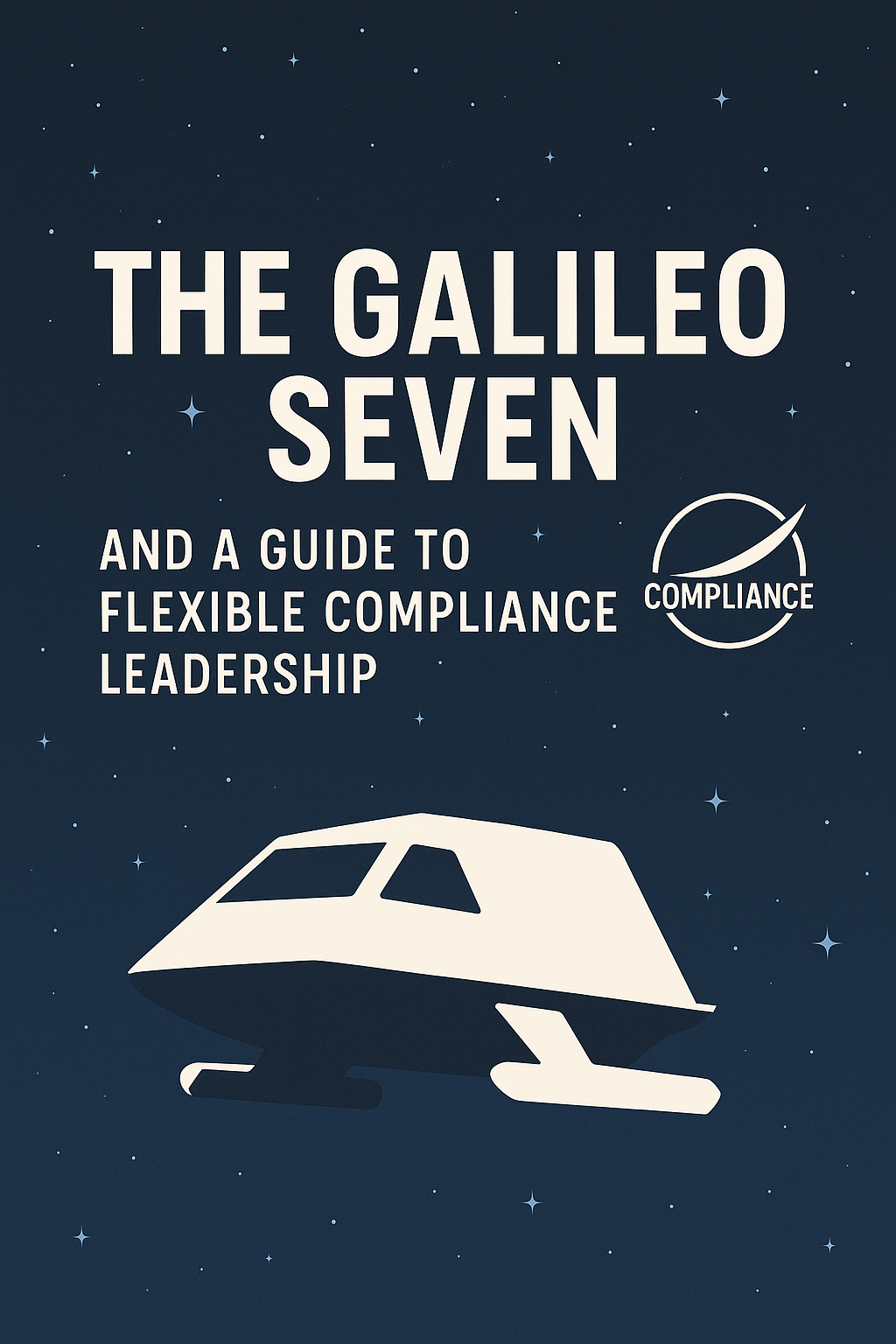
The Galileo Seven and a Guide to Flexible Compliance Leadership

Show Summary

In the rich tapestry of leadership parables woven by Star Trek: The Original Series, the episode “The Galileo Seven” offers an extraordinary case study in adaptive leadership for compliance professionals. Set against a backdrop of crisis and uncertainty, this iconic episode offers invaluable insights into how compliance officers can adapt their leadership styles and strategic approaches to effectively meet diverse challenges.

Captain Kirk dispatches the shuttlecraft Galileo, commanded by Mr. Spock, to investigate a mysterious spatial phenomenon known as the Murasaki 312 quasar-like formation. Things quickly escalate when Galileo crash-lands on Taurus II, a hostile and primitive planet. Faced with limited resources, dwindling time, and escalating internal conflicts among the shuttlecraft crew, Spock must navigate his first significant command crisis without the immediate guidance of Captain Kirk.

As compliance professionals, we often encounter scenarios that require swift adaptation, nuanced leadership, and strategic flexibility. Drawing parallels from “The Galileo Seven,” we next explore critical leadership lessons and their practical implications for compliance professionals.

1. Logic vs. Emotional Intelligence—Know When to Adjust

Illustrated by: Spock’s initial adherence strictly to logic, which causes friction among his crew.

Initially, Spock applies logic rigidly, prioritizing scientific analysis and efficiency above all else. However, his lack of emotional awareness and inability to adapt to crew concerns cause resentment and weaken morale. As tensions rise, Spock learns that logic alone isn’t sufficient; understanding human emotions and addressing them effectively is equally critical.

For compliance officers, this highlights the importance of emotional intelligence in leadership. While compliance processes and risk assessments depend heavily on structured logic and rigorous analysis, successful compliance leaders understand that emotions, fears, and motivations drive people. Balancing logical policy enforcement with emotional intelligence ensures your team remains engaged, cooperative, and responsive.

In practical terms, adapting your style may involve taking extra time to explain why certain compliance measures are important, demonstrating empathy when implementing changes, and offering reassurance during stressful regulatory situations. Compliance professionals should cultivate active listening skills, emotional awareness, and compassion to foster trust and collaboration within their teams.

2. Collaborative Decision-Making—Recognize the Power of the Team

Illustrated by: Spock’s initial refusal to accept team input, followed by his eventual realization of its value.

Initially, Spock resisted input from his team, confident his logic alone would lead them to safety. However, after multiple setbacks, including the loss of crew members and mounting internal pressure, Spock recognizes the need for collaborative input. By listening to the experiences, ideas, and even fears of his crew, Spock refines his strategy and ultimately makes better decisions.

In compliance, unilateral decision-making can often lead to resistance or compliance failures. Encouraging team participation fosters diverse perspectives, enriches problem-solving, and enhances the success of implementation. Whether facing a regulatory inquiry, adjusting internal policies, or conducting investigations, actively soliciting and integrating feedback from stakeholders, legal, HR, audit, and operations can lead to stronger, more sustainable compliance solutions. A compliance officer skilled in collaborative leadership builds cross-functional coalitions and leverages collective insights to refine strategies, fostering a sense of shared responsibility and buy-in. 

3. Adaptive Communication—Tailor Your Message

Illustrated by: Spock learning to communicate more effectively under crisis conditions.

Initially, Spock’s communication style was overly technical, direct, and unemotional. This approach alienates crew members who need reassurance, context, and encouragement. Only when Spock learns to adjust his communication, becoming more direct yet compassionate, does he rally his team to cooperate effectively in their pursuit of survival.

For compliance professionals, transparent, adaptable communication is paramount. Compliance officers frequently interact with diverse audiences, including frontline employees, senior executives, regulatory authorities, and external stakeholders. Each group requires a tailored approach—employees need practical, understandable instructions, senior executives seek strategic implications and bottom-line impacts, and regulators require precise, factual responses.

Effective compliance communication demands flexibility: the ability to modulate tone, simplify complex concepts, and inspire confidence. Building skills in adaptive communication can turn a compliance officer from an overseer into an influential leader who can motivate compliance ownership across an organization.

4. Strategic Flexibility—Be Prepared to Shift Tactics

Illustrated by: Spock’s decision to jettison shuttle fuel as a distress signal.

Facing imminent disaster and running out of conventional options, Spock makes an unconventional decision to ignite Galileo’s remaining fuel to create a distress signal. This act is a decisive departure from his logic-based strategy, demonstrating Spock’s ability to pivot rapidly under pressure.

Compliance leadership requires similar strategic flexibility. Regulations evolve, new risks emerge, and organizational dynamics shift rapidly. Compliance officers must be agile, ready to abandon approaches that are not working, and pivot to new strategies that address changing landscapes. This may involve revising compliance programs, innovating training methods, or rapidly adapting investigation techniques in response to emerging risks.

The willingness to adopt novel solutions, even at the last minute, exemplifies adaptive leadership in compliance. Embracing this flexibility enables compliance officers to navigate crises effectively, ensuring organizational resilience and integrity. 

5. Crisis Leadership—Maintain Composure and Provide Clarity

Illustrated by: Spock’s calm demeanor under extreme pressure.

Throughout the escalating crisis, Spock maintains remarkable composure, never allowing panic or emotional strain to overtly influence his behavior. Despite his initial rigid approach, Spock’s consistent composure eventually provides a steadying influence on the crew, reassuring them even in the face of uncertainty.

Compliance officers, frequently on the front lines of organizational crises, fraud allegations, ethical breaches, and regulatory actions, must similarly project steadiness and clarity. Employees and executives alike look to compliance professionals for clear-headed leadership during turmoil. Maintaining calm under pressure, communicating transparently, and methodically addressing problems are hallmarks of effective leadership in crisis management, particularly in compliance-related situations.

Training in crisis management, practicing scenario planning, and developing robust crisis communication strategies enable compliance officers to remain poised under pressure, ensuring they can provide clear direction and maintain organizational stability during challenging times.

6. Continuous Learning—Grow Through Experience

Illustrated by: Spock’s reflection on the mission’s challenges and outcomes.

By the end of the episode, Spock demonstrates meaningful growth as a leader, reflecting on the lessons learned from the crisis and acknowledging his initial shortcomings. His willingness to learn from experience positions him as a stronger, more effective leader moving forward.

Compliance officers should adopt this same mindset of continuous learning. Every compliance incident, audit finding, or policy failure offers valuable lessons. Rather than viewing mistakes as purely negative, compliance professionals can treat them as opportunities to refine their approach, enhance their strategic perspective, and improve compliance practices. A reflective practice—regularly reviewing compliance outcomes, conducting “lessons learned” sessions, and integrating feedback into training and policies—helps compliance officers grow into wiser, more effective leaders.

Final ComplianceLog Reflections

The Galileo Seven” is not just a thrilling adventure; it is a masterclass in adaptive leadership that compliance professionals can emulate. Spock’s journey from rigid logic to adaptive, compassionate leadership underscores that effective compliance officers must be dynamic, empathetic, collaborative, flexible, composed, and continuously learning.

By embracing the leadership lessons from the crew of Galileo, compliance professionals can cultivate resilient and adaptable compliance programs capable of navigating any regulatory, ethical, or organizational challenge. Compliance officers who master these adaptive leadership principles will not only ensure regulatory compliance but also foster cultures of integrity, resilience, and lasting organizational success.

Resources:

Excruciatingly Detailed Plot Summary by Eric W. Weisstein

MissionLogPodcast.com

Memory Alpha