Categories
Blog

The Boeing 737 Max Imbroglio: Part 1 – The DOJ Ditches Transparency

In recent weeks, the spotlight has again intensified on The Boeing Company, following a provocative motion filed by families of victims from the tragic 737 Max crashes. They have petitioned a Texas federal judge to appoint a special prosecutor in Boeing’s criminal conspiracy case, arguing fervently against the Department of Justice’s recent Non-Prosecution Agreement (NPA) with Boeing. At stake is not merely corporate accountability but, fundamentally, the integrity of our justice system itself. Today, I begin a two-part look at the current set of issues raised in the DOJ capitulation to Boeing, its ignoring of the families of the crash victims, and its complete lack of holding Boeing accountable beyond financial penalties.

The victims’ families and the general flying public represent crucial stakeholders who deserve answers, accountability, and assurances of safety. Disturbingly, the DOJ’s actions appear dismissive of these stakeholders. This lack of consideration significantly undermines public confidence in Boeing and the effectiveness of regulatory enforcement.

The victims’ families seek accountability, including criminal charges for executives, strict compliance oversight, and transparency to prevent future disasters.  Instead, they have received a diminished settlement and an opaque independent consultant, leaving them rightly skeptical and outraged, all of which occurred without any meaningful consultation with the DOJ. At its core, the families argue, the DOJ’s latest move sets a hazardous precedent, allowing corporations essentially to circumvent accountability through financial settlements and carefully crafted agreements.

The current controversy revolves around the DOJ’s decision to dismiss a conspiracy charge under the conditions outlined in the $1.1 billion NPA. This agreement, critics assert, permits Boeing to effectively “buy its way out of a criminal conviction,” marking a disturbing shift in how corporate criminal cases might be handled going forward.

The families’ legal representatives have raised compelling arguments about why the NPA represents a perilous deviation from standard judicial procedures. Specifically, their motion asserts that the NPA dangerously erodes the separation of powers by attempting to bypass the judicial review requirement mandated by the Federal Rule of Criminal Procedure 48(a). Such maneuvering, the families contend, could become a worrying precedent that effectively creates a new branch of governmental power, immune to the checks and balances essential to American governance.

Moreover, this case highlights critical issues surrounding the Crime Victims’ Rights Act (CVRA), legislation designed to ensure victims and their families are treated fairly throughout judicial proceedings. The families argue passionately that the NPA, in its current form, diminishes their statutory rights and sidesteps meaningful accountability, thus undermining the broader principles of justice.

Equally concerning is Boeing’s historical engagement with DOJ agreements. Initially, under a Deferred Prosecution Agreement (DPA) brokered in 2021, Boeing pledged reforms and accepted specific responsibilities. However, a disturbing mid-air incident involving a Boeing 737 Max 9 jet in January 2024 revealed serious safety oversights and compliance deficiencies, prompting the DOJ to reexamine Boeing’s commitments. Boeing’s readiness to plead guilty evaporated swiftly when the political landscape appeared favorable, a clear indication, families argue, that the aerospace giant’s commitments were strategic rather than genuine.

This raises fundamental questions about corporate culture, accountability, and oversight. Compliance professionals everywhere must consider: What mechanisms truly ensure meaningful corporate reform? Can performative contrition substitute for authentic, monitored change?

Under the revised NPA, Boeing has agreed to pay significant fines and allocate funds to victim compensation and program enhancements for compliance. Yet notably absent from this agreement is any oversight mechanism akin to the independent compliance monitor stipulated in previous arrangements. Instead, Boeing must merely retain an independent compliance consultant, a far softer requirement and one that has rightly alarmed observers concerned with genuine reform.

From a compliance standpoint, the removal of the independent monitor provision is a clear red flag. Monitors are essential to verifying that changes implemented within a corporation are genuine, sustained, and effective. By settling for a consultant rather than an empowered, independent monitor, the DOJ is creating an environment that is ripe for surface-level reforms that fail to address deeply rooted, systemic issues.

This scenario underscores a crucial lesson for corporate compliance professionals: genuine compliance reforms cannot rely solely on internal assurances or perfunctory oversight. Rigorous external verification mechanisms are essential to ensuring that compliance efforts are meaningful, impactful, and sustained over the long term. The bottom line is that transparency is the key, and this DOJ has completely deleted any Boeing requirement for transparency in its remediation process.

Furthermore, this case illustrates the importance of judicial independence and the robust application of oversight principles. Without vigilant oversight, corporations could increasingly perceive settlements as mere financial calculations rather than genuine opportunities to recalibrate organizational ethics and compliance cultures. Compliance professionals must advocate for and implement frameworks that prioritize meaningful oversight and genuine reform.

As compliance leaders, we must recognize the far-reaching implications of the Boeing case. This case serves as a stark reminder that true corporate reform cannot be bought—it must be earned through demonstrable, monitored change. Regulators and justice departments globally must hold corporations accountable not just financially but also operationally and culturally.

The demand by the victims’ families for a special prosecutor highlights a crucial juncture. Will we endorse a system where accountability is negotiable and oversight diluted? Or will we reaffirm the essential tenets of justice, ensuring robust judicial review, stringent oversight of compliance, and genuine corporate reform?

Boeing’s future actions, closely scrutinized, will reflect its genuine commitment to change. Compliance professionals, corporate leaders, and regulators alike must take heed—reform without rigorous oversight is merely an empty promise. The integrity of corporate compliance demands far more.

Ultimately, the Boeing case offers a powerful lesson: the pursuit of meaningful corporate compliance and ethical integrity requires more than financial penalties; it demands transparency, accountability, and true oversight. For corporations, anything less risks not only reputational harm but also the profound erosion of public trust, which is essential to long-term sustainability.

Tomorrow, we will explore a court-imposed solution to this imbroglio.
Categories
Compliance Tip of the Day

Compliance Tip of the Day – COSO Objective 2 – Risk Assessment

Welcome to “Compliance Tip of the Day,” the podcast that brings you daily insights and practical advice on navigating the ever-evolving landscape of compliance and regulatory requirements. Whether you’re a seasoned compliance professional or just starting your journey, our goal is to provide you with bite-sized, actionable tips to help you stay ahead in your compliance efforts. Join us as we explore the latest industry trends, share best practices, and demystify complex compliance issues to keep your organization on the right side of the law. Tune in daily for your dose of compliance wisdom, and let’s make compliance a little less daunting, one tip at a time.

Today, we continue our look at the 5 COSO Objectives. Today, Number II—Risk Assessments.

For more information on this topic, refer to The Compliance Handbook: A Guide to Operationalizing Your Compliance Program, 6th edition, recently released by LexisNexis. It is available here.

Categories
#RiskNYC Speaker Series

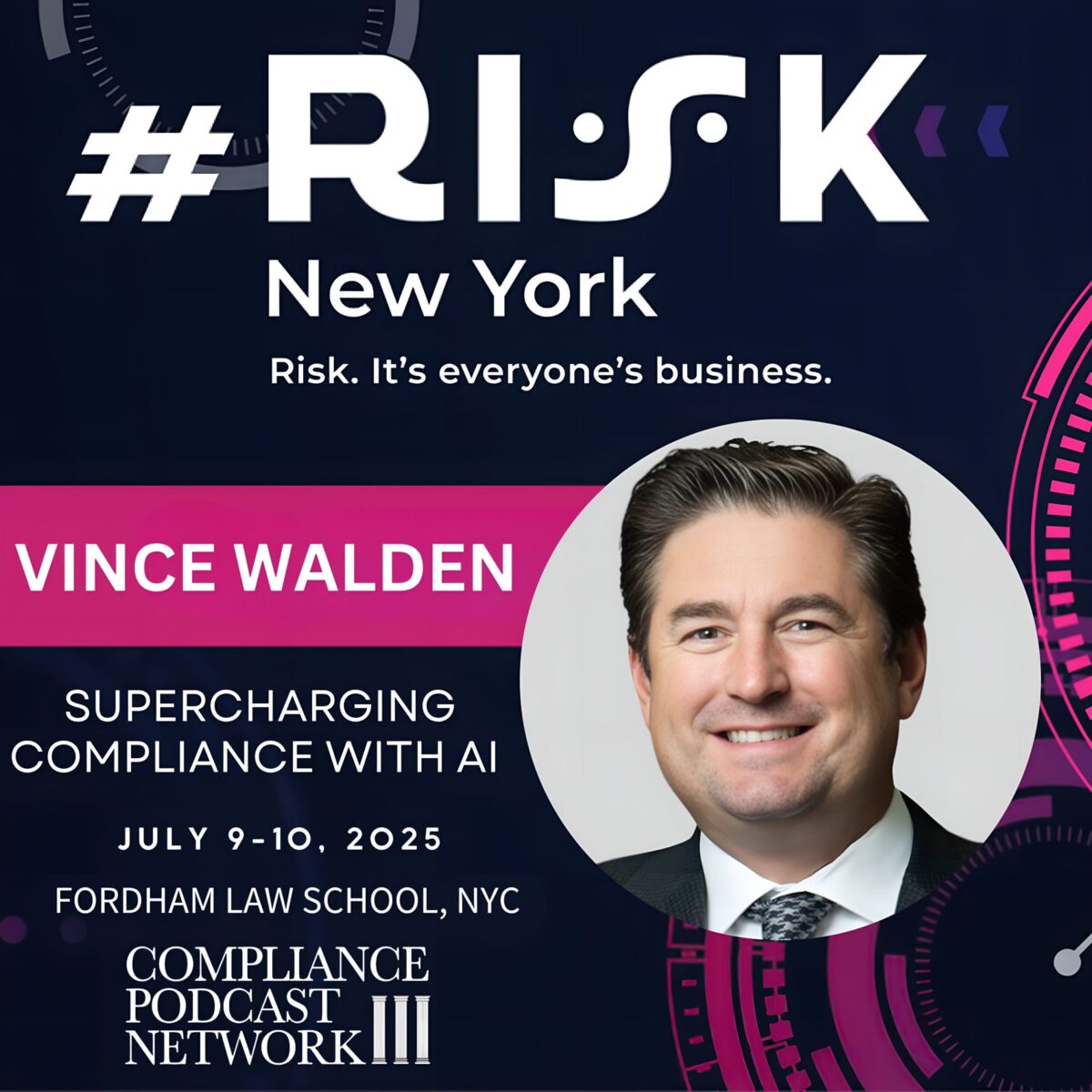
#Risk New York Speaker Series – Supercharging Compliance with AI with Vince Walden

Join Tom Fox and hundreds of other GRC professionals in the city that never sleeps, New York City, on July 9 & 10 for one of the top conferences around, #Risk New York. The current US landscape, shaped by evolving policies, rapid advancements in AI, and shifting global dynamics, demands adaptive strategies and cross-functional collaboration.

At #RISK New York, you will master the New Regulatory Reality by getting ahead of US regulatory shifts and their impact. Conquer AI and Tech Risk by Safeguarding Your Organization in an AI-Driven World and Understanding the Implications of Major Tech Investments. Navigate Financial and Crypto Volatility by Protecting Your Assets and Exploring Solutions in a Dynamic Market. Strengthen Your GRC Framework by Leveraging Governance, Risk, and Compliance for Strategic Advantage. Protect Digital Trust by addressing challenges in cybersecurity and data privacy, and combating misinformation. All while meeting with the country’s top #Risk management professionals.

In this episode of the Risk GRC speaker series, Tom Fox talks with Vince Walden, CEO of Kona AI, about his career in compliance, fraud, and risk management. Vince discusses his passion for data analytics and details the development of a new Compliance and Transaction Monitoring platform. They explore the use of AI, particularly predictive modeling and compliance language models, to enhance risk management. Vince also shares his excitement about the recent acquisition of his company by Covasant and the future of AI-driven compliance technology. The discussion ends with anticipation for the upcoming Risk NYC conference, where Vince looks forward to networking and exchanging insights on current risk challenges.

Resources:

#Risk Conference Series

#RiskNYC—Tickets and Information

Vince Walden on LinkedIn

Categories
Upping Your Game

Upping Your Game: Crowd-Sourcing Risk Management Intelligence with AI

In February, the Trump Administration suspended investigations under and enforcement of the FCPA. Many compliance professionals have since wondered what this will mean for corporate compliance programs going forward. Hui Chen challenged compliance professionals with the statement, “It’s time to up your game.”

This podcast series, sponsored by Ethico and co-hosted with Ethico co-CEO Nick Gallo, hopes to meet Hui Chen’s challenge. We will discuss how compliance professionals can ‘Up Their Game’ by utilizing currently existing Generative AI (GenAI) tools to significantly enhance their compliance programs. As compliance professionals, it is critical to recognize that this moment is not merely about incremental improvements but about elevating our profession to an entirely new level of effectiveness, efficiency, and organizational value.

In this episode, hosts Tom Fox and Nick Gallo explore the revolutionary potential of AI for Speak Up Cultures by introducing risk intelligence directly into business operations. They discuss the intricacies of whistleblowing, speak-up culture, and the integral role of AI and machine learning in enhancing compliance programs. They highlight deficiencies in current systems and propose how AI can crowdsource risk intelligence at scale, improve case triage, and facilitate a collaborative environment. Key points include the importance of anonymity, efficient triage, and how AI facilitates communication with employees in their preferred settings. The discussion also explores transforming the culture of compliance into proactive risk management, ultimately driving efficiency, effectiveness, and a better corporate culture.

Key highlights:

  • Deficiencies in Whistleblowing Processes
  • Crowdsourcing Risk Intelligence
  • The Importance of Anonymity and AI in Reporting
  • Engagement and Communication Strategies
  • AI in Triage and Investigation

Resources:

Upping Your Game-How Compliance and Risk Management Move to 2030 and Beyond on Amazon.com

Nick Gallo on LinkedIn

Ethico

Tom Fox

Instagram

Facebook

YouTube

Twitter

LinkedIn

Categories
Everything Compliance - Shout Outs and Rants

Shout Outs and Rants: Episode 156, To Document or Not

Welcome to this edition of Everything Compliance, Shout-Outs, and Rants. In this episode, we have the quintet of Matt Kelly, Jonathan Marks, Jonathan Armstrong, Karen Woody, and Karen Moore. It’s all hosted by Tom Fox.

  1. Karen Moore shouts out to beleaguered college grads and their difficulties in job searches.
  2. Matt Kelly shouts out to Netflix shareholders to vote off the Board a recalcitrant member.
  3. Jonathan Marks shouts out to graceful leaders and singles out Princess Kate.
  4. Karen Woody shouts out to the Indiana Pacers for defying all the odds.
  5. Jonathan Armstrong shouts out to cricket great Jimmy Anderson.
  6. Tom Fox shouts out the 7 most famous words in American history, “When in the course of human events…” and asks you to think about what they mean in 2025.

The members of Everything Compliance are:

Tom Fox, the Voice of Compliance, is the host, producer, and sometimes panelist of Everything Compliance. He can be reached at tfox@tfoxlaw.com. The award-winning Everything Compliance is part of the Compliance Podcast Network.

Categories
Trekking Through Compliance

Trekking Through Compliance: Episode 23 – Investigative Lessons from A Taste of Armageddon for Compliance Professionals

The episode “A Taste of Armageddon” offers a gripping narrative about two planets waging a computerized war, where casualties are “virtual” until real people are targeted for destruction by assassination teams. Beyond its science fiction thrills, this episode offers a rich canvas for compliance investigators to glean valuable insights into corporate investigations, risk management, and ethical decision-making. Today, we explore five investigative lessons drawn from “A Taste of Armageddon” that every compliance professional can apply in today’s complex corporate environment.

Lesson 1: Don’t Accept the Surface Narrative—Dig Deeper

Illustrated By: Captain Kirk and the Enterprise crew arrive at the planet Eminiar VII and are briefed on a bizarre ongoing “war” with their neighboring planet, Vendikar. They’re told the conflict is conducted entirely through computer simulations, with casualties happening only because of computer-generated attack orders. The officials claim that this system prevents physical destruction and loss of infrastructure.

Compliance Lesson: Compliance must have robust evidence-gathering protocols, document reviews, interviews, digital forensics, and whistleblower input that go beyond the polished explanations offered by senior management or external parties.

Lesson 2: Recognize When Systems Are Manipulated to Conceal Real Harm

Illustrated By: As Kirk digs deeper, he discovers that the “war” computer directs citizens of Eminiar VII to “self-destruct” (die) to simulate casualties, a brutal reality masked by the sanitized computer war facade. The computerized system is essentially a tool to hide the true human cost of conflict under the guise of civility.

Compliance Lesson: Investigators must be vigilant in identifying situations where systems, reports, or data are manipulated to conceal wrongdoing or minimize apparent risk.

Lesson 3: Challenge Institutionalized Norms When They Violate Ethics

Illustrated by: The people of Eminiar VII believe their system is rational and ethical because it avoids the destruction of infrastructure and reduces collateral damage. Yet, the human toll is real and horrific. Kirk challenges this “civilized” war system, calling out the moral bankruptcy of a process that sanctions systematic killing under bureaucratic rules.

Compliance Lesson: Investigators should be empowered to raise red flags about practices that may be “business as usual” internally but are fundamentally unethical or illegal.

Lesson 4: Collaborate Across Teams to Confront Complex Issues

Illustrated By: To expose the truth and disrupt the false war, Kirk and his crew collaborate with disillusioned Eminian officials and civilians. This cooperation allows them to understand the deeper reality and develop strategies to end the deceptive conflict.

Compliance Lesson: Investigative collaboration fosters comprehensive fact-finding, more accurate risk assessments, and the development of effective remediation strategies.

Lesson 5: Be Prepared to Disrupt Business as Usual for the Sake of Ethics

Illustrated By: Kirk’s ultimate act is to disable Eminiar VII’s computer war system, forcing the planet’s leaders to face the harsh realities of war without the illusion of sanitized casualty reports. This disrupts their entire way of life, but is necessary to restore true peace and ethical accountability.

Compliance Lesson: Compliance leaders must be prepared to recommend and implement significant changes, even if they are disruptive, to address systemic issues.

Final ComplianceLog Reflections

Star Trek’s “A Taste of Armageddon” is a compelling allegory about the dangers of complacency, obfuscation, and ethical compromise. For corporate compliance professionals, the episode provides a blueprint for rigorous, courageous, and collaborative investigations that delve beyond polished narratives to uncover uncomfortable truths.

In a business universe full of hidden risks and “virtual wars,” compliance investigations serve as a beacon guiding companies toward ethical and sustainable success. Like the crew of the Enterprise, compliance professionals must be prepared to boldly go where few dare to look and make a tangible difference in their organizations.

Resources:

Excruciatingly Detailed Plot Summary by Eric W. Weisstein

MissionLogPodcast.com

Memory Alpha

Categories
SBR - Authors' Podcast

SBR-Authors Podcast: Unconditional Values in Leadership and Compliance with Andy Crocker

Welcome to the SBR-Authors Podcast! In this podcast series, host Tom Fox visits with authors in the compliance arena and beyond. In this episode, host Tom Fox is joined by aerospace engineer Andy Crocker to discuss his extensive career in aerospace, which encompasses projects ranging from designing launch vehicles to missions focused on sending humans back to the moon.

Crocker examines the impact of these values on teamwork, the limitations of conditional leadership, and the importance of compliance as a natural outcome of a value-driven organization. The discussion also touches on Crocker’s transition phase, his thoughts on instilling these values in broader industry contexts beyond aerospace, and how they can be particularly pivotal for young professionals.

Key highlights:

  • Andy Crocker’s Professional Background
  • The Magic of Rocket Science
  • Transitioning from Tactical to Strategic
  • Values and Leadership in Aerospace
  • The Lunar Landing Competition
  • The Trap of Conditional Leadership
  • Character vs. Compliance
  • Compliance as a Superpower
  • Andy Crocker’s Writing Process

Resources:

Andy Crocker at PR by the Book

Andy Crocker Books on Facebook

Andy Crocker on LinkedIn

Andy Crocker Books Website

PR by the Book Website

Tom Fox

Instagram

Facebook

YouTube

Twitter

LinkedIn

Categories
Daily Compliance News

Daily Compliance News: June 24, 2025, The Questions, Questions and More Questions Edition

Welcome to the Daily Compliance News. Each day, Tom Fox, the Voice of Compliance, brings you compliance-related stories to start your day. Sit back, enjoy a cup of morning coffee, and listen in to the Daily Compliance News. All from the Compliance Podcast Network. Each day, we consider four stories from the business world: compliance, ethics, risk management, leadership, or general interest, all relevant to the compliance professional.

Top compliance stories:

  • Is it safe for Americans to travel abroad? (NYT)
  • What happens when the boss works remotely? (FT)
  • Is bias built into hiring algorithms? (WSJ)
  • Are Canadian companies at risk due to the US’s lack of ABC enforcement? (Globe and Mail)
Categories
Innovation in Compliance

Innovation in Compliance: LeadHERship with Linda Fisk

Innovation is present in many areas, and compliance professionals must not only be prepared for it but also actively embrace it. Join Tom Fox, the Voice of Compliance, as he visits with top innovative minds, thinkers, and creators in the award-winning Innovation in Compliance podcast. In this episode, host Tom Fox visits Linda Fisk, the leader of LeadHERship Global, to discuss the challenges and opportunities faced by female entrepreneurs.

Linda shares her extensive professional journey, from serving as a CMO at notable media companies to founding LeadHERship Global. They discuss the impressive yet under-recognized contributions of women entrepreneurs in the U.S. economy, highlighting stats and trends around new business ventures led by women, especially women of color. Linda emphasizes the ongoing difficulties women face in accessing capital and offers practical steps for success, including addressing stereotypes, learning from each other, and creating supportive networks. The conversation closes with insights on how LeadHERship Global helps women thrive professionally and how men can support this movement. Linda also mentions her recent anthology, “LeadHERship Unveiled,” which features inspiring stories from women leaders.

Key highlights:

  • Current Landscape for Female Entrepreneurs
  • Challenges in Funding for Women Entrepreneurs
  • Practical Steps for Women Entrepreneurs
  • The Vision Behind LeadHERship Global

Resources:

LeadHERship Website

Tom Fox

Instagram

Facebook

YouTube

Twitter

LinkedIn

Categories
Red Flags Rising

Red Flags Rising: S01 E17 – Data-Driven Root-Cause Analysis with Erika Trujillo of SEIA

Mike & Brent welcome Erika Trujillo, Managing Director of SEIA (“say-a”), who, with her company, brings advanced data analytics solutions to solving trade compliance problems. Mike and Brent discuss Erika’s background and the services SEIA provides (00:14); how advanced data analytics can help with export controls risk assessments by, among other things, bringing to bear data from across multiple departments (which is particularly important under U.S. law’s collective knowledge doctrine and the “high probability” standard) (02:10); the importance of differentiating between your company’s “internal data” and the “external data” and of identifying and leveraging what internal data might be sitting within reach (05:03); the importance of contextualization, i.e., taking a holistic perspective at potentially interesting data points that only become informative in the context of other data points, for example data suggesting that EAR99 items that otherwise would not require an export license might be exported for prohibited end-uses or to prohibited end-users (06:53); the need for companies to have the courage to engage with their own data, especially since they are making statements to various governments in any case about their trade flows (09:21); how small- and medium-sized companies can start, step-by-step, to get a handle on their internal data (10:53); how to respond to reports or allegations (i.e., “red flags”) of potential export control violations (12:18); common data pitfalls to avoid (13:51); the importance of prioritization not just in terms of data cleanup projects (14:28); why praying to the accounting platform gods and hoping everything is OK is not sufficient (16:00); the full definition of knowledge (including an awareness of a high probability) and what opportunities that presents for risk-based approaches to trade compliance (16:35); how a data-driven approach to trade compliance can help improve relationships with colleagues in sales and operational functions (18:39); how to overcome the fear of what you might find by taking a deeper dive into your company’s data (19:28); and how a data-driven approach can help with c-suites and boards of directors (20:13). We conclude with a surprise twist in the ever-popular segment, Brent Carlson’s “Managing Up,” in exploring Erika’s mission and purpose in co-founding SEIA.

Resources:

More about SEIA

Contact or Book a Demo with SEIA

Contact Erika

Brent LinkedIn

Mike LinkedIn

Mike & Brent’s “Fresh Looks” Series