Categories
Hill Country Hustlers

Hill Country Hustlers – Building Success and Overcoming Challenges with Ross Dunagan of Flyin’ Diesel Performance

In this episode of the Hill Country Hustlers Podcast, host Zach Green speaks with Ross Dunagan, the owner of Flyin’ Diesel Performance, to discuss his journey from starting a small mom-and-pop shop to growing a thriving business in Kerrville, Texas. Ross shares his background, the challenges he faced starting, and the importance of overcoming fear and leveraging available resources. He delves into the significance of communication, loyalty, and making use of key ratios to ensure business growth. Ross also highlights the evolving nature of leadership and the importance of employee relationships in a successful business. The conversation touches on the rewards of entrepreneurship, the joy of giving back to the community, and the continuous pursuit of personal and professional growth.

Key highlights:

  • Challenges and Overcoming Fear in Entrepreneurship
  • The Importance of Relationships and Networking
  • Managing Growth and Leadership
  • Handling Rapid Business Growth
  • The Role of Communication in Business
  • The Entrepreneurial Spirit

Resources:

Zach Green on LinkedIn

Flyin Diesel Performance

Categories
Compliance Into the Weeds

Compliance into the Weeds: Boeing’s New Safety Initiatives and Compliance Reforms

The award-winning Compliance into the Weeds is the only weekly podcast that takes a deep dive into a compliance-related topic, literally going into the weeds to explore a subject more fully. Are you seeking insightful perspectives on compliance? Look no further than Compliance into the Weeds! In this episode of Compliance into the Weeds, Tom Fox and Matt Kelly discuss Boeing’s recent safety initiatives and reforms, as outlined in their annual aerospace safety report.

They explore Boeing’s efforts to improve its speak-up culture, internal reporting systems, and the introduction of an expansive Safety Champions Program. The episode explores the procedural changes Boeing has implemented, including the handling of third-party reports and increased transparency for employees. Additionally, they examine the challenges and necessities of manager training in fostering an ethical corporate culture. The conversation concludes with insights on the recent Federal District Court hearing regarding Boeing’s non-prosecution agreement and the implications for transparency and accountability.

Key highlights:

  • Speak Up Culture Enhancements
  • Ambassador Program Expansion
  • Manager Training and Corporate Culture
  • Court Hearing on Boeing’s Non-Prosecution Agreement

Resources:

Matt Kelly in Radical Compliance

Tom

Instagram

Facebook

YouTube

Twitter

LinkedIn

A multi-award-winning podcast, Compliance into the Weeds, was most recently honored as one of the Top 25 Regulatory Compliance Podcasts, a Top 10 Business Law Podcast, and a Top 12 Risk Management Podcast.

Categories
Trekking Through Compliance

Trekking Through Compliance: Episode 24 – This Side of Paradise: Essential Takeaways for Compliance Vigilance

Show Summary

Star Trek has consistently excelled at blending imaginative storytelling with deeply reflective, ethical, and compliance lessons. In the episode “This Side of Paradise,” Captain Kirk and the crew of the USS Enterprise visit a colony thought to be lost, only to discover colonists who appear unnaturally happy and content due to the influence of strange alien spores. These spores eliminate negative emotions and ambition, creating an illusion of paradise. However, beneath the serene surface lies an unsettling truth, one that reveals significant lessons for corporate compliance professionals.

Lesson 1: The Danger of Complacency

Illustrated By: Upon their arrival, Captain Kirk and his crew are astonished at how content and relaxed the colonists appear, lacking any sense of urgency or purpose beyond their immediate happiness. The spores create an environment devoid of ambition or challenge.

Compliance Lesson: Complacency is a significant risk in corporate compliance. When companies become too comfortable, essential controls can slip, leaving vulnerabilities unnoticed.

Lesson 2: Understanding the Real Nature of Risks

Illustrated by Spock, affected by the spores, embracing an emotional side long repressed, initially finding joy and peace. Yet, Kirk soon realizes that beneath the artificial happiness lies a dangerous stagnation and lack of progress.

Compliance Lesson: Compliance officers must develop comprehensive risk assessment processes that look beneath surface-level compliance indicators.

Lesson 3: The Critical Importance of Culture

Illustrated By: Despite being seduced by the spores’ false paradise, Captain Kirk resists their influence due to his strong commitment to duty and mission, illustrating his deeply embedded professional and personal integrity.

Compliance Lesson: Organizations that foster strong ethical values and clearly defined principles are better equipped to withstand pressures and challenges.

Lesson 4: The Necessity of Clear and Effective Communication

Illustrated by: Kirk ultimately defeats the spores by broadcasting an emotionally charged message that disrupts their tranquilizing effects, restoring awareness and rational thinking to the affected crew.

Compliance Lesson: Compliance officers must clearly articulate expectations, rules, and regulations through targeted and impactful messaging.

Lesson 5: Resilience in the Face of Adversity

Illustrated By: After breaking the spores’ influence, the crew members realize the illusory nature of their paradise and recommit themselves to their mission and responsibilities, emerging stronger and more focused.

Compliance Lesson: Encouraging resilience involves preparing for potential compliance breaches with robust response plans, clear accountability structures, and lessons-learned reviews.

Final ComplianceLog Reflections

This Side of Paradise offers a vivid metaphor for corporate compliance professionals, illustrating the dangers lurking within complacency, the hidden nature of certain risks, and the powerful influence of a well-embedded compliance culture. By emphasizing proactive vigilance, thorough risk assessments, robust communication, and organizational resilience, compliance leaders can steer their companies clear of deceptively comfortable but ultimately harmful situations. Like Captain Kirk, compliance professionals must boldly confront challenges, keeping the integrity and commitment central to their mission and ensuring sustainable and ethical organizational success.

Resources:

Excruciatingly Detailed Plot Summary by Eric W. Weisstein

MissionLogPodcast.com

Memory Alpha

Categories
Compliance Tip of the Day

Compliance Tip of the Day – COSO Objective 3 – Control Activities

Welcome to “Compliance Tip of the Day,” the podcast that brings you daily insights and practical advice on navigating the ever-evolving landscape of compliance and regulatory requirements. Whether you’re a seasoned compliance professional or just starting your journey, our goal is to provide you with bite-sized, actionable tips to help you stay ahead in your compliance efforts. Join us as we explore the latest industry trends, share best practices, and demystify complex compliance issues to keep your organization on the right side of the law. Tune in daily for your dose of compliance wisdom, and let’s make compliance a little less daunting, one tip at a time.

Today, we continue our look at the 5 COSO objections. Today, Number III—Control Activities.

For more information on this topic, refer to The Compliance Handbook: A Guide to Operationalizing Your Compliance Program, 6th edition, recently released by LexisNexis. It is available here.

Categories
Daily Compliance News

Daily Compliance News: June 25, 2025, The PCAOB Elimination Hits Roadblock Edition

Welcome to the Daily Compliance News. Each day, Tom Fox, the Voice of Compliance, brings you compliance-related stories to start your day. Sit back, enjoy a cup of morning coffee, and listen in to the Daily Compliance News. All from the Compliance Podcast Network. Each day, we consider four stories from the business world: compliance, ethics, risk management, leadership, or general interest, all relevant to the compliance professional.

Top compliance stories:

  • DeepSeek is bad, very bad for the US. (Reuters)
  • A global AI divide isn’t coming; it’s here. (NYT)
  • PCAOB elimination hits a roadblock. (WSJ)
  • Tesla was threatened in France for deceptive marketing. (FT)
Categories
Great Women in Compliance

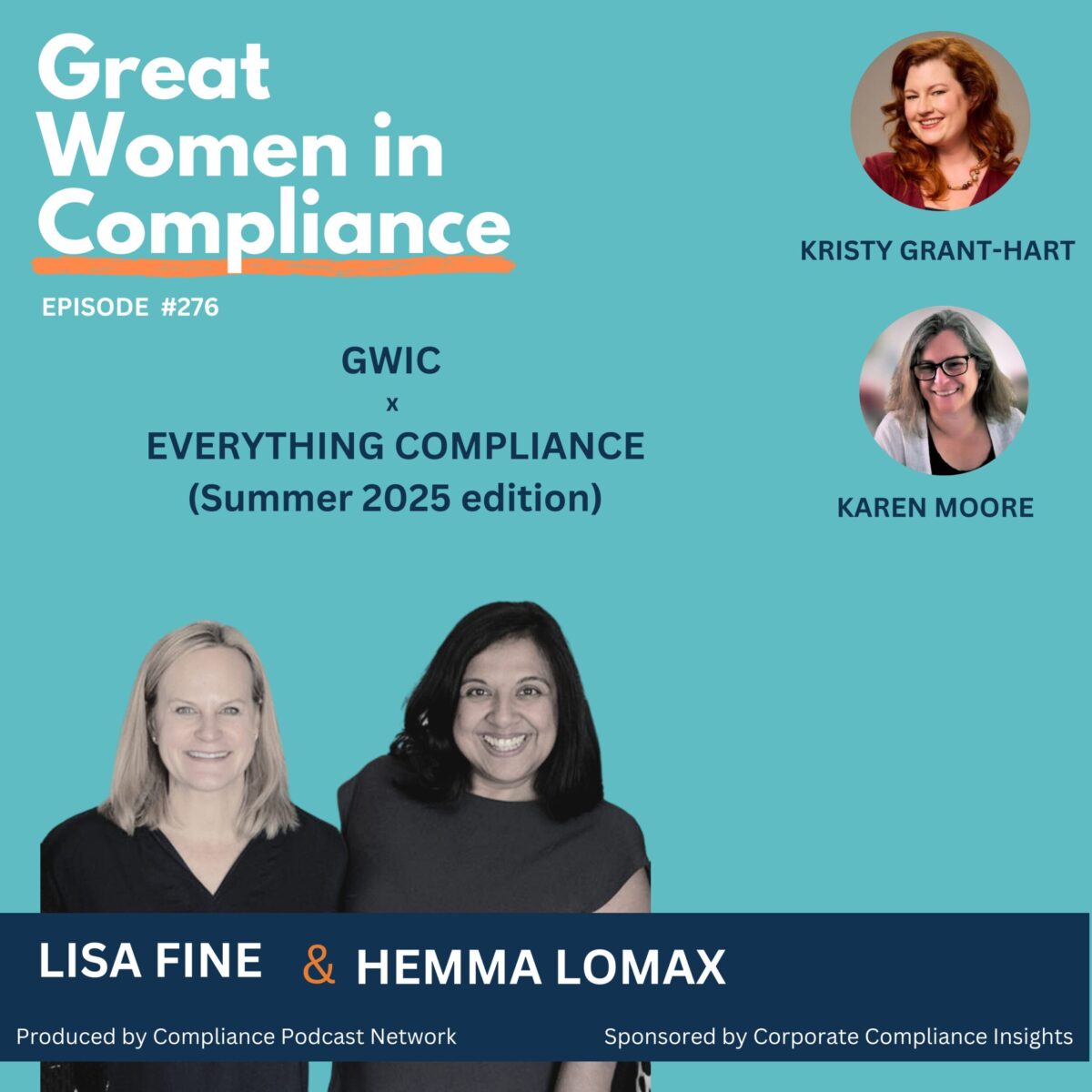
Great Women in Compliance: GWIC X EC Q2 2025 – Exploring Compliance Innovations

We’re back with another GWIC x EC crossover episode. Today, we have the quartet of Great Women in Compliance of Kristy Grant-Hart, Karen Moore, Lisa Fine, and Hemma Lomax.

The GWIC quartet discusses various intriguing topics related to compliance. Lisa Fine kicks off the conversation by discussing the new ‘failure to prevent fraud’ guidance in the UK, which places greater responsibility on companies to avoid engaging in fraud. The group delves into the implications of this law and its extraterritorial elements. Hemma Lomax shifts the conversation to changes in the False Claims Act in the US, highlighting its expanded use beyond fraudulent billing to areas like cybersecurity and diversity obligations. Karen Moore introduces the innovative ‘Karma’ rewards system by Revolut Bank in the UK, which incentivizes compliance behaviors through team performance multipliers. Kristy Grant-Hart wraps up with a fascinating discussion on AI, touching on AI’s potential as a whistleblower and whether AI could attain employment rights if it becomes sentient. They conclude by sharing their rants and raves, offering insights on topics ranging from the importance of local theaters to women’s leadership in compliance.

Join the Great Women in Compliance community on LinkedIn ⁠here⁠

Categories
Blog

Illusions of Compliance Paradise: Essential Takeaways from Star Trek for Corporate Vigilance

Show Summary

Star Trek has consistently excelled at blending imaginative storytelling with deeply reflective, ethical, and compliance lessons. In the episode “This Side of Paradise,” Captain Kirk and the crew of the USS Enterprise visit a colony thought to be lost, only to discover colonists who appear unnaturally happy and content due to the influence of strange alien spores. These spores eliminate negative emotions and ambition, creating an illusion of paradise. However, beneath the serene surface lies an unsettling truth, one that reveals significant lessons for corporate compliance professionals. Here are five key lessons.

Lesson 1: The Danger of Complacency

Illustrated By: Upon their arrival, Captain Kirk and his crew are astonished at how content and relaxed the colonists appear, lacking any sense of urgency or purpose beyond their immediate happiness. The spores create an environment devoid of ambition or challenge.

Compliance Lesson: Complacency is a significant risk in corporate compliance. When companies become too comfortable, essential controls can slip, leaving vulnerabilities unnoticed. Regularly scheduled compliance audits and continual education programs keep organizations vigilant, proactive, and adaptable to regulatory shifts and evolving risks. Compliance professionals must foster an environment that constantly challenges complacency, encouraging active questioning and continual improvement.

Lesson 2: Understanding the Real Nature of Risks

Illustrated by Spock, affected by the spores, embracing an emotional side long repressed, initially finding joy and peace. Yet, Kirk soon realizes that beneath the artificial happiness lies a dangerous stagnation and lack of progress.

Compliance Lesson: Not all risks are immediately apparent. Compliance officers must develop comprehensive risk assessment processes that look beneath surface-level compliance indicators. In-depth analyses should consider potential indirect impacts and hidden dangers within seemingly benign situations. Organizations benefit significantly from continuously evolving their risk management strategies, remaining alert to subtler, systemic issues that can be more damaging than obvious violations.

Lesson 3: The Critical Importance of Culture

Illustrated By: Despite being seduced by the spores’ false paradise, Captain Kirk resists their influence due to his strong commitment to duty and mission, illustrating his deeply embedded professional and personal integrity.

Compliance Lesson: A robust compliance culture is vital in resisting unethical temptations. Organizations that foster strong ethical values and clearly defined principles are better equipped to withstand pressures and challenges. Compliance officers should promote integrity as a foundational corporate value, embedding it deeply within organizational practices. Culture-building initiatives, training programs, and leadership modeling are instrumental in cultivating resilient and ethical business environments.

Lesson 4: The Necessity of Clear and Effective Communication

Illustrated by: Kirk ultimately defeats the spores by broadcasting an emotionally charged message that disrupts their tranquilizing effects, restoring awareness and rational thinking to the affected crew.

Compliance Lesson: Effective communication is fundamental to a successful compliance program. Compliance officers must clearly articulate expectations, rules, and regulations through targeted and impactful messaging. Open, transparent, and frequent communication helps ensure that all team members clearly understand their roles and responsibilities. Regular updates, engaging training materials, and accessible compliance resources enhance the effectiveness of compliance communication, reducing misunderstandings and promoting transparency.

Lesson 5: Resilience in the Face of Adversity

Illustrated By: After breaking the spores’ influence, the crew members realize the illusory nature of their paradise and recommit themselves to their mission and responsibilities, emerging stronger and more focused.

Compliance Lesson: Organizations must develop resilience to respond effectively to compliance setbacks and regulatory challenges. Encouraging resilience involves preparing for potential compliance breaches with robust response plans, clear accountability structures, and lessons-learned reviews. Compliance officers play a pivotal role in guiding organizations through crises, ensuring that lessons are integrated into future operations, and strengthening the company’s overall compliance posture.

Final ComplianceLog Reflections

Star Trek’s “This Side of Paradise” offers a vivid metaphor for corporate compliance professionals, illustrating the dangers lurking within complacency, the hidden nature of certain risks, and the powerful influence of a well-embedded compliance culture. By emphasizing proactive vigilance, thorough risk assessments, robust communication, and organizational resilience, compliance leaders can steer their companies clear of deceptively comfortable but ultimately harmful situations. Like Captain Kirk, compliance professionals must boldly confront challenges, keeping the integrity and commitment central to their mission and ensuring sustainable and ethical organizational success.

Resources:

Excruciatingly Detailed Plot Summary by Eric W. Weisstein

MissionLogPodcast.com

Memory Alpha

Categories
Blog

The Boeing 737 Max Imbroglio: Part 2 – A Path Forward with a Special Master

In recent weeks, the spotlight has again intensified on The Boeing Company, following a provocative motion filed by families of victims from the tragic 737 Max crashes. They have petitioned a Texas federal judge to appoint a special prosecutor in Boeing’s criminal conspiracy case, arguing fervently against the Department of Justice’s recent Non-Prosecution Agreement (NPA) with Boeing. At stake is not merely corporate accountability but, fundamentally, the integrity of our justice system itself. If all a company is required to do under the Department of Justice (DOJ) is throw money at a series of problems, there will never be true reform.

Yesterday, I began a two-part look at the current set of issues raised in the DOJ capitulation to Boeing, its ignoring of the families of the crash victims, and its complete lack of holding Boeing accountable beyond financial penalties. Today, I want to conclude this short series by proposing a path forward that helps to ameliorate the rights of the parties as well as all the other stakeholders involved in this Boeing imbroglio.

For reasons that are not articulated, the DOJ has dropped its requirement for an Independent Corporate Monitor to oversee the overhaul of culture at Boeing, instead allowing a Boeing-hired compliance consultant to be part of the process. This is wholly insufficient as it requires zero transparency for any of the key parties to the litigation: the families of the victims of the 737 MAX crashes, the Court, and even the DOJ itself. Indeed, the DOJ did not even consult with the families of the victims, as it was reported that the DOJ gave them one day’s notice that it was going to provide Boeing with a Non-Prosecution Agreement (NPA) with no Independent Compliance Monitor.

The significance of an Independent Compliance Monitor tasked with overseeing Boeing’s adherence to compliance and safety protocols over the next three years cannot be overstated. The role of an Independent Compliance Monitor in this case should be expansive. Beyond traditional compliance responsibilities, such as policies, procedures, internal controls, and training, the Independent Compliance Monitor should also address anti-fraud measures, safety, and quality assurance/control (QA/QC) issues. This broader remit is essential, given the systemic failures at Boeing that contributed to the 737 MAX disasters. (Looming, of course, is the 787 Dreamliner crash in India.)

The DOJ previously found disturbing lapses in Boeing’s safety and quality records.  It is unclear whether the DOJ has revised these findings in light of its proposed NPA. Boeing employees reported feeling pressured to prioritize productivity and financial performance over safety and quality, a cultural flaw that contributed to the compliance breaches. This pressure led to out-of-sequence work, poor record-keeping, and inadequate safety audits, all of which are indicative of a deeper systemic problem.

Addressing these issues requires a comprehensive culture-focused approach. An Independent Compliance Monitor must not only enforce existing standards but also foster a culture of integrity and transparency within Boeing. This involves ensuring that employees can report concerns without fear of retaliation and that safety protocols are rigorously followed and documented.

The families of the crash victims are not mere bystanders in this process. They have voiced strong objections to this NPA, particularly its leniency and the lack of accountability for senior executives, as well as for any future actions by Boeing. They argue that the NPA exonerates those responsible for the safety lapses. This concern resonates with many compliance professionals who advocate for robust accountability at all levels of an organization.

In light of the unique facts and procedural history of this matter, judicial oversight will be crucial in ensuring that an Independent Compliance Monitor leads to genuine remediation. Transparency is a cornerstone of effective compliance and accountability, and its absence could undermine the entire process.

This is where the District Court should step in and appoint a Special Master to act as an Independent Compliance Monitor. Under the Federal Rules of Procedure, a District Court can appoint a Special Master to monitor compliance with court orders or settlement agreements. This can be especially useful in cases where the parties have a history of noncompliance or need ongoing oversight. The appointment of a Special Master is a powerful option for this specific fact pattern.

For Boeing to restore its reputation and regain public trust, it must go beyond the minimum requirements of the NPA. This involves a commitment to comprehensive remediation, encompassing cultural change, structural reforms, and rigorous enforcement of safety and compliance standards. All done with transparency.

A Special Master’s remit would be a step in the right direction, but it must be accompanied by genuine transparency and accountability. This includes involving the victims’ families in meaningful ways, such as through regular updates and consultations, and ensuring that their concerns are addressed substantively. In other words, transparency.

The Boeing case serves as a stark reminder of the critical importance of compliance, transparency, and accountability in the corporate world. It highlights the devastating consequences of systemic failures and the urgent need for robust oversight mechanisms. As compliance professionals, we must advocate for comprehensive and transparent processes that ensure not only compliance with legal standards but also the fostering of a culture of integrity and responsibility.

Ultimately, true remediation and accountability are in the best interests of all stakeholders, from the victims’ families seeking justice to the company itself, which strives to rebuild its reputation and restore public trust.  The DOJ has completely abrogated its role in this moving forward. However, the District Court can facilitate this process by appointing a Special Master who can act as an Independent Compliance Monitor.

The path forward is clear: there must be a firm commitment to rigorous compliance, transparent practices, and a culture that prioritizes safety and integrity above all else. However, this must be accompanied by independent oversight. If the DOJ does not wish to assume this role, the District Court should consider appointing a Special Master. Only then can it hope to move beyond the shadows of the 737 MAX scandal and emerge as a leader in the aviation industry once again.