Categories
Compliance Tip of the Day

Compliance Tip of the Day – Compliance Responses to Design Intelligence

Welcome to “Compliance Tip of the Day,” the podcast that brings you daily insights and practical advice on navigating the ever-evolving landscape of compliance and regulatory requirements. Whether you’re a seasoned compliance professional or just starting your journey, our goal is to provide you with bite-sized, actionable tips to help you stay ahead in your compliance efforts. Join us as we explore the latest industry trends, share best practices, and demystify complex compliance issues to keep your organization on the right side of the law. Tune in daily for your dose of compliance wisdom, and let’s make compliance a little less daunting, one tip at a time.

Today, we consider how CCOs and compliance programs need to respond to design intelligence.

For more information on this topic, refer to The Compliance Handbook: A Guide to Operationalizing Your Compliance Program, 6th edition, recently released by LexisNexis. It is available here.

Categories
Compliance Into the Weeds

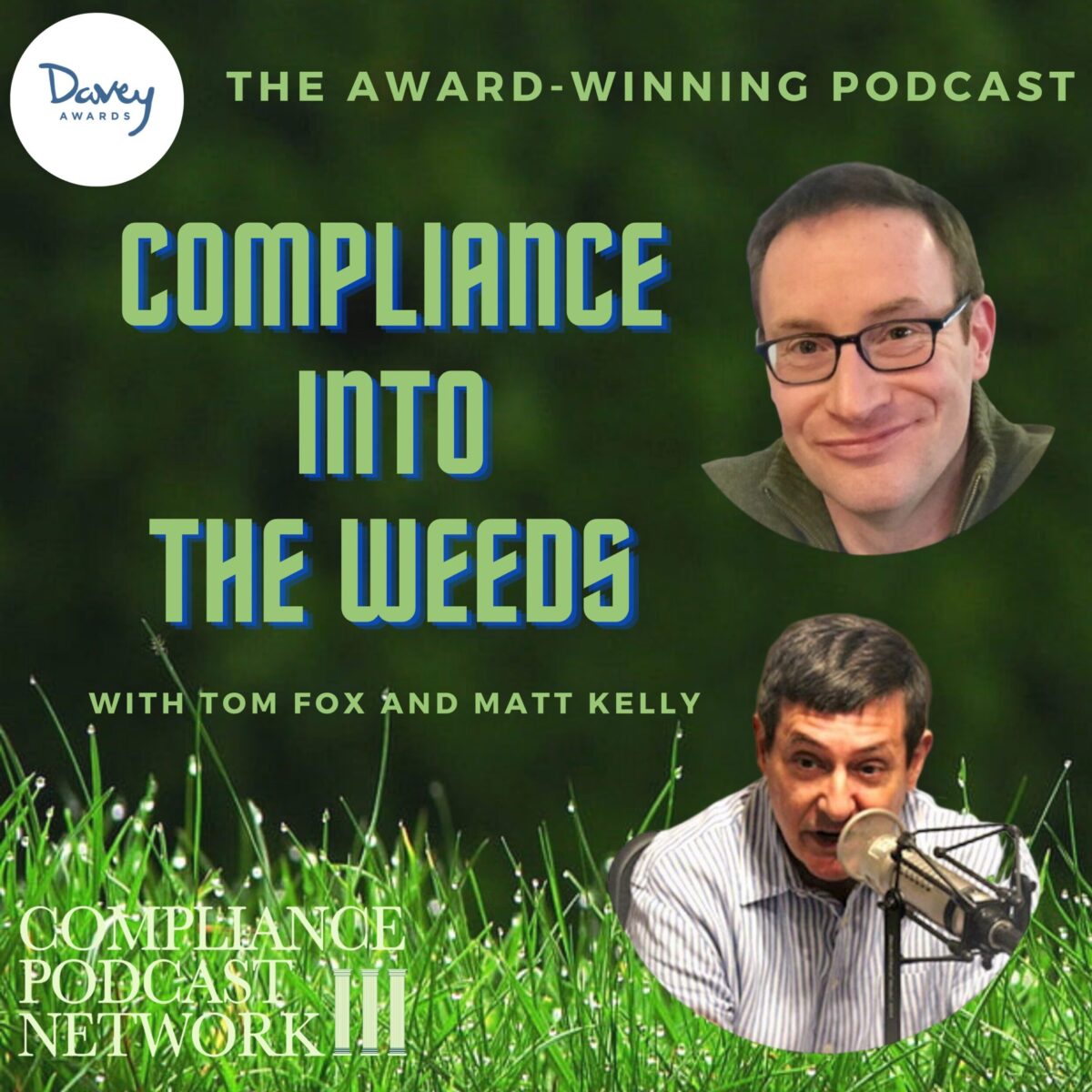
Compliance into the Weeds: Sanctions Compliance Failures: Lessons from Harman International and Interactive Brokers

The award-winning Compliance into the Weeds is the only weekly podcast that takes a deep dive into a compliance-related topic, literally going into the weeds to explore a subject more fully. Seeking insightful perspectives on compliance? Look no further than Compliance into the Weeds! In this episode of Compliance into the Weeds, Tom Fox and Matt Kelly discuss two recent OFAC enforcement actions involving Harman International and Interactive Brokers and the lessons they provide for compliance professionals.

Tom and Matt delve into the facts of both cases, finding under-resourced sanctions compliance programs in both companies. They highlight key issues, including inadequate personnel, misconfigured compliance tools, and a failure to conduct proper risk assessments. Despite self-disclosure and cooperation, both companies faced significant fines and were required to implement extensive remediation measures. The discussion highlights the growing importance of robust sanctions compliance programs in mitigating risks and preventing enforcement actions.

Key highlights:

  • Sanctions Enforcement Cases Overview
  • Harman International’s Compliance Failures
  • Interactive Brokers’ Compliance Issues
  • Lessons and Final Thoughts

Resources:

Matt Kelly in Radical Compliance

Tom

Instagram

Facebook

YouTube

Twitter

LinkedIn

A multi-award-winning podcast, Compliance into the Weeds was most recently honored as one of the Top 25 Regulatory Compliance Podcasts, a Top 10 Business Law Podcast, and a Top 12 Risk Management Podcast. Compliance into the Weeds has been conferred the Davey, Communicator, and W3 Awards for podcast excellence.

Categories
Great Women in Compliance

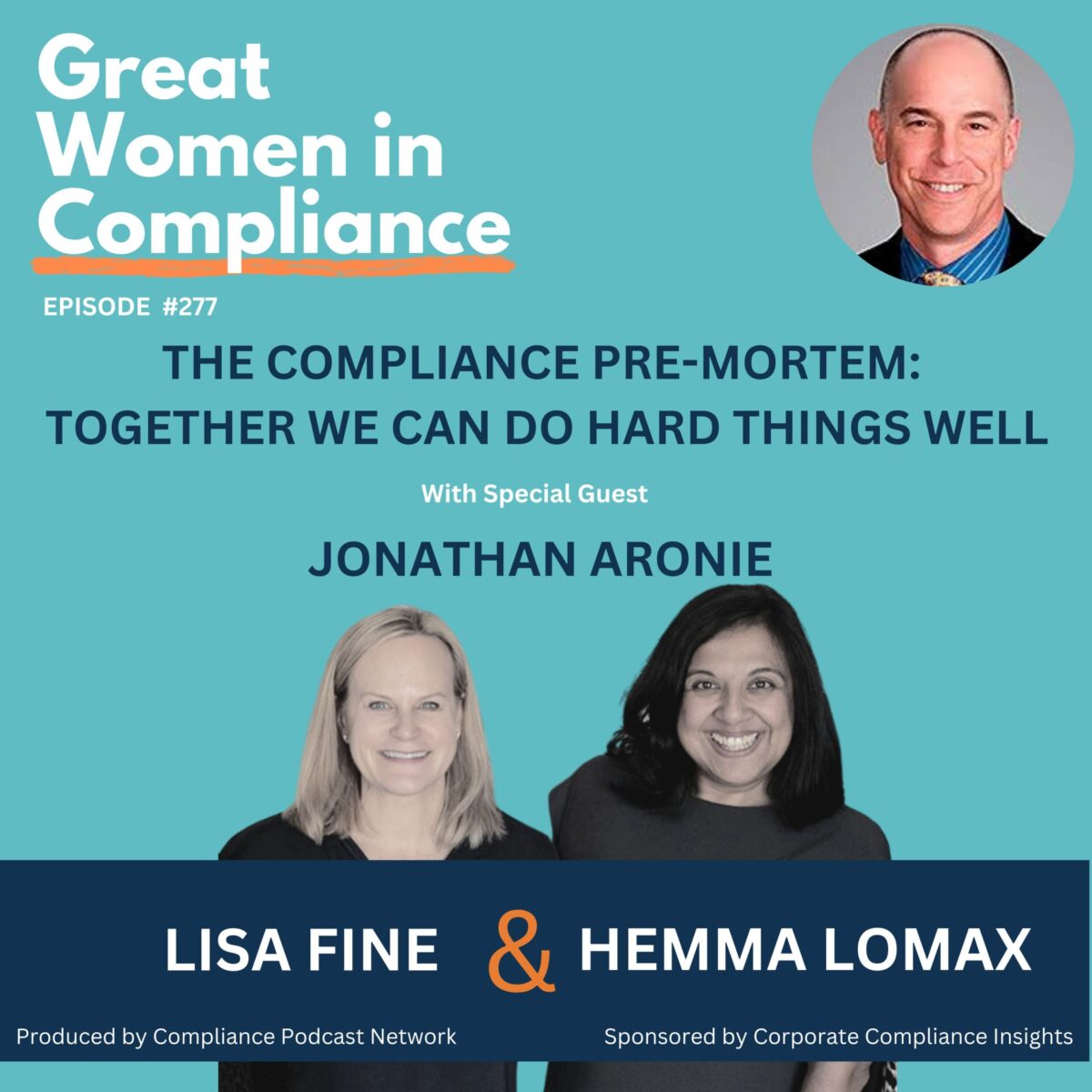
Great Women in Compliance – The Compliance Pre-Mortem: Together We Can Do Hard Things Well with Jonathan Aronie

This GWIC episode features a “Great Gentleman in Compliance,” Jonathan Aronie, a leading expert in government investigations and organizational integrity at Sheppard Mullin. Jonathan joins GWIC co-host Hemma Lomax to discuss his career journey, the innovative compliance tool known as the compliance pre-mortem, and the importance of proactive measures in compliance and governance. He also emphasizes the significance of active bystander intervention programs, derived from law enforcement, as highly effective tools for preventing misconduct in organizations. Additionally, Jonathan offers insights into the challenges and benefits of compliance programs, highlighting the need for continuous improvement and strategic empathy in these efforts.

  • The Psychology of Preventative Compliance
  • The ROI of Compliance and Integrity
  • The Concept of Pre-Mortem in Compliance
  • Common Risks and Blind Spots in Compliance
  • Active Bystander Programs vs. Compliance Hotlines
  • Lessons in Compliance and Culture from Policing
  • Building Continuous Improvement Frameworks
 

Biography

Jonathan Aronie is a partner in and the former leader of the firm’s Governmental Practice, resident in Washington, DC. Jonathan is also a founding member and current leader of the firm’s Organizational Integrity Group, a cross-disciplinary team of litigators, regulatory specialists, federal monitors, and ex-prosecutors with extensive experience helping organizations prevent and defend against challenges to their organizational integrity. 

Areas of Practice

Jonathan counsels and represents large and small businesses in some of the country’s most prominent classified and unclassified government contract matters, including bid protests, claims, self-disclosures, internal investigations, Department of Justice investigations, and False Claims Act investigations. As the leader of the firm’s Organizational Integrity Group, Jonathan also dedicates significant time to working with clients to identify and mitigate known and unknown risks before they become problems.

Jonathan’s experience includes litigating under the qui tam provisions of the False Claims Act, conducting early risk-based “legal pre-mortems,” developing and implementing corporate compliance programs, conducting internal investigations (proactive and defensive), and providing advice on the FAR Mandatory Disclosure Rule as well as a variety of federal regulatory and statutory matters. He frequently represents clients before the DOJ, the Government Accountability Office, the General Services Administration, and other defense and civilian agencies. Additionally, Jonathan is cleared at the highest levels and counsels and defends clients in classified matters.

Jonathan has authored more than 100 articles and co-authored what is regarded by many as the leading treatise on the GSA Multiple Award Schedule Program, published by Thomson Reuters. He is a regular speaker at national and international forums, as well as CLE programs, including government-sponsored symposia. He is a regular presenter at Coalition for Government Contracting programs and served on the ABA Task Force that drafted guidance regarding the FAR Mandatory Disclosure Rule.

https://www.sheppardmullin.com/jaronie

Resources

Sheppard Mullin’s Organizational Integrity Group

Active Bystandership for Law Enforcement

Everyone Benefits When An Ethics & Compliance Program Is Integrated Throughout An Organization. By: Jonathan Aronie,

Jonathan Aronie on LinkedIn

Categories
The Hill Country Podcast

The Hill Country Podcast – Trey Atkission: Leadership, Service, and Community in Kerrville

Welcome to award-winning The Hill Country Podcast. The Texas Hill Country is one of the most beautiful places on earth. In this podcast, Hill Country resident Tom Fox visits with the people and organizations that make this one of the most unique areas of Texas. This week, Tom welcomes Trey Atkission, the general manager of Cecil Atkission Motors in Kerrville.

Trey shares insights about his professional journey from studying accounting and professional selling at Baylor to his various roles in the automotive industry, culminating in his current leadership position. They discuss the unique combination of skills that have benefited Trey in his career, highlighting the importance of communication and sales abilities for accountants. Trey also reflects on the responsibilities and rewards of running a business in a small town, emphasizing the importance of community involvement and support. The episode also touches on the impact of the COVID-19 pandemic and Trey’s leadership during this challenging time.

Key highlights:

  • Trey Atkission’s Early Life and Education
  • Professional Journey: From Airplane Broker to Dealership Manager
  • Community Involvement and Responsibilities

Resources:

Trey Atkission on LinkedIn

Cecil Atkission Motors Website

Other Hill Country Network Podcasts

Hill Country Authors Podcast

Hill Country Artists Podcast

Texas Hill Country Podcast Network

Artwork

Nancy Huffman Fine Art

Categories
Daily Compliance News

Daily Compliance News: July 23, 2025, The Pardon in the Wind Edition

Welcome to the Daily Compliance News. Each day, Tom Fox, the Voice of Compliance, brings to you compliance-related stories to start your day. Sit back, enjoy a cup of morning coffee, and listen in to the Daily Compliance News. All, from the Compliance Podcast Network. Each day, we consider four stories from the business world, including compliance, ethics, risk management, leadership, or general interest, relevant to the compliance professional.

Top stories include:

  • Former ComEd CEO ordered to 24 months in prison. (abc7chicago)
  • DAG wants to talk to Maxwell. (Reuters)
  • Mike Lynch’s estate ordered to pay $945 MM to HP. (NYT)
  • Zelensky moves to defang the Ukraine ABC commission. (WSJ)

You can donate to flood relief for victims of the Kerr County flooding by going to the Hill Country Flood Relief here.

Categories
Trekking Through Compliance

Trekking Through Compliance: Episode 52 – Five Cross-Cultural Compliance Lessons from “The Omega Glory”

As compliance professionals, we often talk about global organizations “boldly going” where few have gone before, into new markets, unfamiliar territories, and diverse cultures. But what happens when the culture you find is fundamentally different, yet disturbingly familiar? Star Trek’s “The Omega Glory” is one of the original series’ most controversial and fascinating explorations of cross-cultural misunderstanding, bias, and the search for common ground.

For the modern compliance officer, “The Omega Glory” is more than just a Star Trek curiosity. It’s a primer on the perils and potential of cross-cultural communication and a reminder that misunderstanding and ethnocentrism can undermine even the most well-intentioned mission.

Lesson 1: Don’t Assume Your Culture’s Symbols or Values Are Universal

Illustrated By: The Yangs hold these objects sacred but have lost the original meaning, reciting “freedom” and “justice” without understanding them.

Compliance Lesson: In global business, it is all too easy to assume that your organization’s symbols, policies, and values are understood the same way everywhere. What feels like common sense or “best practice” at headquarters may mean something entirely different or nothing across cultures.

Lesson 2: Recognize and Overcome Ethnocentrism—Your Way Is Not the Only Way

Illustrated By: Captain Tracey rationalizes his betrayal by viewing the Comms through his biased lens and refuses to see value in the Yangs’ ways.

Compliance Lesson: Ethnocentrism, the belief that one’s own culture is superior or “normal,” is a common barrier to cross-cultural compliance. Like Tracey, corporate leaders may favor one culture’s approach to ethics, risk, or problem-solving, dismissing others as backward or inefficient.

Lesson 3: Find the Universal, but Honor the Local

Illustrated by: Kirk translates a seemingly parochial value into a universal principle, bridging the cultural gap.

Compliance Lesson: While symbols, language, and rituals may differ across cultures, there are often shared ethical aspirations—fairness, trust, respect, and justice—that can unite global teams. The challenge is to articulate these universals in a way that honors local realities.

Lesson 4: Listen Actively and Engage with Curiosity

Illustrated By: Kirk doesn’t just lecture; he listens, observes, and asks questions—even when the answers are uncomfortable or surprising.

Compliance Lesson: Effective cross-cultural communication begins with active listening and curiosity, rather than assumptions or pronouncements.

Lesson 5: Bridge Divides with Shared Purpose, Not Just Rules

Illustrated By: In the episode’s climax, Kirk reframes the “rules” as a call to unity and understanding.

Compliance Lesson: Policies and procedures are essential, but they’re not enough to build absolute alignment across cultures. What endures is shared purpose: a vision that transcends division and speaks to the aspirations of every group in your organization.

To Truly Go Boldly, Build Cross-Cultural Bridges

The Omega Glory” is a sometimes messy, always provocative meditation on the risks and rewards of cross-cultural engagement. For compliance professionals, it serves as a reminder that communication isn’t just about translation or policy deployment; it is about building bridges.

Resources:

Excruciatingly Detailed Plot Summary by Eric W. Weisstein

MissionLogPodcast.com

Memory Alpha

Categories
Blog

The Compliance Guide to Designed Intelligence: Part 2 – Rethinking Governance for the Age of AI

Yesterday, I began a two-part review of the article “What Is a Designed Intelligence Environment?” in which authors Michael Schrage and David Kiron examine how enterprises must rethink their intelligence and compliance strategies to survive and thrive in the new world of AI-rich operations. I found their insights for compliance professionals both practical and transformative. Previously, we considered what is Designed Intelligence. Tomorrow, we take a deeper dive into what it means for compliance.

For decades, we have approached compliance through policies, procedures, and periodic reviews, trusting that careful planning and diligent oversight would guide us through the challenges of regulatory change and operational risk. However, the rise of artificial intelligence has forever altered this equation. Now, the decisions that shape our organizations are made not just by people, but by increasingly autonomous machines and systems that learn, adapt, and interact in ways that can outpace human comprehension.

This new reality demands a new approach to compliance, one that goes beyond enforcing existing rules and begins to architect the very environments in which human and machine intelligence operate. The article “What Is a Designed Intelligence Environment? ” offers a timely and robust framework for this challenge. Rather than treat AI as just another tool in the compliance toolbox, it urges us to rethink how knowledge, reasoning, and governance are structured across the enterprise. For the compliance professional, this shift is as profound as it is practical: our mission is no longer to control risk but to orchestrate intelligence itself.

Five Key Takeaways for the Compliance Professional

1. Observability Over Prediction: Embrace Real-Time Monitoring

Traditional compliance programs often rely on the classic cycle of predict, plan, execute, and measure. However, as the article emphasizes, Stephen Wolfram’s principle of computational irreducibility suggests that in highly complex, AI-rich environments, outcomes cannot be predicted; they must be observed as they occur. This is not a theoretical point; rather, it is a practical call to action for compliance.

In a world where both human and machine agents make critical decisions, compliance leaders need to build systems that provide real-time visibility into these interactions. The case of the pharmaceutical R&D pipeline illustrates this vividly: instead of forcing premature rankings of drug candidates, the company built a computational observatory, allowing emergent patterns to drive decision-making. For compliance, this means investing in tools and processes that enable continuous monitoring, immediate detection of anomalies, and dynamic feedback loops, moving from static after-the-fact audits to active, ongoing oversight.

2. Semantic Formalization: Make Compliance Computable

If your compliance program still relies on lengthy policy manuals and inconsistent training, it’s time to elevate it. The article introduces the concept of semantic formalization, defining key business and compliance concepts in a manner that enables both humans and machines to execute and reason with them. This isn’t just data management; it’s about ensuring every stakeholder and system shares a common, computable language for compliance.

For example, a multinational retailer struggling with customer experience (CX) consistency turned things around by building a semantic kernel, a shared ontology for complaints, resolutions, and metrics. Compliance teams must similarly formalize definitions for key terms, including risk, conflict of interest, and reporting obligations. This creates a foundation where both human and AI agents can interpret and act on compliance requirements, ensuring consistency, auditability, and scalability.

3. Translate Between Multiple Realities

Every department, human expert, and AI system in your organization “computes” reality differently. Financial models assess risk through simulations, operations utilize failure analysis, and AI identifies statistical correlations. The article’s exploration of real space, the idea that these are not just different perspectives but fundamentally different computational rule sets, changes the compliance game.

Instead of forcing alignment through top-down mandates, compliance officers must become expert translators and orchestrators of change. The aerospace design review case proves the point: rather than punishing disagreement between engineers and AI, leadership created a real mediator, mapping and reconciling the underlying rules of each party. Compliance professionals should develop frameworks and protocols to make these internal logics explicit, resolve conflicts, and coordinate decision-making without imposing artificial consensus.

4. Do Not Simply Deploy Smarter Tools, But Architect Intelligence Environments

Throwing advanced AI or analytics at compliance problems is not enough. The article argues forcefully that intelligence, whether human or machine, must be designed into the very infrastructure of the enterprise. Most organizations still treat intelligence as an emergent property of tools, rather than an intentional product of environment design.

For compliance, this means working proactively with IT, legal, and operational leaders to design systems where intelligence (learning, reasoning, and adaptation) is orchestrated by default. Real-time observability, semantic formalization, and rule-based mediation must be built into the core of your compliance framework, not added as afterthoughts. This approach enables faster, higher-quality decisions, reduces systemic risk, and enhances organizational agility.

5. From Enforcer to Orchestrator: Redefine the Compliance Role

The most important takeaway is the redefinition of what it means to be a compliance professional in the era of AI. The future of compliance is not just about enforcing standards and conducting audits; it is about orchestrating intelligence across human and machine systems. This means guiding the translation between different rules and perspectives, architecting environments for safe collaboration, and ensuring ethical execution in a world of real-time, adaptive agents.

Compliance officers must expand their skill sets by learning the basics of AI, systems engineering, and data science, developing fluency in semantic modeling, and building cross-functional relationships with technology and business leaders. By leading the design of intelligence environments, compliance professionals can become strategic partners in innovation, not just gatekeepers of risk.

As we enter a new era defined by AI, the compliance profession finds itself at a crossroads. The systems we govern are no longer straightforward, linear, or purely human—they are dynamic, adaptive, and built from the collaboration between people and machines. The article “What Is a Designed Intelligence Environment? ” makes clear that our old tools—checklists, policy manuals, and after-the-fact audits—are no longer sufficient for the task ahead. Instead, we must build environments where intelligence itself is orchestrated, monitored, and governed by design.

This transformation is not about abandoning the core values of compliance, integrity, transparency, and accountability; it is about embracing new methods to uphold them in a complex world. We must shift from prediction to observability, from description to formalization, and from enforcement to orchestration. We must learn to translate and mediate between diverse ways of thinking and design infrastructures that enable human and machine intelligence to flourish safely and ethically.

Categories
Blog

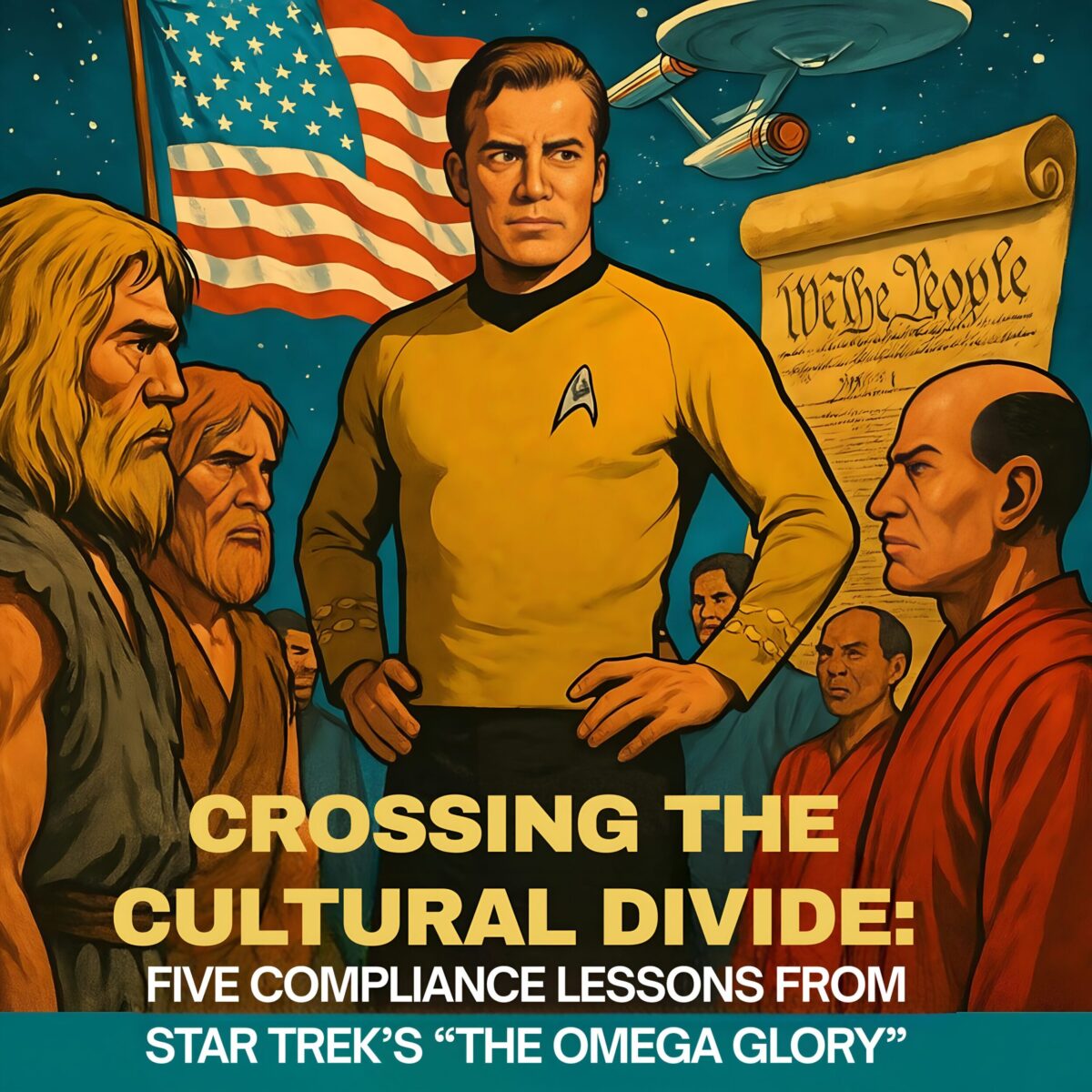
Crossing the Cultural Divide: Five Compliance Lessons from Star Trek’s “The Omega Glory”

As compliance professionals, we often talk about global organizations “boldly going” where few have gone before, into new markets, unfamiliar territories, and diverse cultures. But what happens when the culture you find is fundamentally different, yet disturbingly familiar? Star Trek’s “The Omega Glory” is one of the original series’ most controversial and fascinating explorations of cross-cultural misunderstanding, bias, and the search for common ground.

When Captain Kirk and the Enterprise crew encounter a planet locked in a centuries-long war between two factions, the Yangs and the Comms, they discover not only echoes of Earth’s past but also a profound challenge: how to understand, engage, and communicate across seemingly insurmountable cultural divides.

For the modern compliance officer, “The Omega Glory” is more than just a Star Trek curiosity. It’s a primer on the perils and potential of cross-cultural communication, and a reminder that misunderstanding and ethnocentrism can undermine even the most well-intentioned mission.

Today, we explore five cross-cultural compliance lessons, backed by memorable scenes, that resonate for today’s global organizations.

Lesson 1: Don’t Assume Your Culture’s Symbols or Values Are Universal

Illustrated By: When Kirk and company finally realize that the Yangs are a “parallel” of Earth’s Yankees, complete with a tattered American flag and a distorted version of the U.S. Constitution, the moment is both poignant and unsettling. The Yangs hold these objects sacred, but they have lost the original meaning, reciting “freedom” and “justice” without understanding their true significance.

Compliance Lesson: In global business, it is all too easy to assume that your organization’s symbols, policies, and values are understood the same way everywhere. What feels like common sense or “best practice” at headquarters may mean something entirely different or nothing across cultures.

Effective cross-cultural communication starts with humility. Don’t take for granted that core values, codes of conduct, or even compliance “hot words” will be universally understood. They may be recited back, as the Yangs do with the Pledge of Allegiance, but without real comprehension or application. Translate, not just in terms of, but conceptually, your compliance values and policies for each culture. Use local examples and context. Verify understanding through discussion, rather than just distributing documents.

Lesson 2: Recognize and Overcome Ethnocentrism—Your Way Is Not the Only Way

Illustrated By: Captain Tracey, the stranded Federation captain, throws in his lot with the Comms, convinced their culture’s “discipline” and “order” make them superior. He rationalizes his betrayal by viewing the Comms through his biased lens and refuses to see value in the Yangs’ ways.

Compliance Lesson: Ethnocentrism, the belief that one’s own culture is superior or “normal,” is a common barrier to cross-cultural compliance. Like Tracey, corporate leaders may favor one culture’s approach to ethics, risk, or problem-solving, dismissing others as backward or inefficient.

Such bias blinds organizations to local realities, breeds resentment, and undermines buy-in for compliance programs. Actual cross-cultural effectiveness requires cultural intelligence: the ability to recognize, adapt to, and respect differences. Provide cross-cultural training to compliance teams and business leaders. Encourage self-reflection on cultural biases and challenge assumptions about what constitutes the “right” and “wrong” ways of operating.

Lesson 3: Find the Universal, but Honor the Local

Illustrated By: Kirk’s breakthrough comes when he helps the Yangs recognize that the Constitution’s words—“We the People”—apply to everyone, not just their tribe. He translates a seemingly parochial value into a universal principle, bridging the gap between cultures.

Compliance Lesson: While symbols, language, and rituals may differ across cultures, there are often shared ethical aspirations —fairness, trust, respect, and justice —that can unite global teams. The challenge is to articulate these universals in a way that honors local realities.

Compliance communication should strike a balance between global standards and local flexibility. It’s not enough to declare “one policy, everywhere.” Instead, ask: How do our core principles show up in this culture? How can we adapt while staying true to our values? Co-create codes of conduct, training modules, and communications with local input. Make space for culturally relevant examples, stories, and illustrations that bring compliance to life.

Lesson 4: Listen Actively and Engage with Curiosity

Illustrated By: Throughout the episode, the Enterprise crew must decode the Yangs’ language, symbols, and intentions. Kirk doesn’t just lecture; he listens, observes, and asks questions—even when the answers are uncomfortable or surprising.

Compliance Lesson: Effective cross-cultural communication begins with active listening and curiosity, rather than assumptions or pronouncements. Before launching new policies or investigating potential misconduct, take time to learn local perspectives. Listen for what’s not being said. Recognize when confusion or resistance may mask deeper concerns.

In a compliance context, this means building trust, asking open-ended questions, and showing respect for cultural differences even when it challenges your assumptions. Use listening tours, focus groups, and confidential interviews to gather local insights before implementing global compliance initiatives. Train compliance professionals in active listening and culturally sensitive questioning.

Lesson 5: Bridge Divides with Shared Purpose, Not Just Rules

Illustrated By: In the episode’s climax, Kirk calls both the Yangs and the Coms to embrace the true meaning behind their sacred words, not as tribal weapons, but as a foundation for peace and shared future. He reframes the “rules” as a call to unity and understanding.

Compliance Lesson: Policies and procedures are essential, but they’re not enough to build absolute alignment across cultures. What endures is shared purpose: a vision that transcends division and speaks to the aspirations of every group in your organization.

When compliance is positioned as a partner in building something greater – a fair workplace, a sustainable business, and a respected global brand – it resonates beyond checklists and codes. People will rally around shared meaning, not just mandates. In your cross-cultural compliance communications, highlight stories of global teamwork, shared victories, and how living your values advances business and personal success. Move from “you must” to “we can, together.”

To Truly Go Boldly, Build Cross-Cultural Bridges

The Omega Glory” is a sometimes messy, always provocative meditation on the risks and rewards of cross-cultural engagement. For compliance professionals, it’s a reminder that communication isn’t just about translation or policy deployment; it is about bridge-building.

As your organization grows, diversifies, and explores new frontiers, remember: the actual test of your compliance program is not how well it works at headquarters, but how deeply it connects across every culture you serve. The Enterprise crew learned that words matter only when lived out by all people. For compliance, that’s the only path to lasting, meaningful impact.

Resources:

Excruciatingly Detailed Plot Summary by Eric W. Weisstein

MissionLogPodcast.com

Memory Alpha