Categories
Compliance Tip of the Day

Compliance Tip of the Day – Bringing Predictive Analytics into Your Compliance Regime

Welcome to “Compliance Tip of the Day,” the podcast where we bring you daily insights and practical advice on navigating the ever-evolving landscape of compliance and regulatory requirements. Whether you’re a seasoned compliance professional or just starting your journey, we aim to provide you with bite-sized, actionable tips to help you stay on top of your compliance game. Join us as we explore the latest industry trends, share best practices, and demystify complex compliance issues to keep your organization on the right side of the law. Tune in daily for your dose of compliance wisdom, and let’s make compliance a little less daunting, one tip at a time.

Today, we consider how you can bring predictive analytics into your program to make it proactive rather than reactive.

For more on this topic, check out The Compliance Handbook, a Guide to Operationalizing your Compliance Program, 6th edition, which LexisNexis recently released. It is available here.

Categories
Daily Compliance News

Daily Compliance News: July 29, 2025, The Is CEO Conduct Ever Personal Edition

Welcome to the Daily Compliance News. Each day, Tom Fox, the Voice of Compliance, brings you compliance-related stories to start your day. Sit back, enjoy a cup of morning coffee, and listen in to the Daily Compliance News. All, from the Compliance Podcast Network. Each day, we consider four stories from the business world, compliance, ethics, risk management, leadership, or general interest for the compliance professional.

Top stories include:

  • US states are leading the charge to break up big pharma. (FT)
  • What image does it have for profits: UnitedHealth. (NYT)
  • Does any CEO have Personal Conduct? (Bloomberg)
  • Corruption and battlefield failures. (NYT)

You can donate to flood relief for victims of the Kerr County flooding by going to the Hill Country Flood Relief here.

Categories
Everything Compliance - Shout Outs and Rants

Shout Outs and Rants: Episode 158, No To Ukraine Corruption

Welcome to this Edition of award-winning Everything Compliance. In this episode, we have the quartet of Matt Kelly, Jonathan Marks,  and Jonathan Armstrong, with Tom Fox, the Compliance Evangelist, sitting in as both host and a guest this week.

  1. Matt Kelly shouts out to the people of Ukraine for fighting against corruption and rants about the DOJ cover-up of the Epstein files.
  2. Jonathan Marks shouts out to Alexsys Thompson and her book, The Power of a Graceful Leader.
  3. Jonathan Armstrong shouts out to the city of Berlin and the people of Germany, and how they have taken ownership of their role in WWII.
  4. Tom Fox shouts out to the Lincoln Center Starbucks in NYC for supporting the Texas Hill Country and making him a part of its 5:30 AM family.

The members of Everything Compliance are:

The host, producer, and sometime panelist of Everything Compliance is Tom Fox, the Voice of Compliance. He can be reached at tfox@tfoxlaw.com.  The award-winning Everything Compliance is a part of the Compliance Podcast Network.

Categories
Innovation in Compliance

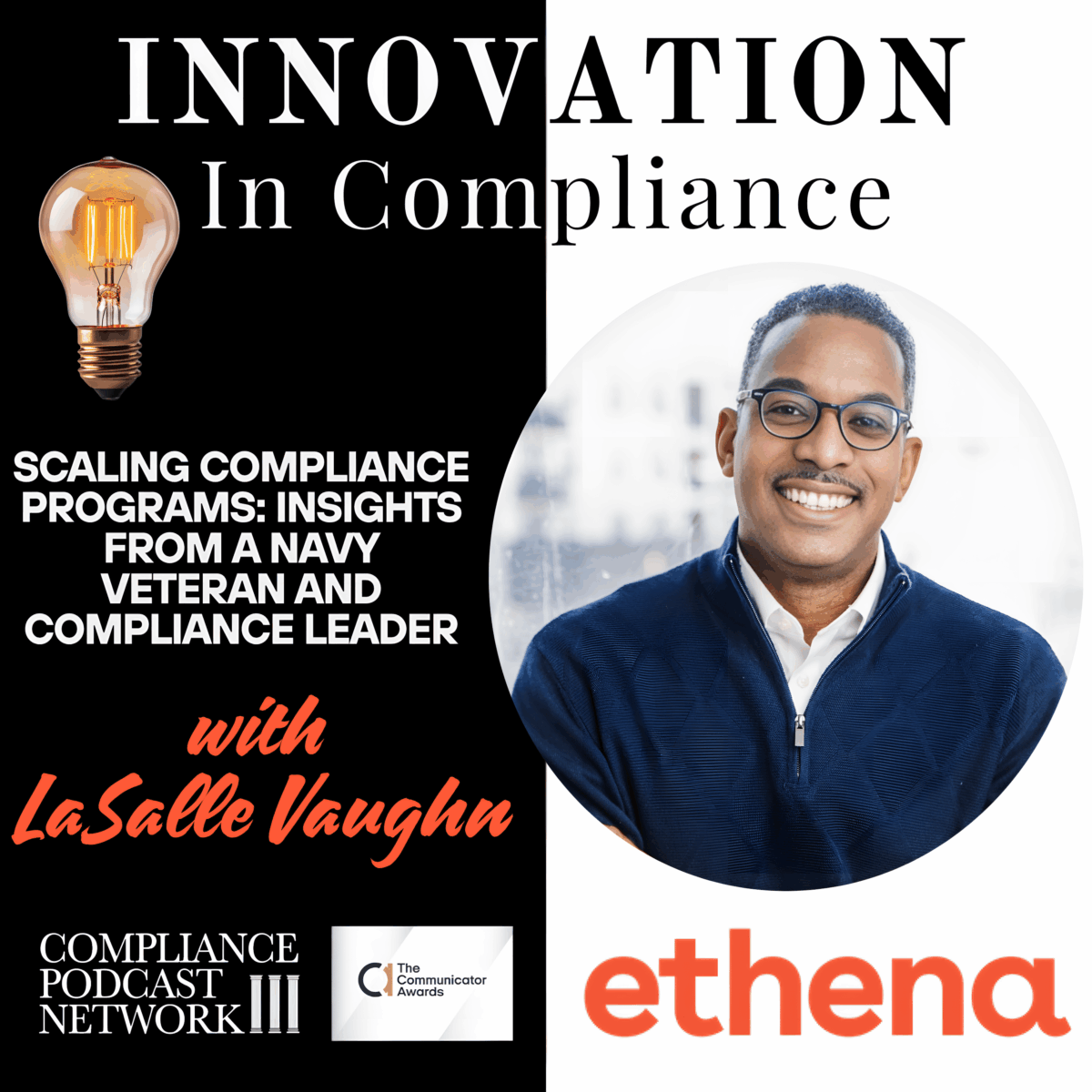
Innovation in Compliance: Scaling Compliance Programs: Insights from a Navy Veteran and Compliance Leader

Innovation comes in many areas, and compliance professionals need to be ready for it and embrace it. Join Tom Fox, the Voice of Compliance, as he visits with top innovative minds, thinkers, and creators in the award-winning Innovation in Compliance podcast. This series is introduced by Tom Fox and hosted by Roxeanne Petraeus. Ethena sponsors this special five-part series on Innovation in Compliance.

In this engaging episode, Roxeanne Petraeus sits down with LaSalle Vaughn, a seasoned compliance leader and Navy veteran. They delve into Vaughn’s extensive experience in scaling compliance programs for both large and small companies, emphasizing the importance of top leadership buy-in, cross-functional collaboration, and creative compliance training solutions. Vaughn shares his journey to becoming a board member, the significance of network relationships, and how his military background informs his approach to building a strong compliance culture. The discussion also highlights the unique qualities of the Ethena compliance platform and the necessity of effective customer support. Listeners gain valuable insights on effective compliance strategies and career development in the compliance field.

Key highlights:

  • LaSalle Vaughn’s Background and Experience
  • Scaling Compliance Programs
  • Getting C-Suite Buy-In for Compliance
  • Cross-Functional Collaboration in Compliance
  • Path to Board Service
  • Military Influence on Compliance and Culture

Resources:

LaSalle Vaughn on LinkedIn

Ethena Website

Roxanne Petraeus on LinkedIn

Ethena on LinkedIn

Tom Fox

Instagram

Facebook

YouTube

Twitter

LinkedIn

Categories
Word of the Week

Word of the Week with Kenneth O’Neal – Understanding Reciprocity: The Power of Mutual Giving and Receiving

Each week, Kenneth O’Neal discusses a word that describes a principle or value of the Qualities of Success. We suggest you use the Word of the Week in your thoughts, deeds, and actions. You may currently possess the qualities and desire to develop them to a higher level. You could replace a bad habit with a good habit. Write an action step and use it daily to develop the Quality in your life. In this episode, Kenneth discusses the word – Reciprocity.

In this episode, Rick and Kenneth dive into the concept of ‘reciprocity,’ highlighting its significance as a foundational principle in human relationships and social behavior. Kenneth explains how reciprocity involves a mutual exchange of privileges, actions, or favors and emphasizes its positive impact on building trust, respect, and strong community connections. They also discuss the moral obligation to return kindness and the potential negative aspects of reciprocity when used for manipulation. The conversation is enriched with historical references, ethical teachings, and reflective questions aimed at encouraging listeners to embrace generosity with sincerity. The show wraps up with insights on the importance of giving without expecting anything in return and the broader implications of sowing and reaping in personal and social contexts.

Key highlights:

  • Word of the Week: Reciprocity
  • Historical Examples of Reciprocity
  • Modern Understanding of Reciprocity
  • Reflective Questions on Generosity

Resources:

KRONEAL Consulting

Categories
Blog

Beyond the Checklist: Dynamic Fraud Risk Assessments for the Failure to Prevent Fraud Offense

We continue our review of the Economic Crime and Corporate Transparency Act 2023, which has elevated the expectations for senior leadership and boards across large organizations. Fortunately, the UK government has put out a document entitled “Economic Crime and Corporate Transparency Act 2023: Guidance to organisations on the offence of failure to prevent fraud.” (The Guidance) Section 3.2 of the official guidance, titled “Top Level Commitment,” should be required reading for every compliance professional seeking to build a credible, defensible, and sustainable anti-fraud culture. Today, we take a deep dive into the requirement for a fraud risk assessment.

As compliance professionals eagerly anticipate the impending go-live of the UK’s Failure to Prevent Fraud Offense, it is paramount to revisit the foundational pillar of any anti-fraud strategy—the fraud risk assessment. The act of assessing fraud risk has always been critical, but in this new legislative context, its significance cannot be overstated. The comprehensive risk assessment outlined by guidance in section 3.2 provides a blueprint that can prepare your organization not only to meet compliance standards but also to strengthen your corporate defenses against fraud.

Risk assessments must be both dynamic and regularly updated. Static, outdated assessments leave your organization exposed, failing to capture evolving fraud techniques and risks introduced by changes in personnel, procedures, technology, or external environments. Organizations are now explicitly encouraged to leverage their existing risk assessment frameworks, extending them to encapsulate the broader scope of the Failure to Prevent Fraud Offense. This approach not only maximizes efficiency but also ensures thoroughness and cohesion within your risk management strategies.

Identifying Associated Persons

The term “associated persons” casts a wide net, and it is essential to thoroughly understand who within and outside your organization could potentially expose you to risk. This includes agents, contractors, and personnel in sensitive roles such as finance or procurement. Each category presents unique fraud risks, ranging from false representation and failure to disclose to false accounting and abuse of position. Properly categorizing and assessing these typologies enables targeted, efficient mitigation measures and preventive strategies tailored to specific vulnerabilities.

Leveraging the Fraud Triangle

Compliance professionals must use the Fraud Triangle. Opportunity, motive, and rationalization are foundational tools to structure their risk assessments. Each element provides a lens through which potential fraud scenarios can be systematically evaluated:

  1. Opportunity: Does your organization inadvertently offer avenues for fraudulent activity due to weak controls, insufficient oversight, or technological vulnerabilities? For instance, departments such as finance, procurement, and marketing often harbor increased opportunities for fraud due to their access to funds or sensitive information. It’s also crucial to consider external agents or contractors operating with minimal oversight.
  2. Motive: Financial incentives and operational pressures can drive individuals towards fraudulent activities. Compliance teams must critically assess whether reward systems such as bonuses or commissions could unintentionally incentivize fraud. Additionally, organizational pressures related to achieving financial targets, impending mergers, acquisitions, or regulatory deadlines must be closely monitored.
  3. Rationalization: The justification of fraudulent acts often stems from organizational culture and industry norms. A company that subtly tolerates fraud, perhaps viewing it as a necessary evil for winning business or reaching targets, sets the stage for rationalization. Ensuring a robust speak-up culture and providing effective whistleblowing channels can significantly mitigate this risk.

Using Diverse Sources and Preparing for Emergency Scenarios

Risk assessment is enriched by diverse sources, including data analytics, past audit findings, industry-specific information, regulatory enforcement actions, and publicly available prosecutions or DPAs. These resources not only help identify potential fraud scenarios but also benchmark your organization’s prevention measures against industry standards and practices.

Unexpected emergencies, from natural disasters to economic crises, inherently increase fraud risks. Organizations must proactively incorporate emergency scenarios into their risk assessments. Doing so not only complies with the statutory obligation to demonstrate reasonable fraud prevention measures but also practically prepares your organization to adapt and maintain integrity during challenging times swiftly.

Classification and Regular Review of Risks

A thorough risk assessment involves classifying inherent risks by their likelihood and impact. This classification is vital in prioritizing resources effectively, focusing efforts on mitigating high-impact, high-probability risks. Regular reviews of your risk assessment, typically every two years, or sooner if triggered by significant internal or external changes, ensure its continued relevance and effectiveness.

Failing to update and refine your risk assessment regularly can expose your organization to severe consequences. Courts may interpret outdated assessments as indicators of inadequate preventive measures, leaving your organization vulnerable to penalties and reputational harm.

Five Key Takeaways for the Compliance Professional

Here are five key takeaways for the compliance professional:

1. Dynamic and Regular Updates Are Essential:

Risk assessments must not be viewed as one-off or static exercises. Continuous monitoring, regular updating, and adaptation to emerging fraud threats are essential to maintain relevance and ensure comprehensive fraud prevention capabilities.

2. Comprehensive Identification of Associated Persons:

Given the expansive definition of “associated persons,” compliance professionals must carefully identify and categorize all internal and external parties capable of exposing the organization to fraud risks. Tailored fraud risk mitigation strategies should then be developed based on these typologies.

3. Utilize the Fraud Triangle Effectively:

Applying the fraud triangle’s elements, opportunity, motive, and rationalization, can provide structure and depth to fraud risk assessments. This systematic approach helps to uncover specific vulnerabilities and inform targeted preventive measures.

4. Broaden Your Sources of Risk Intelligence:

Compliance professionals must leverage multiple sources, including past audit reports, data analytics, regulatory enforcement actions, and publicly available case studies. Integrating this diverse intelligence enhances the effectiveness and breadth of fraud risk assessments.

5. Incorporate Emergency Scenario Planning:

Fraud risks escalate during emergencies. Preparing and integrating emergency scenarios into your fraud risk assessment framework helps ensure that robust fraud prevention measures remain effective during crises, aligning your risk management practices with statutory obligations and best practices.

The Time to Act is Now

The clock is ticking towards the implementation of the Failure to Prevent Fraud Offense, and complacency is not an option. Conducting and maintaining a dynamic, comprehensive fraud risk assessment is no longer just best practice. It is a statutory necessity. By rigorously identifying associated persons, leveraging the Fraud Triangle, drawing insights from diverse sources, preparing for emergency scenarios, and regularly reviewing your assessment, your organization can confidently demonstrate its commitment to fraud prevention. Proactive engagement in these activities not only fortifies your compliance posture but also significantly enhances your organization’s resilience against fraud. Compliance professionals must seize this opportunity to reinforce their strategic value, embedding effective anti-fraud measures into their organizational culture and operations as we move closer to this critical regulatory milestone.

Join us tomorrow as we consider the procedures to implement your fraud risk assessment.

Categories
Red Flags Rising

Red Flags Rising: S01 E22 – All-In on America’s AI Action Plan

Mike and Brent go All-In regarding America’s AI Action Plan, unveiled by the White House on Wednesday, July 23, 2025, and discussed in detail at a forum the same day co-sponsored by the All-In Podcast and the Hill & Valley Forum.

Mike and Brent discuss how these developments relate to the “Moment of Truth” discussed in Episode 20 (00:31), the Three Pillars of America’s AI Action Plan (01:07), how the Three Pillars relate to their recent BRG ThinkSet magazine article (01:45), the commercial opportunity presented by full-stack AI export privileges under the AI Action Plan and how the “stack sweeps” previewed on Episode 19 are the compliance corollary to this commercial opportunity (02:32), Secretary of Commerce Howard Lutnick’s remarks about where to draw the line between sensitive and non-sensitive exports from a national security perspective and how this relates back to their recent ThinkSet article (05:00), how Pillar Three—Lead in International AI Diplomacy & Security—relates to many ongoing bilateral trade negotiations (07:23), the importance of not making anyone look like a sucker or a fool (08:34), the AI Action Plan’s reference to secondary tariffs as a means to make sure other countries don’t “backfill” where U.S. export controls create opportunities (08:53), the potential impact of the Maintaining American Superiority by Improving Export Control Transparency Act that is on the President’s desk for signature into law (11:20), the continuing relevance of end-user and end-use controls and the “high probability” standard (14:10), how Pillar Three also focuses on strengthening AI compute export controls enforcement by the Department of Commerce with support from the U.S. intelligence community (15:23), updates on Department of Commerce political employees’ confirmation process and reference therein to the Bureau of Industry & Security’s “red flag” guidance to industry (16:21), and the fundamental “deal” between the U.S. government and the U.S. tech sector evident in the AI Action Plan (18:42). Mike and Brent then conclude with an “all-in” version of Brent Carlson’s “Managing Up” segment (24:46).

Resources:

America’s AI Action Plan

The White House’s Announcement of America’s AI Action Plan

The All-In Podcast

The Hill & Valley Forum

Brent LinkedIn

Mike LinkedIn

Mike & Brent’s “Fresh Looks” Series