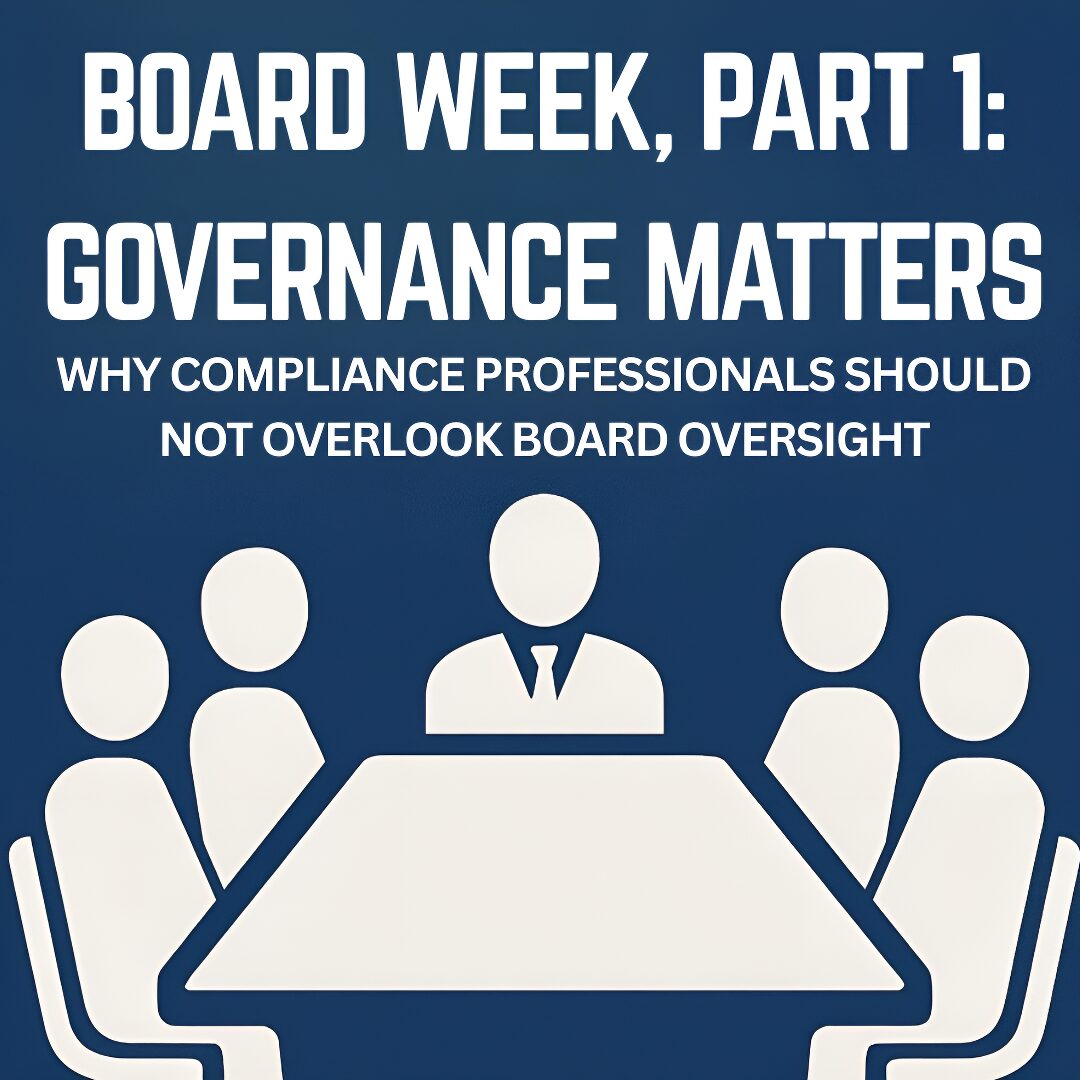
In the world of corporate governance, certain responsibilities of boards of directors are well understood. Boards are expected to oversee management, safeguard shareholder interests, and set a company’s long-term strategic direction. But one of the most overlooked aspects of board governance—at least in the day-to-day discussions of compliance professionals—is the degree of oversight that boards themselves receive. A recent article in the Harvard Law School Forum on Corporate Governance, entitled “Governance Matters, Don’t Overlook Board Oversight,” addressed this issue. I have used it as a starting point to explore the role of a compliance professional in Board oversight.
Too often, boards operate with a degree of insulation, shielded by tradition or by the assumption that their strategic decisions are unassailable. Yet as the recent research and findings by AllianceBernstein highlight, board oversight is not only critical but also directly correlated with corporate performance. Put, effective boards create more value; ineffective boards destroy it. And this is where compliance professionals must bring their focus.
If you are a compliance officer, general counsel, or governance leader, you cannot afford to treat the board as outside your scope of influence. In fact, the oversight of boards, particularly through director elections and ongoing accountability mechanisms, is where compliance intersects most directly with corporate governance and shareholder value.
The Power of Director Elections
Shareholder proposals and debates over executive compensation often dominate the headlines of the proxy season. Yet the real power lies in director elections. Voting for or against directors, especially those who chair key committees such as governance, compensation, or audit, is the single strongest way investors hold boards accountable.
In the 2024 proxy season, directors who chaired their nominating and governance committees received 5% more dissenting votes than their peers. This statistic is telling. Investors are no longer content to observe board performance passively; they are sending direct messages when governance is misaligned or oversight is ineffective.
For compliance professionals, this matters because director elections can be used as a form of leverage. They are a barometer of investor confidence in the board’s ability to manage risk, oversee strategy, and deliver long-term value. If investors are expressing dissent, compliance leaders should view this as an opportunity to engage with both the board and management about governance improvements.
Effective Boards Drive Better Performance
The AllianceBernstein findings are clear: companies with boards deemed “effective” by director election outcomes consistently deliver stronger stock returns than those with underperforming boards. The article notes that U.S. companies whose boards received full investor support showed an annualized average total return of 12.8% between 2018 and mid-2025. By contrast, companies where multiple directors were opposed delivered a paltry 1.2% median return.
This is not a coincidence. Effective boards ask the right questions, challenge management when necessary, and ensure alignment between corporate strategy and the interests of shareholders. Ineffective boards rubber-stamp poor decisions, fail to check management excesses, and ultimately allow risks, whether operational, financial, or cultural, to metastasize. Compliance professionals should take note: the effectiveness of your board is not just a governance issue; it is also a compliance and risk management issue.
What Makes a Board Effective?
What separates effective boards from ineffective ones? According to the research, three factors are most important: composition, structure, and actions.
- Composition: High-quality boards are majority-independent, diverse in skills and backgrounds, and free from chronic attendance issues or overcommitments. A board packed with insiders or directors stretched too thin across other boards is a recipe for groupthink and poor oversight.
- Structure: Strong boards have formal committees, majority-vote standards, and annual elections of directors. These structural mechanisms ensure accountability and prevent entrenchment.
- Actions: Ultimately, boards must prove their effectiveness through their behavior—aligning executive pay with performance, ensuring disciplined capital allocation, and actively engaging with shareholders.
This framework is highly relevant for compliance professionals. For instance, when conducting governance risk assessments, evaluating board composition and independence should be part of the exercise. Likewise, compliance leaders can advocate for structural safeguards, such as mandatory annual elections, as part of governance reforms.
Case Study: Oversight Failures at a Major U.S. Bank
The research cites a major U.S. bank where historical governance failures, ranging from fraud and risk management breakdowns to workplace misconduct, were tied directly to board shortcomings. For years, these issues went unchecked, undermining trust and shareholder value.
AllianceBernstein engaged in a multiyear dialogue with the bank’s board and senior leaders, consistently voting against relevant directors until changes were made. Over time, this pressure led the bank to implement improved oversight mechanisms and make management incentives more accountable.
For compliance professionals, the lesson is clear: governance failures at the board level often cascade into compliance risks throughout the entire organization. Weak boards allow cultural rot to take hold. Strong boards reinforce accountability and create an environment where compliance programs can thrive.
Lessons for Compliance Professionals
What does all this mean for those of us in the compliance profession? I see five clear lessons:
- Board Oversight Is Part of Compliance Oversight
- Compliance programs cannot exist in a vacuum. They are only as strong as the board that oversees them. If a board is disengaged, conflicted, or ineffective, compliance initiatives will falter.
- Use Data to Evaluate Governance Risks
- Just as compliance uses data analytics to detect fraud or waste, governance effectiveness can be monitored through director election outcomes, shareholder dissent levels, and engagement activity. These are risk indicators for board oversight.
- Engage with Investors as Allies
- Investors are increasingly using their voting power to hold boards accountable. Compliance professionals should view this as an opportunity to align governance reforms with investor expectations.
- Advocate for Structural Safeguards
- Push for board practices such as annual elections, majority-vote standards, and the recruitment of diverse directors. These mechanisms prevent stagnation and strengthen oversight.
- Link Culture to Governance
- A board that tolerates poor oversight also tolerates poor culture. Compliance professionals should emphasize that governance effectiveness is not just about strategy; it is about setting the cultural tone for the entire organization.
Keep Your Eye on the Board
As the authors conclude, investors and stakeholders should ask one simple question: Is the board delivering for shareholders? Disappointing boards often yield disappointing results. Boards that earn full investor confidence, by contrast, consistently outperform.
For compliance professionals, this insight is invaluable. Governance effectiveness is not a secondary issue; rather, it is central to the organization’s resilience and performance. Director elections may not grab headlines, but they are where the battle for governance accountability is truly fought.
Boards perform best when they know investors, employees, and compliance leaders are watching. When compliance functions collaborate with shareholders and regulators to demand accountability at the board level, organizations are stronger, cultures are healthier, and risks are mitigated.
Elevating Compliance Through Governance Oversight
Effective boards drive better corporate performance, safeguard shareholder interests, and provide the necessary oversight to ensure management accountability. Ineffective boards, by contrast, create fertile ground for governance failures, compliance breaches, and cultural erosion.
For compliance professionals, this means that governance oversight must be viewed as part of the compliance mandate. Compliance is not simply about monitoring transactions or training employees; it is about ensuring that the board itself is fit for purpose. By applying the same rigor we bring to anti-corruption or fraud prevention to board governance, we elevate the compliance function into a true partner in corporate value creation.
Director elections are a powerful mechanism for accountability. But they are only the beginning. Compliance leaders should engage proactively with investors, advocate for robust board structures, and ensure cultural alignment from the top.
In today’s environment of heightened scrutiny, where investors demand stewardship and regulators demand accountability, compliance professionals have a unique opportunity. By stepping into the governance conversation and making board oversight part of the compliance agenda, we can help build organizations that are not only compliant but resilient, trusted, and positioned for long-term success.
That is the mandate for the modern compliance professional.