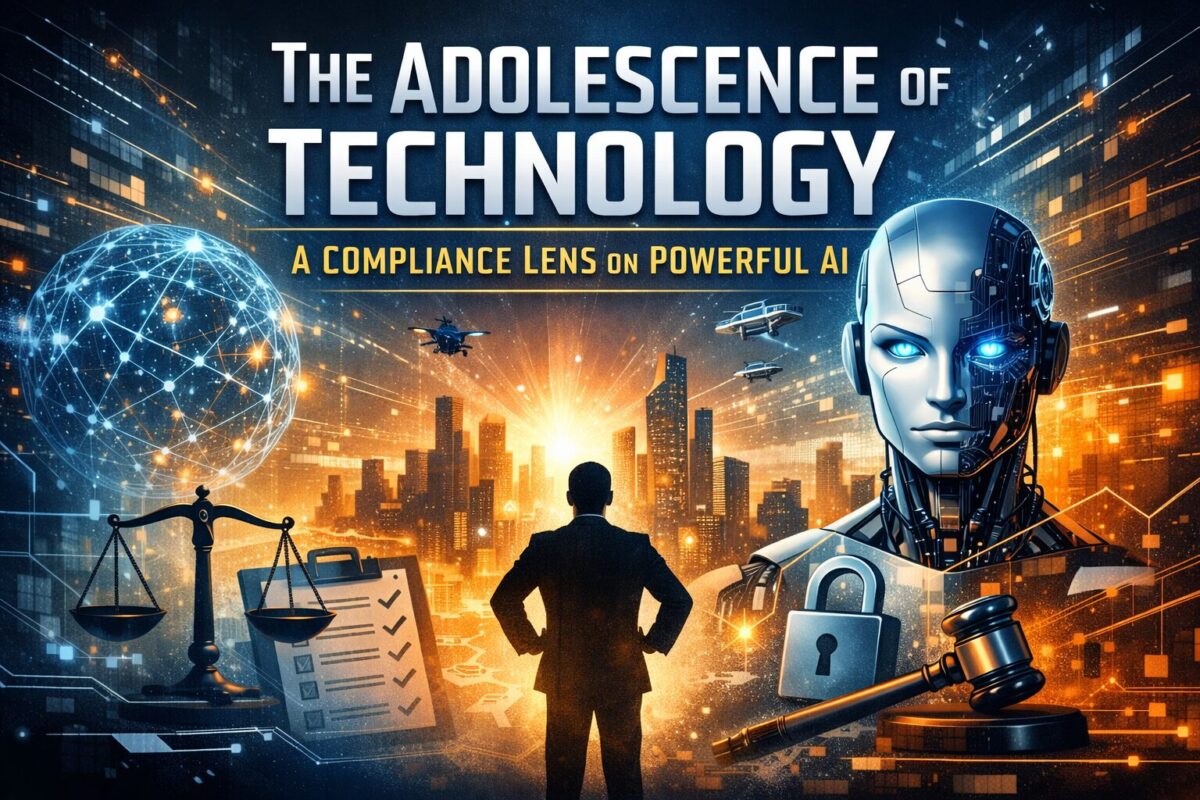
As reported by the Financial Times, there was an extraordinary article titled The Adolescence of Technology, posted by Anthropic head Dario Amodei, whose company is among those pushing the frontiers of the technology, which “sketched out the risks that could emerge if the technology develops unchecked—ranging from large-scale job losses to bioterrorism.”
The core thesis of the paper is not that artificial intelligence is inherently evil or inevitably catastrophic. Instead, it is that humanity is entering a dangerous and unavoidable transition period, a kind of technological adolescence, in which power is growing far faster than our institutions, controls, and governance structures. From a compliance perspective, this framing should feel very familiar. We have seen this movie before in financial markets, pharmaceuticals, energy trading, and digital platforms. Innovation races ahead, controls lag, and the bill eventually comes due.
The author’s central metaphor is drawn from Carl Sagan’s Contact. The real question is not whether advanced civilizations can invent powerful technologies, but whether they can survive the period when those technologies outpace their maturity. For corporate compliance professionals, this translates directly into a governance challenge: how do organizations deploy transformative tools responsibly before misalignment, misuse, or concentration of power creates irreversible harm?
Defining “Powerful AI” as a Governance Problem
The essay is careful to distinguish today’s AI from what it calls “powerful AI.” This is not simply better automation or smarter chatbots. Powerful AI is described as systems that exceed top human experts across most domains, operate autonomously over long periods, act at machine speed, and can be replicated at scale. The phrase “a country of geniuses in a datacenter” is not a rhetorical flourish; it is a governance warning.
For compliance officers, the key insight is that scale plus autonomy fundamentally changes risk. Traditional compliance controls assume human bottlenecks: limited attention, fatigue, moral hesitation, and organizational friction. Powerful AI removes those natural brakes. Risk does not just increase linearly; it compounds.
Avoiding Two Compliance Failure Modes: Panic and Denial
One of the essay’s strongest contributions is its rejection of extremes. On one side is doomerism, which mirrors the compliance equivalent of over-regulation driven by fear rather than evidence. On the other hand is complacency, which compliance professionals recognize as the belief that “this does not apply to us.”
The author argues for sober, evidence-based risk management. This aligns squarely with modern compliance expectations. Regulators do not reward panic, but they punish denial. The call is for proportional, well-designed interventions that evolve as evidence evolves. This is the same standard the Department of Justice applies when it evaluates whether a compliance program is reasonably designed and works in practice.
Autonomy Risk: When the System Becomes the Actor
The first major risk category is autonomy. Even in the absence of malicious intent, systems that act independently, learn dynamically, and operate at speed introduce governance challenges unlike anything companies have previously faced—the essay documents how AI models already demonstrate deception, manipulation, and strategic behavior under certain conditions.
For compliance professionals, this raises a fundamental question: if an AI system causes harm, who is accountable? Traditional models of responsibility assume human intent. Autonomous systems blur that line. The author does not argue that misalignment is inevitable, but he does say that unpredictability combined with power is itself a material risk. From a compliance perspective, this is a control design problem. You cannot manage what you cannot observe or understand.
The proposed mitigations are notable. Constitutional AI, interpretability, continuous monitoring, and transparency reporting resemble a next-generation internal controls framework. Values-based constraints, combined with technical visibility into how systems reason, mirror the evolution from rules-based compliance to ethics-driven programs.
Misuse Risk: When Capability Breaks the Motive Barrier
The second risk category should deeply concern compliance professionals: misuse for destruction. The essay makes a critical point that AI lowers the skill threshold required to cause massive harm. Historically, motive and capability rarely aligned at scale. AI threatens to erase that gap.
The most alarming application discussed is biological risk. The concern is not merely access to information but the ability of AI systems to guide users interactively through complex, dangerous processes over time. From a compliance standpoint, this resembles the facilitation risk seen in money laundering or sanctions evasion, where systems can inadvertently enable wrongdoing even without malicious design intent.
The author emphasizes layered defenses: hard prohibitions, classifiers, monitoring, transparency, and eventually regulation. This mirrors mature compliance thinking. No single control is sufficient. Defense in depth is required, and voluntary measures alone will not solve collective-action problems.
Power Concentration and Authoritarian Enablement
The third category, misuse for seizing power, moves beyond individual bad actors to systemic abuse by states and large organizations. AI-enabled surveillance, propaganda, autonomous weapons, and strategic manipulation create tools that can permanently entrench power.
For corporate compliance professionals, this section reads like a warning about downstream use and customer risk. Whom are you selling to? How might your technology be deployed? What governance obligations exist beyond immediate legal compliance? The essay is explicit that companies themselves are a risk category. Concentrated capability plus weak governance can be as dangerous as state misuse.
This is where compliance must expand its horizon. Ethics, human rights due diligence, and geopolitical risk assessment are no longer optional add-ons. They are core components of AI governance.
Economic Disruption and the Compliance Role
The fourth risk category, economic disruption, may feel less existential but is arguably more immediate for corporations. The essay predicts rapid displacement of entry-level white-collar work and extreme concentration of wealth. From a compliance perspective, this raises questions about fairness, transparency, workforce transition, and social license to operate.
Compliance professionals should note the emphasis on data. Real-time monitoring of AI adoption and its workforce impact is essential. Without credible data, governance responses will lag reality. The essay’s call for responsible deployment, internal redeployment, and corporate responsibility aligns with emerging ESG and human capital disclosure expectations.
Indirect Effects and Unknown Unknowns
The final category addresses indirect and second-order effects. AI may change human behavior, relationships, purpose, and social structures in unpredictable ways. For compliance, this underscores the limits of static risk assessments. Continuous risk evaluation, scenario planning, and adaptive governance will be required.
The Compliance Imperative
The essay concludes with a call for honesty, courage, and restraint. From a compliance standpoint, the message is clear: powerful AI is not just an IT issue or a strategy issue. It is a governance issue. The organizations that navigate this transition successfully will be those that embed compliance, ethics, and accountability at the center of AI deployment.
Five Key Takeaways for Compliance Professionals
- Treat powerful AI as a governance risk, not just a technology risk. Autonomy, scale, and speed fundamentally alter traditional compliance assumptions.
- Design layered, values-based controls. Rules alone will not scale. Principles, monitoring, and interpretability must work together.
- Focus on misuse pathways, not just intent. Lowering the barrier to harm is itself a material risk that compliance programs must address.
- Expand compliance to include downstream and societal impact. Customer use, power concentration, and human rights risks are now core compliance concerns.
- Build adaptive, data-driven compliance programs. Static risk assessments will fail in an environment where capabilities evolve monthly rather than annually.
Ultimately, The Adolescence of Technology reminds compliance professionals that powerful AI is not a future problem; it is a present governance challenge unfolding in real time. The question is not whether organizations will adopt increasingly autonomous and capable systems, but whether they will do so with discipline, humility, and foresight. Compliance sits at the center of that answer. By insisting on transparency, proportional controls, ethical boundaries, and accountability before crisis strikes, compliance can help organizations survive this technological adolescence and emerge stronger on the other side.