Categories
Blog

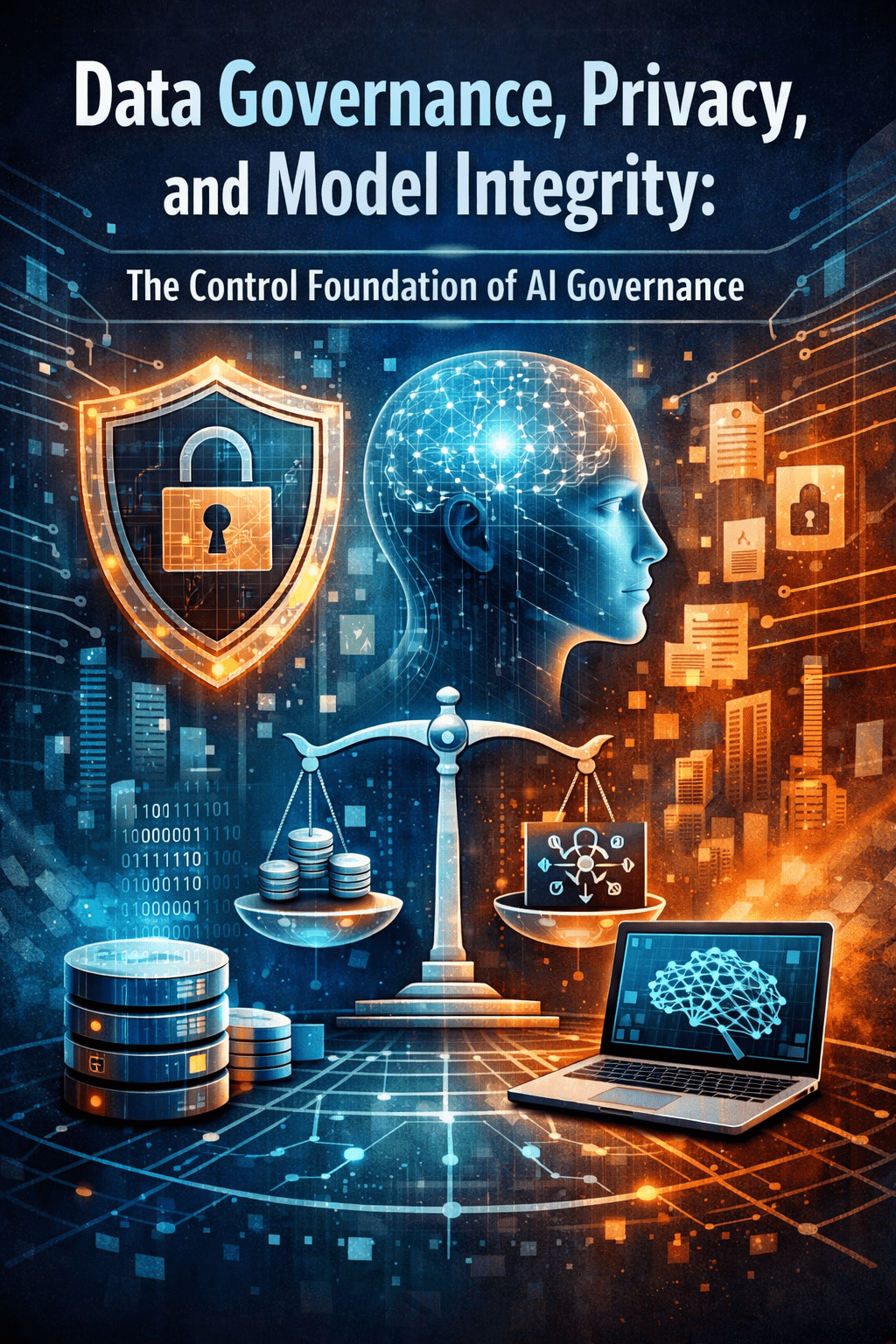
Data Governance, Privacy, and Model Integrity: The Control Foundation of AI Governance

Artificial intelligence may look like a technology story on the surface, but beneath that surface lies a governance reality every board and Chief Compliance Officer must confront. AI systems are only as sound as the data that feeds them, the controls that govern them, and the integrity of the outputs they generate. When data governance is weak, privacy obligations are poorly managed, or model integrity is assumed rather than tested, AI risk can move quickly from a technical flaw to enterprise exposure.

In the prior blog posts in this series, I examined the foundational questions of AI governance: board oversight and accountability, and the danger of strategy outrunning governance. Today, I want to turn to a third issue that sits at the core of every credible AI governance program: data governance, privacy, and model integrity.

This is where the AI conversation often moves from excitement to discipline. Companies may be eager to deploy tools, automate functions, and improve decision-making. But none of that matters if the underlying data is flawed, sensitive information is mishandled, or the model produces outputs that are unreliable, biased, or impossible to explain in context—the more powerful the technology, the more important the governance framework beneath it.

For boards and CCOs, this is not simply a technical control matter. It is a governance matter because failures in data integrity, privacy management, and model performance can have legal, regulatory, reputational, financial, and cultural consequences simultaneously.

AI Governance Begins with the Data

There is an old saying in technology: garbage in, garbage out. In the AI era, that phrase remains true, but it is no longer sufficient. In corporate governance terms, the problem is not merely bad data. It is unknown, unauthorized, untraceable, biased, stale, overexposed, or used in ways the organization never properly approved. That is why data governance is the control foundation of AI governance.

Every AI use case depends on inputs. Those inputs may include structured internal data, public information, personal data, third-party data, proprietary records, historical documents, transactional records, prompts, or user interactions. If management does not understand where that data comes from, who has rights over it, whether it is accurate, how it is classified, and whether it is appropriate for the intended purpose, then the company is not governing AI. It is merely using it.

For compliance professionals, this point should feel familiar. Data governance is not new. What is new is the speed and scale at which AI can amplify data weaknesses. A spreadsheet error may affect one report. A flawed AI input may affect thousands of interactions, recommendations, or decisions before anyone notices.

Why Boards Should Care About Data Lineage

Boards do not need to become technical experts in model training or data architecture. But they do need to ask whether management understands the provenance and reliability of the information flowing into critical AI systems.

At a governance level, this is a question of data lineage. Can the company trace the source of the data, how it was curated, whether it was changed, and whether it was approved for the intended use? If a customer, regulator, employee, or auditor asks why the system reached a particular result, can management explain not only the output, but the data conditions that shaped it?

A board that does not ask these questions risks receiving polished dashboards and impressive demonstrations while missing the underlying weaknesses. AI systems can sound authoritative even when they are wrong. That is part of what makes governance here so essential. Confidence is not the same as integrity.

This is also where the Department of Justice’s Evaluation of Corporate Compliance Programs (ECCP) offers a helpful mindset. The ECCP pushes companies to think in terms of operational reality. Do policies work in practice? Are controls tested? Is the company learning from what goes wrong? The same discipline applies here. A company should not assume its data environment is fit for AI simply because it has data available. It should test, verify, document, and challenge that assumption.

Privacy Is Not an Adjacent Issue

Too many organizations still treat privacy as adjacent to AI governance rather than central to it. That is a mistake. AI systems often rely on data sets that include personal information, employee information, customer records, usage patterns, communications, or behavior-based inputs. Even when a company believes it has de-identified or anonymized data, there may still be re-identification risks, overcollection concerns, retention issues, or use limitations tied to law, contract, or internal policy.

For the board and the CCO, privacy should not be discussed as a compliance side note. It should be part of the approval and governance architecture from the outset. Before an AI use case is deployed, management should understand what personal data is involved, whether its use is permitted, what notices or disclosures apply, what access restrictions are required, how the data will be retained, and whether any vendor relationships create additional privacy exposure.

This is particularly important in generative AI environments, where employees may paste confidential, proprietary, or personal information into tools without fully appreciating the consequences. A privacy incident in the AI context may not begin with malicious intent. It may begin with convenience. That is why governance must focus not only on policy, but on system design, training, and usage constraints.

The CCO has a critical role here because privacy governance often intersects with policy management, employee conduct, training, investigations, and disciplinary response. If privacy is left solely to specialists without integration into the broader governance process, the organization risks building fragmented controls that do not hold together under pressure.

Model Integrity Is a Governance Question

Model integrity sounds like a technical term, but it is really a governance concept. It asks whether the system is performing in a manner consistent with its intended purpose, risk classification, and control expectations.

That means asking hard questions. Is the model accurate enough for the use case? Has it been validated before deployment? Are there known limitations? Does it perform differently across populations or scenarios? Can outputs be reviewed in a meaningful way by human decision-makers? Are there conditions under which the model should not be used? These are not engineering questions alone. They are governance questions because they determine whether management is relying on the system responsibly.

This is where NIST’s AI Risk Management Framework is especially valuable. NIST emphasizes that organizations should map, measure, and manage AI risks, including those related to validity, reliability, safety, security, resilience, explainability, and fairness. It is not enough to say that a tool works most of the time. The organization must understand where it may fail, how failure will be detected, and what safeguards are in place when it does.

ISO/IEC 42001 reinforces the same discipline through the lens of management systems. It requires structured attention to risk identification, control design, monitoring, documentation, and continual improvement. In other words, it treats model integrity not as a technical aspiration, but as an organizational responsibility. For boards, the takeaway is direct: if management cannot explain how model integrity is validated and maintained, then the board does not yet have assurance that AI is being governed effectively.

Third Parties Increase the Stakes

One of the more dangerous assumptions in AI governance is that outsourcing technology also outsources risk. It does not. Many organizations will deploy AI through third-party vendors, embedded tools, software platforms, or external service providers. That may be practical, even necessary. But it also means the company may be relying on data practices, training methods, model assumptions, or privacy safeguards it did not design and cannot fully see.

That is why data governance, privacy, and model integrity must extend to third-party risk management. Procurement cannot focus solely on functionality and price. Legal cannot focus solely on contract form. Compliance, privacy, security, and risk all need to understand what the vendor is doing, what data is being used, what rights the company has to inspect or question performance, and what happens when the vendor changes the model or its underlying terms.

This is not simply good vendor management. It is a governance necessity. A company remains accountable for business decisions made using third-party AI tools, especially when those tools affect customers, employees, compliance obligations, or regulated activities.

Documentation Is What Makes Governance Real

As with every major governance issue, documentation is what turns theory into evidence. If a company is serious about data governance, privacy, and model integrity, it should have records that show it. Those records may include data inventories, data classification standards, model validation summaries, privacy assessments, vendor due diligence files, testing results, approved use cases, control requirements, escalation logs, and remediation actions. Without this documentation, governance becomes anecdotal. With it, governance becomes reviewable, auditable, and improvable.

This is another place where the ECCP mindset is so useful. Prosecutors and regulators tend to ask the same core question in different ways: how do you know your program works? In the AI context, the answer cannot be “our vendor told us so” or “the business says the tool is helpful.” It must be grounded in evidence, testing, and management discipline.

What Boards and CCOs Should Be Pressing For

Boards should expect management to present AI use cases with enough clarity to answer four questions. What data is being used? What privacy implications attach to that use? How has model integrity been tested? What controls will remain in place after deployment?

CCOs should press equally hard from the management side. Is there a documented data governance process for AI? Are privacy reviews built into the intake and approval process? Are models validated according to risk? Are third-party tools subject to diligence and contract controls? Are incidents and anomalies logged and investigated? Are employees trained not to expose confidential or personal information through improper use? These are not burdensome questions. They are the practical questions that separate governed AI from hopeful AI.

Governance Requires Trustworthy Inputs and Defensible Outputs

In the end, AI governance depends on a simple but demanding truth: the organization must be able to trust what goes into the system and defend what comes out of it.

If the data is poorly governed, privacy rights are handled casually, or model integrity is assumed rather than demonstrated, then no amount of strategic enthusiasm will make the program safe. Boards will not have real oversight. CCOs will not have a defensible control environment. The company will merely have a faster way to create risk.

That is why data governance, privacy, and model integrity are not support issues in AI governance. They are central issues. They determine whether the enterprise is using AI with discipline or simply hoping for the best.

In the next article in this series, I will turn to the fourth governance challenge: ongoing monitoring, where many organizations discover that approving an AI use case is far easier than governing it after it goes live.


Categories
31 Days to More Effective Compliance Programs

31 Days to a More Effective Compliance Program: Day 28 – The Importance of Data Governance

Welcome to 31 Days to a More Effective Compliance Program. Over this 31-day series in January 2026, Tom Fox will post a key component of a best-practice compliance program each day. By the end of January, you will have enough information to create, design, or enhance a compliance program. Each podcast will be short, at 6-8 minutes, with three key takeaways that you can implement at little or no cost to help update your compliance program. I hope you will join each day in January for this exploration of best practices in compliance. In today’s Day 28 episode, we look into the crucial importance of data governance in the realms of compliance and cybersecurity.

Key highlights:

  • The Role of Data Governance in Compliance and Cybersecurity
  • Data Governance and ESG
  • Understanding Data Privacy Laws

Resources:

Listeners to this podcast can receive a 20% discount on The Compliance Handbook, 6th edition, by clicking here.

Categories
Trekking Through Compliance

Trekking Through Compliance – Episode 8 – Miri

In this episode of Trekking Through Compliance, we consider the episode Miri, which aired on October 27, 1966, Star Date 2713.5. In this episode of Trekking Through Compliance, we explore one of the eeriest and most profound cautionary tales in the Star Trek canon: “Miri.” When the crew responds to a distress signal from a planet that’s an exact duplicate of Earth, they find a society ravaged by a failed experiment in human longevity. Only children remain, while the adults, the “grups,” have all died from a virulent disease.

This haunting story is not simply science fiction. It is a case study of what happens when risk management is treated as an afterthought. We draw parallels between the biohazard breakdowns on the planet and the kinds of failures that modern compliance officers must guard against, whether in public health readiness, supply chain risk, or workforce welfare.

Episode Summary

A disfigured man attacks a landing party, who die after Kirk strikes him. They discover a preadolescent, Miri, who ran away from them because “grups” kill and maim children before dying. She and her friends are “onlies,” the only ones left. The distress call is traced to an automated signal. The landing party, except for Spock, notices purple lesions on their bodies; Miri tells them that these are the first signs of the disease, and they will soon develop into the same condition as the other adults. When the disease begins, its victims have seven days to live. Although Spock is immune, he considers himself a carrier who could infect the Enterprise if he returns.

Back on the Enterprise, after vaccinating everyone and leaving the children in the care of a medical team, Kirk sends for teachers and advisers to help the children improve their lives.

Key highlights:

1. Disaster Preparedness—A Cure Without a Contingency Plan

🖖Illustrated by: The civilization’s experiment to extend life, which instead wipes out all adults.

This central failure underscores the risks associated with scientific advancement that lacks proper risk assessment. The developers had no fallback, no regulatory oversight, and no crisis management framework in place. For compliance professionals, this serves as a reminder that innovation must be paired with effective scenario planning and disaster recovery protocols.

2. Environmental and Public Health Compliance—Invisible Risks Become Existential Threats

🖖Illustrated by: The crew’s infection with the disease upon beaming down, with lesions appearing days later.

This serves as a metaphor for health and safety non-compliance. Enterprises must be vigilant about how workplace conditions, unseen hazards, and biological risks can impact staff and operations. Proactive monitoring and rapid-response mechanisms are essential components of any risk management strategy.

3. Data Governance and Early Warning Systems—Responding Too Late

🖖Illustrated by: The automated distress signal continued even though no adult survivors remained.

The signal was still active, but no one was listening until it was far too late. In modern organizations, this is equivalent to ignoring audit logs, internal control alerts, or whistleblower reports that go unread. A culture of attentiveness to data and signals is crucial to catching issues before they cascade.

4. Supply Chain Risk—Critical Resource Shortages in the Field

🖖Illustrated by: The crew’s struggle to develop a cure with limited time, no labs, and deteriorating conditions.

Kirk and McCoy were caught without adequate resources. This scenario mirrors the real-world risks companies face when they lack redundancy in their supply chains, fail to conduct thorough vendor audits, or fail to plan for logistical disruptions. A robust compliance framework includes stress-testing the supply chain for resilience under duress.

Employee Welfare and Isolation—Psychological and Ethical Concerns in Hazard Zones

🖖Illustrated by: Spock’s decision not to return to the Enterprise due to the risk of contamination.

Spock’s sacrifice is a model of ethical risk containment. In any risk environment, whether it is a pandemic, data breach, or financial misconduct, companies must empower employees to make ethically sound decisions while providing mental health support for those isolated by crisis response roles.

Final Starlog Reflections

Miri is a chilling illustration of what happens when ambition outpaces ethics and planning. The children left behind are the victims of a society that prioritizes progress over protection. For compliance professionals, this episode serves as a vivid reminder that a well-crafted compliance program is not just about preventing misconduct—it’s about preparing for the unknown.

Resources

Excruciatingly Detailed Plot Summary by Eric W. Weisstein

MissionLogPodcast.com

Memory Alpha

Categories
31 Days to More Effective Compliance Programs

31 Days to a More Effective Compliance Program: Day 28 – The Importance of Data Governance

Welcome to a special podcast series on the Compliance Podcast Network, 31 Days to a More Effective Compliance Program. Over these 31 days of the series in January 2025, Tom Fox will post a key part of a best practices compliance program daily. By the end of January, you will have enough information to create, design, or enhance a compliance program. Each podcast will be short, at 6–8 minutes, and will include three key takeaways you can implement at little or no cost to help update your compliance program. I hope you will join us each day in January for this exploration of best practices in compliance.

On Day 28, we look into the crucial importance of data governance in compliance and cybersecurity. As data generation increases, businesses must enhance their efforts in managing, organizing, and preserving data to meet regulatory obligations and ensure accuracy, accessibility, and adherence to legal standards. We discuss the growing trend of converging compliance, data governance, and cyber security and the necessity of breaking down organizational silos for effective collaboration. Business and legal teams rely on well-managed data to make informed decisions, analyze trends, and measure key performance indicators.

The episode also covers the challenges in gaining buy-in from the ELT and the vital process of transforming corporate culture to prioritize data governance and cybersecurity. We touch on the complexities of regional data privacy laws inspired by GDPR and emphasize the importance of understanding specific regulations for compliance. With key takeaways, including the significance of data preservation, the intertwined nature of compliance, data governance, and cybersecurity, and the urgency for organizations to prioritize data governance, this episode is packed with essential insights for compliance professionals.

Key highlights:

  • The Role of Data Governance in Compliance and Cybersecurity
  • Data Governance and ESG
  • Understanding Data Privacy Laws

Resources:

Click here to receive a 20% discount on The Compliance Handbook, 5th edition, for listeners to this podcast.

Categories
Compliance Tip of the Day

Compliance Tip of the Day: The Importance of Data Governance

Welcome to “Compliance Tip of the Day,” the podcast where we bring you daily insights and practical advice on navigating the ever-evolving landscape of compliance and regulatory requirements.

Whether you’re a seasoned compliance professional or just starting your journey, our aim is to provide you with bite-sized, actionable tips to help you stay on top of your compliance game.

Join us as we explore the latest industry trends, share best practices, and demystify complex compliance issues to keep your organization on the right side of the law.

Tune in daily for your dose of compliance wisdom, and let’s make compliance a little less daunting, one tip at a time.

In today’s episode, why is data governance the key factor that impacts the importance of compliance, data governance, and cybersecurity in business?


For more information on the Ethico ROI Calculator and a free White Paper on the ROI of Compliance, click here.

Categories
31 Days to More Effective Compliance Programs

One Month to a More Effective Compliance Program Through Data Analytics: Day 11 – The Importance of Data Governance

In today’s digital landscape, compliance, data governance, and cybersecurity have become crucial aspects of running a successful business. The convergence of these three disciplines is a growing trend, emphasizing the need for collaboration and breaking down silos within organizations. The key factor that impacts the importance of compliance, data governance, and cybersecurity in business is data governance.

Data governance involves managing and organizing data for accuracy, accessibility, and compliance. With the increasing amount of data being generated for compliance and other corporate functions, it has become crucial for organizations to have effective data governance and legal technology services in place to ensure compliance with regulatory obligations. It plays a significant role in both the business and legal aspects of an organization. CCOs and compliance professionals rely on data to make informed decisions, analyze trends, and measure key performance indicators. From a legal perspective, data governance is essential for providing legal advice and meeting regulatory obligations.

 Three key takeaways:

1. Data preservation and credibility are crucial for effective compliance representation if a regulator comes knocking.

2. Compliance, data governance, and cybersecurity are intertwined in today’s business landscape.

3. As the digital landscape continues to evolve, organizations must prioritize data governance and stay compliant and competitive in the business world.

For more information on KonaAI, click here.

Categories
Innovation in Compliance

Innovation in Compliance – Oshri Cohen on the Role of a CTO in Compliance

The role of a Chief Technology Officer (CTO) in compliance and data governance is explored in this podcast episode between Tom Fox and Oshri Cohen. They discuss the varying responsibilities of a CTO based on company size, with larger organizations focusing on strategic planning while smaller organizations have the CTO as the head engineer. The importance of the CTO in managing risks, particularly in industries like healthcare and finance, is emphasized, along with the role of the board in providing oversight. The conversation also delves into the significance of data strategy, compliance, and data governance, emphasizing the need for collaboration between the CTO and the Chief Compliance Officer (CCO). Technical due diligence and the establishment of a data commission within organizations are suggested as strategies for effective data governance. Overall, the conversation highlights the crucial role of the CTO in ensuring compliance and protecting sensitive information.

  • The Role of a CTO in Compliance
  • Data Strategy and Compliance
  • Data Governance Challenges
  • Data Governance and Startups
  • Risks in System Audits

 Resources:

Oshri Cohen on LinkedIn

Tom Fox

Instagram

Facebook

YouTube

Twitter

LinkedIn

Categories
Data Driven Compliance

Data Driven Compliance: Malcolm Hawker and Fit for Purpose Data

Are you struggling to keep up with the ever-changing compliance programs in your business? Look no further than the award-winning Data Driven Compliance podcast, hosted by Tom Fox, which is a podcast featuring an in-depth conversation around the uses of data and data analytics in compliance programs.

Is your company’s data fit for purpose? In this episode of the Data Driven Compliance podcast, host Tom Fox welcomes Malcolm Hawker of Profisee, a company that creates MDM software, to discuss the importance of data quality, master data management (MDM), and data governance. They also explore how proper data management can drive exceptional results, reduce costs, and ensure compliance.

Key Highlights:

  • Data must be accurate, complete, timely, and unique to be fit for purpose within an organization’s business processes.
  • Master data management (MDM) solves the “single version of the truth” problem, helping organizations maintain consistent and trustworthy data across various systems and departments.
  • Effective data governance involves creating and implementing policies and procedures related to data management to optimize value, reduce costs, and ensure compliance.
  • Regardless of technology trends, the foundation of accurate, consistent, trustworthy, and fit-for-purpose data remains essential for successful decision-making and operations.

Notable Quotes:

“Data quality is all about making sure that you have data that is fit for purpose, that can be used efficiently in operations within the business, can be accurate and consistent, and trustworthy within the analytics, the reports used by that organization.”

“My point here is that from a governance perspective, …the foundation of data quality, master data management – all the things that go into creating accurate, consistent, trustworthy, fit-for-purpose data – those things never go away.”

“Modern younger business leaders are turning to LinkedIn, and they’re turning to YouTube and podcasts for these types of insights. I need to be where the business leaders are.”

Resources:

Malcolm Hawker on LinkedIn

CDO Matters LIVE Podcast

Profisee

 Tom Fox 

Connect with me on the following sites:

Instagram

Facebook

YouTube

Twitter

LinkedIn

Categories
Data Driven Compliance

Aron Clymer – Using Data as a Path to Yes

Data Driven Compliance, hosted by Tom Fox, is a podcast featuring an in-depth conversation about the uses of data and data analytics in compliance programs. In this episode, host Tom Fox visits Aron Clymer, Founder and CEO of Data Clymer, who leads a full-stack data engineering firm to empower businesses to unlock the value of their data but discovers the challenge of creating a competitive advantage in the data space.

Aron Clymer spent twenty years working with enterprise software and data in Silicon Valley and corporate America. After building a data team at Salesforce, he became a professional services expert to gain experience with multiple industries. He created Data Clymer, a full-stack data engineering firm, to help businesses extract value from their data. Through data warehousing and business intelligence tools, Aron and his team can give companies access to all the data they need. By democratizing data access, Aron is helping companies create a competitive advantage and trust in their data.

Key Highlights

·      How can companies gain a competitive advantage through data?

·      What is the modern data stack, and what does it involve?

·      How can businesses make the most of their data to ensure trust and accuracy?

 Notable Quotes

1.     “What’s beautiful about a central data warehouse for any organization is it takes all of your data and puts it in a single location – so you can extract the value of all the data you have and create a competitive advantage.”

2.     “You must trust the data before it becomes valuable.”

3.     “It’s worth the effort to think it through and consistently model your data.”

4.     “Any employee in a company should be able to access data very easily.”

5.     “Data is critical for all that – data governance, data cleansing, data integrity.”

 Resources

Aron Clymer on LinkedIn

Data Clymer

 Tom Fox 

Connect with me on the following sites:

Instagram

Facebook

YouTube

Twitter

Categories
Compliance Into the Weeds

COSO Framework for Sustainability Controls and Reporting

The award winning, Compliance into the Weeds is the only weekly podcast which takes a deep dive into a compliance related topic, literally going into the weeds to more fully explore a subject. In this episode, join Tom and Matt as they discuss a new sustainability framework that companies can use to improve their sustainability efforts. The document emphasizes the importance of data governance and using a recognized control framework for effective financial reporting, similar to COSO. The hosts explore the challenges of collecting and managing sustainability data, while highlighting the need for organizations to have a Chief Data Governance Officer and an in-house data committee. They discuss the importance of competent leadership, effective communication, and the role of vendors offering sustainability supporting solutions. Tune in to discover how the right oversight mechanisms can save organizations money by streamlining IT vendors and why sustainability data reporting is the new challenge of achieving Sarbanes Oxley compliance in the 2000s.

 Key Highlights

·      COSO Internal Control Framework for Sustainability Disclosures

·      Comparing Sustainability and Ethics/Compliance Frameworks

·      Challenges in Sustainability Data Collection

·      Importance of Data Governance in Large Enterprises

 Notable Quotes

1.     “ESG and sustainable business information, on the other hand, tends to be longer term and more qualitative.”

2.     Revenue numbers are in dollar returns and carbon emissions are not.

3.    Radically different sorts of disclosures and data there, but you have to think through.

4.    You’re going to have to make sure that the data governance mechanisms you have? Do you have a Chief Data Governance Officer? Some organizations do. Do you have an in house data committee to think about are we collecting all of this data?

 Resources

Matt  on LinkedIn

Matt on Radical Compliance

Tom

Instagram

Facebook

YouTube

Twitter

LinkedIn