Categories
Blog

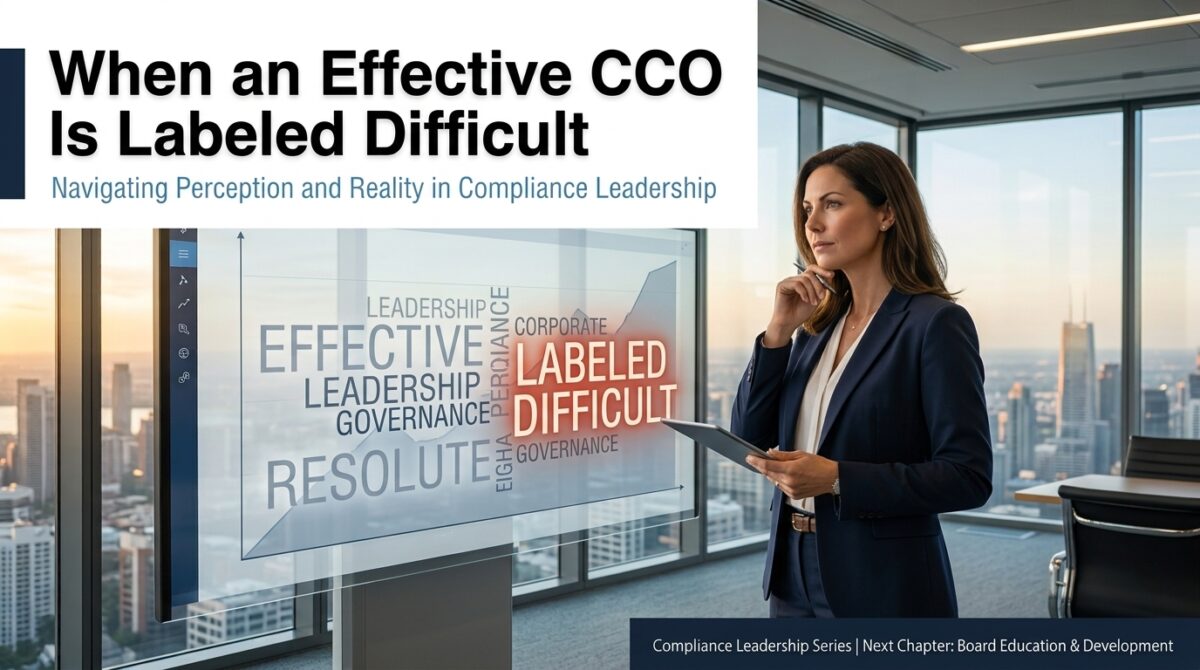
When an Effective CCO Is Labeled Difficult

A business leader calls a Chief Compliance Officer (CCO) difficult after a proposed distributor fails to provide basic ownership information. The transaction is important to the quarter. The CCO has asked for the missing information, explained the concern, and identified what is needed to proceed. In the performance discussion that follows, the focus shifts to whether the CCO understands the business.

This hypothetical presents a governance question. Did the CCO handle the matter poorly, or did an appropriate challenge expose a business practice management would prefer to leave alone? The answer requires evidence about the decision, the CCO’s conduct, and the operating environment. A label provides none of that.

Luis Velasquez examines this diagnostic problem in Why Effective Leaders Get Branded as Problems, published in Harvard Business Review. He identifies four sources of leadership friction: genuine skill deficits, historical reputation, overextension of a leadership strength, and organizational barriers. His framework provides a useful starting point for evaluating CCO effectiveness while protecting the independence necessary to perform the role. The compliance applications below build on his analysis.

Diagnose the Conflict Before Evaluating a CCO

Velasquez describes an evaluation trap in which organizations treat visible behavior as the explanation for friction while giving insufficient attention to context. Once a leader acquires a negative reputation, subsequent assessments can reinforce it without testing whether the original diagnosis was sound.

For compliance, this creates a particular risk. A CCO’s responsibilities include raising concerns that may complicate a transaction, challenge an executive, or require management to change an established practice. Friction can arise while the function is doing its job. It can also arise when compliance communicates poorly, applies inconsistent standards, or takes too long to decide. An effective evaluation must examine both possibilities.

Start with the event behind the criticism. What decision was required? What information was available? What did the compliance request say, when, and why? What alternatives did a CCO identify? Which actions by the business affected the outcome? These questions create a basis for assessing performance without assuming the conclusion.

Address Genuine Skill Gaps Directly

Velasquez’s first category recognizes that leaders sometimes lack a necessary capability. Applied to CCOs, relevant gaps may include unclear communication, weak prioritization, insufficient business knowledge, or ineffective delegation. Consider a CCO who repeatedly sends lengthy technical explanations without identifying the decision management must make. Executives may reasonably struggle to act on the advice. Similarly, a compliance team that treats every request as equally urgent can consume resources while delaying matters that warrant immediate attention.

Those are legitimate performance concerns when supported by recent examples and a clear account of their consequences. Agree on the improvement required, provide support, and assess the result. Independence does not excuse disrespectful conduct, poor execution, or unsupported recommendations. It gives a CCO room to exercise judgment while remaining accountable for the work’s quality and delivery. A sound review evaluates whether a CCO explains concerns clearly and helps the business identify acceptable ways forward where they exist.

Replace Old Reputation With Current Evidence

Velasquez’s second category concerns historical reputation. A leader may change while the organization still relies on an outdated account of how that person operates. A CCO who joined during a serious control failure may initially have imposed tight review requirements. Years later, colleagues may still describe the function as inflexible even after it has introduced clearer thresholds, delegated decisions, and improved turnaround times.

The evaluation process should test whether the criticism reflects current experience. Ask for specific recent interactions, the applicable requirements, and the outcome. Compare those accounts with evidence of how the process now works. Older incidents may remain relevant, but explain their continued significance rather than assume it.

A CCO can contribute by demonstrating improvement through current service measures, examples of resolved issues, and feedback from people who use the process. The objective is an accurate assessment. Favorable anecdotes alone are no more sufficient than a repeated negative label.

Recognize When a Strength Needs a Different Application

Velasquez distinguishes a missing skill from a strength used too broadly. That distinction matters for a compliance leader whose career has rewarded detailed review and personal control of important decisions. Those habits may help stabilize a troubled program. As the business grows, the same approach can create bottlenecks if routine matters still require a CCO’s personal involvement. The leader needs to develop the team and establish clear decision authority while retaining appropriate escalation for significant concerns.

The response should specify where judgment can be delegated, what standards apply, and how quality will be checked. This preserves the value of careful review while changing how it is delivered. A CCO should be willing to examine this possibility candidly. A complaint about delay may reveal poor business planning, an overly centralized compliance process, or both. Correcting one cause does not remove the need to address the other.

Examine Whether the Organization Undermines the Role

Velasquez’s fourth category addresses organizational barriers involving culture, resources, incentives, and decision rights. This is where the implications for compliance independence become particularly significant.

A company may require review before engaging a third party while rewarding executives who commit to start dates before review begins. It may expect timely investigations while restricting access to relevant records. It may ask a CCO to escalate serious concerns and then criticize the escalation as a failure to collaborate.

In each case, evaluate the contradiction alongside a CCO’s response. Coaching the leader to communicate more effectively may help, but it cannot supply missing authority or correct an incentive that rewards bypassing controls. A CCO should document the constraint, its practical consequences, and the proposed correction. Management should identify who will resolve it and by when. Repeated, material barriers belong in discussions with the responsible board committee, particularly when they prevent the function from carrying out agreed responsibilities.

Make Board Support Concrete

Board support for a CCO should be visible in the governance process. Directors need access to an account of significant compliance concerns that explains the facts, management’s response, and any unresolved differences. The responsible committee should also understand the basis for material criticism of a CCO’s performance. Where criticism arises from an executive whose conduct or decisions compliance has challenged, that context warrants examination. It does not automatically invalidate the criticism or establish retaliation.

An appropriately independent review should consider the substance of the concern, how it was raised, and the evidence behind any proposed personnel action. Human resources, legal, and the relevant board leadership should have clear roles consistent with the company’s governance arrangements. Regular private discussions between a CCO and ELT leadership (or the appropriate board committee) can help surface barriers before a performance dispute becomes entrenched. Directors should ask whether compliance has the access, resources, and authority needed to deliver what management expects.

Evaluate Effectiveness With Measures That Fit the Role

An evaluation based heavily on executive satisfaction can discourage necessary challenge. A review based solely on activity counts provides an equally incomplete picture. Assess the quality and timeliness of advice, the prioritization of risk, the development of the team, and the follow-through on significant issues. Consider whether recommendations are supported and whether remediation addresses the underlying problem. Business feedback remains useful when it is specific and examined in context.

The central discipline is to evaluate the work and its consequences. Agreement with management is not a reliable measure of effectiveness; disagreement alone does not demonstrate courage or sound judgment.

Action Steps for the CCO

Use Velasquez’s framework to improve how performance concerns are examined:

  1. Ask for specific evidence. Identify recent events, decisions, and consequences behind broad criticisms. Respond to substantiated concerns directly.
  2. Test all four explanations. Examine skill gaps, outdated reputation, overused strengths, and organizational constraints. Recognize that more than one may contribute.
  3. Agree on meaningful performance measures. Include advice quality, timeliness, prioritization, team capability, and remediation follow-through alongside contextualized business feedback.
  4. Document barriers to effective execution. Record missing resources, restricted access, conflicting incentives, or unclear authority, with proposed corrections and accountable owners.
  5. Establish a credible board review process. Clarify escalation and evaluation arrangements so significant concerns about a CCO and constraints on the role receive informed consideration.

Effective compliance leadership requires both sound judgment and the ability to make that judgment understood. Organizations strengthen accountability when they evaluate those capabilities fairly and address the conditions that prevent a CCO from using them.
Categories
Blog

How Compliance Should Show Up Before the Crisis

Recently, my colleague Matt Kelly wrote a blog post about retaliation against Chief Compliance Officers (CCOs). Matt and I explored it in an episode of the podcast Compliance into the Weeds. Matt’s post and our discussion crystallized one of the frustrations of the CCO role: compliance is often experienced solely by senior management as a late-arriving messenger of bad news. When compliance walks into the room, something has already gone wrong. The tone changes. Defenses go up. Trust narrows.

Yet the most consequential moments for a CCO are precisely those situations where the stakes are highest. A potential regulatory disclosure. A decision about whether to notify a government agency. A moment where delay, missteps, or poor coordination can turn a manageable issue into an enterprise-level crisis. If compliance is only visible in those moments, the relationship with the CEO and executive leadership team is already at a disadvantage.

Interestingly, in our podcast, we explored a technique which might be termed “coaching management ahead of time”. Matt picked up the strategy of using a training borrowed from the cyber world of incident training for a cyber-attack. I see this as a very powerful way not only to communicate compliance but also to train on the specific issues senior management will face if a reportable compliance incident occurs. You could train on such hypotheticals by walking the executive leadership team through them so they understand the process, while also providing training on the specific issues.

I think this approach offers practical, repeatable ways to build trust with senior management before a crisis, so that when compliance raises a serious issue, the function is seen as a stabilizing force, not a source of panic.

The Core Problem: Compliance as the Bearer of Bad News

Many compliance officers do excellent technical work but still struggle to earn executive trust. The reason is not competence. It is timing and framing. Senior leaders often experience compliance in three narrow contexts:

  • An investigation has begun.
  • A whistleblower allegation has escalated; and/or
  • A regulator may need to be notified.

In those moments, compliance is necessarily directive. The CCO must slow decisions down, insist on process, and sometimes recommend outcomes executives would prefer to avoid. Without a foundation of trust, those recommendations can feel punitive or overly conservative. The solution is not softer messaging during crises. The solution is familiarity with the compliance process long before the crisis arrives.

Process Transparency as a Trust-Building Strategy

Trust is built through predictability. Senior executives are far more comfortable with difficult outcomes when they understand the process that leads there. This is where scenario-based training becomes one of the most underused tools in the compliance arsenal. Instead of waiting for a live issue, the CCO can walk the executive leadership team through realistic hypotheticals:

  • A fact pattern that suggests regulatory notification may be required
  • How compliance evaluates credibility and materiality
  • Who is involved at each stage and why
  • What decisions will management be asked to make
  • What actions help, and what actions make things worse

These sessions are not about assigning blame or rehearsing fear. They are about demystifying how compliance operates when the stakes are high.

Why Scenario-Based Training Works With Executives

Scenario-based discussions resonate with executive teams for several reasons. First, they are practical. Executives do not need another policy overview. They want to know what actually happens when something goes wrong. Second, they are respectful of executive time and intelligence. A well-designed hypothetical treats leadership as decision-makers, not students. Third, they normalize compliance involvement.

When executives have already walked through a compliance-led process in a low-pressure setting, that process feels familiar rather than threatening during a real event. Most importantly, scenario-based training reframes compliance from a reactive function to a preparedness function.

The Strategic Role of Informal Engagement

These conversations do not need to occur only in formal training sessions. In fact, some of the most effective trust-building happens outside structured settings.

  • A short walkthrough during an executive offsite.
  • A tabletop discussion over lunch.
  • A casual conversation that begins with, “Let me show you how we would handle this if it ever happened.”

These informal touchpoints matter because they remove fear from the equation. They allow executives to ask questions they might not ask during a live issue. They also allow compliance to show judgment, nuance, and business awareness. This is not a charm offensive. It is a deliberate relationship strategy.

Training on What Not to Do

One of the most valuable elements of scenario-based transparency is the ability to explain mistakes before they occur. Executives often want to help in a crisis. That instinct, while well-intentioned, can create problems. Premature document reviews. Side conversations. Incomplete recollections. Overconfident assurances.

Scenario training allows the CCO to say, in advance, “Here is what helps us protect the company,” and just as importantly, “Here is what can unintentionally make things worse.” When executives understand these boundaries ahead of time, compliance interventions during a real issue feel protective rather than restrictive.

From Messenger of Doom to Stabilizing Force

When compliance has invested in transparency and education, something important shifts. When the CCO later says, “We believe this may require regulatory notification,” that recommendation is no longer heard in isolation. It is understood as part of a known, previously discussed process.

Executives may not like the conclusion, but they trust the path that led there. That trust allows compliance to do its job effectively. It reduces friction. It shortens response time. It improves decision quality. Most importantly, it positions compliance as an advisor whose presence brings structure and clarity to uncertainty.

What Compliance Officers Should Take Away

For compliance officers, the lesson is not about presentation skills or tone management. It is about timing and familiarity. If senior management only experiences compliance during moments of stress, compliance will always feel adversarial. If senior management understands the compliance process before the stress arrives, compliance becomes a stabilizing influence.

Scenario-based training, informal engagement, and process transparency are not “nice to have” activities. They are strategic tools for relationship-building at the highest levels of the organization. The most trusted CCOs are not those who avoid bringing bad news. They are the ones who ensure that when bad news arrives, it is delivered within a framework everyone already understands. That is how compliance earns trust before the crisis and credibility during it.

Categories
Trekking Through Compliance

Trekking Through Compliance – Episode 75 – Compliance Lessons from The Way to Eden

In this episode of Trekking Through Compliance, we consider the episode The Way To Eden, which aired on February 21, 1969, and occurred on Star Date 5832.3

Story Synopsis

This episode explores themes of counterculture, utopian ideals, and the clash between authority and freedom. The charismatic Dr. Sevrin leads a group of space-age hippies that the USS Enterprise crew encounters. These travelers are on a quest to find the mythical planet Eden, a place they believe to be a paradise free from the technological and societal constraints of the Federation.

The episode begins with the Enterprise intercepting a stolen space cruiser carrying Dr. Sevrin and his followers. These individuals reject the Federation’s technological advances and structured society, seeking instead a return to a more natural and harmonious way of life. Captain Kirk is tasked with understanding and containing the group, as their leader, Dr. Sevrin, is a carrier of a deadly disease that threatens any world he encounters.

As the narrative unfolds, the episode delves into the ideals and motivations of Sevrin and his followers, highlighting the tensions between their desire for freedom and the responsibilities imposed by society. The conflict escalates as Sevrin’s group takes control of the Enterprise, forcing the ship toward their vision of paradise. Ultimately, their quest for Eden leads to tragedy, revealing that the planet they sought is a toxic wasteland incapable of sustaining life.

“The Way to Eden” is an allegory for the 1960s counterculture movement, reflecting societal debates on conformity, freedom, and the search for a better world. The episode critiques the establishment’s rigidity and the naive idealism of those who reject it entirely. Through its narrative, “The Way to Eden” invites viewers to reflect on the balance between progress and preservation, individual desires and collective responsibilities, making it a poignant exploration of human nature and societal values.

Commentary

The episode, which centers on a group of space hippies headed by Dr. Sevrin who search for the utopian planet Eden, emphasizes important compliance lessons. Topics discussed include the illusion of utopia and unforeseen consequences, the power of influence and manipulation, the importance of adaptability and evolving risk, and the value of diversity and multiple perspectives. Tom Fox also notes interesting continuity elements and character appearances and shares fun facts about the episode’s production and reception.

Key Highlights

  • Story Synopsis
  • Fun Facts and Continuity Issues
  • Compliance Lessons from The Way to Eden

Resources

Excruciatingly Detailed Plot Summary by Eric W. Weisstein

MissionLogPodcast.com

Memory Alpha

Categories
31 Days to More Effective Compliance Programs

One Month to a More Effective Compliance Program Through Data Analytics: Day 11 – The Importance of Data Governance

In today’s digital landscape, compliance, data governance, and cybersecurity have become crucial aspects of running a successful business. The convergence of these three disciplines is a growing trend, emphasizing the need for collaboration and breaking down silos within organizations. The key factor that impacts the importance of compliance, data governance, and cybersecurity in business is data governance.

Data governance involves managing and organizing data for accuracy, accessibility, and compliance. With the increasing amount of data being generated for compliance and other corporate functions, it has become crucial for organizations to have effective data governance and legal technology services in place to ensure compliance with regulatory obligations. It plays a significant role in both the business and legal aspects of an organization. CCOs and compliance professionals rely on data to make informed decisions, analyze trends, and measure key performance indicators. From a legal perspective, data governance is essential for providing legal advice and meeting regulatory obligations.

 Three key takeaways:

1. Data preservation and credibility are crucial for effective compliance representation if a regulator comes knocking.

2. Compliance, data governance, and cybersecurity are intertwined in today’s business landscape.

3. As the digital landscape continues to evolve, organizations must prioritize data governance and stay compliant and competitive in the business world.

For more information on KonaAI, click here.