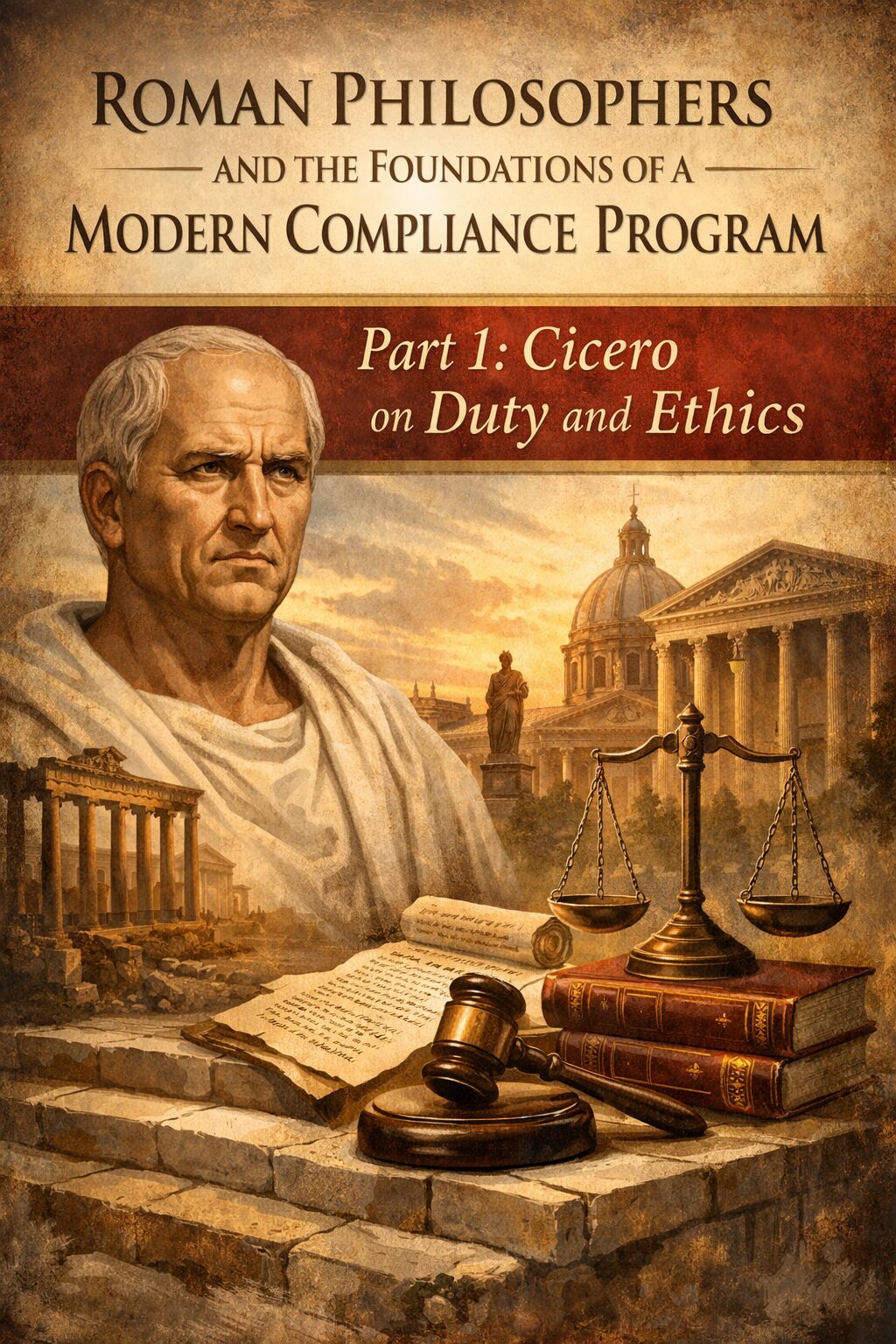
I recently wrote a series on the direct link between ancient Greek Philosophers and modern corporate compliance programs and compliance professionals. It was so much fun and so well-received that I decided to follow up with a similar series on notable Roman Philosophers. This week, we will continue our exploration of the philosophical underpinnings of modern corporate compliance programs and compliance professionals by looking at five philosophers from Rome, both from the BCE and AD eras.
We will consider Cicero and the duty, law, and the moral limits of business; Seneca and power, pressure, and ethical decision-making under stress; Marcus Aurelius and ethical leadership and tone at the top; Epictetus and accountability, control, and ethical agency; and we will conclude with Lucretius to explore rationality, fear, and risk perception. Today, we begin with Cicero and the ethical foundations of the compliance program.
I. Cicero in Context: Duty in an Age of Power and Commerce
Marcus Tullius Cicero lived at the intersection of law, politics, and commerce during the final decades of the Roman Republic. Rome was wealthy, expansive, and deeply corrupt. Provincial governors enriched themselves through bribery and extortion. Political power was routinely monetized. Legal technicalities were used to justify conduct that plainly violated any reasonable notion of fairness or justice.
It was in this environment that Cicero wrote De Officiis (On Duties), a work addressed not to philosophers, but to those who held power and responsibility. Cicero was not interested in abstract virtue. He was interested in how people entrusted with authority should behave when tempted by profit, pressure, or expediency.
For Cicero, duty was not optional. It arose from one’s role and the trust placed in that role. Public office, commercial activity, and leadership all carried moral obligations that custom, convenience, or legal loopholes could not waive. Most importantly, Cicero rejected the idea that what was profitable could excuse what was unethical. Where profit and moral duty conflicted, duty had to prevail.
This framing makes Cicero uniquely relevant to modern corporate compliance. Large organizations, like the Roman Republic, operate through delegated authority, complex incentives, and diffuse accountability. Cicero understood that without an ethical foundation grounded in duty, institutions eventually hollow out, even if they remain technically lawful.
II. The Compliance Problem Cicero Illuminates: When Law Becomes the Ceiling
One of the most persistent failures in corporate compliance programs is treating legal compliance as the ultimate objective rather than the minimum requirement. Organizations ask, “Is it legal?” far more often than they ask, “Is it right?” or “Is this consistent with our obligations as stewards of trust?” Cicero would have recognized this failure immediately. In De Officiis, he warned against the misuse of legal form to justify immoral conduct. He argued that clever interpretations of the law, when divorced from justice, ultimately destroy trust in institutions. This is not merely a moral observation. It is an operational one.
Modern enforcement actions repeatedly demonstrate that misconduct often occurs in plain sight, enabled by policies, approvals, and structures that technically comply with written rules. The Department of Justice has been explicit that a compliance program that exists only on paper, or that focuses solely on technical adherence, will not be viewed as effective. The DOJ Evaluation of Corporate Compliance Programs (ECCP) asks whether a company’s program is “well designed,” “applied in good faith,” and “actually works in practice.” These questions implicitly echo Cicero’s concern. A program that treats legality as the ceiling rather than the floor may satisfy internal counsel, but it fails as an ethical governance system.
Cicero teaches that compliance programs must be grounded in duty: to customers, markets, employees, shareholders, and society. Without that grounding, rules become tools for avoidance rather than instruments of integrity.
III. Modern Corporate Application: Cicero, DOJ Expectations, and Real-World Failures
The ECCP places increased emphasis on culture, leadership accountability, and the role of the board. These expectations align closely with Cicero’s insistence that those in power bear heightened ethical responsibility.
Consider enforcement actions involving bribery, corruption, or fraud in which senior leaders claimed ignorance while benefiting from the outcomes. In multiple Foreign Corrupt Practices Act resolutions, the DOJ has rejected arguments that misconduct occurred despite policies, rather than because governance systems tolerated or incentivized it. In cases such as Airbus and Goldman Sachs, regulators highlighted failures in oversight, escalation, and ethical decision-making at senior levels. From a Cicero-inspired perspective, these are failures of duty. Leaders accepted the benefits of authority without fully embracing its obligations. Compliance programs existed, but they were not anchored in a shared understanding that ethical duty limits what is acceptable in profit-seeking behavior.
Applying Cicero to modern compliance design suggests several concrete actions:
First, the code of conduct should be framed as a statement of duties rather than merely a list of prohibitions. Employees should understand not only what is forbidden, but why certain conduct violates the organization’s obligations to stakeholders.
Second, senior leadership accountability must be explicit. Cicero believed that authority magnifies moral responsibility. The DOJ now expects boards and executives to actively oversee compliance, not passively receive reports. A compliance program that cannot demonstrate meaningful leadership engagement will struggle under scrutiny.
Third, incentives matter. Cicero warned that when institutions reward success without regard to means, they invite corruption. Modern compliance programs must align compensation, promotion, and recognition with ethical behavior, not merely financial outcomes. The DOJ has repeatedly emphasized incentives and discipline as indicators of program effectiveness.
Finally, compliance should be positioned as a governance function, not a technical one. Cicero understood law as a moral instrument, not a procedural shield. Compliance professionals should frame their role as guardians of institutional duty, helping the organization navigate gray areas where legal guidance alone is insufficient.
Key Takeaways for Compliance Professionals
1. Ethical Foundation. Compliance professionals should view Cicero as the ethical foundation of a modern compliance program. Cicero establishes that compliance must be grounded in duty rather than fear of enforcement. He frames ethical behavior as an obligation arising from trust and authority, not as a discretionary choice. A compliance program without this foundation risks becoming a technical exercise divorced from purpose.
2. Law as a Floor. Compliance should treat law as the minimum standard, not the ultimate objective. Cicero warned against using legal formality to justify conduct that violates justice and fairness. Modern compliance failures often arise when organizations ask only whether conduct is legal rather than whether it is right. Effective compliance programs must push beyond legality to reinforce ethical judgment.
3. Governance and Stewardship. Compliance should be positioned as a core governance function. Cicero believed that those entrusted with authority act as stewards, not owners, of institutional power. Compliance should therefore be integrated into governance structures rather than treated as a peripheral control function. This positioning reinforces accountability to stakeholders and long-term institutional integrity.
4. Leadership Duty. Compliance should impose heightened ethical obligations on those with power. Cicero argued that authority magnifies moral responsibility rather than diminishing it. Senior leaders and boards must therefore be held to higher compliance expectations, not exempted for performance or status. Ethical leadership is essential to a program’s legitimacy.
- Compliance should align incentives with integrity, not just results.
- Cicero warned that rewarding success without regard to means invites corruption. Modern compliance programs fail when compensation and promotion structures undermine stated values. Incentive alignment is a critical control, not a human resources afterthought.
5. Cultural Legitimacy. Compliance should reinforce trust as an institutional asset.
Cicero understood that institutions survive only so long as they retain public and internal trust. A compliance program grounded in duty strengthens credibility with employees, regulators, and stakeholders alike. Trust is not a soft concept; it is the currency of effective governance.
6. Duty Over Expediency. Finally, Cicero teaches that ethical systems collapse when expediency displaces duty. A compliance program that exists only to manage risk or avoid penalties will eventually lose legitimacy. Compliance grounded in duty, by contrast, becomes a stabilizing force for the institution itself.
Conclusion
Cicero provides the compliance professional with the ethical foundation for a program: duty, legitimacy, and moral purpose. But he largely assumes that once duty is understood, it will be followed. Experience tells us otherwise. Modern compliance failures rarely occur because people do not know the rules or the obligations. They occur because pressure, fear, ambition, and rationalization overwhelm judgment at precisely the moments when duty matters most. That is where Cicero necessarily gives way to Seneca.
If Cicero explains why a compliance program must exist and what it must stand for, Seneca confronts the harder question of how ethical commitments erode under stress. The transition from Cicero to Seneca mirrors the transition from program design to real-world operation, when incentives tighten, stakes rise, and ethical clarity is tested. This is where compliance programs are no longer theoretical and where many begin to fail.
Join us tomorrow as we explore Seneca and compliance under pressure, using Cicero’s foundation as the explicit point of departure.