Today, we conclude our exploration of Enlightenment Thinkers to see their influence on modern compliance programs. This week’s category is broader than philosophers, as many of these men excelled in numerous fields, including science, mathematics, calculus, and medicine. However, each contributed a key component that relates directly to our modern compliance regimes. In this concluding post, we consider Isaac Newton’s theorem that misconduct is rarely random.
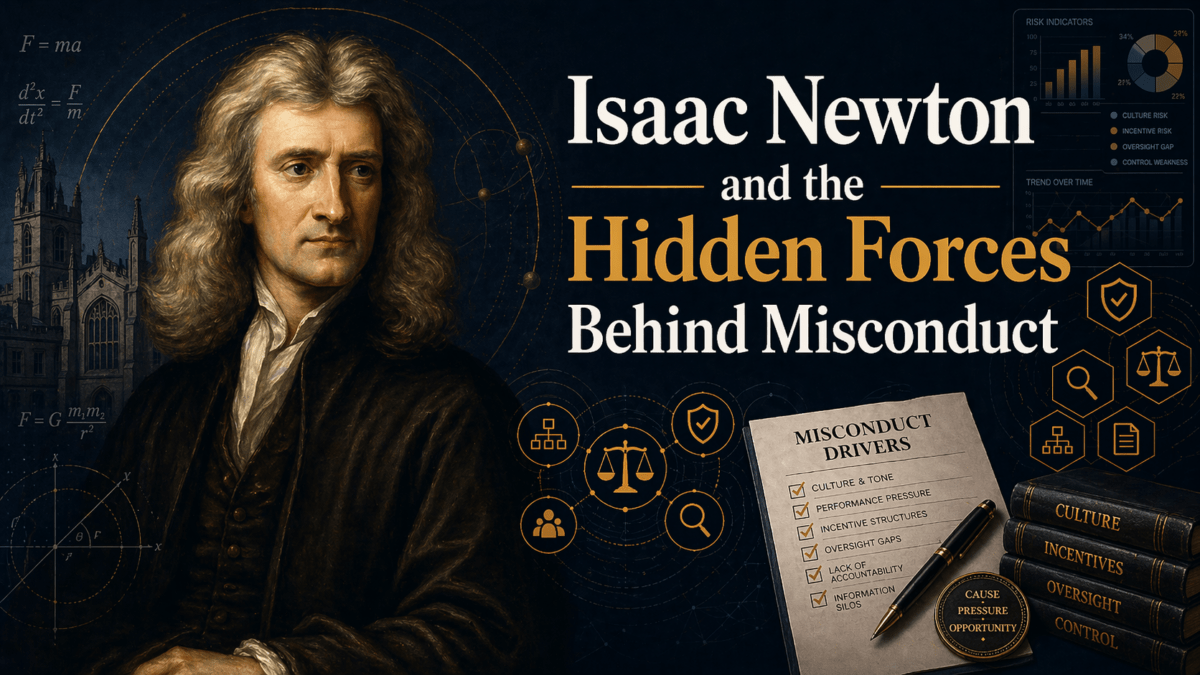
If Francis Bacon taught us that a compliance program must be grounded in evidence, René Descartes taught us that evidence must be examined with rigor, John Locke taught us that the system must be legitimate, and Thomas Hobbes taught us that institutions need order, Isaac Newton brings this series to its final and perhaps most powerful insight: misconduct is rarely random. Forces drive it. Pressures. Incentives. Structural weaknesses. Repeated patterns. Hidden relationships. The most mature compliance programs understand that reality and act on it.
Newton is remembered as the great scientist of motion, force, and causation. He gave the world a way to understand that observable events are often the result of underlying principles that can be identified, studied, and predicted. His work was not simply about describing what happened. It was about explaining why it happened and how the same forces might operate again. For the compliance professional, that is a profoundly useful way to think. A hotline complaint, a bribery incident, a books-and-records failure, a retaliation claim, or a control breakdown should never be seen as a one-off event. The real question is Newtonian: what forces produced this result? In a best practices compliance program, that question is the bridge from reaction to prevention.
Why Newton Matters to Compliance
Newton helps compliance professionals move beyond event-based thinking. Too often, organizations respond to misconduct by focusing only on the visible incident. Someone violated policy. Someone approved a bad payment. Someone ignored a red flag. Someone retaliated against a whistleblower. Those facts matter, of course, but they are usually only the surface expression of deeper conditions. Newton would urge us to ask what was acting beneath the surface.
Was the employee under intense sales pressure? Were performance incentives designed in a way that rewarded output but ignored process? Was a business unit growing so quickly that controls were bypassed in the name of speed? Did management tolerate workarounds because the local market was too important to slow down? Was the company relying on outdated monitoring tools in a rapidly changing business model? Were risk signals present but scattered across functions with no one connecting them?
That is Newton’s great gift to compliance. He reminds us that forces shape behavior, and if you want to reduce misconduct, you must understand and address the forces that make misconduct more likely.
The DOJ Expects Companies to Understand Causes, Not Just Outcomes
The Department of Justice’s Evaluation of Corporate Compliance Programs (ECCP) reflects this Newtonian logic with remarkable consistency. The ECCP asks whether a company performs root cause analysis, adapts its program based on lessons learned, uses data to identify patterns, aligns incentives with ethical conduct, and can demonstrate that controls are responsive to emerging risks. These are not narrow enforcement questions. There are questions about causation.
The ECCP is not satisfied when a company says it found the bad actor and imposed discipline. Regulators want to know what the company learned. Why did the misconduct happen? Were there prior warning signs? Was the conduct enabled by poor oversight, flawed incentives, weak middle management, insufficient resources, or ineffective controls? Did the company identify those drivers and change the system? That is exactly the sort of inquiry Newton would have appreciated.
Root Cause Analysis Is Newton in Practice
If there is one place where Newton’s influence should be front and center, it is root cause analysis. In compliance, root cause analysis is the discipline of looking beyond the immediate violation to identify the pressures, structures, incentives, and system weaknesses that created the conditions for failure. This is where many companies still fall short.
A company uncovers improper payments and concludes that an employee acted dishonestly. Perhaps that is true. But Newton would ask what else was in motion. Was there a compensation model that encouraged aggressive behavior without corresponding control discipline? Were finance and compliance understaffed relative to expansion? Did business leadership send signals that revenue mattered more than process? Had similar concerns surfaced in audit findings or prior investigations? Was a third-party oversight process designed for a smaller and less risky operating model? A true root cause analysis keeps asking until the organization understands the forces at work.
Incentives Are Among the Strongest Forces in Any Organization
Newton’s framework is especially valuable when thinking about incentives. Every organization generates motion through what it rewards, measures, and celebrates. If those incentives are poorly designed, they can push employees and managers toward decisions that undermine the compliance program even when the formal policy language is sound. This is one of the most underappreciated truths in compliance.
A company may say all the right things about integrity, but if promotions, bonuses, and recognition go disproportionately to people who hit aggressive numbers regardless of how they achieved them, employees receive a different message. If managers are evaluated on speed and volume but not on control discipline, they will often treat process as friction. If local market leaders are given extraordinary flexibility without matching oversight, the organization may create precisely the pressures and blind spots that breed misconduct.
The ECCP has increasingly focused on compensation structures, clawbacks, and incentive alignment for precisely this reason. Regulators understand that culture is shaped not only by leadership’s words, but also by tangible rewards that guide daily conduct. Newton helps compliance professionals explain why this matters. Incentives are not background conditions. They are active forces inside the corporate system.
Analytics Help the Company See What the Eye Misses
A Newtonian compliance program also leverages analytics more effectively. Newton’s work showed that patterns in motion could be identified through disciplined observation and analysis. Modern compliance can do something similar. Data analytics, trend reviews, and integrated monitoring allow a company to detect patterns that an isolated human review might miss. That does not mean technology replaces judgment. It means technology can help reveal the forces and relationships that judgment must then interpret.
Consider a multinational company reviewing third-party spend, travel, and entertainment data, hotline trends, and investigation outcomes. Each data set alone may show only limited information. But when viewed together, patterns may emerge. A particular region may show above-average use of high-risk intermediaries, greater discounting, delayed documentation, and increased employee complaints about management pressure. No single data point proves misconduct. But together they may reveal a system under strain.
This is where Newton connects back to Bacon. Bacon tells us to gather evidence. Newton tells us to study how patterns and causes operate across the system. Together, they produce a compliance function that is empirical, analytical, and forward-looking.
Misconduct Is Often a Systems Failure, Not Merely an Individual Failure
One of the most valuable lessons Newton offers the compliance profession is that misconduct is frequently systemic. This does not excuse individual wrongdoing. Personal accountability remains essential. But if a company stops with personal accountability, it may miss the broader organizational truth.
An employee may make an improper payment, but the surrounding system may have made that outcome easier, more predictable, or more likely. A senior manager may retaliate against a reporter, but the broader culture may have conditioned leaders to treat bad news as disloyalty. A financial control breakdown may involve one approving official, but the deeper problem may be a long-standing tolerance for informal overrides. In each case, the misconduct event should prompt a systems review.
This is particularly important in fast-changing environments. Growth, acquisitions, digital transformation, remote work, AI deployment, and market stress all alter the forces acting on the organization. Controls designed for one operating model may not be sufficient for the next. A Newtonian compliance officer understands that governance must evolve as the system changes. The question is never just whether the policy still exists. The question is whether the underlying forces have shifted in ways the compliance program has not yet caught up to.
Newton and the Future of Compliance
Newton is particularly relevant today because the modern compliance landscape is increasingly defined by complexity. Third-party ecosystems are larger. Data flows are faster. Business models shift more quickly. AI and automated decision-making create new risks that can change over time through drift, scale, and changing use cases. In that world, static compliance is not enough. A company needs to understand how moving systems work.
This is where frameworks like NIST and ISO/IEC 42001 become useful companions to Newtonian thinking. They emphasize lifecycle governance, ongoing monitoring, documented accountability, testing, and adaptation. In the AI context, especially, the lesson is clear: a control that works on day one may not be enough on day two. Risks evolve—inputs change. Vendors change. User behavior changes. Governance must therefore be dynamic, evidence-based, and attentive to emerging forces.
The same is true across compliance more broadly. Companies cannot assume that yesterday’s control environment will manage tomorrow’s pressures. Newton teaches that motion continues unless acted upon, and in the corporate setting, that means risk patterns will continue to develop unless governance actively intervenes.
The Compliance Officer as Interpreter of Organizational Forces
If Bacon casts the compliance officer as an institutional scientist, Descartes as a guardian of clear thinking, Locke as a steward of legitimacy, and Hobbes as an architect of order, Newton casts the compliance officer as an interpreter of organizational forces. That is a sophisticated and necessary role.
The compliance officer must ask what is really driving conduct across the enterprise. Which incentives are shaping decisions? Which processes are creating blind spots? Which managers are transmitting pressure? Which data trends suggest a deeper problem? Which repeated “isolated incidents” are no longer isolated at all? Which changes in the business model have altered the risk environment without corresponding updates to governance?
Those are not merely compliance questions. They are strategic governance questions. That is why Newton is such a fitting conclusion to this series. He pulls together all that came before. Evidence matters. Rigor matters. Legitimacy matters. Order matters. But ultimately, the mature compliance program does something more. It understands how these elements interact inside a living system. It seems that misconduct does not fall from the sky. It emerges from forces that can be studied, anticipated, and changed. Isaac Newton would have understood that a well-governed institution learns to read its own motion.
Five Lessons Learned for the Modern Compliance Professional
First, misconduct is rarely random. It is usually the product of identifiable pressures, incentives, weaknesses, and structural conditions.
Second, root cause analysis must go beyond the visible event. The goal is to understand the forces that made the event more likely.
Third, incentives are among the strongest drivers of conduct. A company must align compensation, promotion, and recognition systems with ethical and compliant behavior.
Fourth, analytics and trend analysis are essential tools for seeing patterns across the system. They help the company detect pressure points before they become crises.
Fifth, the most mature compliance programs are systemic and preventive. They do not simply respond to incidents. They study the organization well enough to reduce the conditions that produce misconduct.
Closing It Out
This five-part journey through Bacon, Descartes, Locke, Hobbes, and Newton shows that the architecture of a modern compliance program is not merely legal or procedural. It is intellectual. Bacon teaches us to demand evidence. Descartes teaches us to examine it with discipline. Locke teaches us that the system must be legitimate. Hobbes teaches us that institutions require order. Newton teaches us to understand the forces that shape outcomes.
Together, they offer a powerful framework for the compliance professional, the board, internal audit, legal, and business leadership. A best practices compliance program is not simply a collection of policies. It is a way to see the organization clearly, govern it credibly, and continuously improve it. That is as true now as it would have been revolutionary in their own time.