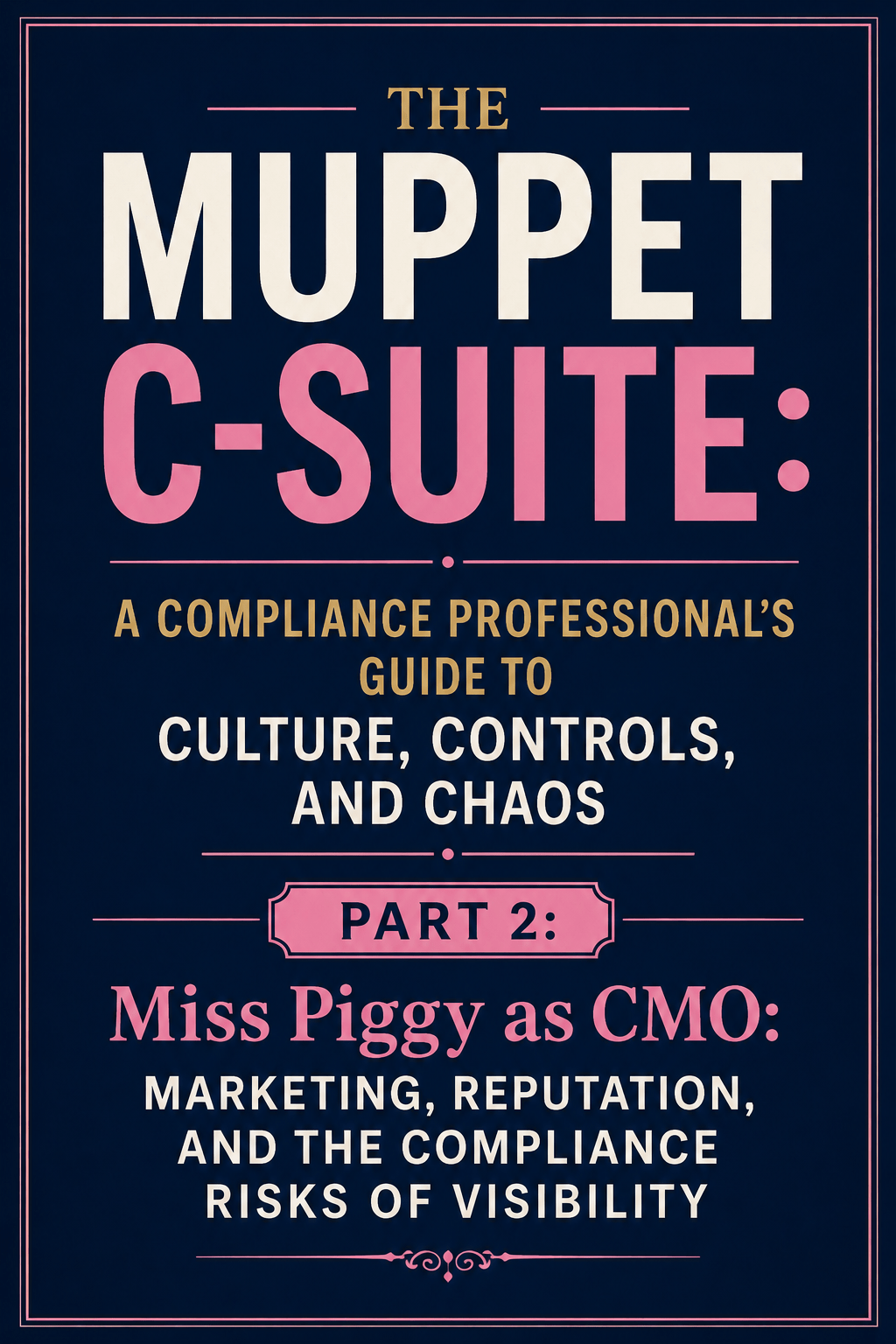
This week, we are honoring the return of The Muppets for a 2026 Special Edition. I thought it would be fun to look at business leadership teams through the lens of The Muppets. Every compliance professional has worked with a Kermit, managed a Piggy, worried about a Gonzo, or tried to contain an Animal. This series uses the Muppet executive team as a framework to explore leadership, governance, innovation, operational risk, and corporate compliance through the lens of the DOJ’s Evaluation of Corporate Compliance Programs and modern governance expectations.
In Part 2, we consider Miss Piggy, for if Kermit the Frog represents tone at the top, Miss Piggy represents what happens when tone meets brand, ambition, ego, visibility, and commercial pressure. And rest assured, every organization has a Miss Piggy. She is talented, visible, confident, persuasive, and deeply invested in how the enterprise is perceived. She understands audience, image, influence, and reputation. She knows that attention has value. She also knows that if she is not in the spotlight, something has gone terribly wrong.
As Chief Marketing Officer, Miss Piggy would be a powerful business asset. She would elevate the brand, command the room, and make sure the organization was never ignored. But from a compliance perspective, she would also pose a familiar governance challenge: how does a company manage a high-performing, high-visibility executive whose role creates real legal, ethical, and reputational risks? The answer is not to silence her. The answer is to govern the risk.
Marketing Is a Front-Line Compliance Function
Too many organizations still treat marketing as a creative function sitting outside the core compliance risk universe. That is a mistake. Marketing is where corporate promises become public commitments. It is where product claims, customer expectations, sustainability statements, influencer relationships, social media messaging, and reputational positioning move from internal strategy to external representation. That makes marketing a front-line compliance function.
Miss Piggy, as CMO, would own risks tied to:
- misleading advertising,
- unsubstantiated claims,
- endorsement and influencer disclosures,
- ESG and sustainability messaging,
- customer communications,
- crisis response, and
- and brand conduct.
A best-practices compliance program should recognize marketing as a risk-owning function, not simply a department that occasionally needs legal review. The DOJ’s Evaluation of Corporate Compliance Programs asks whether compliance is operationally integrated into the business. Marketing is one of the places where that question becomes real. If compliance is not in the marketing workflow, it is not fully embedded in the business.
The Danger of Brand Overconfidence
Miss Piggy’s greatest strength is also her greatest risk: confidence. Confidence sells. Confidence builds loyalty. Confidence moves customers, investors, employees, and markets. But when confidence becomes overclaiming, the organization moves from brand leadership to regulatory exposure.
This is especially true in today’s environment, where companies face scrutiny over public statements about the following:
- product performance,
- privacy and data use,
- artificial intelligence,
- sustainability,
- diversity and inclusion,
- supply chain integrity, and
- and social responsibility.
A CMO may view these statements as brand positioning. Regulators, plaintiffs’ lawyers, customers, and investors may view them as representations. That gap is where risk lives.
Miss Piggy would be very good at bold public messaging. A mature compliance program would make sure ‘bold’ does not become misleading. Every material claim should be substantiated, reviewed, documented, and tied back to actual operational capability. From a compliance perspective, the issue is not whether the brand voice is strong. The issue is whether the company can prove what the brand voice says.
Pre-Clearance Is a Control, Not a Creative Insult
Miss Piggy would not naturally enjoy pre-clearance. No high-performing marketing executive wants to be told that a slogan needs review, a campaign needs substantiation, or a public commitment needs documentation. But a mature compliance program should not approach marketing review as censorship. It should approach it as a risk-based control.
Not every tweet, tagline, or internal graphic requires legal and compliance approval. But high-risk communications do. That includes:
- comparative advertising,
- pricing claims,
- product capability statements,
- sustainability or ESG commitments,
- AI-related statements,
- customer testimonials,
- influencer content,
- and statements made during crisis response.
The control should be risk-tiered. Routine materials move quickly. High-risk materials receive enhanced review. Urgent communications have an expedited escalation path. This is the difference between a compliance program that enables the business and one that becomes a bottleneck. Miss Piggy does not need a hall monitor. She needs clear guardrails, fast answers, and a process she can trust.
Incentives Drive Marketing Behavior
The ECCP places significant emphasis on incentives and discipline. That principle applies directly to marketing. If Miss Piggy is rewarded only for reach, growth, visibility, impressions, engagement, and market buzz, then the compliance program should not be surprised when risk increases. People respond to what the organization measures and rewards. A mature organization would include compliance-sensitive measures in the CMO’s performance evaluation, such as:
- accuracy of public claims,
- adherence to review protocols,
- cooperation with Legal and Compliance,
- quality of campaign documentation,
- responsible use of influencers and third parties,
- and responsiveness to identified risks.
This does not mean making marketing timid. It means making marketing accountable. A high-performing CMO should be rewarded not simply for attention, but for trustworthy attention. In a mature company, brand value and compliance discipline should reinforce each other.
Reputation Risk Is Enterprise Risk
Miss Piggy understands reputation instinctively. She knows that perception matters. Compliance professionals should understand the same thing. Reputation risk is not soft risk. It can affect:
- customer trust,
- employee morale,
- investor confidence,
- regulatory scrutiny,
- litigation exposure,
- and board credibility.
Marketing sits at the center of that risk. A company may have excellent internal policies, strong controls, and thoughtful governance. But if its public messaging outruns its operational reality, the entire enterprise becomes exposed.
That is why marketing claims must be connected to internal controls. If the company says it has a rigorous third-party due diligence program, Compliance should be able to prove it. If the company says its AI is responsible, explainable, or human-supervised, Legal, Compliance, IT, and Risk should be able to document the governance structure behind that claim. The brand cannot promise what the control environment cannot support.
Miss Piggy as a Culture Carrier
Miss Piggy is not merely a marketing executive. She is a culture carrier. People watch her. They follow her cues. They imitate her confidence, her urgency, and sometimes her impatience. In many organizations, highly visible commercial leaders shape culture more powerfully than formal ethics statements. This creates opportunity.
If Miss Piggy publicly supports ethical marketing, substantiation of claims, customer transparency, and responsible branding, she becomes a compliance multiplier. She can make compliance feel commercially relevant rather than bureaucratic. But if she treats review processes as obstacles, dismisses concerns as negativity, or celebrates outcomes without regard to the methods used, the message to the organization is equally clear. Tone at the top matters. So does tone from the spotlight.
The CMO and the Board
Boards should care deeply about marketing risk. That does not mean the board should review every campaign. It means the board should understand whether the company has governance over high-risk communications and reputation-sensitive claims.
Board-level questions might include:
- What public claims are we making that could create legal or regulatory exposure?
- Are ESG, AI, privacy, and product claims substantiated?
- Who approves high-risk public statements?
- How do Legal, Compliance, and Marketing coordinate?
- Do incentives reward responsible growth or merely visibility?
- What reputational risks are emerging from social media, influencers, or public commitments?
These are not academic questions. They go directly to governance, controls, and oversight.
5 Key Takeaways for the Compliance Professional
1. Marketing is a risk-owning function.
Brand messaging, public claims, influencer relationships, and reputation management must be part of the compliance risk assessment.
2. Public claims require proof.
Companies should be able to substantiate material statements about products, ESG, AI, privacy, supply chains, and corporate responsibility.
3. Pre-clearance should be risk-based.
Compliance should not review everything, but it must review high-risk communications through a clear and efficient process.
4. Incentives shape marketing risk.
CMOs should be evaluated not only on visibility and growth but also on accuracy, cooperation, documentation, and responsible brand conduct.
5. Reputation risk is governance risk.
Boards and senior leaders should treat marketing claims as enterprise risk when those claims affect trust, regulatory exposure, or corporate credibility.
From Piggy to Gonzo
Miss Piggy teaches compliance professionals that visibility must be governed. Brand power creates opportunity, but it also creates exposure when public messaging runs ahead of facts, controls, or operational capability. In Part 3, we turn from reputation risk to innovation risk. Gonzo, as Chief Innovation Officer, will take us into the world of experimentation, emerging technologies, AI governance, and the compliance challenge of ensuring that innovation does not outrun accountability.
Because every company eventually faces its Gonzo moment: the moment when someone says, “What could go wrong? ”