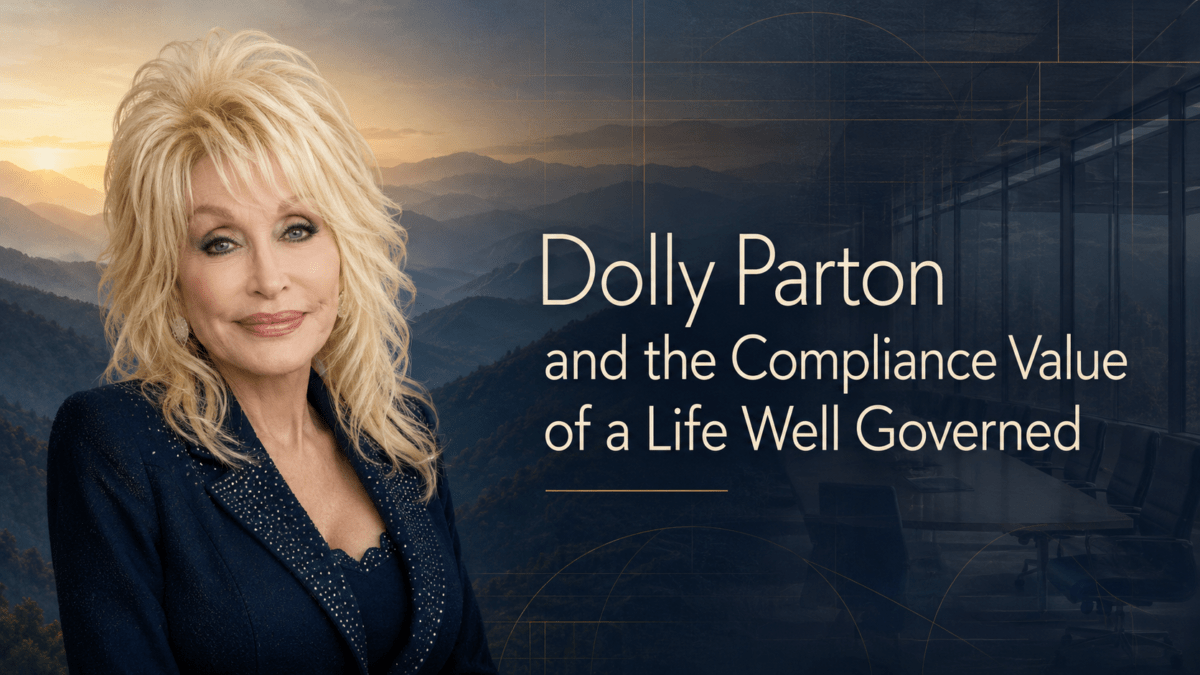
Dolly Parton died this week. Her death closed one of the most remarkable careers in American entertainment, but it did not close the institutions, ideas, and expectations she built. For corporate compliance professionals, that durability is what makes her story more than a tribute. It becomes a lesson in how values can be converted into governance. Today I want to honor Parton, what she did, and what she stood for, and perhaps hope that her life will inspire all of us to be just a little better.
Parton was one of twelve children. Parton began singing on local radio and television as a child and appeared at the Grand Ole Opry at thirteen. She wrote her first song at age 6. She moved to Nashville after high school, established herself as a songwriter, and became a national star through The Porter Wagoner Show. She then built a solo career that crossed country, pop, film, television, theater, publishing, tourism, and philanthropy. She recorded more than fifty albums, wrote roughly 3,000 songs, won ten Grammy Awards, and created works such as “Jolene,” “I Will Always Love You,” and “9 to 5” that became part of the American vocabulary. One of the most amazing facts I learned while researching this piece was that “Jolene” and “I Will Always Love You” were written on the same day. How is that for creative inspiration?
Parton did not run a corporate compliance program, and her career should not be forced into that frame. Yet she demonstrated something every CCO and Board of Directors needs to understand: culture becomes credible when stated values, hard decisions, operating systems, and visible conduct reinforce one another over time. Her public identity rested on kindness, independence, dignity, humor, and respect. She repeatedly made those commitments tangible in contracts, businesses, philanthropy, and crisis response.
Her entrepreneurship deserves equal attention. Parton moved from performer to owner, producer, publisher, and partner, most visibly through Dollywood and the enterprises built around it. The portfolio was diverse, but it was not random. Music, storytelling, family entertainment, Appalachian identity, hospitality, and community investment all reinforced a coherent promise. Compliance professionals should recognize the governance advantage of that clarity. Diversification creates new legal, operational, third-party, and reputational risks, but a stable purpose helps leaders decide which opportunities fit, which controls must travel with the business, and which deals to decline.
Independence Before Applause
Parton understood the difference between access to power and surrender to it. She left Porter Wagoner in 1974 to build an independent career, expressing gratitude for the partnership without allowing it to define her future. She later declined an opportunity for Elvis Presley to record “I Will Always Love You” when his manager demanded a share of the publishing rights—saying no cost her an extraordinary short-term opportunity. Retaining ownership preserved the long-term value of her work, especially when Whitney Houston’s recording became a worldwide success. Business Insider called it “her smartest business move.”
That decision should resonate with compliance leaders. Independence is not a paragraph in a charter. It is the authority to resist pressure when revenue, status, or a powerful executive makes acquiescence attractive. A CCO needs direct access to the board, control over investigative escalation, sufficient resources, and protection against retaliation. Chuck Watson once said, “Sometimes the best deal is the one you don’t make.” A board should test whether that independence works when it is expensive, inconvenient, and unpopular. If compliance can say no only when nothing important is at stake, it is not independent.
Purpose Made Operational
Parton’s philanthropy offers an equally powerful lesson in program effectiveness. She created the Dollywood Foundation in 1988 to improve educational outcomes in her home county. Its Buddy Program paired students and offered a financial incentive for graduation; the dropout rate for the participating classes fell from 35 percent to 6 percent. In 1995, inspired by her father’s inability to read and write, she launched the Imagination Library. What began in Sevier County became a network operating across five countries that has delivered more than 300 million free books to young children.
This was not the purpose of branding. It was purpose translated into a defined population, a repeatable delivery model, local partnerships, funding, data, and measurable results. That is the same transition the Department of Justice asks companies to make when it evaluates whether a compliance program is well designed, adequately resourced, and working in practice. A value in the code of conduct must become an owner, a control, an escalation path, testing, and remediation. Intent is the beginning of a compliance program, not proof of one.
Listen to the People Who Experience Power
Parton’s film and song “9 to 5” gave popular form to workplace realities many employees already knew: power can be abused, unfairness can become routine, and people with the least authority often carry the greatest burden. The song endured because it recognized the lived experience behind organizational charts. It made a workplace issue visible without turning the people affected into abstractions.
Compliance programs fail when they listen only upward. Hotline statistics, exit interviews, culture surveys, investigation themes, retaliation allegations, and manager-level trends must reach leaders in a form that supports action. Boards should ask whether employees believe they can speak without losing status, opportunity, or employment. They should also ask whether the organization learns from weak signals before they become red flags. A speak-up system is not effective because a telephone number exists. It is effective when people trust the process and see consistent, fair outcomes.
Trust Earned Through Response
Parton’s businesses remained closely connected to the community that formed her. Dollywood became Sevier County’s largest employer, while its stated operating culture emphasizes hospitality, authenticity, collaboration, and respect. The company supports employee development, including tuition assistance. When wildfires devastated East Tennessee, Parton helped organize direct support for affected families. During the COVID-19 pandemic, her $1 million gift established a Vanderbilt research fund that supported work connected to the Moderna vaccine.
The compliance lesson is that reputation is a lagging indicator of accumulated conduct. Trust is built before a crisis through thousands of ordinary decisions about employees, customers, communities, and counterparties. A crisis tests it through the speed, fairness, transparency, and competence of the response. A company cannot purchase credibility with a campaign after years of contrary conduct. The best crisis communication remains a well-governed response supported by facts, accountable owners, and visible follow-through.
A Board Agenda Worthy of the Lesson
Parton’s legacy was unusually broad, but its organizing logic was simple. Know what matters. Protect it when pressure arrives. Build systems that carry values beyond the founder. Listen to people whose voices are easiest to overlook. Measure whether the work changes outcomes. Repeat the conduct long enough that stakeholders can rely on it.
- For directors, that logic produces five practical questions. What principles will the company not trade away for a transaction or quarterly target?
- Does the CCO possess real independence, resources, information, and access?
- Which data prove that stated values operate at the employee and third-party level?
- Are speak-up and investigation systems producing trust, learning, and remediation?
- When the company faces a crisis, can the board see decisions, owners, deadlines, testing, and closure rather than a record showing only that management made a presentation?
Dolly Parton understood that a carefully created image can open a door, but only character and performance can keep it open for seven decades. Compliance leaders often describe their goal as building a culture of integrity. Her career reminds us what that requires: independent judgment, operational discipline, attention to the less powerful, measurable impact, and consistency when no applause is guaranteed. That is not only a fitting business lesson from her life; it is a demanding standard for every organization that wants to be trusted.