Categories
Blog

Preparing for the New Data Security Program, Part 2

Yesterday, I began a two-part blog post on preparing to respond to the Department of Justice’s (DOJ) new Data Security Program (DSP), which was released on April 8, 2025. Today, I want to conclude this series by reviewing additional key actions you can take now to prepare for the full effective date of October 6, 2025.

  • Set up internal processes for training, audit, and reporting.

The DSP does not just ask for policies; it demands proof of implementation. Your organization must build internal compliance muscle around training, auditing, and reporting specific to DSP obligations. Start with training. Who needs to know what? Procurement teams must understand vendor screening protocols. IT and security teams must recognize DSP risk categories. Legal must know the redlines on cross-border data sharing. Executives must understand their certification responsibilities. Everyone must grasp the stakes: violations carry real-world consequences, including civil penalties and criminal charges.

Next comes auditing. You must create audit plans that review DSP compliance across your data lifecycle, collection, storage, access, processing, sharing, and deletion. These audits should be independent, recurring, and specific to your Data Compliance Program. And don’t forget: if you engage in restricted transactions, you must conduct an audit and submit an annual compliance certification. This is not optional, but mandatory compliance activity is baked into the regulation.

Lastly, establish internal reporting mechanisms. That includes hotlines or portals for employees to report suspected violations and internal systems for escalating rejected transactions to compliance or legal. DSP requires you to report known or suspected breaches within 14 days. This is not a theoretical SLA; failing to meet the timeline is a compliance failure. Build templates, designate responsible officers, and track every report. If your whistleblower program is not integrated with your data governance team, you are already behind the proverbial 8-ball.

Think of this as building a new compliance pillar, just like you did for FCPA or anti-money laundering. It’s not about reinventing the wheel but about embedding DSP-specific requirements into the systems, teams, and culture you already rely on.

  • Engage your board and C-suite on DSP requirements. This is national security compliance, not just privacy.

One of the most underappreciated risks in corporate compliance today is the leadership’s assumption that DSP is just an extension of privacy laws. It is decidedly not. This is national security compliance. And that means the board and C-suite must be informed and actively engaged.

Start by educating the board on how the DSP aligns with existing fiduciary duties and oversight obligations. Directors must understand that data exposure to hostile foreign powers could result in enforcement actions, reputational damage, shareholder litigation, and, in some sectors, revocation of government contracts. This could raise the level of a material disclosure risk for public companies.

The C-suite also has new legal responsibilities. Senior officers must sign off on DSP compliance certifications, ensure audits are conducted, and provide adequate resources for risk management. That means CEOs, GCs, and CFOs are personally accountable for implementation, and their failure to act could aggravate an enforcement action. Bring DSP compliance into board audit committee agendas. Create executive-level working groups that include the CISO, Chief Privacy Officer, General Counsel, and Chief Compliance Officer. Produce quarterly dashboards showing compliance metrics, known or suspected violations, audit results, and third-party risk assessments.

Do not make the mistake of treating this like another privacy briefing. Treat it like an FCPA or sanctions discussion, with risk maps, case studies, DOJ priorities, and benchmark expectations, because this is not about theoretical data misuse. It’s about preventing hostile state actors’ strategic exploitation of American data. And that is a matter of national urgency. If your board does not understand this message, it is up to compliance to evangelize the message before regulators do it for you.

  • Start building your Data Compliance Program today—October 6, 2025, is not as far off as it seems.

October 6, 2025, may feel like a future problem, but let me assure you that the future is already knocking at your door. The DOJ has given us a roadmap and a runway. What you do with that time will define your compliance posture for years. Don’t treat the DSP as a regulatory cliff. Treat it as a strategic build.

Begin by appointing a DSP compliance lead with data governance and regulatory experience. Next, map your data flows, classify your datasets, and identify your exposure to restricted or prohibited transactions. Use that information to build a risk profile. That’s your foundation.

Then, develop your Data Compliance Program. Create written policies for due diligence, vendor screening, internal reporting, and audit procedures. Set up governance structures, designate accountable officers, and prepare for annual certifications. Do not wait until Q3 to scramble; start embedding controls into your existing compliance infrastructure now.

Use this runway to build muscle memory: conduct tabletop exercises, test your reporting protocols, and audit your readiness. Engage your business units with training, mock scenarios, and real-life case studies. The goal is not just compliance; it is about cultural adoption. You’ve already failed if your people see this as a box-checking exercise. The organizations that will thrive under DSP are the ones that treat this not as a regulatory burden but as an opportunity to lead. Because let’s face it: national security compliance is the new frontier. And October 6, 2025, won’t end this journey. It’s the beginning.

The DSP marks a seismic shift for compliance professionals in the era of data as a national security asset. This is not just another privacy framework but a national security regulation with teeth. U.S. companies must now treat data governance the way they’ve treated anti-bribery compliance or export controls: with rigor, documentation, and executive oversight. That starts with reviewing and aligning privacy policies to DSP-defined risk categories, especially around government-related and bulk-sensitive personal data.

Vendor agreements must be audited for exposure to covered persons or countries of concern and updated with enforceable clauses to prevent prohibited data transfers. Organizations must also build robust internal training, auditing, and reporting systems, with mandatory 14-day reporting windows for violations. Most critically, boards and C-suites must be actively engaged, and this is national security compliance, not just IT hygiene. The clock is ticking, with full enforcement kicking in on October 6, 2025. Compliance professionals have a unique opportunity to lead from the front, building a proactive, risk-based Data Compliance Program that integrates DSP mandates into business operations before DOJ examiners come knocking. The message is clear: Know your data. Know your risks.

Finally, take action before your inaction becomes your liability.

Categories
Compliance Tip of the Day

Compliance Tip of the Day – Using Supply Chain to Innovate in Compliance

Welcome to “Compliance Tip of the Day,” the podcast where we bring you daily insights and practical advice on navigating the ever-evolving landscape of compliance and regulatory requirements. Whether you’re a seasoned compliance professional or just starting your journey, we aim to provide bite-sized, actionable tips to help you stay on top of your compliance game. Join us as we explore the latest industry trends, share best practices, and demystify complex compliance issues to keep your organization on the right side of the law. Tune in daily for your dose of compliance wisdom, and let’s make compliance a little less daunting, one tip at a time.

How to use your supply chain partners to innovate for your compliance program.

For more on this topic, check out The Compliance Handbook, a Guide to Operationalizing Your Compliance Program, 6th Edition, which LexisNexis recently released. It is available here.

Categories
Career Can D0

Confident Voices, Lasting Impact with Aletta Rochat

What happens when someone dares to speak up—not just clearly, but confidently—in the moments that matter most? Aletta Rochat, International President-Elect of Toastmasters International, joins Mary Ann Faremouth on this episode of Career Can Do to explore how powerful communication and leadership skills can shape careers, strengthen confidence, and create lasting personal impact.

Aletta shares insights from her global leadership journey, emphasising the unifying nature of Toastmasters: “We come from different countries who might speak different languages and have different cultures. But as Toastmasters, we unite and connect. And we’re there for a common purpose. And that’s why it works so well.”

In times of crisis, communication can be your greatest tool. Aletta recalls a moment shared by a longtime Toastmaster she mentored: “Suddenly, with the confidence she built up through Toastmasters, she was able to take charge in a very stressful moment… and to keep calm in the midst of something that could have been exceptionally stressful.” Experiences like these, she says, highlight how communication skills, built over time, become instinctive when you need them most.

She also tells the inspiring story of Emil, a new member who gave his first speech—despite a profound stutter: “It took him 16 agonizingly long minutes to get those words out.” With ongoing support, Emil went on to become a confident leader. “He learned, and he improved because of the support of the members around him. He couldn’t have done that by himself.”

Looking ahead to her conference session, Building Clubs That Are Member Magnets, Aletta promises to keep things practical and impactful: “I’m not going to give you the theory. I’m going to give you the stuff that works.”

Reflecting on her 16-year Toastmasters journey, Aletta sums it up in one word: “Enriching.” She explains, “Toastmasters is not a spectator sport. The more you get involved, the better the return on investment.”

This episode is a powerful reminder that communication isn’t just a skill—it’s a life-changing asset, and one that’s more essential now than ever.

Resources

Toastmasters on the Web | District 65 Annual Conference 2025

Aletta Rochat on the Web | LinkedIn

Mary Ann Faremouth on the Web | X (Twitter)

Categories
Daily Compliance News

Daily Compliance News: May 15, 2025, The Downfall in Davos Edition

Welcome to the Daily Compliance News. Each day, Tom Fox, the Voice of Compliance, brings you compliance-related stories to start your day. Sit back, enjoy a cup of morning coffee, and listen in to the Daily Compliance News—all from the Compliance Podcast Network. Each day, we consider four stories from the business world: compliance, ethics, risk management, leadership, or general interest for the compliance professional.

Top stories include:

  • The whistleblower brings claims to the World Economic Forum. (FT)
  • The Office of Federal Contract Compliance will lay off 90% of the workforce. (Federal News Network)
  • JBS to go public. (Forbes)
  • The Trump Administration scraps AI Diffusion rules. (WSJ)
Categories
Blog

Preparing for the New Data Security Program, Part 1

Yesterday, I introduced the Department of Justice’s (DOJ) new Data Security Program (DSP), which was released on April 8, 2025, and implemented under Executive Order 14117. Today, I want to begin reviewing key actions you can take now to prepare for the full effective date of October 6, 2025. We will complete our review of key steps to take tomorrow.

1. Review your current data governance and privacy policies—align them with DSP risk categories.

Data governance is no longer just about classification and access rights; it’s now a frontline national security function. The DSP requires fundamentally rethinking how organizations define, inventory, and control sensitive data. Compliance officers must start with a forensic review of current data governance frameworks: What data are you collecting? Who touches it? Where does it live? Who can access it, and how is it transferred internally and externally? Once mapped, each dataset must be examined through the DSP lens: Is it government-related? Does it contain bulk sensitive personal data? Is it linked to current or former U.S. government personnel? These are not simply IT questions. These are compliance questions with profound legal implications.

Next, organizations must evaluate their privacy policies for blind spots. Many policies were written for GDPR or CCPA, not for adversarial data exfiltration by foreign intelligence services. If your data policies are not risk-aligned to DSP categories, such as data brokered to third parties or aggregated in ways that make re-identification likely, you are flying blind in a regulatory minefield. This isn’t a call for a quick redline but a strategic overhaul of how you structure data controls, policies, and risk frameworks. Collaborate with your CISO, but lead with your compliance hat on. The DOJ is not asking for IT security alone, and they are demanding accountable, auditable compliance with national security-grade rigor. Treat this like an FCPA compliance program: document everything, know your risk vectors, and escalate anomalies. The age of “data policy as an afterthought” is over. In the DSP era, data is not just a privacy concern but a geopolitical flashpoint.

2. Audit your third-party vendor agreements for exposure to covered persons or countries of concern.

Third-party risk just got geopolitical. Under the DSP, vendor due diligence has become a national security obligation. You must now screen for performance and financial viability and whether any foreign vendor, subcontractor, or partner is a “covered person” or tied to a country of concern like China, Russia, Iran, North Korea, Venezuela, or Cuba. Even indirect ownership or residency triggers a compliance obligation. That friendly cloud storage provider with a branch in Shenzhen? Is that IT support firm subcontracting code maintenance to Belarus? They may now be regulatory liabilities under the DSP.

Start with a comprehensive audit of all current vendor agreements, focusing on data-sharing terms, sub-licensing permissions, and geographic exposure. Can the vendor access, process, or host government-related or bulk-sensitive personal data? If so, is there a clause prohibiting onward transfer to covered persons or countries of concern? If not, you’re potentially out of compliance. You may need to renegotiate or terminate contracts that create risks you can’t control. Relying on “we didn’t know” is insufficient, as the DSP holds U.S. persons accountable for failing to implement reasonable and proportionate due diligence.

Also, consider implementing a DSP-specific screening protocol that goes beyond sanctions and AML lists and includes the DOJ’s Covered Persons List. Integrate this into your vendor onboarding, renewal, and periodic review processes. Remember, under the DSP, even inadvertent exposure can constitute a violation. That means it’s no longer enough to run a vendor through OFAC and call it a day. You need a national security screening lens. Compliance must lead this effort, not procurement, legal, or IT. If a vendor relationship enables DSP-prohibited access, the legal liability will land squarely on your doorstep.

3. Draft contractual clauses that prohibit data resale or access by covered entities.

The DSP has thrown a wrench into how we think about contract drafting. Referencing generic data use terms or standard confidentiality clauses is no longer sufficient. You’re exposed if your contracts do not explicitly prohibit the onward sale or transfer of covered data to countries of concern or covered persons. Under the DSP, exposure is not simply reputational but both civil and criminal.

Compliance teams should immediately collaborate with legal and procurement to update all relevant agreements. That includes data-sharing contracts, licensing, cloud service agreements, vendor onboarding templates, and M&A data room protocols. Insert clauses prohibiting foreign counterparties from transferring sensitive personal or government-related data to any covered person or country of concern. Go further: mandate that they notify you of any suspected breach and certify compliance annually.

Do not stop at language insertion. Require enforceability mechanisms, termination clauses, indemnification provisions, and audit rights. The DOJ clarified that including boilerplate language will not shield you from enforcement. You may have committed a prohibited transaction if you knew or should have known that a foreign vendor resold data to a hostile actor. Even the best legalese won’t save you without operational controls to back it up.

Consider maintaining a DSP Clause Library, a set of pre-approved terms for use across contracts by legal and compliance staff. Train your contract managers on red flags. Build escalation protocols when counterparties push back. And do not forget to update your templates as the DOJ issues more guidance. In short, think of DSP compliance clauses the way you would anti-corruption reps and warranties in an FCPA context: a first line of defense, but only effective when part of a broader compliance architecture.

The Department of Justice’s new Data Security Program, effective October 6, 2025, is a game-changer for corporate compliance. It redefines data governance as a national security obligation, requiring companies to align privacy policies with DSP risk categories and scrutinize third-party vendors for ties to covered persons or countries of concern. Compliance professionals must proactively draft enforceable contracts, build auditable training and reporting systems, and educate C-suites and boards that DSP is not “just privacy”; rather, it is national security compliance. With the clock ticking, the time to act is now. Join us tomorrow for Part 2, where we continue the roadmap to DSP readiness.

Categories
Red Flags Rising

Red Flags Rising: S01 E12 – End-Use and End-User Catch-Alls

In a timely episode discussing end-use and end-user controls and how the full definition of “knowledge”–to include “an awareness of a high probability”–runs through those controls, Mike starts by summarizing key developments on May 13, 2025, right before publication, specifically issuance that day of three key guidance documents by the U.S. Bureau of Industry & Security (BIS) on exactly these topics in the context of advanced computing integrated circuits, Huawei, Infrastructure as a Service (IaaS), and data centers (00:00). Mike and Brent then discuss the end-use and end-user catch-all provisions and why they are often overlooked (02:31), how those catch-all provisions apply to real-world scenarios (05:02), why the Entity List is best thought of as a “backstop” to the end-use and end-user provisions (08:21), what to do if a customer or counterparty ends up on the Entity List (10:34), the collective knowledge doctrine and its implications (15:12), how and where to draw the line in risk-based due diligence of distributors and resellers (16:45), the pros and cons of raising an advice of counsel defense (18:49), how boards of directors can best fulfill their duty of oversight (21:11), and the importance of periodic risk assessments that include the potential risks under the “high probability” standard (23:43). Mike and Brent then conclude with Brent’s recurring segment, “Managing Up” (26:48).

Resources:

The Three May 13, 2025, BIS Guidance Documents Related to Advanced Computing Integrated Circuits:

1. BIS Policy Statement

2. Industry Guidance

3. Guidance on General Prohibition 10

“The Blind Men and the Elephant”

Brent LinkedIn

Mike LinkedIn

Mike & Brent’s “Fresh Looks” Series

Categories
Innovation in Compliance

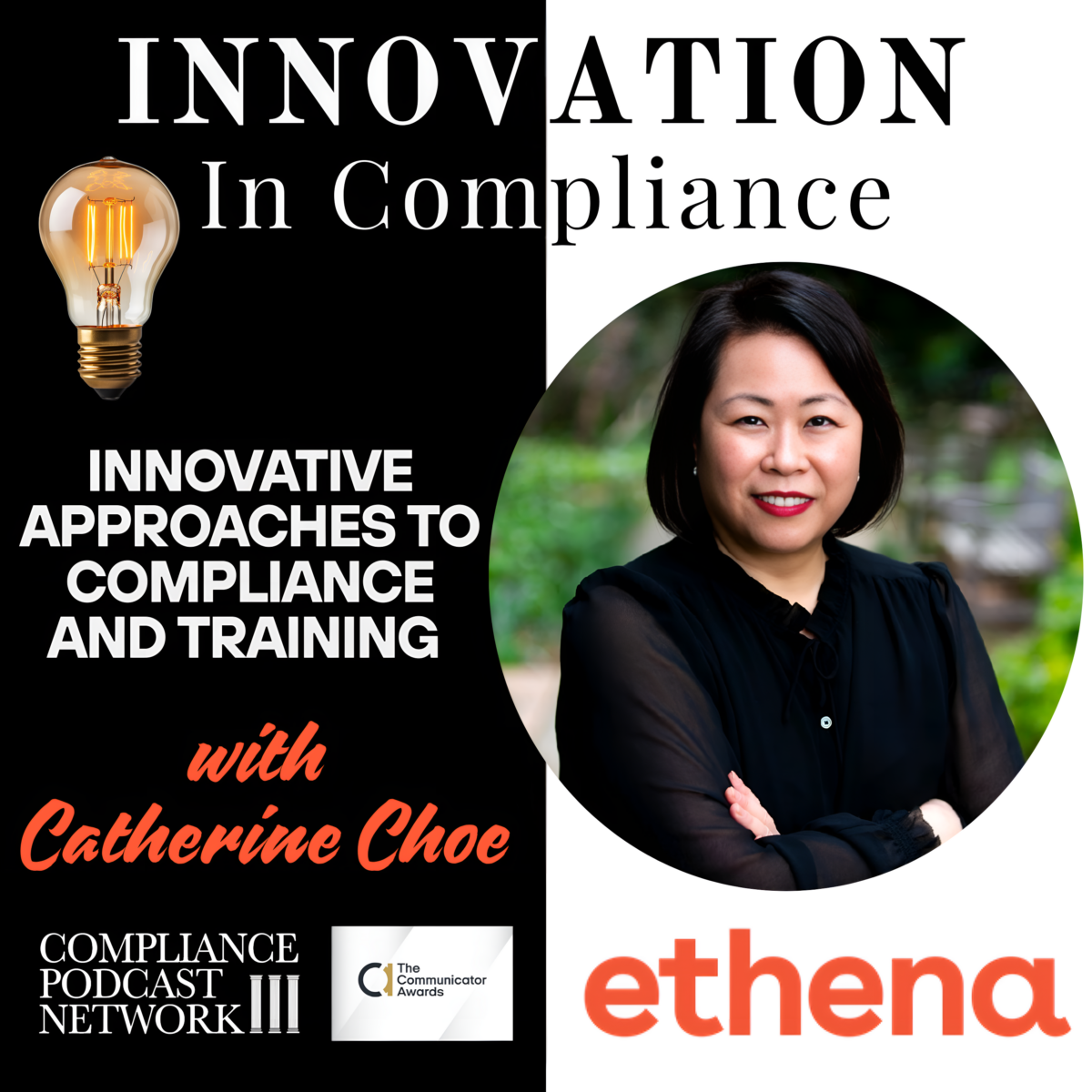
Innovation in Compliance: Innovative Approaches to Compliance and Training with Catherine Choe

Innovation comes in many areas, and compliance professionals need to be ready for it and embrace it. Join Tom Fox, the Voice of Compliance, as he visits with top innovative minds, thinkers, and creators in the award-winning Innovation in Compliance podcast. This series is introduced by Tom Fox and hosted by Roxeanne Petraeus. Ethena sponsors this special five-part series on Innovation in Compliance.

In this episode, Roxeanne Petraeus sits down with Catherine Choe, Chief of Staff to the Chief Legal Officer at Zendesk to discuss Choe’s unique career path leading to her current role at Zendesk. The conversation delves into compliance best practices, highlighting Choe’s insights on making training programs effective and engaging. They explore the implementation of innovative approaches like the ‘test out’ feature and the potential impact of AI on compliance. The discussion underscores the importance of a customer-centric approach and adaptability in compliance training.

Key highlights:

  • Catherine Choe’s Career Journey
  • Best Practices in Compliance
  • Operationalizing Compliance Training
  • Innovative Approaches: Test Out
  • AI’s Impact on Compliance
  • Feedback and Customization

Resources:

Catherine Choe on LinkedIn

Zendesk Website

Zendesk on LinkedIn

Ethena Website

Roxanne Petraeus on LinkedIn

Ethena on LinkedIn

Tom Fox

Instagram

Facebook

YouTube

Twitter

LinkedIn

Categories
Compliance Tip of the Day

Compliance Tip of the Day – Asking Questions to Further Compliance

Welcome to “Compliance Tip of the Day,” the podcast where we bring you daily insights and practical advice on navigating the ever-evolving landscape of compliance and regulatory requirements. Whether you’re a seasoned compliance professional or just starting your journey, we aim to provide bite-sized, actionable tips to help you stay on top of your compliance game. Join us as we explore the latest industry trends, share best practices, and demystify complex compliance issues to keep your organization on the right side of the law. Tune in daily for your dose of compliance wisdom, and let’s make compliance a little less daunting, one tip at a time.

How asking questions works to create trust and a culture of compliance.

For more on this topic, check out The Compliance Handbook, a Guide to Operationalizing Your Compliance Program, 6th Edition, which LexisNexis recently released. It is available here.

Categories
Daily Compliance News

Daily Compliance News: May 14, 2025, The Widened Whistleblower Program Edition

Welcome to the Daily Compliance News. Each day, Tom Fox, the Voice of Compliance, brings you compliance-related stories to start your day. Sit back, enjoy a cup of morning coffee, and listen in to the Daily Compliance News—all from the Compliance Podcast Network. Each day, we consider four stories from the business world: compliance, ethics, risk management, leadership, or general interest for the compliance professional.

Top stories include:

  • The C-Suite wants to quantify AI’s impact. (Forbes)
  • General Dynamics in hot water over wage and hour compliance. (Reuters)
  • Of dress codes and walkouts at Starbucks. (Bloomberg)
  • Broader DOJ whistleblower program announced.  (WSJ)
Categories
The Hill Country Podcast

The Hill Country Podcast – Resilience and Leadership in Coaching with Jen Hardy

Welcome to the award-winning The Hill Country Podcast. The Texas Hill Country is one of the most beautiful places on earth. In this podcast, Hill Country resident Tom Fox visits with the people and organizations that make this the most unique area of Texas. This week, Tom welcomes Jen Hardy, who shares her inspiring journey from being a high school soccer player in Austin, Texas, to becoming a successful coach and leader.

Jen talks about her challenging yet transformative experience at Schreiner University, where she transitioned from playing to coaching soccer. She elaborates on how she developed her leadership skills, the lessons learned from coaching, and how she addressed her shortcomings to support her athletes better. After leaving public education, Jen co-leads the Academy of MotivAction, focusing on supporting high-stress professionals in overcoming burnout and building resilience. She also discusses her recent honor of giving the commencement speech at Schreiner University and her key message on the importance of self-identity beyond professional achievements.

Key highlights:

  • Early Life and Journey to Kerrville
  • College Soccer Experience at Schreiner
  • Transition to Teaching and Coaching
  • Coaching Philosophy and Growth
  • Current Career and Business Ventures
  • Commencement Speech and Reflections

Resources:

Jen Hardy on LinkedIn

MotivAction

Other Hill Country Network Podcasts

Hill Country Authors Podcast

Hill Country Artists Podcast

Texas Hill Country Podcast Network

Artwork

Nancy Huffman Fine Art