Categories
Innovation in Compliance

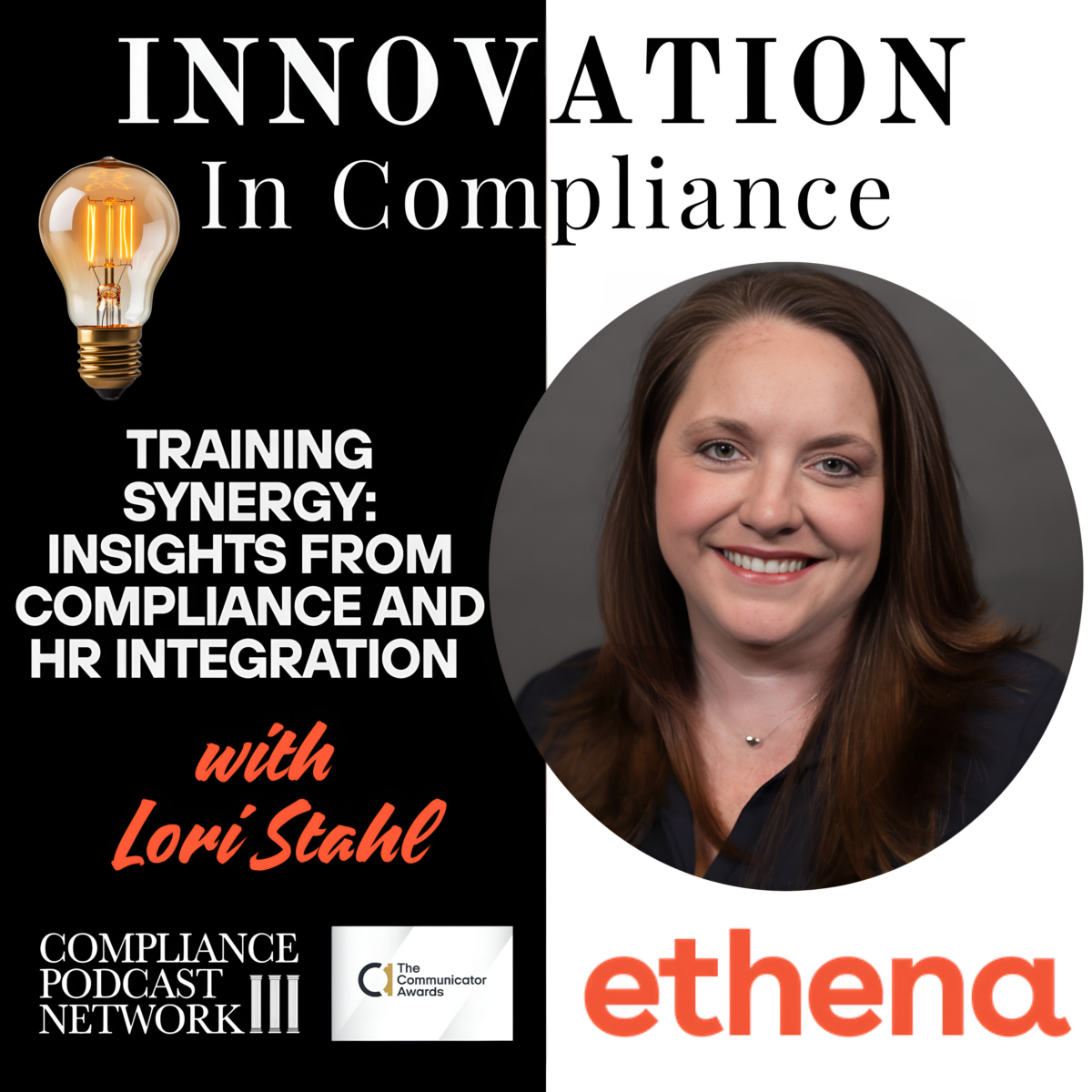
Innovation in Compliance: Training Synergy: Insights from Compliance and HR Integration with Lori Stahl

Innovation comes in many areas, and compliance professionals must be ready for and embrace it. Join Tom Fox, the Voice of Compliance, as he visits with top innovative minds, thinkers, and creators in the award-winning Innovation in Compliance podcast. This series is introduced by Tom Fox and hosted by Roxanne Petraeus.  The sponsor of this special five-part series on Innovation in Compliance is Ethena.

In this episode, Roxanne Petraeus visits with Lori Stahl, Chief People Officer at Synaptics Incorporated. Stahl discusses the intersection of HR and compliance training and covers the importance of a seamless, non-siloed approach to training; the challenges of staying current with compliance laws; and the benefits of using an external platform like Ethena for consistency and ease. Stahl also highlights the value of tailored, role-specific training and real-time microlearning to enhance employee engagement and effectiveness. The conversation concludes with a discussion on future innovations, including the potential of AI and adaptive learning in compliance training.

Key highlights:

  • HR and Compliance Training Overlaps
  • Challenges of Siloed Training
  • Effective Compliance Strategy
  • Choosing Athena for Compliance Training
  • The Importance of Customer Success
  • Future of Compliance Training

Resources:

Lori Stahl on LinkedIn

Synaptics Incorporated on LinkedIn

Synaptics Incorporated Website

Ethena Website

Roxanne Petraeus on LinkedIn

Ethena on LinkedIn

Tom Fox

Instagram

Facebook

YouTube

Twitter

LinkedIn

Categories
Hill Country Authors

Hill Country Authors – Unveiling Historical Fiction: Jann Alexander on ‘Unspoken’ and the Dust Bowl

Welcome to a new season of the award-winning Hill Country Authors Podcast, sponsored by Stoney Creek Publishing. In this podcast, Hill Country resident Tom Fox visits with authors who live in and write about the Texas Hill Country. In this episode, Tom visits with Jann Alexander, a seasoned art director turned professional writer.

Jann shares insights into her journey from a 30-year career in commercial design to becoming a full-time author. She discusses her extensive research on Texas history, which inspired her new historical novel, ‘Unspoken,’ set around the 1935 Black Sunday dust storm. Jann delves into her creative process, the environmental and emotional impacts of the Dust Bowl, and how these elements shape her characters and narrative. She provides a glimpse into her book launch and how audiences can engage with her work through her blog and upcoming events.

Key highlights:

  • Jann’s Academic and Professional Background
  • Research and Writing Process
  • The Dust Bowl and Black Sunday
  • Impact on Farmers and Communities 

Resources:

Jann Alexander on LinkedIn

Jann Alexander Website

Pre-order Unspoken

Podcast Cover Art

Nancy Huffman Fine Art

Tom Fox

Instagram

Facebook

YouTube

Twitter

LinkedIn

Categories
Compliance Tip of the Day

Compliance Tip of the Day – Role of Chatbots in Compliance

Welcome to “Compliance Tip of the Day,” the podcast where we bring you daily insights and practical advice on navigating the ever-evolving landscape of compliance and regulatory requirements. Whether you’re a seasoned compliance professional or just starting your journey, we aim to provide bite-sized, actionable tips to help you stay on top of your compliance game. Join us as we explore the latest industry trends, share best practices, and demystify complex compliance issues to keep your organization on the right side of the law. Tune in daily for your dose of compliance wisdom, and let’s make compliance a little less daunting, one tip at a time.

Today, we look at how chatbots can enhance and improve engagement with your compliance program. 

For more on embedded compliance, check out my new book, Upping Your Game: How Compliance and Risk Management Move to 2030 and Beyond, available from ⁠Amazon.com⁠.

Categories
Blog

The Role of AI Chatbots in Compliance

Today, most compliance professionals deal with a dynamic environment where questions and potential issues do not wait conveniently for office hours. Whether you oversee a global team operating in multiple time zones or are responsible for a fast-paced organization where rapid decision-making is crucial, you know compliance guidance can’t afford to lag. Enter AI-driven chatbots, your newest and perhaps most valuable partner in corporate compliance.

In today’s interconnected and highly scrutinized business world, employees frequently face challenging ethical questions and policy conundrums that demand immediate answers. Gone are the days when a compliance inquiry could sit in an inbox for days before receiving attention. Moreover, employees don’t always have time to sift through thick manuals or dense codes of conduct. There is genuine excitement about the potential of AI-driven chatbots to streamline compliance processes.

How AI-Driven Chatbots Work in Corporate Compliance

Think of these AI chatbots as your tireless policy librarians and advisors, available round-the-clock to dispense instant, accurate answers. They harness advanced natural language processing (NLP) and machine learning (ML) to parse employee questions, interpret the intent behind the inquiry, and pull tailored responses directly from your organization’s policies, procedures, and regulatory guidelines. These tools can be embedded into familiar platforms like Microsoft Teams, Slack, or corporate intranets, making compliance support conveniently accessible in the same digital spaces employees frequent for daily work interactions.

One of the most compelling advantages of these chatbots is their precision and consistency. Unlike human counterparts, who may inadvertently provide varied interpretations or answers to similar queries, a well-trained AI-driven chatbot consistently references a single source of truth: your organization’s policies and procedures. This substantially mitigates the risk of inconsistent guidance or misinformation.

Further enhancing their utility, AI chatbots “learn” from interactions, gradually improving their accuracy and understanding. Companies like HSBC have adopted solutions leveraging Google’s cloud technology, allowing their internal compliance chatbots to retrieve and serve precise policy excerpts dynamically. Consequently, employees receive prompt answers and understand the underlying rationale, reinforcing their comprehension of the compliance landscape.

Strategic Insights for Leveraging Compliance Chatbots Effectively

Deploying AI chatbots in compliance programs is not merely about technological integration; rather, it is about strategically embedding these tools to enrich your organization’s compliance culture. What key strategic considerations do you need to consider when starting such a project?

1. Define Clear Use Cases and Boundaries

2. Begin with specificity. Determine precisely which compliance areas your chatbot will handle effectively: HR FAQs, gift and hospitality policies, or conflict-of-interest disclosures. Establishing clear boundaries on the bot’s capabilities prevents confusion and ensures alignment with regulatory guidelines. The chatbot should offer practical advice within its designated sphere while deferring more complex matters or nuanced interpretations to human compliance professionals.

3. Ensure a Human Escalation Path

4. It is crucial to maintain a clearly defined point at which AI steps aside for human intervention. If an inquiry hints at significant risks, such as harassment, fraud, or serious ethical violations, the chatbot should automatically flag the issue and escalate it to human compliance officers. Implementing an intelligent and seamless hand-off preserves both regulatory integrity and employee trust.

5. Rigorous Real-Life Testing

6. Before full deployment, pilot your chatbot using authentic scenarios from past employee questions, hotline inquiries, or email communications. This rigorous, scenario-based testing helps identify gaps in the chatbot’s knowledge base or its linguistic comprehension capabilities. Testing should also encompass how employees phrase similar questions, ensuring robust NLP adaptability.

6. Integrate Chatbots Seamlessly into Workflows

7. Ease of access and ubiquity are key. Integrate your compliance chatbot within platforms employees regularly use. Whether via Teams, Slack, your intranet, or even mobile texting, embedding compliance support into daily workflows reinforces that compliance isn’t a separate responsibility but integral to everyone’s daily duties. With Gen Z’s growing presence in the workforce, familiarity and ease with chatbot interfaces make them a natural fit for employee communication.

8. Harness Chatbot Analytics for Compliance Insights

9. Your chatbot isn’t just an answering service; it’s a goldmine of compliance intelligence. Monitor chatbot usage analytics to discern compliance knowledge gaps and identify areas where employee uncertainty or confusion is prevalent. By analyzing the volume, type, and frequency of queries, compliance teams can proactively adjust training materials, simplify complicated policies, or spotlight emerging risk areas requiring deeper intervention.

Practical Challenges to Keep in Mind

While the benefits are substantial, implementing AI-driven chatbots also involves careful management of certain challenges. Accuracy and privacy concerns remain paramount. Compliance professionals must constantly validate and verify chatbot responses against evolving regulations and internal policy updates. Organizations must also ensure robust cybersecurity measures, keeping data shared through chatbots confidential and protected.

Additionally, fostering employee confidence and trust in using chatbots as compliance resources is vital. Staff must perceive chatbots as reliable advisors rather than surveillance tools. Transparent communication about the chatbot’s purpose, limitations, and data privacy policies can go a long way in cultivating trust and widespread adoption.

The Future Is Here: Chatbots in Best Practices Compliance Programs

AI chatbots’ transformation to corporate compliance programs can’t be overstated. What was once a passive, reactive role for compliance departments has evolved into a proactive, integral presence in daily business activities. AI chatbots do not merely react to compliance inquiries; they actively guide ethical decision-making in real-time, reinforcing a compliance-conscious organizational culture.

Moreover, beyond answering straightforward questions, sophisticated chatbots can engage in context-rich dialogues, prompting employees for additional information to provide tailored, nuanced guidance. Chatbots are increasingly capable of recognizing compliance red flags and potential conflicts of interest, immediately providing appropriate guidance or escalating issues to compliance professionals as necessary.

AI-driven compliance chatbots also serve as vital first-line intake mechanisms, lowering barriers to reporting ethical concerns or policy violations. By providing approachable and conversational interfaces, they encourage more candid, detailed reporting than traditional methods, thus strengthening your overall compliance ecosystem.

The introduction of AI-driven chatbots signifies a pivotal advancement for corporate compliance functions. Offering instantaneous, tailored guidance at critical moments significantly enhances employees’ understanding and adherence to compliance requirements. Furthermore, by automating routine inquiries, these intelligent virtual assistants liberate compliance professionals to concentrate on high-risk areas, strategic oversight, and program enhancement.

As we stand at the intersection of technology and compliance, AI chatbots represent both a convenience and an essential compliance asset. For compliance professionals committed to building ethical, responsive, and resilient organizations, integrating these smart assistants thoughtfully into their compliance toolkit is a step not merely toward efficiency but toward compliance excellence.

Further, as Carten Tams continually reminds us, it is all about the UX. Employees want to have access to the answers to their questions when they need the information. Using chatbots can enhance the UX for your employees. If you can improve the UX and provide the information needed more timely, what is holding you back?


Categories
Red Flags Rising

Red Flags Rising: S01 E10 – AI Diffusion: A Proposed Path for Industry & Government

Mike & Brent propose an AI Diffusion Rule path forward to help both companies and the U.S. government. They start with an update on last-minute reporting before the episode was published (00:00) then cover the attention the AI Diffusion Rule is getting before its May 15, 2025 compliance date (03:56), the Rule’s similarity’s to the First World War’s “rationing system” for export controls (08:08), a report by Barath Harithas of the Center for Strategic & International Studies (CSIS) about the AI Diffusion Rule (09:15), how the AI Diffusion Rule incorporates by reference for companies in Tier 2 countries several new U.S. inbound and outbound restrictions that turn on the “high probability” standard (10:53), a CSIS report by Gregory C. Allen on DeepSeek and AI export controls in which Allen raises concerns about a high-regulation, low enforcement (or high loopholes) environment—which Mike & Brent refer to as Allen’s “One-Way Policy Fallacy” (13:21), and what Tier 2 countries (e.g., India, Israel, Singapore, Saudi Arabia, and the UAE)—and their U.S. design or manufacturing companies can do to best position customers in such countries to have national companies become National Validated End Users to obtain more chips (19:07). They conclude with the latest installment, back by ever-increasing popular demand, of Brent Carlson’s “Managing-Up” segment (23:51).

Resources:

CSIS, Barath Harithas, The AI Diffusion Framework: Securing U.S. AI Leadership While Preempting Strategic Drift (Feb. 18, 2025)

CSIS, Gregory C. Allen, DeepSeek, Huawei, Export Controls, and the Future of the U.S.-China AI Race (Mar. 7, 2025)

Gregory C. Allen’s “AI Policy” Podcast

Bloomberg Law, Michael Huneke, Outbound Investment Rule Embraces New National Security Paradigm (Nov. 7, 2024)

Brent LinkedIn

Mike LinkedIn

Mike & Brent’s “Fresh Looks” Series

Categories
Compliance Tip of the Day

Compliance Tip of the Day – AI and Behavioral Analytics

Welcome to “Compliance Tip of the Day,” the podcast where we bring you daily insights and practical advice on navigating the ever-evolving landscape of compliance and regulatory requirements. Whether you’re a seasoned compliance professional or just starting your journey, we aim to provide bite-sized, actionable tips to help you stay on top of your compliance game. Join us as we explore the latest industry trends, share best practices, and demystify complex compliance issues to keep your organization on the right side of the law. Tune in daily for your dose of compliance wisdom, and let’s make compliance a little less daunting, one tip at a time.

Today, we dive into how behavioral analytics is revolutionizing corporate compliance and the critical lessons for compliance professionals ready to lead the next generation of risk management.

For more on embedded compliance, check out my new book, Upping Your Game: How Compliance and Risk Management Move to 2030 and Beyond, available from Amazon.com.

Categories
Daily Compliance News

Daily Compliance News: April 30, 2025, The 4 AM Wake-Up Call Edition

Welcome to the Daily Compliance News. Each day, Tom Fox, the Voice of Compliance, brings you compliance-related stories to start your day. Sit back, enjoy morning coffee, and listen to the Daily Compliance News. All, from the Compliance Podcast Network. Each day, we consider four stories from the business world: compliance, ethics, risk management, leadership, or general interest for the compliance professional.

Top stories include:

  • China will support ‘normal’ business relations with US companies. (WSJ)
  • Don’t yell at your staff. (FT)
  • SFO issues corporate cooperation guidance. (SFO Press Release)
  • Waking up at 4 AM gains traction. (WSJ)
Categories
The Hill Country Podcast

The Hill Country Podcast – From Car Audio to Coins: Mike Russ’s Entrepreneurial Journey

Welcome to the award-winning The Hill Country Podcast. The Texas Hill Country is one of the most beautiful places on earth. In this podcast, Hill Country resident Tom Fox visits with the people and organizations that make this the most unique area of Texas. This week, Tom sits down with Kerrville-based entrepreneur Mike Russ, owner of Mr. Mint Coins & Collectibles.

Mike shares his journey from starting a car audio business at 19 to eventually transitioning into the collectibles market. He details his experience in buying and selling gold, silver, collectible coins, and sports memorabilia. Mike discusses the importance of educating new collectors, his passion for coins, and how he has built a successful business around his lifelong hobby. The conversation also touches on the challenges and rewards of running a small business, the impact of market trends on gold and silver prices, and Mike’s plans for the future of his shop. Listeners will get insights into the unique world of collectible trading and the practical aspects of managing such a venture.

Key highlights:

  • Mike’s Business in Kerrville
  • Mike’s Journey as an Entrepreneur
  • Transition to Coin and Collectibles Business
  • Details on Collectibles and Coins
  • Buying and Selling Gold

Resources:

MR Mint Coins & Collectibles

Other Hill Country Focused Podcasts

Hill Country Authors Podcast

Hill Country Artists Podcast

Texas Hill Country Podcast Network

 Cover Art

Nancy Huffman Fine Art

Categories
Blog

Behavioral Analytics: Revolutionizing Corporate Compliance in the AI Age

In today’s high-velocity business world, checking a compliance box once a year is as useful as lighting a football stadium with a candle. The 2025 compliance function is no longer a reactive afterthought; it’s a strategic business partner actively shaping corporate culture, managing risks, and protecting enterprise value.

Behavioral analytics is at the heart of this evolution, a powerful tool transforming how compliance professionals assess culture, predict risks, and drive proactive interventions. Let’s dive into how behavioral analytics is revolutionizing corporate compliance and the critical lessons for compliance professionals ready to lead the next generation of risk management.

The New Reality of Compliance

Once upon a time, compliance was about writing policies, training employees, and investigating breaches after the fact. Those days are long gone. Today, driven by digital transformation, skyrocketing regulatory expectations, and the explosive power of AI and machine learning, compliance moves upstream, spotting risks early, analyzing cultural shifts in real-time, and becoming a guardian of ethical business practices before crises occur.

As I often say (and will continue to preach), effective compliance equates to greater business efficiency and profitability. Regulators have clarified that access to real-time internal data is now an expectation, but it is not nice. Compliance teams must embrace tools that enable them to predict and prevent problems rather than simply reacting to them.

Behavioral Analytics Explained

Behavioral analytics might sound like a buzzword, but the concept is simple: it’s about understanding how people act and why they behave the way they do before their behavior becomes a problem. Key components include:

  • Employee Behavior Analysis: AI systems track work patterns, communication anomalies, and procedural deviations to identify potential misconduct or disengagement early.
  • Survey Data: Modern surveys, analyzed through AI, can track sentiment shifts in real time, uncovering emerging risks or weakening ethical climates.
  • Internal Communications Monitoring: By applying natural language processing (NLP) to emails, chats, and meeting notes, compliance can detect early signs of dissatisfaction, unethical behavior, or brewing fraud.

Behavioral analytics gives compliance professionals a real-time, actionable view of the company’s ethical health, moving beyond static audits or annual risk assessments.

The Business Case for Behavioral Analytics

We need to be clear: compliance must always deliver business value. Behavioral analytics offers just that:

  • Enhancing Transparency: Providing an unobstructed view into ethical culture and emerging risks.
  • Improving Risk Management: Allowing early interventions that prevent costly misconduct.
  • Enabling Real-Time Insights: Facilitating fast, informed decision-making based on real-world, real-time data.
  • Driving Data-Driven Decisions: Replacing intuition and subjective judgment with objective, evidence-based compliance strategies.

In short, behavioral analytics turns compliance into a proactive, strategic asset, not just a defensive mechanism.

Lessons from the Trenches: Albemarle’s Experience

Pioneers like Albemarle have shown how to operationalize behavioral analytics effectively. Their journey offers critical lessons for compliance officers seeking to lead cultural transformation.

1. Collaboration Across Functions is Crucial

Behavioral analytics does not live in a vacuum. Albemarle’s compliance teams worked closely with HR and Health & Safety to access meaningful data proxies, like attrition rates and near-miss safety incidents, that illuminated deeper cultural health indicators. Lesson: Compliance must break down silos and build bridges across departments to gain a holistic view of organizational health.

2. Prioritize Data Accessibility and Quality

Albemarle focused on easily accessible, high-quality metrics that reflected real employee behaviors, such as engagement with compliance communications, rather than mere policy completions. Lesson: Quality and accessibility of data are non-negotiable. Choose metrics illuminating employee ethics and engagement, not just compliance “checkmarks.

3. Real-Time Monitoring Drives Proactive Compliance

Waiting for an annual survey is like driving by looking only in the rearview mirror. Albemarle’s real-time monitoring system enabled rapid responses to emerging risks. Lesson: Compliance must invest in real-time analytics to anticipate, not just react to, ethical risks.

4. Tailor Metrics to Your Organization

Albemarle’s metrics were not generic but tailored to the company’s specific risks and operations. Lesson: There is no one-size-fits-all in behavioral analytics. Customize your metrics to fit your organizational DNA.

5. Engage Leadership Through Meaningful Insights

Raw data does not move leaders—stories do. Albemarle’s compliance team translated analytics into clear, strategic insights tied directly to business outcomes, winning executive buy-in. Lesson: Tell compelling stories with your data. Show leadership how ethical culture impacts performance, resilience, and reputation.

Conclusion: The Future is Now

Behavioral analytics is not just the next shiny compliance tool; it is the foundation for the future of proactive, strategic risk management.

Compliance professionals who master these tools and are willing to collaborate across departments, prioritize data quality, customize metrics, and meaningfully engage leadership will not only protect their companies from misconduct but also help them thrive ethically and financially. The future of compliance is behavioral—in real time, strategic, and here.

Are you ready to lead it?

The above is from my latest book, Upping Your Game: How Compliance and Risk Management Move to 2030 and Beyond, which is available from Amazon.com.

Categories
Compliance Tip of the Day

Compliance Tip of the Day – AI and Compliance Education

Welcome to “Compliance Tip of the Day,” the podcast where we bring you daily insights and practical advice on navigating the ever-evolving landscape of compliance and regulatory requirements. Whether you’re a seasoned compliance professional or just starting your journey, we aim to provide bite-sized, actionable tips to help you stay on top of your compliance game. Join us as we explore the latest industry trends, share best practices, and demystify complex compliance issues to keep your organization on the right side of the law. Tune in daily for your dose of compliance wisdom, and let’s make compliance a little less daunting, one tip at a time.

Today, we explore why the future is now for AI and Compliance Education.

For more on embedded compliance, check out my new book, Upping Your Game: How Compliance and Risk Management Move to 2030 and Beyond, available from Amazon.com.