Categories
Blog

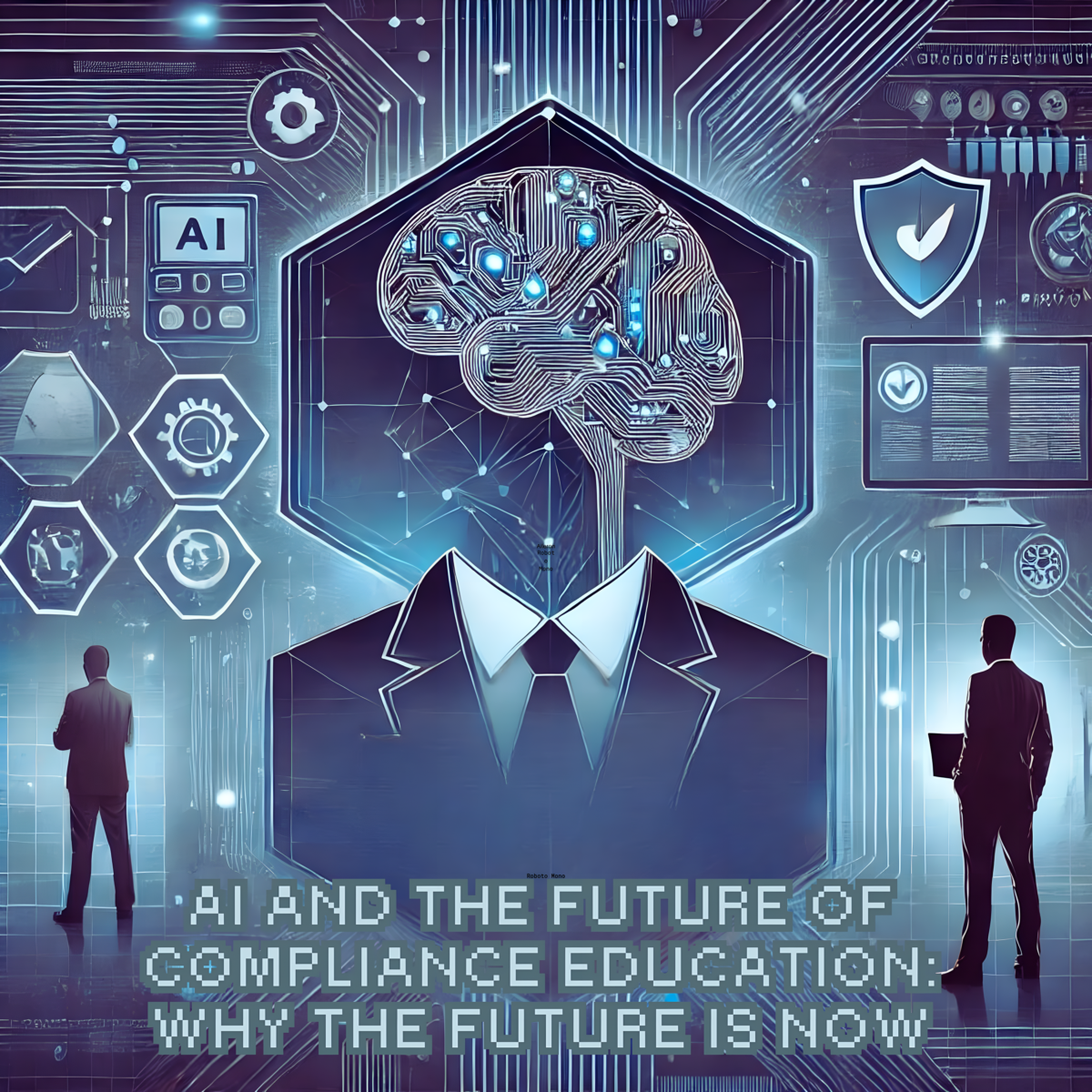
AI and the Future of Compliance Education: Why the Future is Now

For too long, compliance training has been seen as little more than a necessary evil, a one-size-fits-all exercise in checking a regulatory box. Employees shuffled through mandatory seminars, PowerPoint decks, and click-through e-learning modules, treating them as hurdles to clear, not learning opportunities. That world is dead. Buried. In 2025, compliance education is radically transforming, and AI is leading the way.

The future of compliance education is personal, immediate, engaging, and embedded. It’s about delivering the right knowledge to the right employee at the right time, i.e.,. Before a violation occurs. Compliance is no longer a periodic event; it’s a continuous experience. How can AI, microlearning, gamification, and VR completely change the game, and what lessons must compliance professionals learn today to build a better tomorrow?

Lesson 1: Traditional Training is Outdated—AI is Leading the Way

First, yesterday’s training models cannot keep up with the proper pace of modern regulatory risk. Static, annual training modules don’t resonate with today’s workforce or dangers. Enter AI. Smart compliance platforms now personalize training based on individual employee roles, learning styles, risk exposure, and past behavior. Employees are no longer passive listeners but active participants in scenario-based simulations that mirror real-world dilemmas. Imagine practicing an FCPA dilemma in a gamified environment rather than skimming through a bullet-point list.

Even better, AI does not simply deliver content; it measures how employees engage with it. Advanced analytics track progress, flag disengagement, and allow compliance teams to adjust real-time training strategies. The result? A proactive, continuously evolving compliance culture.

If you’re still relying on static training in a dynamic risk environment, you are not only behind; you are exposed.

Lesson 2: Customization is Key—One Size Fits Nobody

Let’s be blunt: Generic compliance training wastes everyone’s time. Different employees face different risks. Your sales team in Latin America needs training that is different from your engineering team in Berlin. A one-size-fits-all approach is not simply ineffective; it can indeed be counterproductive.

AI-driven compliance platforms address this head-on by customizing content at the individual level. They analyze roles, responsibilities, risk profiles, and even upcoming activities. Imagine this: An employee traveling to a high-risk country automatically receives reminders about anti-bribery policies, gift-giving guidelines, and applicable trade sanctions before they step on the plane.

This proactive, role-specific approach exceeds DOJ expectations around tailored training (first articulated in the 2017 Evaluation of Corporate Compliance Programs and reinforced in the 2024 ECCP). It embeds compliance into employees’ day-to-day decision-making.

Customization drives engagement. Engagement drives behavior change. Behavior change protects the organization. It is that simple.

Lesson 3: Real-Time Compliance Training is Proactive, Not Reactive

Historically, compliance teams operated in a reactive mode. Violations occurred, investigations followed, and training was assigned as a remedial slap on the wrist—no more. With AI, compliance training can now be real-time and predictive. Imagine an AI system that monitors workflow data and employee behavior, delivering just-in-time reminders before a decision is made, not after a violation occurs.

Picture this: An employee processing an unusual third-party payment receives an instant alert reminding them of anti-corruption controls. Another employee about to click a suspicious email gets a real-time warning about phishing attacks. AI can even draw insights from external events. If a major competitor is penalized in China for export control violations, your employees operating in that region can immediately receive a warning and updated guidance.

Real-time training transforms compliance from a “policing” function into a “partnering” function, guiding employees to make better decisions in the moment. That’s the future we should be building toward.

Lesson 4: Gamification and Microlearning Supercharge Retention

We’ve known for years that traditional long-form compliance training doesn’t stick. Most employees forget 70% of what they learned within a week. Why? Because brains aren’t wired to retain dense information delivered in passive, hour-long blocks. Gamification and microlearning flip the script.

Microlearning delivers bite-sized, focused modules that employees can absorb quickly, perfectly tailored to today’s fast-paced work environments. Gamification adds points, badges, competitions, and rewards to incentivize engagement. Together, they create training experiences that are not only more effective but also fun. And the results aren’t theoretical. Studies show that microlearning can improve knowledge retention by up to 75%. Walmart’s use of VR compliance training led to a reported 30% decrease in policy violations.

When employees are immersed in gamified simulations where decisions have consequences and feel the real-world weight of ethical challenges, they build the muscle memory to act correctly under pressure. Compliance becomes instinct, not obligation.

If you are serious about building a culture of compliance, gamification and microlearning must be part of your toolkit.

Lesson 5: AI is the Ultimate Training Effectiveness Engine

Finally, AI does not just deliver better training; it measures and improves it.

Modern AI-powered compliance platforms track every interaction. They identify which employees are struggling, which departments face higher risks, and which topics aren’t sticking. They can predict which employees are most likely to face ethical dilemmas—and target interventions accordingly. This feedback loop is transformative. Instead of guessing whether training “worked,” compliance professionals can know and take swift action when needed. AI-driven insights allow for dynamic course corrections, ensuring compliance education stays aligned with emerging risks, regulatory updates, and organizational changes.

By embedding continuous improvement into training, AI moves compliance education from a static obligation to a living, breathing strategy for risk management and corporate resilience.

Conclusion: The Future Is Now—Are You Ready?

The transformation of compliance education isn’t a “someday” concept. It is happening right now. Leading companies are already embedding AI, gamification, microlearning, real-time alerts, and VR simulations into their compliance ecosystems—and they’re seeing measurable results. Compliance training is no longer a boring box to check. It’s a dynamic, personal, data-driven force multiplier for ethics, integrity, and business performance.

The real question for compliance professionals today isn’t whether AI will reshape compliance education. It’s whether your organization will be a leader or a laggard in embracing change. The future of compliance education is here. It is immersive, predictive, personal, and powered by AI.

Are you ready to lead the way?

In short, the future of whistleblower programs is here—and it’s intelligent.

The above is from my latest book, Upping Your Game: How Compliance and Risk Management Move to 2030 and Beyond, available from Amazon.com.


Categories
Corruption, Crime and Compliance

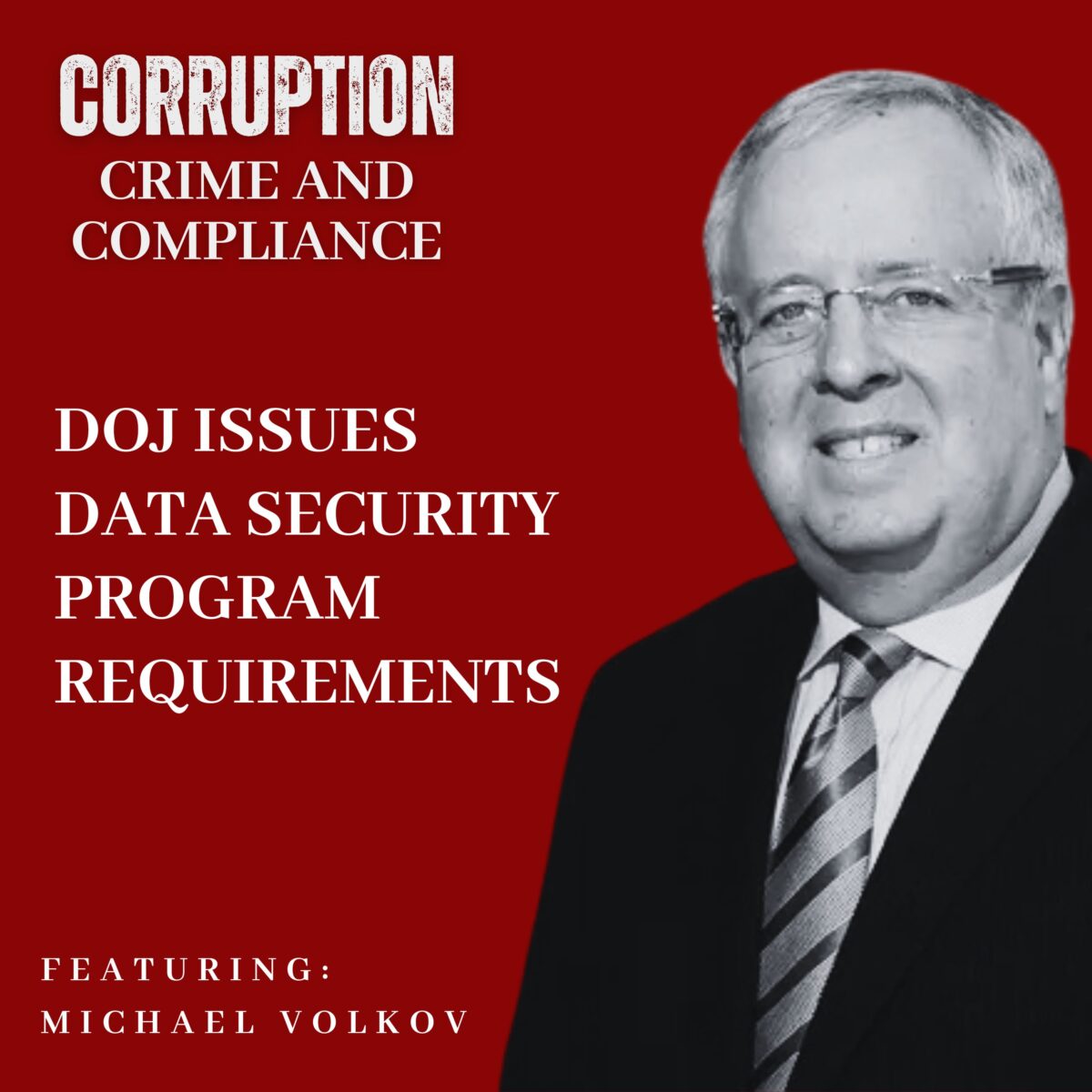
DOJ Issues Data Security Program Requirements

Could your routine data transfers now violate federal law? The DOJ’s new Data Security Program (DSP) targets the flow of U.S. sensitive personal and government data to foreign adversaries — and the clock is ticking. In this episode of Corruption, Crime and Compliance, Michael Volkov breaks down the Justice Department’s sweeping new Data Security Program, enacted under Executive Order 14117 and finalized in January 2025.

You’ll hear him discuss:

  • The origins of the DSP, created through Executive Order 14117 under the Trump Administration, and the key national security concerns it addresses.
  • What constitutes a “covered data transaction” and the thresholds for U.S. personal and government data that trigger compliance obligations.
  • The list of “countries of concern” and what it means for companies doing business with entities tied to these regions.
  • The types of U.S. data covered by the DSP, including biometric, genomic, financial, and geolocation data, and the specific quantity thresholds that trigger restrictions.
  • Why data brokerage and bulk human genomic data transactions are prohibited outright, raising new compliance challenges for affected industries.
  • How “restricted transactions” like cloud computing services and vendor agreements are subject to conditional exceptions under the DSP.
  • The critical actions U.S. companies must take during the 90-day enforcement hiatus, including vendor assessments, renegotiations, and compliance system updates before the July 8th deadline.

Resources

Michael Volkov on LinkedIn | Twitter

The Volkov Law Group

Categories
Adventures in Compliance

Adventures in Compliance: The Novels – A Study in Scarlet, Introduction to Compliance Lessons

In this new season of Adventures in Compliance, host Tom Fox will explore the Sherlock Holmes novels in depth. Over the course of this season, Tom will do so in a four-part series. The four novels we will consider from the ethics and compliance perspective are A Study in Scarlet, The Sign of Four, The Hound of the Baskervilles, and The Valley of Fear.

For our first offering this season, we begin with A Study in Scarlet. In part 1 of our four-part exploration of this novel, which introduced Sherlock Holmes and Dr. Watson to the world. We begin by summarizing the novel’s plot, which dsummarizeiscusses key events and Holmes’ brilliant deductive methods. We then take a deep dive into five critical compliance lessons from the story, including the dangers of institutional abuse of power, the imperative for structured justice, the necessity of root cause analysis, due diligence, and transparent communication within organizations. Join us for an engaging episode that underscores the relevance of Sherlock Holmes’ investigative strategies to modern compliance practices.

Highlights include:

  • Welcome to a New Season of Adventures in Compliance
  • The Summary of and a Deep Dive into ‘A Study in Scarlet’
  • Ethical Lessons for Compliance Professionals

Resources:

The New Annotated Sherlock Holmes

Sherlock Holmes FAQ by Dave Thompson

Connect with Tom Fox

Instagram

Facebook

YouTube

Twitter

LinkedIn

Categories
FCPA Compliance Report

FCPA Compliance Report – From Compliance to Commercial Value: Removing Friction with AI

Welcome to the award-winning FCPA Compliance Report, the longest-running compliance podcast. In this episode, Tom welcomes back Jag Lamba, CEO at Certa, to discuss the use of GenAI in compliance tools.

Lamba advocates for the transformative power of artificial intelligence in revolutionizing third-party risk management. Lamba believes businesses can streamline processes, reduce friction, and enhance decision-making throughout various phases of third-party interactions by leveraging AI, particularly generative AI and natural language processing tools. He emphasizes that AI can simplify complex tasks like analyzing extensive reports and identifying specific risks, thus improving compliance reporting and operational efficiency. Lamba envisions a future where AI seamlessly integrates into core business operations, making compliance management an inherent and valuable aspect of organizational workflows, particularly benefiting smaller and mid-sized companies.

Key highlights:

  • Automating Third-Party Risk Management with AI
  • AI-powered Tools Enhancing Third Party Risk Management
  • AI-driven Automation for Enhanced Compliance Reporting
  • Automating Compliance Tasks to Boost Operational Efficiency

Resources:

Jag Lamba on Linkedin

Certa AI

Tom Fox

Instagram

Facebook

YouTube

Twitter

LinkedIn

For more information on the use of AI in Compliance programs, see my new book, Upping Your Game. You can purchase a copy of the book on Amazon.com

Categories
Compliance Tip of the Day

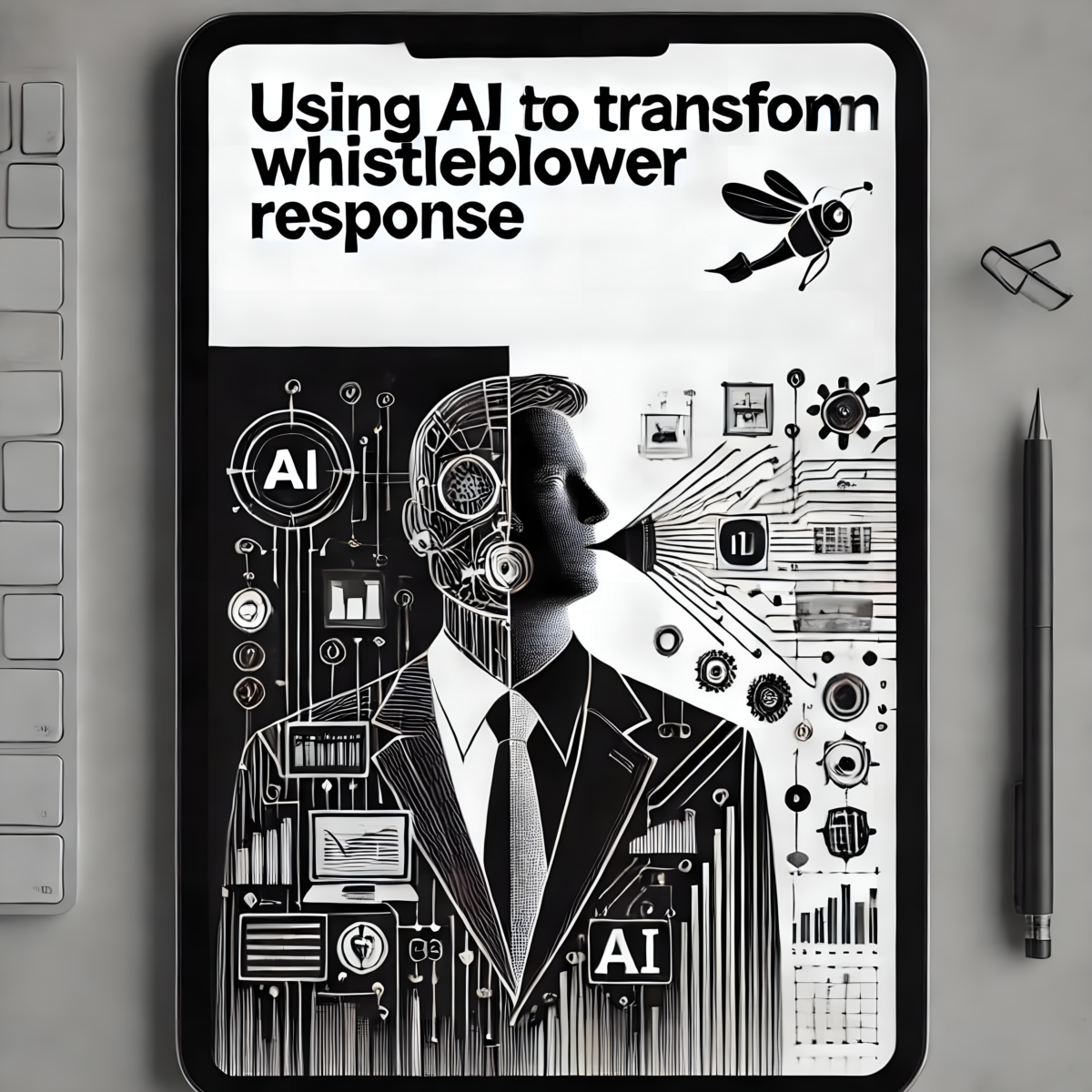
Compliance Tip Of the Day – Using AI to Transform Whistleblower Response

Welcome to “Compliance Tip of the Day,” the podcast where we bring you daily insights and practical advice on navigating the ever-evolving landscape of compliance and regulatory requirements. Whether you’re a seasoned compliance professional or just starting your journey, we aim to provide bite-sized, actionable tips to help you stay on top of your compliance game. Join us as we explore the latest industry trends, share best practices, and demystify complex compliance issues to keep your organization on the right side of the law. Tune in daily for your dose of compliance wisdom, and let’s make compliance a little less daunting, one tip at a time.

Today, we consider how you can use AI to improve your whistleblower response and your culture of speaking up.

For more on embedded compliance, check out my new book, Upping Your Game: How Compliance and Risk Management Move to 2030 and Beyond, available from Amazon.com.

Categories
Blog

Using AI to Transform Whistleblower Response

When it comes to internal reporting programs, the days of the lonely 1-800 hotline are over. Today’s compliance landscape demands real-time action, smarter triage, greater protections for whistleblowers, and trust. Fortunately, we now have the tools to meet that demand. Artificial Intelligence (AI) and predictive analytics transform whistleblower programs from sluggish, reactive systems into powerful, proactive compliance assets.

This shift could not be timelier. Regulators like the DOJ and SEC have clarified that robust, responsive whistleblower programs are not just a “nice to have” but mandatory. Companies that fail to get this right risk regulatory penalties and devastating hits to their reputation and employee trust. AI offers the compliance community a tremendous opportunity to enhance whistleblower protection, build credibility, and drive a true culture of compliance. Today, I want to summarize key lessons compliance professionals can draw from this evolving space.

Lesson 1: AI as a Guardian of Whistleblower Anonymity

Historically, fear of retaliation has been the Achilles’ heel of internal reporting programs. Employees hesitate to come forward when they don’t trust the system to protect them.

AI changes that. Using sophisticated Natural Language Processing (NLP), AI systems can automatically strip away identifiers, names, job titles, and department names from reports while preserving the critical context needed for an investigation. This is not simply a technical improvement. Instead, it should be seen as a trust builder. Compliance officers must lean into these anonymization technologies and communicate their existence to employees. If employees know the system genuinely protects their identities, the likelihood of them speaking up and doing so internally increases dramatically.

The bottom line: anonymity protections powered by AI are no longer optional; they’re essential.

Lesson 2: Real-Time Prioritization Through Machine Learning

Another game-changer AI brings is the ability to sort and prioritize whistleblower reports in real-time. In the old world, investigators had to slog through hundreds or thousands of cases manually, often missing the truly high-risk ones. Machine learning algorithms today can review incoming reports, categorize them by urgency, and identify patterns that would otherwise go unnoticed.

This means faster action on serious allegations and earlier intervention to mitigate legal and reputational risks. Compliance professionals should build KPIs around AI-driven triage: How quickly are high-risk reports escalated? How often are machine-prioritized cases substantiated? What’s the employee satisfaction rate with the process?

AI-powered triage means your whistleblower system can evolve from a passive intake mechanism to a real-time risk management engine.

Lesson 3: Meet Employees Where (and How) They Communicate

Here is a hard truth in compliance: if your speak-up program is still just a hotline, you are losing the next generation of reporters. Vince Walden puts it best: different generations communicate differently. Millennials, Gen Z, and certainly Gen Alpha are far more comfortable with digital chat-based systems than voice calls. In fact, in one major telecom company, the top question employees asked the compliance chatbot was, “Is this a conflict of interest?” Thus, proving how valuable and revealing these interactions can be.

The lesson is clear: You need chatbots, mobile-first platforms, and AI-driven systems that not only receive reports but also interact, guiding users through the reporting process, clarifying ambiguous issues, and capturing better data upfront. Modernizing your intake channels is not just about technology; it’s about inclusivity and building a true culture of compliance that meets employees where they are.

Lesson 4: Expansion of the Grievance Mechanism Use Case

Compliance isn’t just about FCPA violations and insider trading anymore.

New regulatory frameworks like Europe’s Corporate Sustainability Due Diligence Directive (CSDDD) require grievance mechanisms that extend to supply chain employees and local communities affected by a company’s operations. Your AI-enhanced grievance mechanisms must be flexible enough to receive and triage various issues, such as code of conduct violations, human rights complaints, community grievances, and more.

Andrew McBride has noted that AI-driven intake systems can immediately ask follow-up questions when an initial report is unclear, vastly improving the quality of the information collected. That front-end improvement makes triage, investigation, and resolution much more efficient.

Lesson learned: Build a grievance mechanism that isn’t one-size-fits-all. Flexibility is the new mandate.

Lesson 5: AI for Smarter, Scalable Triage

Finally, Matt Galvin has pointed out the richest opportunity: using AI to automate and scale the triage process fully. Imagine a system trained on thousands of past investigations that can predict the most likely next steps for each new report, whether a simple follow-up, a deep-dive investigation, or escalation to senior leadership.

AI models developed from 5,000 annual complaints identified predictable investigative paths at one company, making triage faster, smarter, and far more cost-effective. Of course, Galvin wisely cautioned that you need a robust and affordable solution to make this practical, especially if you’re operating across high-cost jurisdictions. But the payoff is immense: more efficient investigations, lower operating costs, and a stronger, data-driven compliance posture.

Lesson: The future of whistleblower response is not simply about responding; rather, it is about predicting, prioritizing, and preempting risk.

Final Thoughts

The future of whistleblower programs is not about adding more hotlines or printing more posters. It is about embedding AI and predictive analytics into every layer of your reporting system, from intake to triage to resolution. AI helps compliance teams protect anonymity, prioritize real risk, meet employees where they are, expand the use cases for grievance mechanisms, and scale triage operations without scaling costs.

AI doesn’t replace the demands of human judgment compliance—it amplifies them. The compliance officers who understand this shift, embrace these tools, and lead their organizations through the transition will not just improve whistleblower response. They will make compliance a strategic asset that drives transparency, trust, and sustainable growth.

In short, the future of whistleblower programs is here—and it’s intelligent.

The above is from my latest book, Upping Your Game: How Compliance and Risk Management Move to 2030 and Beyond, available from Amazon.com.

Categories
Daily Compliance News

Daily Compliance News: April 28, 2025, The Santos Sobs Edition

Welcome to the Daily Compliance News. Each day, Tom Fox, the Voice of Compliance, brings you compliance-related stories to start your day. Sit back, enjoy morning coffee, and listen to the Daily Compliance News. All, from the Compliance Podcast Network. Each day, we consider four stories from the business world: compliance, ethics, risk management, leadership, or general interest for the compliance professional.

Top stories include:

  • George Santos sobs at sentencing. (The Daily Beast)
  • The FCPA pause is a boon to corrupt companies. (Bloomberg)
  • Congress wants to kill PCAOB. (FT)
  • Multiple errors led to a catastrophic crash. (⁠NYT⁠)
Categories
Sunday Book Review

Sunday Book Review: April 27, 2025, The Books on Business for May Edition

In the Sunday Book Review, Tom Fox considers books that would interest the compliance professional, the business executive, or anyone who might be curious. These could be books about business, compliance, history, leadership, current events, or anything else that might interest Tom. Today, we look at three books on business you should consider reading in May, as suggested by reporters and columnists from the FT.

  1. Business School and the Noble Purpose of the Market: Correcting the Systemic Failures of Shareholder Capitalism by Andrew J. Hoffman
  2. Transcend: Unlocking Humanity in the Age of AI by Faisal Hoque
  3. There’s Nothing Like This: The Strategic Genius of Taylor Swift by Kevin Evers

Resources:

Business Books: What to Read this Month in the FT

The Sunday Book Review was recently honored as one of the Top 100 Book Podcasts.

Categories
10 For 10

10 For 10: Top Compliance Stories For the Week Ending April 26, 2025

Welcome to 10 For 10, the podcast that brings you the week’s Top 10 compliance stories in one podcast each week. Tom Fox, the Voice of Compliance, brings you the compliance professional and the compliance stories you need to know to end your busy week. Sit back, and in 10 minutes, hear the stories every compliance professional should know from the prior week. Every Saturday, 10 For 10 highlights the most important news, insights, and analysis for the compliance professional, all curated by the Voice of Compliance, Tom Fox. Get your weekly filling of compliance stories with 10 for 10, a podcast produced by the Compliance Podcast Network.

  • New book on the use of AI in Compliance. (Amazon)
  • Trump now sues law firms for representing clients or issues he disapproves of. (Reuters)
  • EU fines Meta and Apple for anti-trust violations. (FT)
  • DOJ wipes out crypto enforcement. (WSJ)
  • 3 Adams prosecutors resign rather than lie. (NYT)
  • In UAE, AI writes the laws. (CIO)
  • China built a Nepali airport through corruption. (NYT)
  • US banks urged to pull from Chinese securities offerings. (WSJ)
  • Binance gets compliance. (Bitcoin.com News)
  • Jaime Dimon says to tighten up meetings. (FT)

You can check out the Daily Compliance News, which features four curated compliance and ethics stories each day, here.

Connect with Tom 

Instagram

Facebook

YouTube

Twitter

LinkedIn

You can purchase a copy of my new book, Upping Your Game, on Amazon.com.

Categories
Because That's What Heroes Do

Deep Space 9 – Episode 30: Deep Trek Themes from Tacking into the Wind

In this season’s exploration, Tom and Megan are joined by Star Trek maven Alex Murphy (Murphy) from Montreal. Murphy is a local historian, cinema, and TV fan who loves weird foreign films, all things horror, and obscure media. He has been watching Trek since he was a tiny punk, and it’s been a lifelong love. In this episode, the team concludes an exploration of the introduction to a new character for DS9’s final season. Today, they review the episode Tacking into the Wind.

In this episode, Megan, Murphy, and Tom deeply dive into one of Murphy’s favorite episodes, focusing on its potent themes and relevance to current events. They discuss the episode’s focus on mirrors and self-reflection, seen through the Cardassian rebellion and the struggles within the Klingon government. The significance of various characters’ actions, including Damar’s emotional arc and Garak’s hidden influence, is examined in detail. The team also highlights parallels to historical and contemporary political climates, making this episode a poignant reflection on power and corruption. This discussion is rich with insights into the narrative and character development, providing a thorough analysis of one of the series’ standout episodes. Tom sees a direct line from TOS and TNG to this episode.

Key highlights:

  • Mirrors and Reflections: Thematic Analysis
  • Klingon Politics and Personal Ties
  • Homage to the Star Trek Legacy
  • Bashir and O’Brien’s Quest to Find a Cure

Resources:

Megan Dougherty

LinkedIn

One Stone Creative

Twitter

Tom

Instagram

Facebook

YouTube

Twitter

LinkedIn