Categories
Life with GDPR

The Case of the Rogue Employee

Jonathan Armstrong and Tom Fox return for another episode of Life with GDPR. In the 2020 Morrisons case the UK Supreme Court ruled that an employer can be legally responsible for data breaches caused by their employees, although in the particular situation in that case the court ruled that Morrisons (the employer) was not liable for the actions of their rogue employee. In this episode, Tom and Jonathan look at the more recent case of Isma Ali v. Luton Borough Council where the High Court ruled that in committing the data security breach actions the rogue employee undertook, she had solely pursued her own interests and so the employer was not liable for her conduct. Some of the issues we consider include:

1.     What were the underlying facts of the case?

2.     What was the court’s ruling?

3.     Key Takeaways for the data privacy, data protection practitioner, including:

·      Take a close look at security measures and ensuring that access rights are policed. Data loss prevention and monitoring systems should also be in place to check for large data files leaving the organization – depending on the circumstances, a rogue employee might be after a lot of data;

·      Put in place appropriate policies and procedures to make sure that data protection principles like data security and data minimization are properly understood;

·      Perform a Data Protection Impact Assessment for new processes;

·      Make sure that employees in trusted roles are reliable and that their access rights are reviewed.

·      Put in place and rehearse a data breach notification procedure, including detection and response capabilities;

·      Training staff on all of the above; and,

·      Check existing insurance or taking out new insurance to cover the range of potential risks from “innocent” errors to the actions of a rogue employee.

Resources

Check out the Cordery Compliance, client alert on this topic, click here. For more information on Cordery Compliance, go their website here. Also check out the GDPR Navigator, one of the top resources for GDPR Compliance by clicking here.

Categories
Daily Compliance News

March 17, 2022 the World’s Most Ethical Companies Edition


In today’s edition of Daily Compliance News:

  • Ethisphere announces 2022 World’s Most Ethical Companies. (Ethisphere Press Release)
  • Interpol has new center to fight financial crimes.  (OCCRP)
  • SEC Commissioner Lee to step down. (Reuters)
  • Big 4 under regulatory scrutiny. (WSJ)
Categories
Blog

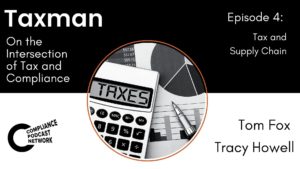
Tax and Compliance: Tax and Supply Chain

What is the intersection of tax and compliance? Why does a Chief Compliance Officer (CCO) or compliance professional need to sit down with the corporate head of tax? How does a corporate tax function fit into a best practices compliance program? It turns out there is quite a bit a compliance professional can learn from a tax professional. Moreover, there are many aspects of tax which should be considered by a CCO and compliance professional from an overall risk management perspective. Unfortunately, these questions are rarely explored in the compliance community.
To explore these issues (and remedy this lack of awareness) I recently sat down with noted tax professional Tracy Howell to explore these and other questions. We tackled these issues and others in a five-part podcast series for Innovation in Compliance. Today, we consider the role of tax in the Supply Chain. We also expand that to compliance, because compliance also has a huge role in this area.

Obviously, this topic has become more prominent over the last couple of years during the pandemic. Over the past couple of weeks, with the Russia invasion of Ukraine, it has become even more hyper-critical. One of the things we saw in the pandemic was that many companies with long established Supply Chains, perhaps not single source suppliers, but close to single source suppliers, found themselves scrambling when huge swaths. With the Russian invasion of Ukraine, we have had the largest amount of economic sanctions delivered by any administration in the modern era. Companies are struggling with not only responding to the sanctions but responding to the business dislocation from Russia and Belarus to Ukraine and into eastern Europe.
Clearly Supply Chain is critical for an organization, especially an organization that manufactures and has any substantial delivery of materials and services. There is also the question of where the highest risk in your Supply Chain might be. Is it in the critical component(s) in the acquisition of goods? Is it in the delivery of services? Or is it simply in the manufacturing process itself? Moreover, if you think of Supply Chains as only having a traditional focus on the acquisition of goods, comprising both the quality of the goods and the cost of the goods, and concluding with the delivery of the goods for consumption or later sale; you are missing a key component. That key component is tax and as Howell stated, “there can be a substantial tax component in each one of those steps of acquisition costs. If you are buying goods in foreign jurisdictions that can be transaction taxes, such as GST or VAT.”
Howell provided the following example. “If a company’s buying raw materials in a third country, in the shipping terms, we’d normally say title transfers in international waters, that’s a good thing for the buyer. Because that means if I’m buying something and I take title in international waters, it should not trigger any transaction taxes. However, if you are not paying attention to where you acquire goods from and then you take title within the country of origin’s territory, guess what? That could trigger up to a VAT liability of 15 to 20%. This means that if your Supply Chain is not interacting or does not have a relationship with tax, and the taxes can add a 15% to 20% component to the cost of goods in a transaction, which dramatically impacts the company’s cost of goods sold (COGS).”
However, if there is a good relationship between tax and Supply Chain, there can also be additional benefits tax brought to the fore and such benefits are more critical in 2022 and beyond because they can help a company plan for disruptions in the supply chain. For instance, if Supply Chain looks for alternative suppliers, or a different geo-region for component parts, tax can step in and do an analysis that would at least give them an estimate of what the tax costs are going to be.
Howell said that tax can provide “Supply Chain with the data that is beyond the cost of good, or the cost of material, or the cost of service. A tax professional can do so by modeling out the liability that a multinational could incur, including up to five different possible sources for goods and materials. From there you can extend your model out to see what the additional tax burden would be in each one of those scenarios. From there you can check to see if there are any tax incentives that either exist or that your organization can go negotiate.”
But the risk management that tax can bring to Supply Chain does not end there; particularly once tax and Supply Chain have established a relationship and it is understood how tax can assist Supply Chain in the procurement of goods and services. Through a documented process, it creates and entire framework for the organization to use going forward because at any given time Supply Chain will be looking for goods and services in different locations. Howell said, “you can have a mission creep. It is important for tax to have that relationship with Supply Chain so as their functionality changes and your organization is acquiring new goods in different locations, you can document the changes, and update your framework as needed when new tax issues can come to play.”

Join us tomorrow for our concluding post when we consider the role of tax in a corporate ESG program. Check out the full podcast series Taxman: On the Intersection of Tax and Compliance on the Compliance Podcast Network. Check out Tracy Howell on LinkedIn.

Categories
Jamming with Jason

The Difference 1% Makes with Luke Layman


Most motivational speakers use words like “make a massive change,” “set a big harry, audacious goal,” “work until your eyeballs bleed.” You get the point, and you are left feeling that unless you scale Mt Everest, you are a failure. That’s why so many people never start or stop quickly.
But what if that is a broken strategy that sets you up to fail? The real trick is making the little 1% changes that make all the difference when working from the identity of the person who already has what you want? It seems much simpler, and it works.
You go from “trying to lose weight” to being an athlete. When you set your intention on being an athlete or someone healthy, the path you need to take becomes clear when you decide. You don’t have to know all the steps to get started, and even a poor decision is better than no decision.
My guest today is Luke Layman. He is a former fighter pilot, entrepreneur, and host of the Shift Work podcast. As CEO and investor in a family of 7 & 8 figure businesses, he understands what it takes to grow and scale businesses. Luke believes entrepreneurship is the only path to true wealth and freedom. He is passionate about living a life of intentional alignment, making 1% changes, and leaving behind a trail of better humans.
Tune into this #jammingwithjason #podcast episode at: https://www.jasonmefford.com/jammingwithjason261/

Categories
Compliance Kitchen

SWIFT Bans


EU excludes Russian and Belarusian banks from SWIFT; restricts maritime and telecom exports to Russia.

Categories
Innovation in Compliance

Taxman: Why Tax Needs a Seat at the Table


In episode 3 of the Taxman series, Tom Fox and Tracy Howell strive to answer the question: ‘Why should tax have a seat at the table?’


Tax and the Table
The table refers to the front end of when an organization is trying to define what it wants to do, where it wants to do it, and how it’s going to perform. A corporation’s ultimate objective is to generate net income or distributable profit, something tax professionals are well-suited to assist with because they are experts in damage control and risk mitigation. Tracy points out, “Tax can provide an umbrella to achieve corporate objectives if they’re involved in the front end.”
 
Tax’s Relationship with Other Stakeholders 
In a company, a functional lead will often pose the question: ‘Why do we need tax here?’ According to Tracy, “A good tax guy has to be proactive and provide examples to get the tax men at the table.”
 
Educating Corporate Functions Outside of Tax 
Tracy’s advice is to build a relationship with the functional experts, and “create the situation where you’re a trusted business advisor”. He recommends one-on-one interactions above all. However, it is important to remember that in a global organization, the outcome may not always be successful. For this approach to yield positive results, he comments, “there has to be some buy-in, compliance, and a willingness to talk tax.”
 
Resources
Tom Fox’s Email
Tracy Howell | Email | LinkedIn
 

Categories
The Hill Country Podcast

Joanne Easley-a Hill Country Author

Welcome to The Hill Country Podcast. The Texas Hill Country is one of the most beautiful places on earth. In this podcast, recent Hill Country resident Tom Fox visits with the people and organizations that make this the most unique areas of Texas. Join Tom as he explores the people, places and their activities of the Texas Hill Country. In this episode, I visit with Joanne Easley, an author from Medina. Joanne writes fiction about complicated women. In this episode, she tells us her about her journey to the Hill Country and talks about a writing life.

Some of the highlights include:
·      Background on Joanne.
·      Why she began writing fiction.
·      The stories she tells about complicated women.
·      Why she and her husband moved to the Hill Country.
Resources
Joanne Easley on Facebook
Joanne Easley website

Categories
Compliance Into the Weeds

A Ukrainian Compliance Professional-Tim Khashinov-Batirov

Compliance into the Weeds is the only weekly podcast which takes a deep dive into a compliance related topic, literally going into the weeds to more fully explore a subject. This week, Matt and Tom visit with our Ukrainian colleague Tim Khashinov-Batirov. Tim is well-known in the worldwide compliance community as Compliance Man. He is currently a refugee in The Netherlands at the time of this recording. In this episode, Tim talks about his escape from Ukraine, what life has been like as a displaced person in Europe, the current and burgeoning refugee crisis and some things that we in America can do right now to help those still in Ukraine and those who are refugees. Other topics we consider include:

·      How the bonds of brotherhood between Russia, Belarus and Ukraine may have been permanently destroyed?

·      What do ordinary Russians think about the invasion?

·      Armies like companies run on culture. Why and how has the corruption in the Russian Army hollowed out its culture from the inside?

·       The leadership of President Zelensky and his impact on the Ukrainian people.

·      The negative leadership of Russia President Putin.

Resources for Donations for Ukraine and Ukrainians
UNICEF
Salvation Army
Red Cross

Categories
Daily Compliance News

March 16, 2022 the Privacy Police Edition


In today’s edition of Daily Compliance News:

  • California creating its Privacy Police. (NYT)
  • Resisting corruption.  (PsychToday)
  • Exxon loses dismissal request. (Reuters)
  • Swedbank in AML hot water again. (WSJ)
Categories
Blog

Tax and Compliance: Why Tax Needs a Seat at the Table

What is the intersection of tax and compliance? Why does a Chief Compliance Officer (CCO) or compliance professional need to sit down with the corporate head of tax? How does a corporate tax function fit into a best practices compliance program? It turns out there is quite a bit a compliance professional can learn from a tax professional. Moreover, there are many aspects of tax which should be considered by a CCO and compliance professional from an overall risk management perspective. Unfortunately, these questions are rarely explored in the compliance community.
To explore these issues (and remedy this lack of awareness) I recently sat down with noted tax professional Tracy Howell to explore these and other questions. We tackled these issues and others in a five-part podcast series for Innovation in Compliance. In Part 3, we consider the issue of why tax needs a ‘seat at the table’.
I first met Tracy Howell when I had a tax issue come up in a contract interpretation and someone told me to go see him about the issue. I literally went to the basement of our building and there was the corporate tax team. I introduced myself and told him about the issue. We worked on it and he gave me some ideas. As I was leaving, he also made clear that the issue could have been handled in the contract negotiation and language put directly into the contract. From that visit, I understood why tax needed a ‘seat at the table’.
Corporate income tax is a significant component of an entity’s operating expenditures with statutory tax rates within any jurisdiction between 20% to 30% of profits. Howell said, “The business cycle includes sales, cost to deliver those sales which generate a profit, and many people think “Okay, that’s the end of it.” But then you take on the additional work of corporate income tax and it’s a significant component.” This is the reason Howell believes that “tax needs to be at the table, at the front end when a business organization is trying to define what it wants to do, where it wants to do it and how it’s going to perform what it wants to do.” A corporate tax function “needs to be at the table to help with each one of those components.”
An organization needs to ask (and answer) such questions as “Where will you manufacture the products?Where do you want to sell those goods? Where is your customer base?” Howell said that with the location of the manufacturing activity and the subsequent resale to third parties to generate a profit “you can get different answers based on where you’re manufacturing and where you’re selling.” If tax is not at the table, the “thought process is pretty much focused on the manufacturing activity, the procurement of raw materials, the application of direct labor equals finished goods, and then where you sell them.” However from the tax perspective, at the point in time each of those activities occurs “you can get substantially different results if you are manufacturing and then you are trying to sell across 25 different borders, but you are importing goods from five different countries. Tax can provide an umbrella, to achieve those corporate objectives.” But a key is that tax needs to be involved at the front end as opposed to at the back end.
Howell added that tax works with a wide variety of corporate disciplines. He pointed to tax and the corporate HR function. If your organization is a multinational company, it is literally sending  people around the world, for both short and long periods of time. Each country has certain rules about having to pay income taxes for foreign employees. If you send an employee from the US to the UK to work offshore, you have a certain amount of days before you are required pay income tax on that employee. Howell said that if tax is “interacting with a HR professional on the provision of people, they can put in a management system to prevent an employee from being in country too long and triggering the change in employment status. This can be a substantial impact for 20 or 30 employees whose tax cost are not factored into the price of their products they are servicing.”
We then turned to how tax can get a seat at the compliance table. Howell said it all starts with relationships. But relationships are two-way affairs. I have long advocated that a CCO gets out of the office and goes down the hall to meet other executives. The same holds true with your tax folks. Howell said the reason this is so critical is a CCO needs to have solid relationships with functional experts inside an organization. He stated, “it sounds a little bit of a cliche … You need to create the situation where you’re a trusted business advisor.”
I asked about tax putting on training for groups such as a corporate compliance function, with such strategies as Lunch ‘N’ Learns or other types of trainings. Howell responded, “I have found that one-on-one interaction has to happen before you can just send updates, emails, training seminars. It needs to have an in-person component. In a global organization, you are not going to be able to get in front of everybody, but the relationship must start at the top down, with those functional leads. There has to be some buy-in top down in an organization around compliance and then a willingness to talk tax. The belief that tax is here to help, there has to be some buy in on that angle.”
Join us tomorrow when we consider the role of tax in Supply Chain. Check out the full podcast series Taxman: On the Intersection of Tax and Compliance on the Compliance Podcast Network. Check out Tracy Howell on LinkedIn.