Where does creativity fit into compliance? In more places than you think. Problem-solving, accountability, communication, and connection—they all take creativity. Join Tom Fox and Ronnie Feldman on Creativity and Compliance, part of the award-winning Compliance Podcast Network.
Ronnie’s company, Learnings, and Entertainment, utilizes the entertainment devices people use to consume information in their everyday, non-work lives and applies it to important topics around compliance and ethics. It is not only about being funny. It is about changing the tone of your compliance communications and messaging to make your compliance program, policies, and resources more accessible. In this episode of Creativity and Compliance, Tom Fox and Ronnie Feldman are joined by Katie Lawler, EVP and Global Chief Ethics Officer at U.S. Bank.
They deeply dive into the importance of creativity in corporate ethics programs, particularly how innovative approaches help engage employees and drive behavior change. Katie shares insights on embedding ethics into daily operations, discussing successful initiatives like the ‘Ethics RideShare’ video series and ‘Ethics Mythbusters.’ They highlight balancing creativity with budget constraints, leveraging internal communication channels, and humanizing the ethics office to foster a more approachable environment. Tune in to discover actionable tips for making your compliance programs more engaging and effective.
Key highlights:
The Value of Creativity in Ethics Programs
Ethics Rideshare: A Creative Initiative
Humanizing Leadership During the Pandemic
Ethics Mythbusters: Debunking Common Misconceptions
Compliance Confessions – inspired by “Mean Tweets,” these 90-second commercials address misconceptions and excuses to promote speak-up culture and the E&C team as positive and helpful.
E&C Training Jams – a soulful singer banters with ethics & compliance, explaining policies, sharing examples, and debunking excuses.
Tales from the Hotline– Real speak-up-themed stories about workplace behavior gone wrong.
Workplace Tonight Show!– E&C meets SNL Weekend Update, explaining corporate risk topics and why employees should care.
60-Second Communication & Awareness Shorts– A variety of short, customizable, music and multimedia, quick-hitter “commercials” promoting integrity, compliance, speaking up, and the E&C team as helpful advisors and coaches.
Custom Live & Digital Programing– Custom creative programming that balances the seriousness of the subject matter with a more engaging delivery. After all, you can’t bore people into learning.
It is always interesting when the regulators catch up to the business world. That is what has happened around corporate culture. The Department of Justice is now assessing corporate culture for any company under investigation. Yet, more than simply complying with this mandate, companies should strive to foster the best culture that they can achieve. The reason is deceptively simple—the better the culture, the better the company. However, many business executives and even compliance professionals do not know how to craft a culture that allows your employees and your organization to implement such strategies. How can you unlock the power of a thriving workplace culture?
In this episode, Tom welcomes Sam Silverstein and introduces Tara Stone, the Director of Client Success at Sam Silverstein, Inc. Tara shares her entrepreneurial journey, from selling golf balls as a child to running multiple businesses, before transitioning into her current role. She discusses the critical importance of listening, asking powerful questions, and continuous self-development in achieving professional and personal growth. Sam highlights the vital role of workplace culture in organizational success and elaborates on the Fractional Chief Culture Officer program aimed at helping businesses build high-performing, sustainable cultures. Tara also emphasizes the value of investing in oneself and the impact of personal development on all aspects of life. The episode provides invaluable insights for corporate compliance officers and other leaders looking to foster accountability and strong relationships within their organizations.
Welcome to “Compliance Tip of the Day,” the podcast where we bring you daily insights and practical advice on navigating the ever-evolving landscape of compliance and regulatory requirements. Whether you’re a seasoned compliance professional or just starting your journey, we aim to provide bite-sized, actionable tips to help you stay on top of your compliance game. Join us as we explore the latest industry trends, share best practices, and demystify complex compliance issues to keep your organization on the right side of the law. Tune in daily for your dose of compliance wisdom, and let’s make compliance a little less daunting, one tip at a time.
Today, we look at how organizations embed compliance into everyday workflows, providing instant, in-process guidance on regulatory requirements and legal mandates.
Welcome to the Daily Compliance News. Each day, Tom Fox, the Voice of Compliance, brings you compliance-related stories to start your day. Sit back, enjoy a cup of morning coffee, and listen to the Daily Compliance News—all from the Compliance Podcast Network. Each day, we consider four stories from the business world: compliance, ethics, risk management, leadership, or general interest for the compliance professional.
Top stories include:
Cognizant counsel fired after Trump’s order. (Law360) sub req’d
Is self-disclosure now a gamble? (Law360) sub req’d
Unilever fires activist CEO of Ben & Jerry’s. (BBC)
This episode discusses the recent executive order signed by US President Donald J. Trump instructing the Department of Justice to halt enforcement of the decades-old, much-dreaded Foreign Corrupt Practices Act (FCPA) pending a one-year review. In our initial “Regulatory Ramblings Spotlight” segment, we speak with Philip Rohlik, an American attorney in mainland China with the law firm Debevoise & Plimpton, to get a sense of what the president’s decision means for Hong Kong and the broader Asia-Pacific.
Following that, we have a longer chat on the global implications of President Trump’s move with Tom Fox, a veteran compliance and anti-corruption lawyer, noted FCPA specialist, and podcaster, and Malcolm Nance, a former US naval intelligence officer, counterterrorism specialist, and author.
Philip Rohlik
Philip Rohlik is counsel in Debevoise & Plimpton LLP’s Shanghai office. He is a member of the firm’s White Collar & Regulatory Defense and International Dispute Resolution Groups, and his practice focuses on international investigations, securities law, and dispute resolution. He is recognized by “The Legal 500 Asia Pacific—Greater China” (2024-2025) for his anti-corruption and compliance practice and has been described as “very thorough, “hands-on,” and “excellent investigation lawyer.”
Based in Asia since 2011, Philip leads the firm’s dispute resolution team in Shanghai. He joined Debevoise in 2000, having received his J.D. Magna Cumlaude from the New York University School of Law that same year. He received a B.A. Summa Cum Laude with honors from St. Louis University in 1997.
Tom Fox
Tom Fox is based in West Texas and is a prominent member of the compliance community and one of the most well-known legal practitioners regarding the FCPA. Over the past 15 years, he has been a general counsel and chief compliance officer. He is now an independent consultant, assisting companies with anti-corruption, anti-bribery compliance, and international transaction issues.
He is also the author of the award-winning FCPA Compliance and Ethics Blog and the international best-selling book Lessons Learned on Compliance and Ethics. His podcasts have won numerous W3, Davey, Communicator, and Webby awards for podcasting excellence.
Tom is the author of the seminal text “The Compliance Handbook,” now in its 5th edition published by LexisNexis. In addition to his blog and podcast, he is a columnist for “Corporate Compliance Insights” and a contributing editor to the “FCPA Blog.” He is a well-known and frequent speaker on compliance and ethics issues, social media use, and corporate leadership.
Malcolm Nance
Malcolm Nance is based in upstate New York. He is a 20-year veteran of the US Navy, where he was an intelligence officer, cryptographer, and Russian and Arab language specialist. As a master chief, he was responsible for discipline throughout the ranks.
He is best known for his appearances on MSNBC, where he warned about Russian interference in the run-up to the 2016 and 2020 US Presidential elections. Malcolm is also a best-selling author, with his books “The Plot to Hack America,” “The Plot to Destroy Democracy,” “The Plot to Betray America,” and most recently “They Want to Kill Americans,” all of which are well worth reading. Given the radical actions of the second Trump administration, his two most recent books seem eerily prescient. You can discover more from Malcolm at his Substack and his “Black Man Spy” podcast on YouTube.
Discussion:
Three weeks after returning to the White House, US President Donald Trump signed an executive order on February 10 directing the Justice Department to pause prosecutions of Americans accused of bribing foreign government officials while trying to win or retain business in their countries.
Trump’s order pauses enforcement of the nearly half-century-old Foreign Corrupt Practices Act (FCPA) and directs Attorney General Pam Bondi to review current and past actions related to the law and prepare new guidelines for enforcement.
The law, enacted in 1977, prohibits companies that operate in the United States from bribing foreign officials. Over time, it has become a guiding force for how American businesses operate overseas.
“It’s going to mean a lot more business for America,” Trump told reporters while signing the order in the Oval Office at the signing.
Interestingly enough, Trump wanted to strike down the FCPA during his first term in office, calling it a “horrible law” and claiming it made the US the subject of the world’s ridicule and derision.
Anti-corruption watchdog Transparency International said the FCPA made the US a world leader in addressing corruption.
Trump’s executive order “minimizes—and could pave the way for eliminating—the crown jewel in the U.S.’s fight against global corruption,” Gary Kalman, executive director of Transparency International US, said in a statement.
The White House factsheet said that in 2024, the Justice Department and the Securities Exchange Commission filed 26 FCPA-related enforcement actions, and by year-end, at least 31 companies were under investigation.
In the initial segment, Philip Rohlik chats with “Regulatory Ramblings” host Ajay Shamdasani about what the Trump administration’s actions will mean for the fight against bribery and corruption in Hong Kong, Greater China, and APAC writ large. They discuss the possibility that with less FCPA enforcement, the UK Bribery Act (2010) might fill the void to some extent, while acknowledging that the British Serious Fraud Office lacks the resources of the USDOJ to make extraterritorial enforcement a reality.
Philip also shares his advice on what he would tell compliance officers and in-house/general counsel at banking or financial institutions or major corporations in Hong Kong, Singapore, or Beijing. Hint: Now is not the time to relax.
We then turn to the longer conversation portion of the broadcast, where we examine some of the more global, macro-level effects of President Trump’s recent executive order.
Tom and Malcolm shared their visceral responses when they first heard the announcement that the administration would halt FCPA enforcement. Tom asks why Trump took so long because he had raised similar concerns during his first term (2017-21).
They share their concerns about what it will mean for the global fight against bribery and corruption while acknowledging the limitations of the UK Bribery Act. Still, mainland China’s anti-corruption legislation is worth considering as well.
The conversation concludes with Malcolm and Tom advising the legal and compliance professionals serving financial firms and multinational corporations in Asia, the Middle East, and the world more generally. They concur that now is not the time to slack off regarding anti-graft efforts.
They conclude that the FCPA is still a powerful tool. Given the current president’s vindictive and transactional nature, we might expect selective enforcement of the Act under his administration. Indeed, given past experience, it might be inevitable.
Regulatory Ramblings podcasts is brought to you by The University of Hong Kong – Reg/Tech Lab, HKU-SCF Fintech Academy, Asia Global Institute, and HKU-edX Professional Certificate in Fintech, with support from the HKU Faculty of Law.
Delve into the heart of the Texas Hill Country with the award-winning “Hill Country Artists Podcast,” which illustrates and illuminates the vibrant tapestry of art rooted in this iconic region. From the sun-drenched limestone cliffs to the serene Guadalupe River, the Hill Country has been a muse for countless artists, providing a unique backdrop for creativity to flourish. In each episode, we uncover the stories behind the area’s most captivating artworks, converse with local artists about their inspirations, and explore the fusion of Texan traditions with contemporary artistic expressions.
In this episode, Tom visits with Carol Arnold, an accomplished artist from Kerrville, Texas, to discuss her journey and contributions to the arts. Carol shares her recognition by the Kerrville Chamber of Commerce for her work with the Museum of Western Art, elaborates on her role in teaching and fundraising, and highlights upcoming art shows. She reflects on her early influences, the transition from a career in petroleum land management to full-time artistry, and the importance of community support and mentorship throughout her career. Carol also offers insights into her creative process, including how she captures landscapes and wildlife in her artwork. Tune in for a heartfelt exploration of balancing artistic passion with family life and hear about Carol’s upcoming workshops and gallery shows.
Welcome to “Compliance Tip of the Day,” the podcast where we bring you daily insights and practical advice on navigating the ever-evolving landscape of compliance and regulatory requirements. Whether you’re a seasoned compliance professional or just starting your journey, we aim to provide bite-sized, actionable tips to help you stay on top of your compliance game. Join us as we explore the latest industry trends, share best practices, and demystify complex compliance issues to keep your organization on the right side of the law. Tune in daily for your dose of compliance wisdom, and let’s make compliance a little less daunting, one tip at a time.
Today, we look at how organizations are leveraging APIs to get real-time compliance scoring of their operations.
Welcome to the Daily Compliance News. Each day, Tom Fox, the Voice of Compliance, brings you compliance-related stories to start your day. Sit back, enjoy a cup of morning coffee, and listen to the Daily Compliance News—all from the Compliance Podcast Network. Each day, we consider four stories from the business world: compliance, ethics, risk management, leadership, or general interest for the compliance professional.
Top stories include:
Business execs call Trump’s trade policy ‘fluid’. (NYT)
Ex-Credit Suisse head of risk and compliance fined in Switzerland. (Bloomberg)
DOJ enforcement outlook in healthcare under Trump. (Reuters)
What is the role of Artificial Intelligence in compliance? What about Machine Learning? Are you using ChatGPT? We will explore these three questions in this cutting-edge podcast series, Compliance and AI, hosted by Tom Fox, the award-winning Voice of Compliance. In this episode, Tom is joined by Ali Khan, Head of Governance Risk & Compliance at Kandji and an Advisory Board Member (CAB) at Drata.
This episode discusses the essential steps to effectively implement an artificial intelligence management system, as defined by ISO 42001. They start by understanding the standard requirements and expectations, performing a scoping exercise and gap assessment, and securing management’s commitment to the project. Key steps include revamping the risk assessment process to align with ISO 23894, which guides managing AI-related risks and using the NIST AI risk management framework. The design and implementation phase involves creating various AI policies, integrating AI deployment plans, and performing impact and risk assessments. They also discuss Kandji’s internal audit plan, third-party vendor assessment processes, and security awareness training to include AI-specific considerations. The beauty of ISO 42001 is its applicability to organizations of any size and industry that develop, produce, or use AI products or services.
Mike and Brent discuss remarks at the Bureau of Industry & Security’s “Update” Conference that started today in Washington, DC (00:00), specifically Secretary of Commerce Howard Lutnick’s statement that he would take a hard line against China (02:18), including a “dramatic increase” in enforcement (04:01) and fines (13:45). In the returning segment “Brent Carlson’s Managing-Up,” Brent identifies key takeaways for trade compliance professionals to share with stakeholders, management, and boards (15:31).






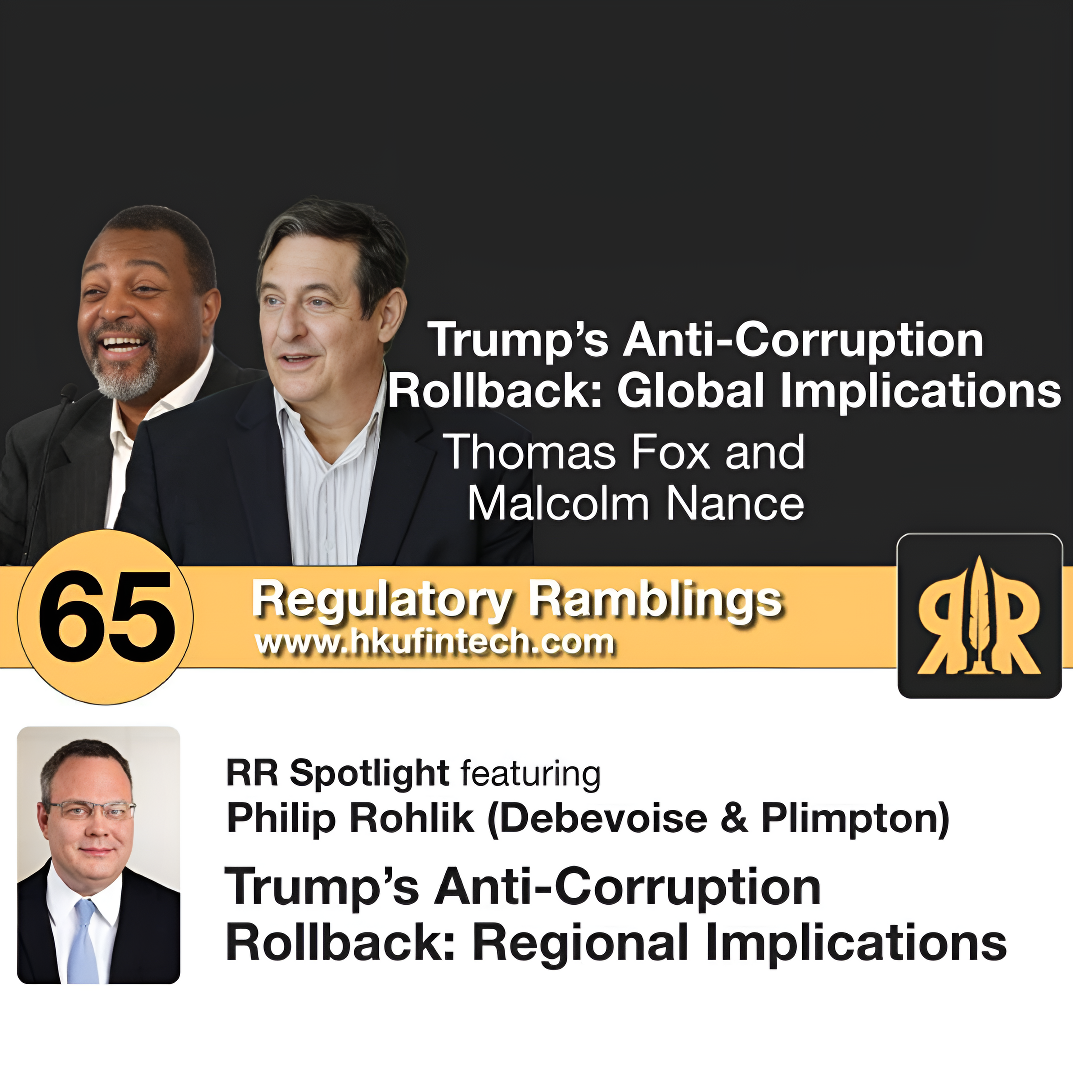
 Philip Rohlik is counsel in Debevoise & Plimpton LLP’s Shanghai office. He is a member of the firm’s White Collar & Regulatory Defense and International Dispute Resolution Groups, and his practice focuses on international investigations, securities law, and dispute resolution. He is recognized by “The Legal 500 Asia Pacific—Greater China” (2024-2025) for his anti-corruption and compliance practice and has been described as “very thorough, “hands-on,” and “excellent investigation lawyer.”
 Tom Fox is based in West Texas and is a prominent member of the compliance community and one of the most well-known legal practitioners regarding the FCPA. Over the past 15 years, he has been a general counsel and chief compliance officer. He is now an independent consultant, assisting companies with anti-corruption, anti-bribery compliance, and international transaction issues.
 Malcolm Nance is based in upstate New York. He is a 20-year veteran of the US Navy, where he was an intelligence officer, cryptographer, and Russian and Arab language specialist. As a master chief, he was responsible for discipline throughout the ranks.