In today’s edition of Daily Compliance News:
· Court loss is a win for climate. (Reuters)
· New types of FCPA enforcement actions coming. (WSJ)
· FTC and anti-trust. (WSJ)
· Mike Lynch has a very bad weekend. (BBC)



Nearly six years ago, Matt Ellis writing in CCI, detailed some of the Foreign Corrupt Practices (FCPA) enforcement actions involving Pemex. He detailed the software company Paradigm BV which had a FCPA enforcement action based in part on consultant payments, gifts and travel expenses for a Pemex official related to a subcontract it performed on a Pemex project. Hewlett-Packard Company (HP) had a FPCA enforcement action, partly involving payments the company made to a technology consultant in connection with the sale of HP software packages and licenses to Pemex. Back in 2008, Siemens AG had the first billion dollar plus FCPA enforcement action including, among other things, the payment of approximately $2.6 million in bribes to a well-connected business consultant in Mexico, some portion of which allegedly was routed to a senior Pemex official to help the company resolve cost overrun issues related to three refinery modernization projects.
Since that time, it seems doing business with Pemex only became riskier under the FCPA due to apparent endemic corruption at Pemex. Key Energy Services, Inc. has a FCPA enforcement action caused by bribes from its Mexican subsidiary paid to a Pemex employee. However, this endemic corruption is not a new feature of doing business with Pemex as far back as 1982, Crawford Enterprises, Inc., Ruston Gas Turbines, Inc., C.E. Miller Corporation and International Harvester Company, had a FCPA violation for paying bribes to sell turbine compression systems to Pemex. Book-ending this early FCPA enforcement action, as late as 2020, Vitol Inc. was involved in paying bribes in violation of the FCPA. In short, doing business with Pemex has always been high risk.
Now a new FCPA risk may have arisen for US companies doing business in the US as Pemex purchased a massive Royal Dutch Shell refinery in Deer Park Texas (Shell Deer Park up to the sale, Pemex Deer Park, after the transfer.) According to Reuters, turnover of the refinery occurred in January as the deal finally passed Committee on Foreign Investment in the United States (CFIUS) review. (How this deal could pass CFIUS review is the subject for another blog post.) Now we have the anomalous situation of Pemex owing one of the largest refineries on the Gulf Coast. What could go wrong?
One only need to look at the Corpus Christi based Citgo Petroleum Corporation which is owned by Venezuela’s state-owned and state-controlled energy company Petróleos de Venezuela S.A. (PDVSA). According to a 2021 Department of Justice (DOJ) Press Release, Jose Luis De Jongh Atencio (De Jongh) while an official at Citgo Petroleum Corporation, laundered millions of dollars in bribes and corruptly provided business advantages to multiple individuals who obtained contracts with Citgo and PDVSA. He accepted more than $7 million in bribe payments from businessmen in exchange for assisting the businessmen and related companies in procuring contracts with Citgo and providing them with other business advantages.
Another case involving Citgo was Jose Manuel Gonzalez Testino (Gonzalez), who pled guilty in federal court in Houston to one count of conspiracy to violate FCPA, one count of violating the FCPA, and one count of failing to report foreign bank accounts. Yet one of the most interesting items was the reference to Citgo Petroleum Corporation and its involvement in the bribery scheme. As noted in the DOJ Press Release it stated, “Gonzalez also admitted to making bribe payments to several PDVSA officials who were based in Houston and employed by Citgo.” Citgo procured goods and services on behalf of PDVSA and “Gonzalez admitted he and his co-conspirators paid at least four Citgo officials in the Special Projects group and provided gifts and other things of value to a senior Citgo executive.” These Citgo/PDVSA enforcement actions have led nearly 20 different guilty pleas or indictments of other former Citgo/PDVSA employees.
Clearly, there is precedent for a FCPA enforcement action in the United States for a US domiciled business if that business has foreign government ownership. The President of Mexico, Andrés Manuel López Obrador, has taken a decided interest in this acquisition and George Baker, writing in the Houston Chronicle, notes this brings on what he calls the AMLO risk to this facility due to Obrador’s tendency to micromanage Pemex. His position on bribery and corruption is certainly well shown in his administration. In addition to his cutting of Pemex’s budget for repair and plant maintenance, what to you think Pemex and the AMLO administration think of compliance? Not much it appears.
What American companies now need to understand is that every transaction, every meal bought for Pemex Deer Park employees or gifts sent over will have to be screened through a FCPA lens. What happens when Pemex officials from Mexico start arriving to oversee their investment? What happens when Pemex officials in Mexico start to oversee and micromanage contracts and procurement? Given the number of FCPA enforcement actions involving Pemex in the past, would it be too surprising to see a repeat of Pemex employees’ actions at Pemex Deer Park?
What type of due diligence is your American company going to engage in for doing business with Pemex Deer Park? Leaving aside the question of what the financial health of the plant will be under the AMLO regime, what about anti-corruption due diligence? Could Pemex pass such scrutiny or would too many read flags arise? What happens if your company is approached to enter into some type of joint or other business relationship with Pemex Deer Park?
What about training? If you are a US company which has only done due diligence with US owned petro-chemical and chemical plants on the Texas Gulf Coast, you have probably never received FCPA anti-corruption training. Now you will need to do so. You will also need to track all your gifts, travel and entertainment expenses with Pemex, with a separate line item entry in your books and records.
All of these issues and questions will be answered as we move forward into the almost brave new world.
In today’s edition of Sunday Book Review:
Resources
5 Great Blizzard Thrillers That Will Speak to Your Snowbound Soul
In this podcast series, two complete MCU fans, Tom Fox, founder of the Compliance Podcast Network and Megan Dougherty, co-founder of One Stone Creative indulge in passion for all things in the Marvel Cinematic Universe by re-watching each movie and then podcasting on every movie in the MCU. If you want to indulge in your love for the MCU with two fans who are passionate about all things MCU, this is the podcast series for you. For this offering, we consider the often under-appreciated Incredible Hulk.
Some of the highlights include:
Ø The story synopsis.
Ø What are the key plot points?
Ø What were some of our favorite cookies?
Ø How does this movie fit into the overall MCU?
Ø How is this movie an homage to prior non-MCU movies?
Next up in our series Thor.
Export restrictions; sanctions on 3 PRC companies – missile proliferation activities.
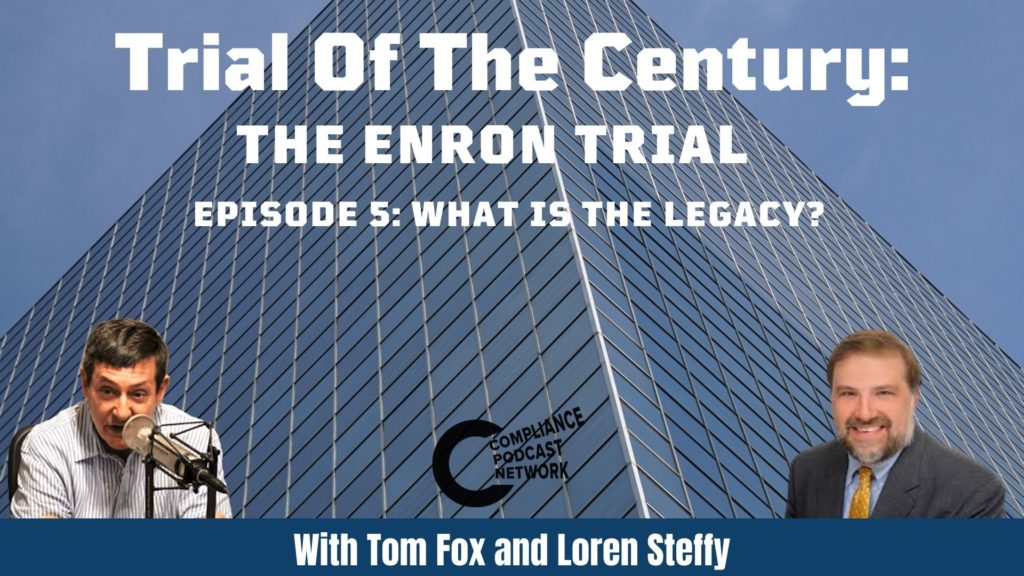
The final episode in The Enron Trial series is here. In part 5, Tom Fox and Loren Steffy take a look at Enron’s legacy, fifteen years after the trial.
Why Should the Trial Be Remembered?
“What the trial really brought home for everyone was the human toll that these kinds of corporate malfeasance cases can have,” explains Loren. When companies try to do whatever is necessary to keep their stock prices up at all costs, a lot of long-term harm comes out of it, “Enron wasn’t only an accounting failure… above all else, it was a human failure.”
Enron’s Innovations
Looking back on Enron’s successes, you begin to wonder, ‘What if?’ Loren highlights how unfortunately it panned out for the corporation, stating that, “They really were out in front of a lot of these trends. Unfortunately they shot themselves in the foot with their accounting.”
Fifteen Years Later – What Has Changed?
There’s a lot that can be learned from the fall of Enron; corporate responsibility is viewed differently, now. It’s no longer only about shareholder value, but also an improved focus on corporate governance. “We’ve realised that our corporations have greater responsibilities in that they have responsibilities to their employees, and they have responsibilities to their communities,” Loren tells Tom.
RESOURCES
Loren Steffy | LinkedIn | Twitter

Jean Bruggeman is Executive Director at Freedom Network USA, an organization with over a decade of leadership in supporting providers of direct services to survivors of human trafficking in the United States. She is a highly effective leader with 20 years of management experience in the non-profit legal and social services sector. She discusses the shortcomings of the immigration system and how it affects human trafficking, and what human trafficking looks like in the US.
In the case of domestic violence against an immigrant spouse, the traditional system is biased towards the abuser if they are a US citizen. They are essentially “handed another weapon in their arsenal to abuse and exploit their spouse,” as they can use their partner’s immigration status as a tool of power over them. There is now a law under the Violence Against Women Act that allows immigrant women to apply for their own visas, therefore taking the control away from their spouses.
Human trafficking is not about a few bad apples, Jean shares. Freedom Network is pulling out all the stops to get at the systemic issues of policy choices and immigrations systems that don’t protect or empower workers, and the racist, misogynistic history in US laws that put people at risk of being victimized.
Resources
Jean Bruggeman on LinkedIn
Lidia Kurganova is a 2L at Washington and Lee, and a staff writer on Law Review. She plans to work at Weil, Gotshal and Manges this summer in their New York office, and hopes to specialize in either corporate or technology, or an intersection of the two. In this episode of Classroom Insiders, Lidia discusses how Justice Powell gradually loosened the SEC’s hold on insider trading regulation.
Insider trading was regulated by states up until the 1960’s, when President Kennedy appointed Chairman William Cary of Columbia Law, who wanted the SEC to have broad regulatory powers. Chairman Cary provided a new federal basis for broad enforcement powers of insider trading, which was then adopted by the Second Circuit in the Texas Gulf Sulphur case and birthed the disclose-or-abstain rule. This decision would stand for the next decade as the preeminent insider trading rule, until Chiarella and Justice Powell.
Justice Powell chipped away at the SEC’s regulatory overreach case by case, starting with Chiarella v. SEC where he introduced the fiduciary relationship element to the disclose-or-abstain rule, and then Dirks v. SEC where he is credited for adding a personal benefit element to the tipper-tippee rule. The majority opinion written by Justice Powell established a personal benefit test, which requires courts to determine whether an insider tipper personally benefits indirectly or directly from disclosure. Three examples of personal benefits are: pecuniary gain, reputation gain, and a presumption of benefit due to close friend or family member relationship.
Resources
Karen Woody on LinkedIn
How long does it take to win a NFL playoff game? Patrick Mahomes says 13 seconds. After perhaps the most thrilling NFL playoff game ever, Tom and Jay are back look at some of the week’s top compliance and ethics stories this week in the 13 Seconds edition.
Stories
1. TI-CPI 2022 Report out. Results not good. TI-CPI Press Release. Rick Messick says make it useful in GAB. Jaclyn Jaeger is disheartened in Compliance Week (sub req’d).
2. Compliance officer burnout? Dick Cassin explores in the FCPA Blog.
3. Emphasizing the ‘G’ in ESG. David Simon in LinkedIn.
4. Investor demand driving ESG risk and compliance initiatives? Valerie Charles and Tracy Groves in CCI.
5. Human Rights Due Diligence. James Reardon and Tomas Navarro look at Switzerland’s new law in FCPA Blog. Tom considers your corporate Human Rights strategy in a 2-part blog series in the FCPA Compliance and Ethics Blog.
6. Monaco Speech and Compliance in 2022. Stephanie Yonekura and Rupinder Garcha in CCI.
7. DOJ announces shift in antitrust policy. DOJ Press Release. Matt Kelly in Radical Compliance.
8. ESG and M&A in 2022. Wachtel lawyers in Harvard Law School forum on Corporate Governance.
9. FTC compliance risk re: cyber and privacy. Debevoise lawyers in Compliance and Enforcement.
10. Cultural and ESG to-do list for 2022 for CCO. Mike Volkov in Corruption Crime and Compliance.
Podcasts and More
11. In January on The Compliance Life, I visited with Valerie Charles, partner at StoneTurn. Val has one of the most interesting journeys in compliance. In Part 1, she discussed her academic background and early professional career. In Part 2, she discussed her move to ComTech. In Part 3, Valerie moved into the consulting world. In the concluding Part 4, Valerie looks down the road for what’s ahead.
12. The Everything Compliance gang took a deep dive into the Microsoft acquisition of Activision Blizzard in a special episode. Check out the Shout Outs and Rants. Finally the gang had a special tribute to Meatloaf here.
13. CCI releases new e-book from Tom “FCPA 2021 Year in Review”. Available free from CCI.
14. Trial of the Century-the Enron Trial. This week, Tom premiered a 5-part podcast series on the Enron Trial with Loren Steffy, who covered the trial for the Houston Chronicle. In Part 1, run up to the trial. In Part 2, the trial begins. In Part 3, the star witnesses and key testimony. In Part 4, the Verdict comes in. In Part 5, what did it all mean. It is be available on the Compliance Podcast Network, Megaphone, iTunes, Spotify and all other top podcast platforms.
15. Check out 31 Days to a More Effective Compliance Program returns, which runs for the month of January, from January 1 to January 31. Available on the Compliance Podcast Network, Megaphone, iTunes, and all other top podcast platforms.
Tom Fox is the Voice of Compliance and can be reached at tfox@tfoxlaw.com. Jay Rosen is Mr. Monitor and can be reached at jrosen@affiliatedmonitors.com.