Categories
Blog

Shore Leave – Why Compliance Should be Fun (At Times)

Show Summary

What does the episode “Shore Leave” have to do with compliance? Quite a bit, it turns out. Intended as a respite for the fatigued crew of the Enterprise, the planet soon becomes a living playground of the imagination where thoughts turn instantly into reality. Fantasies (and nightmares) from the subconscious materialize: White Rabbits, medieval knights, lost lovers, and even Kirk’s old academy rival, Finnegan.

At first glance, “Shore Leave” may not seem like fertile ground for compliance lessons. But in fact, it offers a powerful metaphor for an often-overlooked truth in corporate ethics and compliance programs: compliance does not always have to be serious to be effective. Sometimes, as Carsten Tams reminds us, it should be playful. In today’s episode, we explore how compliance professionals can make training, communications, and culture-building engaginginteractive, and even fun without ever compromising on rigor or integrity. So join me as we unpack six key lessons from “Shore Leave” that illustrate how playfulness can be a surprisingly powerful tool in your compliance toolkit.

1. People Learn More When They’re Not Stressed

Illustrated by: The Enterprise crew’s need for R&R after exhausting missions.

Captain Kirk initially resists the idea of shore leave, arguing that there’s too much work to be done. But Dr. McCoy, supported by Spock’s logical assessment, insists the crew is showing signs of physical and mental exhaustion. Rest is not a luxury, and it is a necessity for operational effectiveness. When the crew beams down, they begin to laugh, explore, and decompress. For a moment, morale is restored.

Compliance Lesson:

Think of your employees the same way you’d think of the Enterprise crew: trained professionals under pressure. If you deliver compliance training in a joyless, legalistic tone, monotone webinars, lengthy policy PDFs, and punishment-driven messaging, instead of creating cognitive overload, you are hindering learning. Neuroscience confirms what “Shore Leave” dramatizes: people learn best when they’re relaxed, open, and stimulated by novelty.

So inject levity. Use storytelling. Create gamified challenges. Host “compliance scavenger hunts” or “ethics escape rooms.” A light touch does not dilute the message. It makes the message stick.

2. Make It Personal, Make It Stick

Illustrated by: The planet’s ability to tailor experiences to each crew member’s thoughts.

The so-called “amusement park planet” adapts its landscape in real-time to reflect each visitor’s thoughts. McCoy sees characters from fairy tales. Sulu finds himself with a samurai. Kirk confronts Finnegan, his mischievous nemesis from the Academy. The planet’s strength lies in its personalization, and each experience is unique, vivid, and relevant to the individual.

Compliance Lesson:

This is precisely what compliance communications should strive to be. People engage with content when it reflects their context, whether that is their role, region, risk exposure, or personal values. A generic, one-size-fits-all compliance email about anti-bribery laws won’t have nearly the impact of a short, animated video showing a sales manager navigating a tricky interaction with a government official in Brazil.

Use personas in your training. Build case studies based on real-life departmental challenges. Include localized content for global audiences. When people see themselves in the message, they remember the lesson.

3. Surprise Can Be a Teaching Tool

Illustrated by: The sudden appearance of surreal figures, from tigers to Alice in Wonderland.

“Shore Leave” keeps the crew and viewers on their toes. When things feel calm, something unexpected occurs. A knight skewers McCoy. A WW2 fighter plane swoops overhead. And Kirk is ambushed by his old nemesis in a fistfight. These surprises grab attention, trigger curiosity, and break the monotony. The episode feels whimsical, but it delivers deeper insights about stress, psychology, and perception.

Compliance Lesson:

In your compliance training program, don’t underestimate the value of surprise. Unexpected storytelling, clever twists, and humorous “wrong way” examples can all disarm your audience and make learning more memorable. Consider starting a training session with a scene from a movie, a meme, or even a parody of a compliance mistake. Then, pivot into serious learning.

Surprise doesn’t mean gimmickry. It means creating moments that catch attention, challenge assumptions, and open up space for meaningful engagement. Your goal is not simply to inform; rather, as Hui Chin told us many years ago, it is to make people think.

4. Let People Engage on Their Terms

Illustrated by: Different crew members experience the planet in different ways.

While the planet remains the same physical space, everyone interacts with it differently. McCoy goes on a fantasy adventure. Sulu finds joy in weapons. Yeoman Barrows imagines herself in a medieval gown. No one is forced into a particular experience; instead, each crew member chooses their path through the environment, making the experience more personal and fulfilling.

Compliance Lesson:

Apply this principle to your compliance communications strategy. Offer multiple modalities. Some people prefer videos; others prefer articles or podcasts. Some individuals may enjoy scenario-based learning games, while others may prefer simulations or role-playing exercises. Design your training architecture like a multi-lane road: different entry points, same destination.

Consider offering voluntary “bonus” compliance events, lunch-and-learns with guest speakers, ethical film screenings, or cross-functional “spot the risk” challenges. When people have choices, they feel a sense of ownership. And ownership increases buy-in.

5. Even Fantasy Has Rules—Define the Boundaries

Illustrated by: The discovery that the planet’s illusions, while playful, can cause real harm.

Initially, the planet seems harmless. But soon, McCoy is seriously injured, and other experiences become increasingly intense. Kirk and his crew learn that while the Earth is designed for recreation, it can become dangerous if participants do not understand the boundaries or rules. The solution is not to avoid play but to clarify the framework.

Compliance Lesson:

This is one of the most important parallels to corporate compliance. Creating engaging, playful content doesn’t mean abandoning standards or structure; it means embracing them freshly and innovatively. The opposite is true. Clear guardrails, defined objectives, code alignment, and measurable outcomes underpin the best compliance engagement programs.

If you host a gamified compliance tournament, ensure that the scoring mechanisms reinforce ethical behavior, not just speed. If you allow user-generated content, ensure review protocols are in place. Structured play can be just as effective and far safer than unsupervised learning. Fun is not the enemy of accountability.

6. Debriefing Deepens Learning

Illustrated by Kirk’s reflection with McCoy and Spock at the end of the episode.

At the end of “Shore Leave,” Kirk pauses to process what happened. He discusses the nature of the planet, its risks, and its benefits. He reflects on his emotional response to Finnegan, his sense of guilt and nostalgia, and what he learned about himself. This moment transforms the experience from play into one of growth and development.

Compliance Lesson:

Never end a training without a debrief. Whether your program was fun, serious, or somewhere in between, reflection is what turns experience into understanding. After a game-based simulation, send out discussion questions. After a role-play session, ask participants to share lessons learned or “What would you do differently?”

Even something as simple as a brief email summary, a leaderboard shoutout, or a team wrap-up call can reinforce key takeaways and prompt their practical application. The brain needs repetition and connection to consolidate learning. Give your audience the chance to process.

Final ComplianceLog Reflections:

Compliance Doesn’t Have to Be a “No-Fun Zone”

Sometimes, you need to channel your inner Ronnie Feldman, for if there is one thing Shore Leave teaches us, it is that even the most disciplined teams need room for release, exploration, and imagination. The same is true in compliance. You’re not just teaching policies; you’re influencing behavior, shaping culture, and earning trust. And if playfulness, humor, and surprise can help you do that more effectively, then beam those strategies aboard.

Compliance has its profound moments, no doubt. But if your entire program is built on fear, formality, and fatigue, you are missing out on one of the most powerful motivators we have: joy.

Resources:
Excruciatingly Detailed Plot Summary by Eric W. Weisstein

MissionLogPodcast.com

Memory Alpha

Categories
Trekking Through Compliance

Trekking Through Compliance: Episode 15 – Shore Leave – Why Compliance Should be Fun (At Times)

Show Summary

In this episode of Trekking Through Compliance, we beam down to the lush, surreal planet featured in the original Star Trek series episode, “Shore Leave.” Intended as a respite for the fatigued crew of the Enterprise, the planet soon becomes a living playground of the imagination where thoughts turn instantly into reality. Fantasies (and nightmares) from the subconscious materialize: White Rabbits, medieval knights, lost lovers, and even Kirk’s old academy rival, Finnegan.

At first glance, “Shore Leave” may not seem like fertile ground for compliance lessons. But in fact, it offers a powerful metaphor for an often-overlooked truth in corporate ethics and compliance programs: compliance does not always have to be serious to be effective. Sometimes, as Carsten Tams reminds us, it should be playful. In today’s episode, we explore how compliance professionals can make training, communications, and culture-building engaginginteractive, and even fun without ever compromising on rigor or integrity. So join me as we unpack six key lessons from “Shore Leave” that illustrate how playfulness can be a surprisingly powerful tool in your compliance toolkit.

Key highlights:

1. People Learn More When They’re Not Stressed

 Illustrated by: The Enterprise crew’s need for R&R after exhausting missions.

Dr. McCoy, supported by Spock’s logical assessment, insists the crew is showing signs of physical and mental exhaustion. Rest is not a luxury; it is a necessity for operational effectiveness. For compliance professionals, the message is that if you deliver compliance training in a joyless, legalistic tone, you are creating cognitive overload rather than facilitating learning. Neuroscience confirms what “Shore Leave” dramatizes: people learn best when they’re relaxed, open, and stimulated by novelty.

2. Make It Personal, Make It Stick

 Illustrated by: The planet’s ability to tailor experiences to each crew member’s thoughts.

No doubt, anticipating GenAI in compliance training, the planet’s strength lies in its personalization; each experience is unique, vivid, and relevant to the individual. This is precisely what compliance communications should strive to be. People engage with content when it reflects their context, whether that is their role, region, risk exposure, or personal values.

3. Surprise Can Be a Teaching Tool

 Illustrated by: The sudden appearance of surreal figures, from tigers to Alice in Wonderland.

When things feel calm, something unexpected occurs. A knight skewers McCoy. A WW2 fighter plane swoops overhead. These surprises grab attention, trigger curiosity, and break the monotony. The episode feels whimsical, but it delivers deeper insights about stress, psychology, and perception. In your compliance training program, do not underestimate the value of surprise. Unexpected storytelling, clever twists, and humorous “wrong way” examples can all disarm your audience and make learning more memorable. Consider starting a training session with a scene from a movie, a meme, or even a parody of a compliance mistake. Then, pivot into serious learning.

4. Let People Engage on Their Terms

Illustrated by: Different crew members experience the planet in different ways.

While the planet remains the same physical space, everyone interacts with it differently. McCoy goes on a fantasy adventure. Sulu finds joy in weapons. Yeoman Barrows imagines herself in a medieval gown. No one is forced into a particular experience; instead, each crew member chooses their path through the environment, making the experience more personal and fulfilling. Now, apply this principle to your compliance communications strategy. Offer multiple modalities. Some people prefer videos; others prefer articles or podcasts. Some individuals may enjoy scenario-based learning games, while others may prefer simulations or role-playing exercises. Design your training architecture like a multi-lane road: different entry points, same destination.

5. Even Fantasy Has Rules—Define the Boundaries

Illustrated by: The discovery that the planet’s illusions, while playful, can cause real harm.

Initially, the planet seems harmless. However, soon, Kirk and his crew discover that while the Earth is designed for recreation, it can become hazardous if participants fail to understand the boundaries or rules. The solution is not to avoid play but to clarify the framework. This is one of the most important parallels to corporate compliance. Creating engaging, playful content doesn’t mean abandoning standards or structure; it means embracing them freshly and innovatively. The opposite is true. Clear guardrails, defined objectives, code alignment, and measurable outcomes underpin the best compliance engagement programs.

6. Debriefing Deepens Learning

 Illustrated by: Kirk’s reflection with McCoy and Spock at the end of the episode.

At the end of “Shore Leave,” Kirk pauses to reflect on what has happened. He discusses the nature of the planet, its risks, and its benefits. He reflects on his emotional response to Finnegan, his sense of guilt and nostalgia, and what he learned about himself. This moment transforms the experience from play into one of growth. Never end a training without a debrief. Whether your program was fun, serious, or somewhere in between, reflection is what turns experience into understanding. After a game-based simulation, send out discussion questions. After a role-play session, ask participants to share lessons learned or “What would you do differently?”

Final ComplianceLog Reflections:

Compliance Doesn’t Have to Be a “No-Fun Zone”

Sometimes, you need to channel your inner Ronnie Feldman, for if there is one thing Shore Leave teaches us, it is that even the most disciplined teams need room for release, exploration, and imagination. The same is true in compliance. You’re not just teaching policies; you’re also influencing behavior, shaping culture, and earning trust. And if playfulness, humor, and surprise can help you do that more effectively, then beam those strategies aboard.

Compliance has its serious moments, no doubt. But if your entire program is built on fear, formality, and fatigue, you are missing out on one of the most powerful motivators we have: joy.

Resources:
Excruciatingly Detailed Plot Summary by Eric W. Weisstein

MissionLogPodcast.com

Memory Alpha

Categories
Corruption, Crime and Compliance

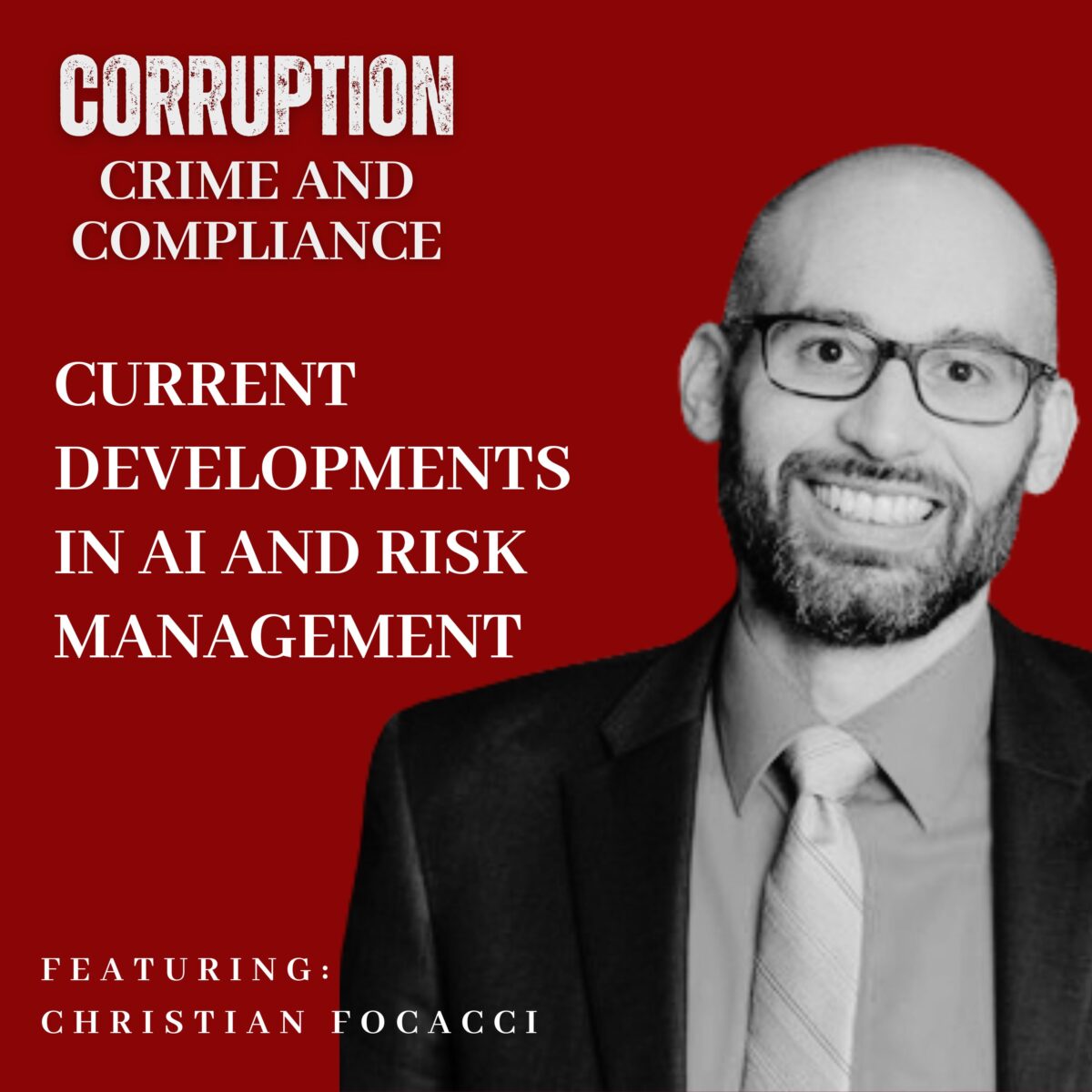
Current Developments in AI and Risk Management with Christian Focacci

Is AI a magic bullet – or just another tool in the compliance toolkit?

What really happens when you let algorithms near your risk decisions?

In this episode of Corruption, Crime and Compliance, Christian Focacci, founder and CEO of Threat.Digital, returns for a thoughtful and highly practical conversation about the state of artificial intelligence in compliance and third-party risk management. Christian’s platform is at the forefront of using large language models and real-time data to transform how companies identify and manage risk – without losing sight of the human judgment that still needs to guide every decision. He and Michael explore what’s changed in the AI landscape over the past year, what’s misunderstood about the technology, and how compliance teams can strike the right balance between innovation and accountability.

You’ll hear them discuss:

  • Why Christian believes you shouldn’t use AI unless it’s truly the right tool for the job, and how this philosophy shapes how Threat.Digital builds and deploys its systems
  • What large language models actually are, how they function under the hood, and why most people fundamentally misunderstand how they learn and process information
  • The growing demand for corporate AI governance, how some risk committees are creating unnecessary delays, and why many internal processes are still focused on the wrong questions
  • How Threat.Digital uses AI to reduce noise in due diligence, replacing bloated, unfiltered search results with clear, high-quality summaries supported by verifiable sources
  • Why the real power of AI isn’t about replacing humans, but about expanding what can be reviewed – moving from 10 data points to 10,000, while helping compliance professionals focus only on what matters
  • The future of due diligence: chaining AI tasks to build multi-layered investigations that trace ownership, pull third-party records, and surface hidden risks in real time
  • How AI is revolutionizing name screening and sanctions checks by eliminating irrelevant fuzzy matches, freeing teams from chasing meaningless alerts and allowing them to act on true risks with confidence

Resources

Christian Focacci on the Threat.Digital | LinkedIn | Email: chris@threat.digital

Michael Volkov on LinkedIn | Twitter

The Volkov Law Group

Categories
Career Can D0

Business Wisdom from Golf with Joe Bronson

What can golf teach us about business, leadership, and personal growth? A lot more than you might think. In this special episode of Career Can Do, Chris Sandland, Director of Operations at Faremouth & Company, steps in as our host, Mary Ann. Chris sits down with Joe Bronson, CEO of The Bronson Group and author of books Golf Chronicles, Through The Green, and Pardon Me. 50 Years of Gold, One Hole at a Time. With decades of experience in both the boardroom and on the golf course, Joe shares stories and insights that show how the game mirrors life, from ethics and decision-making to handling setbacks and building relationships.

Joe has played 93 of the top 100 golf courses in the U.S. and even had the once-in-a-lifetime experience of playing a round with golf legend Arnold Palmer. But beyond the prestige and unforgettable moments, Joe sees golf as a powerful tool for connection and leadership development. Whether he’s navigating a challenging par three or a major business decision, the mindset is often the same: know your skill set, take smart risks, and stay focused on the present.

He explains, “In business, just like in golf, emotion can ruin you. You have to keep things in balance, stay disciplined, and respond to the situation in front of you, not the one behind you.”

Chris and Joe also explore how golf can still be a relevant networking tool, even in today’s digital-first world. Joe argues that spending four hours on a course with someone tells you more about them than a dozen Zoom meetings ever could. And he’s seen firsthand how a well-timed piece of advice from someone who believes in you, even a caddie, can shift your entire approach.

Now retired from corporate life, Joe focuses on giving back. All proceeds from his book support youth golf and university programs, including The First Tee, which helps underprivileged kids learn the game while gaining life skills.

If you’re a leader, a golfer, or just someone trying to make good decisions in work and life, this episode offers timeless lessons, and a few great stories, from someone who’s walked both the fairway and the executive floor.

Resources

Joe Bronson on the Web | Buy Joe’s Books on Amazon

Chris Sandland on LinkedIn

Categories
All Things Investigations

All Things Investigations – Navigating New DOJ Directives: Declinations, Cooperation, and Whistleblower Programs with Mike DeBernardis and Katherine Taylor

Welcome to the Hughes Hubbard Anti-Corruption & Internal Investigations Practice Group’s podcast, All Things Investigation. In this podcast, host Tom Fox is joined by HHR lawyers Mike DeBernardis and Katherine Taylor about the recent speech by Matthew R. Galeotti, Head of the Criminal Division at the U.S. Department of Justice (DOJ);  his attendant Memo entitled Focus, Fairness, and Efficiency in the Fight Against White-Collar Crime; and the updates to the Corporate Enforcement and Voluntary Self-Disclosure Policy; and finally the new Memo on Monitors and Monitorships.

Key highlights:

  • Is meaningful cooperation credit finally here?
  • Did we move from a presumption of a declination to something stronger or at least more tangible?
  • Is the Kenneth Polite “double secret—we know it when we see it” cooperation requirement now a thing of the past, or at least defined?
  • Enhancements to the Whistleblower Program—Initial Thoughts.
  • Monitors—dead and gone or something else?
  • What, if anything, does this change about the role of corporate compliance today?

Resources:

Mike DeBernardis

Hughes Hubbard & Reed website

Katherine Taylor

Categories
Daily Compliance News

Daily Compliance News: June 16, 2025, The Golden Share Edition

Welcome to the Daily Compliance News. Each day, Tom Fox, the Voice of Compliance, brings you compliance-related stories to start your day. Sit back, enjoy a cup of morning coffee, and listen in to the Daily Compliance News. All from the Compliance Podcast Network. Each day, we consider four stories from the business world: compliance, ethics, risk management, leadership, and general interest, all relevant to the compliance professional.

Top stories include:

  • The US now has a golden share of US Steel. (NYT)
  • Will Mike Madigan be sentenced to 7.5 years? (NYT)
  • The DOJ whistleblower program focuses on healthcare fraud. (Reuters)
  • A Congolese customs officer was beaten for anti-corruption efforts. (AP)
Categories
FCPA Compliance Report

#Risk New York Speaker Series – AI Investments and Political Uncertainty with Chris Mason

Join Tom Fox and hundreds of other GRC professionals in the city that never sleeps, New York City, on July 9 & 10 for one of the top conferences around, #Risk New York. The current US landscape, shaped by evolving policies, rapid advancements in AI, and shifting global dynamics, demands adaptive strategies and cross-functional collaboration.

At #RISK New York, you will master the New Regulatory Reality by getting ahead of US regulatory shifts and their impact. Conquer AI and Tech Risk by Safeguarding Your Organization in an AI-Driven World and Understanding the Implications of Major Tech Investments. Navigate Financial and Crypto Volatility by Protecting Your Assets and Exploring Solutions in a Dynamic Market. Strengthen Your GRC Framework by Leveraging Governance, Risk, and Compliance for Strategic Advantage. Protect Digital Trust by addressing challenges in cybersecurity and data privacy and combating misinformation. All while meeting with the country’s top #Risk management professionals.

In this episode, Tom Fox talks with Chris Mason, who recently launched his risk advisory practice, Woodhorn Global, focusing on due diligence investigations. Chris shares insights about his upcoming presentations at the #RiskGRC conference in July, focusing on AI investments and the impact of political uncertainty on the GRC (Governance, Risk, and Compliance) community. They discuss the significance of AI in the field and the importance of adapting to political changes. Chris also emphasizes the value of in-person events in understanding best practices and navigating the evolving risk landscape.

Resources:

#Risk Conference Series

#RiskNYC—Tickets and Information

Chris Mason on LinkedIn

Categories
Adventures in Compliance

Adventures in Compliance: The Novels: Data Analytics from The Sign of Four

In this new season of Adventures in Compliance, host Tom Fox takes a deep dive into the Sherlock Holmes novels. Throughout this season, Tom will explore each novel in a four-part series. The four novels we will consider from the ethics and compliance perspective are A Study in Scarlet, The Sign of Four, The Hound of the Baskervilles, and The Valley of Fear. We continue our four-episode series on the second novel, The Sign of Four, by reviewing how Holmes uses data analytics and pattern recognition in this story.

Timothy and Fiona had so much fun last week that they are back to explore how the methods of the fictional detective Sherlock Holmes can be applied to modern compliance work. By examining the principles from ‘The Sign of Four,’ they take a deep dive into five key lessons that can sharpen the skills of compliance professionals today: the art of discernment, establishing baselines, contextual analysis of data, leveraging technology, and continuous refinement and learning. Their discussion highlights how these timeless analytical approaches, when amplified by modern technology, provide a robust framework for dealing with complex and rapidly changing compliance landscapes.

Highlights include:

  • Applying Holmes’ Methods to Compliance Analytics
  • Lesson 1: The Art of Discernment
  • Lesson 2: Establishing Baselines
  • Lesson 3: Contextual Analysis of Data
  • Lesson 4: Leveraging Technology and Tools
  • Lesson 5: Continuous Refinement and Learning
  • Conclusion: Balancing Timeless Principles with Modern Adaptability

Resources:

The New Annotated Sherlock Holmes

Sherlock Holmes FAQ by Dave Thompson

Connect with Tom Fox

Instagram

Facebook

YouTube

Twitter

LinkedIn

Categories
FCPA Compliance Report

FCPA Compliance Report – Recent DOJ Policy Announcements

Welcome to the award-winning FCPA Compliance Report, the longest-running podcast in compliance. Today, Tom Fox welcomes back James Tillen and Ann Sultan, both partners at Miller & Chevalier, and takes a deep dive into four recent DOJ policy announcements: FCPA Enforcement, White-Collar Enforcement, Criminal Enforcement Policy, and the Whistleblower Pilot Program.

They take a deep dive into Deputy Attorney General Todd Blanche’s memo on Investigations and Enforcement of the FCPA, reviewing the stated main goals of the DOJ and how prosecutors are supposed to achieve these goals. They also consider three directives to prosecutors: focus on cases involving individual misconduct, proceed expeditiously, and consider the collateral consequences. They also examine the White Collar Plan and CEP and ask if we have shifted from a presumption of declination to a more tangible framework and conclude by reviewing what compliance professionals need to consider and investigate now.

Key highlights include:

  • How does the principle of “not attribute[ing] nonspecific malfeasance to corporate structures” impact potential prosecutions of companies and individuals?
  • And how do these priorities jive with other DOJ priorities, such as prosecuting cartels/transnational criminal organizations?
  • What does it mean for companies that the DOJ is prioritizing “serious misconduct”?
  • What are the implications of the DOJ’s stated intent to avoid penalizing “routine business practices in other nations”?
  • Do you see this as a shift in focus for the DOJ to non-US companies?
  • Other DOJ Priorities & Announcements
  • Policy Shifts and Clarifications
  • Looking Ahead: What’s on the Horizon

Resources:

FCPA Spring Review 2025 – Miller & Chevalier

DOJ Criminal Division White Collar Plan

Guidelines for Investigations and Enforcement of the FCPA

Tom Fox

Instagram

Facebook

YouTube

Twitter

LinkedIn

For more information on the use of AI in compliance programs, see Tom Fox’s new book, Upping Your Game. You can purchase a copy of the book on Amazon.com

Categories
Blog

Investigative Lessons from Sherlock Holmes: The Sign of Four

Corporate compliance and Sherlock Holmes may seem worlds apart, but compliance professionals and Sir Arthur Conan Doyle’s legendary detective share a core responsibility: uncovering truths hidden behind complex webs of evidence. “The Sign of Four,” one of Doyle’s most gripping Sherlock Holmes tales, offers powerful investigative insights directly applicable to the realm of compliance. Here are five key lessons compliance professionals can draw from Holmes’s investigative methods in this classic novel.

1. Precise Documentation: “Methodical Observation”

In The Sign of Four, Sherlock Holmes emphasizes the importance of methodical and precise documentation as crucial to solving complex mysteries. Early in the narrative, Holmes carefully examines a mysterious note received by Miss Mary Morstan. His meticulous observation of handwriting, paper quality, and ink composition enables him to deduce the note’s origin and purpose, thereby setting the course of the investigation.

Compliance professionals should emulate Holmes by rigorously documenting every aspect of an investigation to ensure thoroughness and accuracy. Precise records of evidence, witness statements, and procedures ensure accuracy, accountability, and transparency, significantly reducing risks of oversight or misinterpretation. Proper documentation also strengthens the organization’s ability to respond effectively during audits or regulatory inquiries.

2. Logical Analysis: “Eliminating the Impossible”

Holmes famously asserts in The Sign of Four, “When you have eliminated the impossible, whatever remains, however improbable, must be the truth.” This principle guides his pursuit of justice throughout the novel. Holmes methodically rules out improbable scenarios in investigating the disappearance of Captain Morstan and the subsequent quest for hidden treasure, ultimately unveiling Jonathan Small’s elaborate revenge-driven plot.

Compliance officers should similarly use structured analytical frameworks to eliminate false assumptions and unsubstantiated theories during investigations. Adopting logical, disciplined analysis reduces biases, prevents costly mistakes, and fosters more accurate and actionable outcomes. Holmes’s deductive approach encourages compliance professionals to remain vigilant against assumptions that may cloud judgment.

3. Embrace Collaboration: “Leveraging Complementary Strengths”

In The Sign of Four, Sherlock Holmes frequently relies on Dr. Watson’s support and complementary skills. Watson’s medical knowledge and practical insights greatly assisted Holmes during the investigation, notably during examinations of crime scenes and understanding the emotional motivations of suspects and victims.

For compliance professionals, this illustrates the importance of multidisciplinary collaboration. Effective compliance investigations often require collaboration with professionals from diverse specialties, including auditors, forensic accountants, legal advisors, human resources specialists, and IT experts. Embracing a collaborative approach ensures a comprehensive investigation, as each discipline brings unique insights that enhance the overall effectiveness and credibility of the compliance function.

4. Attention to Subtle Indicators: “Noticing Small Clues”

Holmes’s brilliance often lies in noticing seemingly insignificant details overlooked by others. In The Sign of Four, Holmes carefully notes tiny footprints, peculiar scents, and minor discrepancies in testimonies, each subtly directing the investigation toward its resolution. For instance, Holmes’s keen attention to Toby, the trained bloodhound, and his reaction to specific scents help locate key evidence pivotal to unraveling the mystery.

Compliance professionals must likewise sharpen their observational skills to detect subtle indicators of wrongdoing, such as minor financial discrepancies, slight variations in employee behaviors, or seemingly inconsequential procedural anomalies. Often, the most significant compliance breaches initially manifest as minor irregularities. Developing Holmes-like attentiveness can significantly enhance the detection and early resolution of compliance issues.

5. Managing Bias and Assumptions: “Maintaining Objective Judgment”

Throughout, Holmes maintains rigorous objectivity, avoiding emotional biases or ungrounded assumptions. Even when emotionally involved characters, including Watson and Miss Mary Morstan, draw emotional or intuitive conclusions, Holmes insists on relying exclusively on factual evidence and logic. His disciplined approach ensures accuracy and fairness in the investigation’s outcome.

Compliance officers frequently confront emotionally charged scenarios or influential stakeholders, which can pressure outcomes. Maintaining an objective and unbiased judgment is crucial to upholding fairness and integrity during compliance investigations. Holmes’s unwavering dedication to evidence-based analysis exemplifies the importance of unbiased fact-finding in safeguarding organizational ethics and compliance integrity.

Final Thoughts: Integrating Sherlock Holmes’s Methods into Compliance

The Sign of Four offers rich investigative wisdom that is directly applicable to corporate compliance. Sherlock Holmes’s meticulous documentation, disciplined logical reasoning, strategic collaboration, precise attention to detail, and uncompromising objectivity represent invaluable investigative methodologies for today’s compliance professionals.

As compliance continues evolving in complexity and significance, adopting Holmesian investigative rigor enhances our ability to protect organizational integrity, mitigate risks, and ensure regulatory compliance. Compliance professionals who master these investigative practices not only improve their effectiveness but also significantly contribute to their organization’s overall resilience and ethical standing.

In the dynamic landscape of corporate compliance, Sherlock Holmes’s timeless investigative lessons remain as relevant today as in Victorian London, reminding us that excellence in investigation demands continual refinement, unwavering diligence, and precise analytical clarity.