Welcome to AI Today in 5, the newest edition to the Compliance Podcast Network. Each day, I will bring to you 5 stories about AI stories to start your day. Sit back, enjoy a cup of morning coffee and listen in to the AI Today In 5. All, from the Compliance Podcast Network. Each day we consider four stories from the business world, compliance, ethics, risk management, leadership or general interest about AI.
Pitching AI as Mission Critical in wealth management. (FinTechGlobal)
Chinese hackers reportedly used Anthropic for cyberattacks. (WSJ)
Welcome to “Compliance Tip of the Day,” the podcast that brings you daily insights and practical advice on navigating the ever-evolving landscape of compliance and regulatory requirements. Whether you’re a seasoned compliance professional or just starting your journey, our goal is to provide you with bite-sized, actionable tips to help you stay ahead in your compliance efforts. Join us as we explore the latest industry trends, share best practices, and demystify complex compliance issues to keep your organization on the right side of the law. Tune in daily for your dose of compliance wisdom, and let’s make compliance a little less daunting, one tip at a time.
We conclude our week of fun in compliance by looking at how Winnie the Pooh and his friends inform your compliance program. Today, we reflect on lessons from Winnie the Pooh for the CECO.
For more information on this topic, refer to The Compliance Handbook: A Guide to Operationalizing Your Compliance Program, 6th edition, recently released by LexisNexis. It is available here.
Today’s podcast is Mideast-centric, specifically focusing on the United Arab Emirates—and in particular, its most renowned emirate, Dubai. In our spotlight section, we will be joined by two returning guests—Syed Musheer Ahmed of FinStep Asia and Mark Nuttall, founder of the Dubai-based Faustus Consultancy—to discuss the proposition: what has made Dubai a success in the virtual assets space compared to other jurisdictions? Since the start of the decade, the emirate has established a reputation in the cryptocurrency arena.
After that, we speak with authors Jame DiBiasio and Charles d’Haussy about their new book, Arabian Crypto, about digital-asset pioneers in the UAE.
Biography:
Syed Musheer Ahmed has over 18 years of extensive experience as an ecosystem builder in the realms of capital markets, fintech, and virtual assets, which includes a decade as a global markets trader before relocating to Hong Kong to pursue his MBA from the University of Hong Kong and the London Business School’s joint program.
Since 2016, Musheer has contributed extensively to building the region’s fintech and virtual asset ecosystem, particularly as co-founder and concurrent board member, as well as the inaugural general manager of the Fintech Association of Hong Kong.
Based in Hong Kong, he has been the managing director of FinStep Asia for almost five years, a position he has held since founding the firm. In the interim, he served as a financial regulator from October 2022 to January 2024, when he was the Financial Markets Risk Assurance Lead with VARA in Dubai.
Mark Nuttall is a Dubai-based executive, geopolitical advisor, and strategic deal facilitator. With over 25 years of experience in strategic leadership, risk management, and business development, he has held roles at the Metropolitan Police Service (in London), Thomson Reuters, INTERPOL, and Hill and Associates. He founded the Faustus Consultancy and The Iron Club.
Mark offers his executive advisory services across the Asia Pacific, MENA, and Europe, driving growth, optimizing operations, facilitating deals, and enhancing governance. Particularly in risk management and governance, he has extensive experience in implementing plans focused on risk mitigation and resilience, as well as enhancing governance standards. He has also managed complex investigations and multi-agency operations.
In terms of subject matter expertise, Mark has delivered advisory services about compliance, risk reduction, finance, leadership, governance, geopolitics, AML, resilience, security, and ESG. He has also provided keynote speeches and mentorship to C-suite and geopolitical audiences.
Jame DiBiasio has had a remarkable journey, transitioning from a seasoned reporter to writer, editor, author, and content creator (particularly in the realm of fintech), ultimately leading to becoming a media entrepreneur, board director, and podcaster. He still regards himself as all of the above—as he puts it, “leveraging experiences to provide bespoke story-based projects and to advise companies.”
Based in Hong Kong, he is currently the founder and managing partner of JDB Advisors, providing companies in fintech, financial services, wealth management, and digital assets with insight, advice, and services to support their growth and narrative. The firm’s edge lies in its ability to leverage media expertise, encompassing co-authorship, podcasting, writing, research, and recruitment.
Ultimately, he helps fintech and finance businesses with media, narrative, content, and governance. His firm, JDBA, also publishes its own in-house media, The JDB Report, which covers technology and finance.
Jame’s passion, however, is writing. He is the author of a dozen books, five of which are nonfiction. In addition to Arabian Crypto, his other titles include Planet VC, which tells the story of venture capital beyond Silicon Valley; Block Kong, in which he profiles blockchain leaders and entrepreneurs shaping Hong Kong’s virtual asset ecosystem; and Cowries to Crypto—a history of money.
His non-business history books are “The Story of Angkor” and “Who Killed the King of Bagan?”, each covering one of Southeast Asia’s great temple civilizations. Jame also writes fiction under a pen name, which he encourages us to figure out.
Charles d’Haussy is based in Dubai and serves as the CEO of the dYdX Foundation, a community centered on decentralized derivatives trading, with a core focus on a decentralized finance (DeFi) protocol for perpetual futures.
Before joining dYdX, Charles served as the global head of business development at ConsenSys. His diverse career includes entrepreneurial ventures, executive roles in fintech startups, and a stint as the head of fintech at InvestHK, a quasi-governmental body.
In 2018, Charles was recognized as one of the Top 50 FinTech influencers in Asia. His expertise in fintech and blockchain earned him widespread acclaim. In 2021, he co-authored the book Block Kong with Jame.
Discussion:
This episode’s spotlight segment begins with a reference to a recent LinkedIn post by Anton Golub, the Chief Business Officer of the Freedx crypto exchange in Dubai. It helps put things in perspective regarding the emirate’s success in the virtual asset space.
As he put it, Dubai became the world’s largest regulated crypto market. Not New York. Not London. Not Hong Kong. Not Singapore.
Not bad for a place that, well into the early 1990s, only had one major Western-style shopping mall to speak of—the famed Al Ghurair Centre.
According to Golub’s figures, for the year-to-date (YTD) 2025, Dubai logged over AED 2.5 trillion (approximately USD 680.64 billion) in regulated virtual-asset transactions. He adds that Dubai also boasts over 40 licensed entities under the oversight of its Virtual Asset Regulatory Authority (VARA), the world’s first such regulator, which was launched in 2022.
To its credit, Dubai has also fined 19 firms under clear enforcement measures, and more broadly, its neighboring emirate Abu Dhabi—the UAE’s capital—has made a US$2 billion institutional investment into Binance.
All of this has happened in just three short years. What did Dubai understand that other places did not? While planning matters, execution is key. While different jurisdictions debated definitions, the UAE established its fintech infrastructure to support the growth and development yet to come.
To quote Golub’s LinkedIn post: “While Europe buried itself in MiCA [Markets in Crypto-Assets Regulation], Dubai executed. While the US chased headlines, VARA licensed markets.”
Of VARA’s creation, he said it was “built like sovereign infrastructure. Every major exchange—Binance, OKX, Bybit—moved fast to comply. This wasn’t about ‘crypto-friendly. This was crypto-integrated.”
Musheer and Mark reiterate many of the above sentiments while chatting with Regulatory Ramblings host Ajay Shamdasani, all while sharing their own thoughts on why Dubai has become a successful digital asset hub based on their time on the ground there.
As Golub noted, Dubai’s strength was that it had a vision before regulation: the UAE as a nation understands that “digital assets are not about price—they’re about power.” Additionally, they valued “infrastructure before hype” with “tiered licenses,” “real enforcement,” and “credible frameworks.” Lastly, the emirate recognized that integration must precede scale, as “digital assets were woven into AI, banking, [the] cloud, and sovereign funds.”
The net result, according to Golub, is that “Dubai now governs trust infrastructure for a multi-trillion-dollar global asset class. The UAE is not waiting for the future. It’s building it.”
Giving a preview of things to come in the UAE, he points to:
– The tokenization of real-world assets
– Central Bank Digital Currency (CBDC)-backed stablecoin flows (“Digital Dirham”)
– AI-native finance via MGX, G42, Presight
– On-chain financial infrastructure as national policy
The emphasis on execution and Dubai’s “can-do attitude” is also something that both Musheer and Mark stress in an age when so-called crypto hubs like Singapore issue licenses sluggishly, placing a great many firms on provisional status. Those that get to market first will benefit by virtue of being early movers.
Indeed, legal debates about whether stablecoins are currency or securities seem quaint at this point.
The conversation continues with Jame and Charles. The premise of their book, Arabian Crypto, is that the UAE has exploded onto the crypto scene. Every major player, from exchanges to DeFi founders and traditional finance bankers, is establishing a presence in either Dubai or Abu Dhabi.
But why the UAE? How did this nation of 10 million become the leading global hub for crypto? Is it too late for those who want to participate in the UAE’s growth story to join the party?
Arabian Crypto showcases the perspectives of regulators, founders, and executives across the spectrum of digital assets to understand what drives the UAE’s success, how to conduct business in the country, and how to navigate its regulatory landscape. Multiple exciting projects are being built there, and it begs the question: What will it mean for the UAE’s role in the global blockchain-enabled commerce industry?
The book is a valuable primer into the cutting edge of East-meets-West innovation and the future of money.
The authors discuss their views on VARA’s effectiveness as a regulator with Ajay, explaining what prompted them to write the book and what they believe it contributes to the ever-growing body of work on crypto and fintech writ large.
They acknowledge that their target audience is those from the world of tradfi, while also noting that there are lessons for established APAC financial hubs, such as Hong Kong and Singapore, to learn from the UAE as well.
Regulatory Ramblings podcasts is brought to you by The University of Hong Kong – Reg/Tech Lab, HKU-SCF Fintech Academy, Asia Global Institute, and HKU-edX Professional Certificate in Fintech, with support from the HKU Faculty of Law.
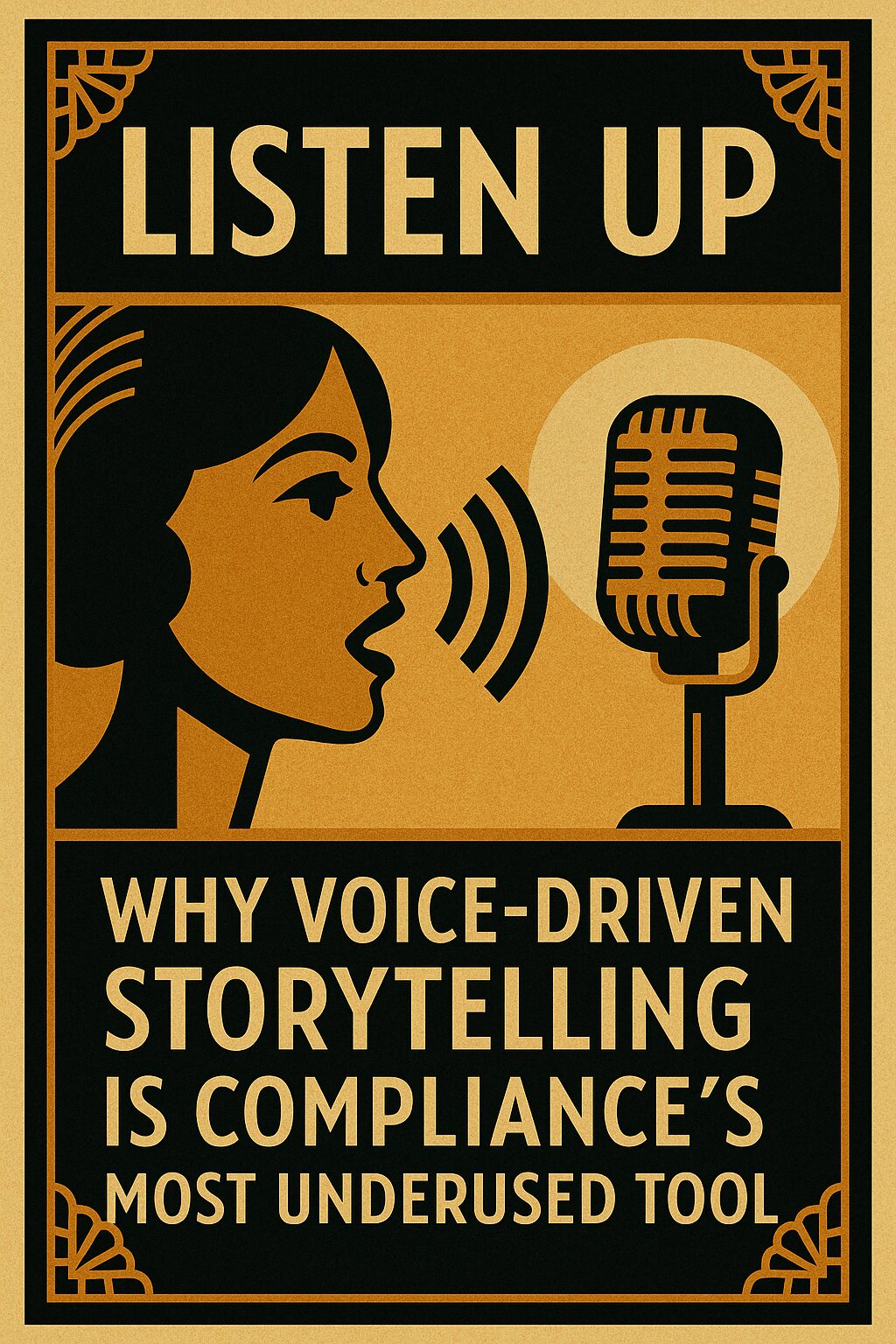
In the modern corporate environment, we face a paradox: we have never had more tools to communicate, yet employees have never felt more overwhelmed by the sheer volume of communication. Emails drown in inboxes. Slide decks gather dust. Policy updates are skimmed at best and ignored at worst. For compliance officers trying to connect with a global workforce, the problem is not merely volume; rather, it is attention, trust, and retention.
That is where audio communications comes into play. Increasingly, forward-leaning companies are turning to voice-driven communication, which includes short audio messages, internal podcasts, andnarrative voice notes, as a powerful way to reach employees where they are. And if you’re not already leveraging the human voice as part of your compliance toolkit, you are missing a deeply effective channel hiding in plain sight.
Because voice is not just another medium; voice is human. Voice conveys credibility, vulnerability, and intention. Voice cuts through noise in ways no written communication can match. And for compliance programs striving to build cultures of ethics and accountability, that authenticity is invaluable.
This makes it an ideal tool for compliance professionals to use in their communications. You can use it in long-form podcasts or short, bite-sized espresso shots of compliance.
Why Voice Still Wins in a Digitized World
Every compliance officer knows that trust is the currency of influence. Trust is built not only through facts but also through perceived sincerity. When employees hear a leader’s voice, it isunpolished, direct, andunfiltered. Corporate employees react differently when listening to a sanitized corporate memo than when reading it.
Tone becomes a tool. Cadence becomes emphasized. A pause invites reflection. A shift in pitch signals seriousness or warmth. These cues are often overlooked in text but are essential when navigating complex ethical issues, gray areas, and behavioral expectations. Voice also supports what I call the narrative advantage. Humans remember stories far better than bullet points. An audio message with a real-world dilemma—“Let me tell you about a call I got last Friday…”—lands with more impact than a list of rules ever will. For compliance, where the goal is not mere knowledge but behavioral change, this is rocket fuel.
Five High-Impact Voice Formats for Compliance Leaders
You do not need an internal studio or a communications team to use voice effectively. You need structure, intention, and consistency. Here are five proven formats I encourage compliance professionals to adopt:
1. Two-Minute Ethics Drops
A weekly, two-minute audio memo from the CCO or another senior leader can reshape how employees perceive compliance. These are not policy recitations. They are reminders, insights, or reflections on real events, brief enough to consume during a commute, meaningful enough to spark thought. Imagine this as the compliance equivalent of a coach’s pre-game talk.
2. Manager Voice Notes
Compliance does not scale unless managers become compliance multipliers. Provide managers with scripts or talking points, and then ask them to record brief voice notes for their teams. Local leaders speaking in their own words create a sense of intimacy and authenticity. People listen differently when the speaker is their direct leader, rather than a representative from headquarters.
3. Decision Diaries
These short, story-based audio segments illustrate how hard decisions are made inside the organization. They highlight the tension between competing priorities—sales versus safety, growth versus due diligence, and speed versus accuracy—and guide employees through the reasoning process. Employees learn not only what decision was made, but also why it was made.
4. Speak-Up Spotlights
One of the most underutilized voice tools is the anonymized “speak-up journey” segment. These episodes take listeners inside the lifecycle of a report without revealing identities. This builds trust in the system, demystifies investigations, and demonstrates action. It is one of the fastest ways to strengthen your speak-up culture.
5. The Board-Level Fireside
A quarterly voice conversation between the CCO and board chair (or audit committee lead) is incredibly powerful. Hearing the board speak directly to employees about ethics and risk sends a crystal-clear message: this topic matters at the highest levels. This is tone-from-the-top in its purest form.
How to Craft Voice Messages That Actually Land
There is an art and a discipline to creating voice content that resonates and drives behavior. Based on what I’ve seen across leading compliance programs worldwide, here are the five principles that matter most.
Lead with humanity, not rules.
Start with a lived moment or recognizable scenario. “I got a call last week that stopped me cold…” is a more effective opening than “According to Policy 3.4.”
Use language meant for the ear.
Short sentences. Natural phrasing. Conversational tone. You are having a hallway conversation, not reading a legal memo.
Deliver one idea per recording.
If your message attempts to cover five policies, employees will remember none of them. Focus on a single behavior change or risk awareness point.
Tie every story to a specific action.
Compliance storytelling without a call to action is entertainment. You want transformation.
Examples:
“If you see a third party offering to ‘open doors,’ log it today.”
“If a customer requests data access, use the Data Transfer Checklist before responding.”
Close with a choice
End with clarity: “If X happens, do Y by Z.” Employees appreciate explicit guidance. Regulators notice it too.
Measuring Impact: Voice Is Still Data
Even though voice feels personal and human-centered, it does not escape measurement. In fact, the metrics are straightforward and incredibly useful:
Reach—How many employees pressed play?
Completion—Do people listen past the first minute?
Reflections—Capture a one-question pulse: “What would you do now? ”
Action proxies—Did advisory requests or help tickets increase after the episode?
When we combine voice with smart analytics, we get a clear picture of engagement and behavioral shifts. This turns compliance storytelling into compliance intelligence.
Governance, Structure, and Safety
Voice communication must be treated like any other formal compliance communication channel. That means:
Pre-clearance of scripts with Legal and HR
Transcripts stored in your compliance file system
Tagging episodes to policy numbers and risk areas
Version control
Localization using local leaders, not HQ dubbing
Done right, voice enhances governance. Done poorly, it creates unnecessary risk. The good news? A solid process solves that problem.
The Fastest Path to Launch: A Ready-Made Starter Kit
If you want to bring voice storytelling into your program quickly, here’s a simple template:
Series title:Choices We Make
Cadence: Weekly, two minutes
Structure:
Hook (10 sec)
Context (30 sec)
Dilemma (30 sec)
Decision (30 sec)
Outcome (20 sec)
Call to action (20 sec)
Three great starter topics for your first episodes:
A conflict of interest dilemma
A third-party red flag escalation
A speak-up report that led to a positive safety change
This is the simplest, fastest, and lowest-cost compliance communication upgrade you can implement.
Closing Thoughts: The Future of Compliance Is Human
We talk endlessly about systems, controls, and technology, and all of those matter. However, at the end of the day, compliance remains a human discipline. It relies on trust, judgment, empathy, and courage—written policies guide. Training informs. If you want your workforce to act with integrity when no one is watching, they need to hear your voice when it matters. Now is the moment to step behind the microphone. Audio connects, but more importantly, voice connects.
Welcome to the Daily Compliance News. Each day, Tom Fox, the Voice of Compliance brings to you compliance related stories to start your day. Sit back, enjoy a cup of morning coffee and listen in to the Daily Compliance News. All, from the Compliance Podcast Network. Each day we consider four stories from the business world, compliance, ethics, risk management, leadership or general interest for the compliance professional.
Yet another corruption scandal shakes Ukraine. (ABCNews)
Welcome to #AITodayin5, the newest addition to the Compliance Podcast Network. Each day, Tom Fox will bring you 5 stories about AI to start your day. Sit back, enjoy a cup of morning coffee, and listen in to AI Today In 5. All, from the Compliance Podcast Network. Each day, we consider four stories from the business world, compliance, ethics, risk management, leadership, or general interest related to AI.
Remember when things were a ‘cool $1 million’; now they’re $50 billion. (Bloomberg)
The AI song is topping the chart in C&W. (ABCNews)
For more information on the use of AI in Compliance programs, my new book, Upping Your Game, is available. You can purchase a copy of the book on Amazon.com.
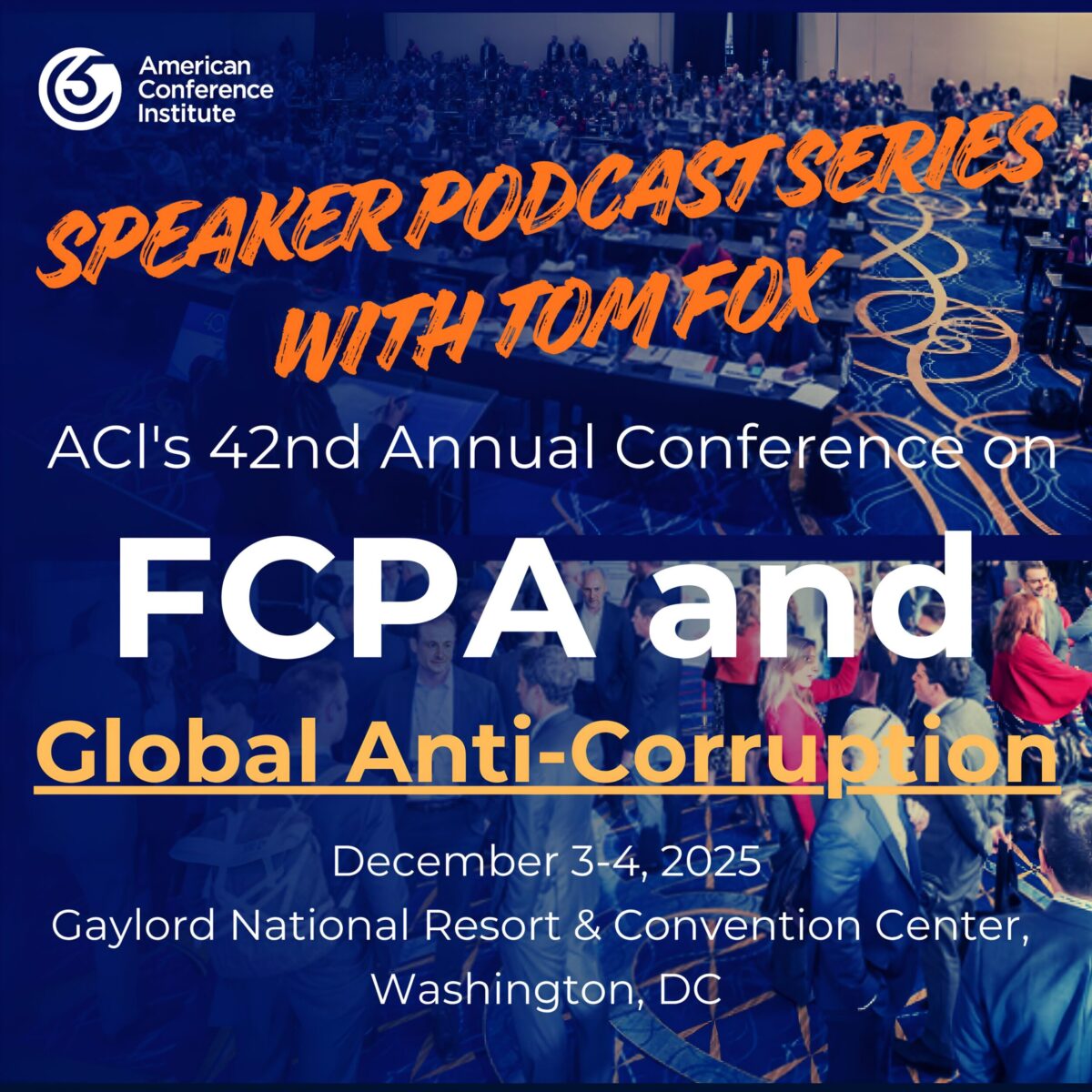
In this episode of the ACI-FCPA and Global Anti-Corruption Conference Speaker Podcasts series, Bryan Judice discusses his presentation at ACI’s Forum on AI and Data Analytics for Anti-Corruption Compliance, which will be held on Tuesday, December 2.
Some of the issues the panel will discuss are:
Agentic AI tools for fraud risk management;
The increased importance of data analytics in fraud prevention.
Cutting-edge AI strategies for fraud risk management into 2026 and beyond.
I hope you can join me at the ACI–FCPA Conference. This year’s event will take place on December 3-4 at the Gaylord National Resort & Convention Center in National Harbor, Maryland, near Washington, D.C. The lineup of this year’s event is simply first-rate, featuring some of the top FCPA professionals, white-collar attorneys, and compliance practitioners in the field.
The 2025 program is being completely redesigned to help your organization stay agile, responsive, and ahead of the curve. Expect a dynamic agenda shaped by real-world priorities, practical takeaways, and the most cutting-edge thinking in compliance—led by a faculty of global practitioners with boots on the ground, encountering the very risks that come across your desk.
Please join me at the event. For information on the event, click here. Listeners of this podcast will receive a discount by using the code D10-999-CPN26.
Welcome to “Compliance Tip of the Day,” the podcast that brings you daily insights and practical advice on navigating the ever-evolving landscape of compliance and regulatory requirements. Whether you’re a seasoned compliance professional or just starting your journey, our goal is to provide you with concise, actionable tips to help you stay ahead in your compliance efforts. Join us as we explore the latest industry trends, share best practices, and demystify complex compliance issues to keep your organization on the right side of the law. Tune in daily for your dose of compliance wisdom, and let’s make compliance a little less daunting, one tip at a time.
We continue our week of fun in compliance by looking at how Winnie the Pooh and his friends inform your compliance program. Today, we consider Piglet and how the role of the CFO informs your compliance program.
For more information on this topic, refer to The Compliance Handbook: A Guide to Operationalizing Your Compliance Program, 6th edition, recently released by LexisNexis. It is available here.
Mike & Brent draw inspiration from the current Broadway run of Waiting for Godot starring Keanu Reeves and Alex Winter to suggest some first principles of risk-based export controls compliance to trade compliance teams. They discuss the futility of the oft-reported sentiment in the trade compliance press of wanting more or clearer guidance from the U.S. government about export controls risk management is not necessary, because the guidance is already here and the “high probability” standard offers a path forward (01:03); how the “high probability” standard and a return to anti-diversion first principles is a way to avoid a repeat of the compliance whipsaw effect occasioned by the announcement, then suspension, of the Affiliates Rule (a/k/a the 50% Rule) (03:47); how an example of this is focusing on your compliance and enforcement risks under General Prohibition 10 and the inchoate provisions of U.S. export controls (07:10); how neither the Affiliates Rule’s adoption nor its suspension changed GP10 or the other anti-diversion regulations under U.S. export controls (12:03); why efforts to comply with the Affiliates Rule were not wasted (14:23); how to deal with and overcome “compliance fatigue” in organizations (16:04); Brent’s latest NYU PCCE post (17:59); and why there was an over-focus on item-based classifications relative to knowledge-based end-use and end-user catch-all provisions and GP10 (19:17).
They then conclude with a righteous installment of Brent Carlson’s “Managing Up” (21:36).
Resources:
“Waiting for Godot,” starring Keanu Reeves and Alex Winter, is currently playing at the Hudson Theater in New York City until January 4, 2026. For tickets, visit here.
If there is one thing the State of Business Podcasting 2025 report makes clear, it is this: the age of guesswork in podcasting is over. Today’s top-performing business shows are not just creating content. They are also building brands, driving measurable engagement, and aligning podcasting strategy directly with business outcomes.
Produced by One Stone Creative and co-founder Megan Dougherty, this annual study has become the industry benchmark for understanding what separates the hobbyists from the heavy hitters. Each year, Dougherty’s team dissects the top 100 self-identified business podcasts on Apple Podcasts, manually evaluating more than 70 individual data points from cadence and reach to sponsorship, branding, and social media integration.
Now in its fifth edition, the 2025 report paints a vivid picture of a maturing medium; one that is professionalizing fast, integrating with video platforms, and leveraging storytelling, community, and analytics in ways that would make any modern marketer proud.
The Data Story: Consistency, Clarity, and Cadence
One of the most striking metrics this year is churn; nearly 48% of the top 100 business podcasts are new to the list, underscoring just how competitive the landscape has become. To stand out, consistency remains king.
The top business podcasts release episodes at a steady clip:
43% publish weekly
21% go daily, and
20% release twice a week
This cadence is not arbitrary. It is a direct reflection of audience expectations. In an environment where listeners have more choices than ever, frequency builds familiarity and familiarity drives loyalty. But cadence alone is not enough. As Dougherty notes, successful podcasters know why they are publishing. Shows that clearly define their purpose, whether that is audience engagement, relationship building, or thought leadership, all perform better, sustain longer, and attract higher-quality guests.
Blueprints for Business Podcast Success
Megan Dougherty’s Business Podcast Blueprints™ have become the backbone of the report, and in 2025, their influence is undeniable. Among the top 100 business podcasts:
48% are built for Audience Engagement,
36% for Thought Leadership,
10% for Conversion,
4% for Content Flywheel, and
Only 2% for Relationship Building.
This data reveals a fascinating trend. Most companies aren’t starting podcasts simply to “have a podcast.” They’re creating strategic media channels that serve a business function, nurturing communities, accelerating sales cycles, or positioning the brand as an industry authority.
If you’re thinking about launching or retooling your show, start by asking one question: “What do I need my podcast to do for the business?” The blueprint model makes that answer measurable, from downloads and leads to authority and influence.
The Look and Feel of a Winning Business Show
In podcasting, branding is everything, and how you look matters almost as much as how you sound. The report finds that:
70% of top shows feature photos of the host on their cover art,
41% include the host’s name in the show title, and
Blue or teal tones dominate the palette, used by 32% of shows.
In other words, the modern podcast brand has moved away from abstract logos and toward human-centered imagery. Listeners want connection, whether that is a face, a voice, or a story.
Interestingly, 18% of business podcasts now sell merchandise, a clear sign that podcasting has evolved from a marketing tactic to a brand ecosystem. From T-shirts to mugs, the best podcasters are not just producing audio; they are creating communities that listeners want to be part of.
Structure and Storytelling Still Win
While formats vary, the interview remains the dominant show structure used by nearly half of all top business podcasts. But there’s growing experimentation:
13% of shows alternate between solo and interview formats,
Others mix news commentary, co-hosted conversations, and call-in episodes.
Episode length is also stabilizing:
The average episode runs 46 minutes,
The most common length is 60 minutes, and
The shortest episodes come in under 2 minutes, likely as highlight reels or quick insights.
And it is not just about content but about craft. 44% of shows start with a strong hook, and nearly 40% employ highly produced editing styles, signaling a shift toward professional audio production standards. As Dougherty’s data makes clear, the days of “just hitting record” are long gone. The top business shows sound intention because they are intentional.
Monetization and Sponsorship Trends
Monetization models are diversifying rapidly. Among the top 100:
58% are sponsored,
17% offer premium or ad-free versions, and
4% are self-sponsored, using the show to promote the host’s own services or products.
Traditional host-read ads remain powerful, but the real innovation lies in integrated brand partnerships where sponsors become part of the story rather than a break in it. The most common sponsorship placements are pre-roll and mid-roll, and brand visibility often extends across formats, from logos on videos to calls-to-action in show notes and websites. The lesson? The smartest business podcasters treat sponsorship as an extension of content strategy, not a detour from it.
Websites, Show Notes, and SEO: The Quiet Powerhouses
Your podcast website is more than a hub; it is your conversion engine. According to the report:
59% of shows post transcripts,
56% link to Apple Podcasts, and
53% to Spotify from their websites.
Detailed show notes also correlate with higher discoverability and engagement. The most successful formats include:
33% written as 1–2 paragraphs,
26% combining descriptions and bullet points, and
13% published as full blog-style recaps.
Adding guest bios, links to mentioned resources, and related episodes not only improves SEO but alsobuilds credibility and keeps listeners in your ecosystem longer.
The Rise of Video-First Podcasting
Perhaps the most transformative trend in this year’s report is the rise of video-first podcasting.
58% of business podcasts now identify as video-first,
97% maintain YouTube channels, and
90% of those publish full podcast episodes.
That is not simply a visual trend but rather a strategic one. Video platforms amplify discoverability, increase audience retention, and open up entirely new monetization channels.
Among video-first shows:
88% post YouTube Shorts,
87% use playlists, and
45% include chapter markers for easy navigation.
The takeaway? In 2025, audio and video are no longer separate lanes; they are parallel tracks in a unified content strategy.
Social Media: The New Discovery Engine
The State of Business Podcasting 2025 shows that successful podcasters do not just publish; they promote relentlessly.
95% of shows are active on Instagram, with 92% using Reels.
89% maintain LinkedIn pages, the platform of choice for professional storytelling.
86% are on X (formerly Twitter), and
76% leverage TikTok, with 75% repurposing podcast content directly into short-form videos.
What’s remarkable is the consistency of posting:
On Instagram, 56% of shows post daily or multiple times daily,
On LinkedIn, more than 40% post weekly or more often, and
On TikTok, daily posting remains common among the top 25% of shows.
This relentless repurposing turns every podcast into a content multiplier. One recording session can fuel a week of clips, quotes, and thought leadership posts.
Where Podcasting Is Headed in 2025 and Beyond
As Dougherty’s research shows, the business podcasting ecosystem is evolving fast, but its principles remain timeless. Success still depends on clarity of purpose, consistency of output, and the courage to connect authentically with your audience.
The difference now is the data. For the first time, podcasters have a clear benchmark of what excellence looks like: consistent cadence, professional branding, strong production values, and strategic social distribution. Podcasting has moved beyond the microphone; it is now a multi-channel business asset.
If your show is still just “content,” you’re leaving opportunity on the table. But if your podcast is part of your business strategy, designed to engage, educate, and build community, you are right where the top 100 are heading.
Final Thought: From Hobby to Engine
The 2025 State of Business Podcasting report doesn’t just offer insights; it offers a roadmap. Whether you’re a seasoned producer or a business leader exploring podcasting for the first time, the message is clear: “You’re only limited by your imagination.”
Podcasting is not just a communications channel. It is a trust engine. A brand builder. And, as Megan Dougherty reminds us year after year, it is one of the most measurable, adaptable, and human tools in the modern marketing toolkit.