Categories
Compliance Tip of the Day

Compliance Tip of the Day – Embedded Compliance

Welcome to “Compliance Tip of the Day,” the podcast where we bring you daily insights and practical advice on navigating the ever-evolving landscape of compliance and regulatory requirements. Whether you’re a seasoned compliance professional or just starting your journey, we aim to provide bite-sized, actionable tips to help you stay on top of your compliance game. Join us as we explore the latest industry trends, share best practices, and demystify complex compliance issues to keep your organization on the right side of the law. Tune in daily for your dose of compliance wisdom, and let’s make compliance a little less daunting, one tip at a time.

Today, we look at how AI can help deliver a more robust compliance regime directly to business operations through embedded compliance.

For more information on the Ethico Toolkit for Middle Managers, available at no charge, click here.

Categories
Blog

Embedded Compliance in Business Processes: Integrating Compliance into the Workflow

We continue explaining how compliance professionals can ‘up their game’ in this new environment under the Trump Administration. Today, I want to consider “embedded compliance,” which integrates compliance checks and controls directly into business processes rather than treating compliance as a separate, after-the-fact function. Embedded compliance means compliance is built into everyday workflows, providing instant, in-process guidance on regulatory requirements.

Rather than retrofitting compliance controls onto existing systems and processes as an afterthought, organizations should proactively integrate compliance measures into the initial design phase of their operational structures. This approach ensures that compliance is inherently woven into the fabric of everyday operations, significantly reducing the risk of regulatory breaches and costly remediation efforts. For instance, when developing new customer onboarding processes, embedding compliance checks such as Know Your Customer (KYC), consent capture, and identity verification into each operational step can prevent compliance gaps that could lead to significant issues later.

Successful compliance by design necessitates close collaboration among compliance officers and teams from IT, product development, and operations. Forming cross-functional working groups where compliance requirements are translated into technical specifications or user stories ensures compliance is integral from the outset. This proactive collaboration creates robust compliance frameworks and establishes a culture where compliance is seen as a fundamental operational requirement rather than an obstacle.

The Role of API-Driven Solutions in Compliance

In addition to proactive integration, organizations should leverage modern technologies like Application Programming Interfaces (APIs) and automation to enhance compliance processes. Traditional manual compliance procedures, which often involve repetitive and time-consuming tasks such as cross-referencing data entries, spreadsheet maintenance, and generating reports, are inefficient and prone to error. By identifying routine compliance activities that consume significant human resources, organizations can implement automation solutions or APIs to streamline these processes, significantly improving efficiency and accuracy. For example, automating the review of employee travel requests against company policy can flag exceptions for human review, freeing up compliance teams to focus on more strategic initiatives. Compliance professionals should thus cultivate an understanding of these tools and collaborate closely with IT departments to ensure effective integration and optimal utilization of automation technologies.

Quality of Data

The effectiveness of embedded compliance heavily depends on the quality and consistency of the data feeding these systems. Ensuring data accuracy and breaking down data silos is critical to the success of compliance initiatives. AI-driven compliance systems are sensitive to data quality, as inaccuracies or inconsistencies can lead to significant compliance oversights or many false positives, undermining trust in these systems. Compliance professionals must champion data integrity by working closely with data management teams to identify and rectify any data gaps or inconsistencies. Efforts should be directed towards establishing a centralized repository of compliance data—a single source of truth that integrates data from various systems such as CRM, ERP, and trading platforms. This merged approach enhances data quality, facilitates comprehensive compliance monitoring, and ensures robust oversight.

Risk-Based 

When implementing embedded compliance, particularly those AI-driven solutions, organizations should adopt a risk-based approach, initially targeting high-risk areas. Not all processes within an organization carry the same level of compliance risk, making it prudent to prioritize areas with the greatest potential impact or likelihood of regulatory violations. For example, financial reporting or transactions with significant regulatory oversight might warrant immediate and thorough automation of compliance checks. Focusing first on clear, rule-based automation within high-risk domains allows organizations to achieve quick, demonstrable successes. These early wins build organizational confidence in embedded compliance solutions and help secure stakeholder buy-in for broader compliance initiatives. Once effectiveness is established in critical areas, the organization can gradually expand embedded compliance measures to include other processes, potentially incorporating more sophisticated AI models.

Transparency

Transparency and explainability are other essential aspects of embedding compliance, especially when using AI and automated systems. Regulators and stakeholders increasingly require clear explanations of compliance-related decisions, particularly for significant regulatory or financial decisions. Organizations must choose or design compliance systems that offer clear, understandable rationales for their decisions. Favoring rule-based compliance engines or explainable AI models ensures organizations can easily document and justify their compliance processes to regulatory authorities. Maintaining comprehensive documentation on these systems’ logic, rules, thresholds, and periodic performance reviews is critical to building trust and ensuring accountability. Treating automated compliance systems with the same scrutiny as human compliance staff ensures robust oversight and early detection of systematic issues, such as unintended biases or data anomalies.

Embedding compliance into business processes from the outset, leveraging APIs and automation, ensuring data quality, adopting a risk-based approach, and prioritizing transparency and explainability are fundamental strategies for enhancing organizational compliance capabilities. By proactively integrating compliance measures into operational frameworks, organizations can significantly mitigate regulatory risks, streamline operations, and foster a compliance-driven organizational culture. Compliance professionals, therefore, play a pivotal role in orchestrating these initiatives, ensuring continuous improvement and adaptability in an ever-evolving regulatory landscape.

Key Lessons for Compliance Professionals

1. Embed Compliance Proactively into Processes

Compliance should never be an afterthought. Pfizer’s proactive model teaches us the value of embedding compliance from the ground up. Companies can prevent compliance breaches at their source by incorporating compliance checkpoints directly within operational processes—such as patient feedback analysis and adverse event tracking. This proactive stance mitigates risk and streamlines operations by addressing potential issues in real time rather than post-event. Compliance professionals must advocate for integration at the earliest stage of business process design, underscoring that compliance by design significantly reduces risks and enhances operational integrity.

2. Leverage AI and Predictive Analytics

The Pfizer model underscores the importance of utilizing AI and predictive analytics to anticipate compliance issues before they materialize. AI-driven systems enable compliance teams to quickly sift through vast datasets, identifying patterns or anomalies that could signal emerging risks. Compliance officers must familiarize themselves with emerging technologies, ensuring they can effectively collaborate with IT and analytics teams to fine-tune predictive models, thus maximizing compliance effectiveness while efficiently managing resource allocation.

3. Continuous, Real-Time Monitoring

Real-time compliance monitoring is no longer optional; it is a necessity. Pfizer’s continuous monitoring systems allow immediate visibility into compliance status, empowering proactive risk mitigation. Compliance professionals must advocate for adopting real-time systems within their organizations, positioning continuous compliance as essential to operational health. By moving beyond periodic audits toward continuous assurance, compliance teams can maintain a dynamic risk posture, adapting swiftly to regulatory changes and business evolution.

4. Foster a Data-Driven Compliance Culture

Data is foundational to embedded compliance, as Pfizer effectively shows. Ensuring data integrity, eliminating silos, and fostering a culture of data-driven decision-making are crucial. Compliance officers should prioritize creating centralized data repositories and robust governance structures, emphasizing high-quality, accurate data as the backbone of compliance monitoring. Promoting a data-literate culture within the organization ensures that all employees understand their role in maintaining compliance and proactively engaging with compliance measures embedded in their daily tasks.

5. Prepare for Regulatory Collaboration

Pfizer’s proactive approach facilitates transparent and efficient communication with regulators, demonstrating the effectiveness of embedded compliance. Regulatory relationships are shifting toward collaboration and real-time interaction, moving beyond traditional periodic reporting. Compliance professionals should expect this shift and prepare their organizations for real-time data sharing and transparency. Developing standardized reporting mechanisms and maintaining continuous readiness positions organizations to navigate the evolving regulatory landscape effectively, fostering trust and confidence with regulatory bodies.

The Future is Now: Pfizer and Pharmacovigilance

Pfizer, a pharmaceutical giant, faces stringent regulatory requirements for drug safety, quality assurance, and pharmacovigilance governed by entities such as the FDA and EMA. To meet these challenges, Pfizer leverages advanced artificial intelligence (AI) and predictive analytics, integrating compliance into every drug development and monitoring stage. Through predictive models, Pfizer proactively identifies potential compliance risks by analyzing diverse data streams, including clinical trial outcomes, patient feedback, and adverse event reports. This early identification allows Pfizer to intervene proactively, addressing potential safety concerns or regulatory issues before they escalate into significant problems. The embedded compliance approach has enabled Pfizer to achieve a real-time, continuous monitoring system that safeguards patient health and enhances operational efficiency and regulatory adherence. By systematically embedding these AI-driven analytics into their core operational frameworks, Pfizer shows a robust commitment to compliance, excellence, and regulatory transparency.

The Pfizer case study provides a roadmap for embedding compliance into business processes. Compliance professionals who adopt these lessons will enhance their organizations’ regulatory standing and contribute significantly to operational efficiency and strategic business outcomes.

Embedding compliance into business processes from the outset, leveraging APIs and automation, ensuring data quality, adopting a risk-based approach, and prioritizing transparency and explainability are fundamental strategies for enhancing organizational compliance capabilities. By proactively integrating compliance measures into operational frameworks, organizations can significantly mitigate regulatory risks, streamline operations, and foster a compliance-driven organizational culture. Compliance professionals, therefore, play a pivotal role in orchestrating these initiatives, ensuring continuous improvement and adaptability in an ever-evolving regulatory landscape.

By adopting these strategic approaches exemplified by Pfizer’s proactive and predictive compliance practices, organizations can effectively navigate complex regulatory environments, safeguard operational integrity, and achieve sustained business success.

Categories
Daily Compliance News

Daily Compliance News: March 4, 2025, The So It Begins Edition

Welcome to the Daily Compliance News. Each day, Tom Fox, the Voice of Compliance, brings you compliance-related stories to start your day. Sit back, enjoy a cup of morning coffee, and listen in to the Daily Compliance News—all from the Compliance Podcast Network. Each day, we consider four stories from the business world: compliance, ethics, risk management, leadership, or general interest for the compliance professional.

Top stories include:

  • Trump eviscerates CTA. (WSJ)
  • Kroger CEO resigns after Board investigation. (NYT)
  • Students must learn to be the human in the loop. (FT)
  • Trump levies tariffs on Mexico, Canada, and China. Canada and China retaliate. (BBC)

For more information on the Ethico Toolkit for Middle Managers, available at no charge, click here.

Check out the FCPA Survival Guide on Amazon.com.

Categories
SBR - Authors' Podcast

SBR – Authors Podcast – Transforming Corporate Careers: Insights from Scott & Tawnya Landis on Embracing Entrepreneurship

Welcome to the SBR – Authors Podcast! In this episode, host Tom Fox visits with authors in the compliance arena and beyond. Today, Tom is joined by Tawnya & Scott Landis, a husband-and-wife team discussing transforming corporate careers.

Tawnya & Scott Landis, fellow authors, C-suite members, and podcasters, discuss their unique entrepreneurial journey. Starting from corporate roles at GE Capital and Intel, they transitioned into financial services, insurance, and real estate investing. After losing everything in the real estate crash, they found new paths as business coaches, emphasizing the importance of a purpose-filled life. They share key insights on helping corporate professionals overcome fears and leap to entrepreneurship, centering discussions on morning routines, vitality, relationships, freedom, and impact as four essential pillars of fulfillment.

The duo also delves into preventing burnout, the significance of fitness and health in sustaining a thriving career, and strategies to measure and balance life quality alongside business goals. As parents of three and seasoned entrepreneurs, they draw from personal experiences to highlight practical steps for energy management, maintaining robust relationships, and achieving financial and personal freedom. The episode concludes with a glimpse into their European expansion plans and ways to connect with them online.


Key highlights:

  • Transitioning from Corporate to Entrepreneurship
  • The Four Pillars of Fulfillment
  • Avoiding Burnout
  • The Importance of Fitness and Health
  • Expanding the Vision Globally

Resources:

The Awakened Life

Business Freedom Forum

Scott on LinkedIn

Tawnya on LinkedIn

Tawnya on Instagram

Scott on Instagram

Tawnya on Facebook

Awakened Life on Facebook

Business Freedom Forum on Facebook

 Tom Fox

Instagram

Facebook

YouTube

Twitter

LinkedIn

Categories
Innovation in Compliance

Innovation in Compliance – Alyssa Borden on The Power of Strategic People Processes in Organizations

Innovation comes in many forms, and compliance professionals need to be ready for and embrace it. Join Tom Fox, the Voice of Compliance, as he visits with top innovative minds, thinkers, and creators in the award-winning Innovation in Compliance podcast. In this episode, host Tom Fox welcomes Alyssa Borden, founder of SuccessBridge, LLC.

Alyssa founded SuccessBridge, LLC, to offer tailored solutions that bridge strategic and tactical needs for diverse organizations. Her approach is centered on understanding each client’s unique situation and embedding herself with their teams to ensure that the solutions provided are both effective and sustainable. Alyssa views every challenge as an opportunity for growth, emphasizing the importance of effective communication and collaboration to navigate workplace changes successfully. Through SuccessBridge, LLC, she aims to empower organizations to build strategic people processes and develop digital upskilling programs, thereby driving transformation and fostering continuous improvement and adaptability.

Key highlights:

  • Strategic Team Building Solutions by SuccessBridge
  • Cultural Alignment Through Hiring Touchpoints
  • Navigating Complexities in Workplace Technology Implementation
  • Strategic Flexibility: Navigating Dynamic Organizational Changes
  • Custom Solutions Through Embedded Team Approach

Resources:

Alyssa Borden on LinkedIn

SuccessBridge, LLC 

Tom Fox

Instagram

Facebook

YouTube

Twitter

LinkedIn

Categories
The Ethics Experts

Episode 200 – Andrew McBride

In this episode of The Ethics Experts, Nick and Gio welcome Andrew McBride.

Andrew McBride is the CEO of Integrity Bridge LLC, a consulting practice that offers strategic and operational compliance support for companies.

Andrew has over 25 years of compliance experience at an international law firm and several multinational companies in the Americas, Europe, and Australasia. In his most recent role as Chief Risk & Compliance Officer at Albemarle Corporation, he built a new ethics and compliance program and recruited a new team against the backdrop of an FCPA investigation. The investigation was resolved through a Non-Prosecution Agreement with the U.S. Department of Justice and a Cease & Desist Order with the U.S. Securities and Exchange Commission. As part of the resolution, Albemarle secured a 45% reduction in penalty due to its cooperation with the investigation and the compliance program built, the largest FCPA % penalty reduction to date. In recognition of these efforts, Albemarle was awarded Compliance Program of the Year by Compliance Week in May 2024.

In parallel to the FCPA investigation and business ethics efforts, Andrew played a key role in supporting Albemarle’s commitment to sustainability, including UN Global Compact membership, management of the company’s human rights framework, and support for the company’s successful efforts to achieve certification against the Initiative of Responsible Mining Assurance (IRMA)’s Mining Standard.

Prior to Albemarle, Andrew was Associate General Counsel Compliance at BHP, Senior Antitrust Counsel at BP, and Managing Associate at Linklaters. Andrew is admitted to practice law in England, Western Australia, and California. He is also a Certified Fraud Examiner.

Categories
Corruption, Crime and Compliance

Ethics and Compliance Trends for 2025

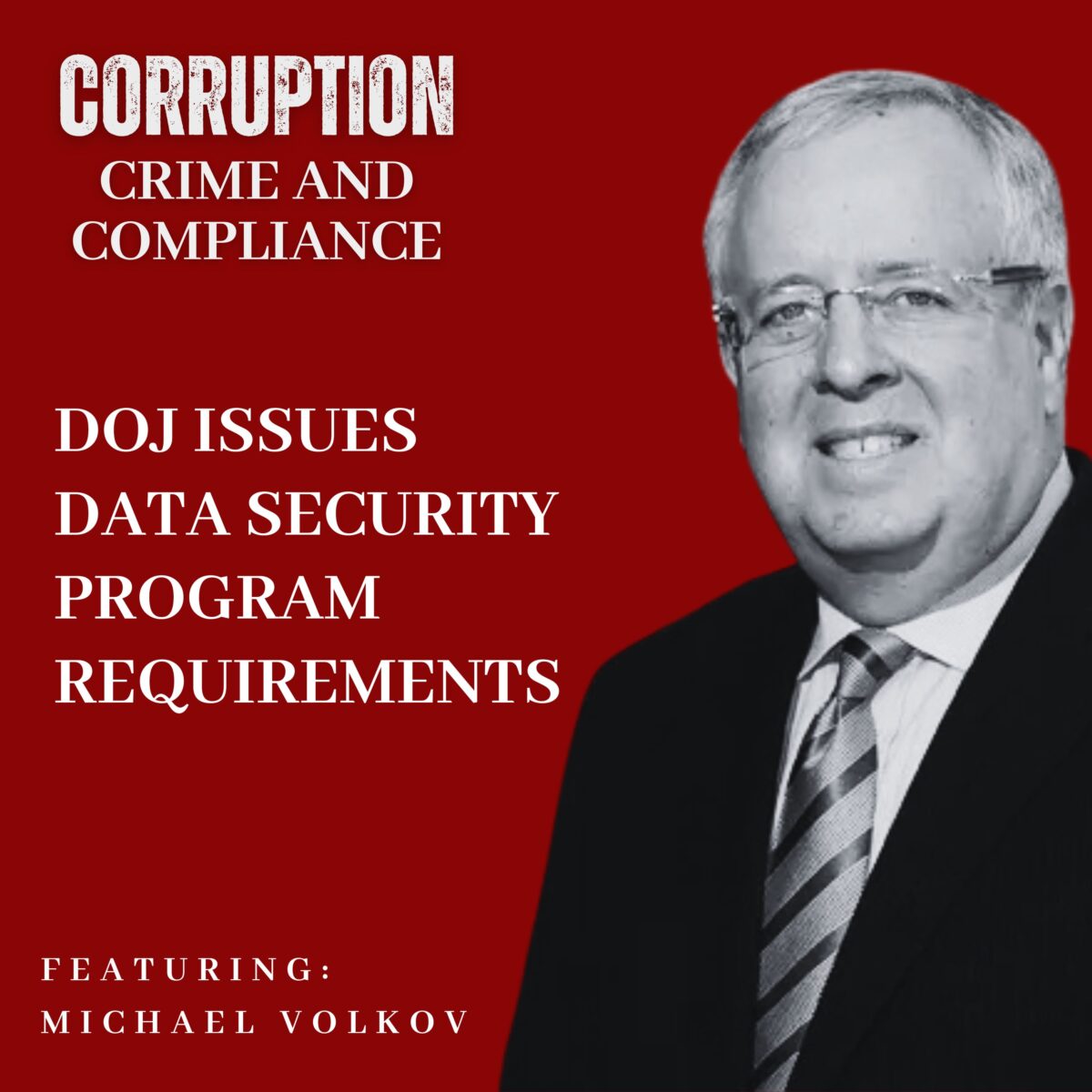
Is your company prepared for the compliance storm ahead? With tariffs shaking global trade, aggressive sanctions enforcement, and new risks from AI, businesses must rethink their strategies. Can your compliance program keep up, or will it be left scrambling? In this episode of Corruption, Crime, and Compliance, Michael Volkov unpacks the rapidly shifting risk landscape facing businesses today. From trade compliance and supply chain disruptions to cybersecurity and government enforcement, he highlights the top legal and compliance challenges of the year and offers practical guidance on how companies can stay ahead. While the regulatory world is in flux, one thing remains certain—organizations that fail to adapt will face significant financial, legal, and reputational consequences.

You’ll hear him discuss:

  • The evolving trade landscape, including tariff enforcement, import risks, and the potential economic fallout of aggressive trade policies
  • Why supply chain mapping is no longer optional, with companies needing to identify vulnerabilities, alternative sourcing strategies, and compliance risks to avoid costly disruptions
  • How businesses should approach the FCPA enforcement pause, what it signals about the government’s priorities, and why global companies remain committed to anti-corruption programs
  • Why compliance teams must elevate import control and export control programs, particularly as the US expands restrictions on advanced computing, AI, and semiconductor exports
  • How transnational criminal organizations are infiltrating legitimate supply chains for money laundering, and what companies must do to strengthen their due diligence efforts
  • The importance of a strong compliance culture in a time of regulatory uncertainty—how companies can remain flexible, proactive, and aligned with their core values despite the shifting landscape

Resources

Michael Volkov on LinkedIn | Twitter

The Volkov Law Group

Categories
Sunday Book Review

Sunday Book Review: March 2, 2025, The Getting Organized Edition

In the Sunday Book Review, Tom Fox considers books that would interest the compliance professional, the business executive, or anyone curious. These could be books about business, compliance, history, leadership, current events, or anything else that might interest Tom. Today, we look at the top books on getting organized.

  1. The Gentle Art of Swedish Death Cleaning: How to Free Yourself and Your Family from a Lifetime of Clutter by Margareta Magnusson
  2. Organizing from the Inside Out, Second Edition: The Foolproof System For Organizing Your Home, Your Office and Your Life by Julie Morgenstern
  3. ADD-Friendly Ways to Organize Your Life: Strategies that Work from an Acclaimed Professional Organizer and a Renowned ADD Clinician by Judith Kolberg and Kathleen Nadeau
  4. How to Keep House While Drowning: A Gentle Approach to Cleaning and Organizing by KC Davis LPC

Resources:

5 Decluttering Books to Bring Order to Chaos. In the NYT

For more information on the Ethico Toolkit for Middle Managers, available at no charge, click here.

Categories
10 For 10

10 For 10: Top Compliance Stories For the Week Ending March 1, 2025

Welcome to 10 For 10, the podcast that brings you the week’s Top 10 compliance stories in one podcast each week. Tom Fox, the Voice of Compliance, brings you the compliance professional and the compliance stories you need to know to end your busy week. Sit back, and in 10 minutes, hear the stories every compliance professional should know from the prior week. Every Saturday, 10 For 10 highlights the most important news, insights, and analysis for the compliance professional, all curated by the Voice of Compliance, Tom Fox. Get your weekly filling of compliance stories with 10 for 10, a podcast produced by the Compliance Podcast Network.

  • Thailand Deports Uyghurs to China. (WSJ)
  • Trump revoked Chevron’s license to do business in Venezuela. (WSJ)
  • CFTC to give credit for self-disclosure. (WSJ)
  • Meta faces a lawsuit for using cheap foreign workers. (Reuters)
  • A More Corrupt World Will Be Bad for America. (Foreign Affairs)
  • 9th Circuit upholds Holmes’s conviction. (Reuters)
  • Coinbase says the SEC will drop the lawsuit. (CNN)
  • Leveling, not raising. (WaPo)
  • A green light for corruption. (FT)
  • AI in 10Ks. (Reuters)
  • Who wants to go back to Russia? (NYT)
  • South Africa’s corruption efforts lag. (Bloomberg)

For more information on the Ethico Toolkit for Middle Managers, available at no charge, click here.

You can check out the Daily Compliance News for four curated compliance and ethics-related stories each day here.

Connect with Tom 

Instagram

Facebook

YouTube

Twitter

LinkedIn

Categories
Compliance Tip of the Day

Compliance Tip of the Day – AI and The Future of Compliance Education

Welcome to “Compliance Tip of the Day,” the podcast where we bring you daily insights and practical advice on navigating the ever-evolving landscape of compliance and regulatory requirements. Whether you’re a seasoned compliance professional or just starting your journey, we aim to provide bite-sized, actionable tips to help you stay on top of your compliance game. Join us as we explore the latest industry trends, share best practices, and demystify complex compliance issues to keep your organization on the right side of the law. Tune in daily for your dose of compliance wisdom, and let’s make compliance a little less daunting, one tip at a time.

Today, we look at how AI can deliver the right compliance knowledge at the right time, when employees need it, to prevent violations before they occur.

For more information on the Ethico Toolkit for Middle Managers, available at no charge, click here.