Categories
The Ethics Experts

Episode 141 – Wade Chumney


In this episode of The Ethics Experts, Nick welcomes Wade Chumney. Wade is an associate professor of Business Ethics and Law at California State University, Northridge and author of, Conscious Business Ethics: The Practical Guide to Wisdom. He joined the David Nazarian College of Business and Economics in August 2014. Prior to that he was employed at Georgia Tech as the Cecil B. Day Assistant Professor of Business Ethics and Law in the Scheller College of Business since 2009. He was previously an assistant professor at Belmont University in Nashville, Tennessee, and a visiting lecturer at the University of Applied Sciences in Wiener Neustadt, Austria. Professor Chumney also spent five years in private practice before embarking on an academic career.
Website: Wadechumney.com
CSUN Professor website: https://www.csun.edu/blaw/wade-chumney
LinkedIn: https://www.linkedin.com/in/wadechumney/
Twitter: https://twitter.com/icomecorrect

Categories
Corruption, Crime and Compliance

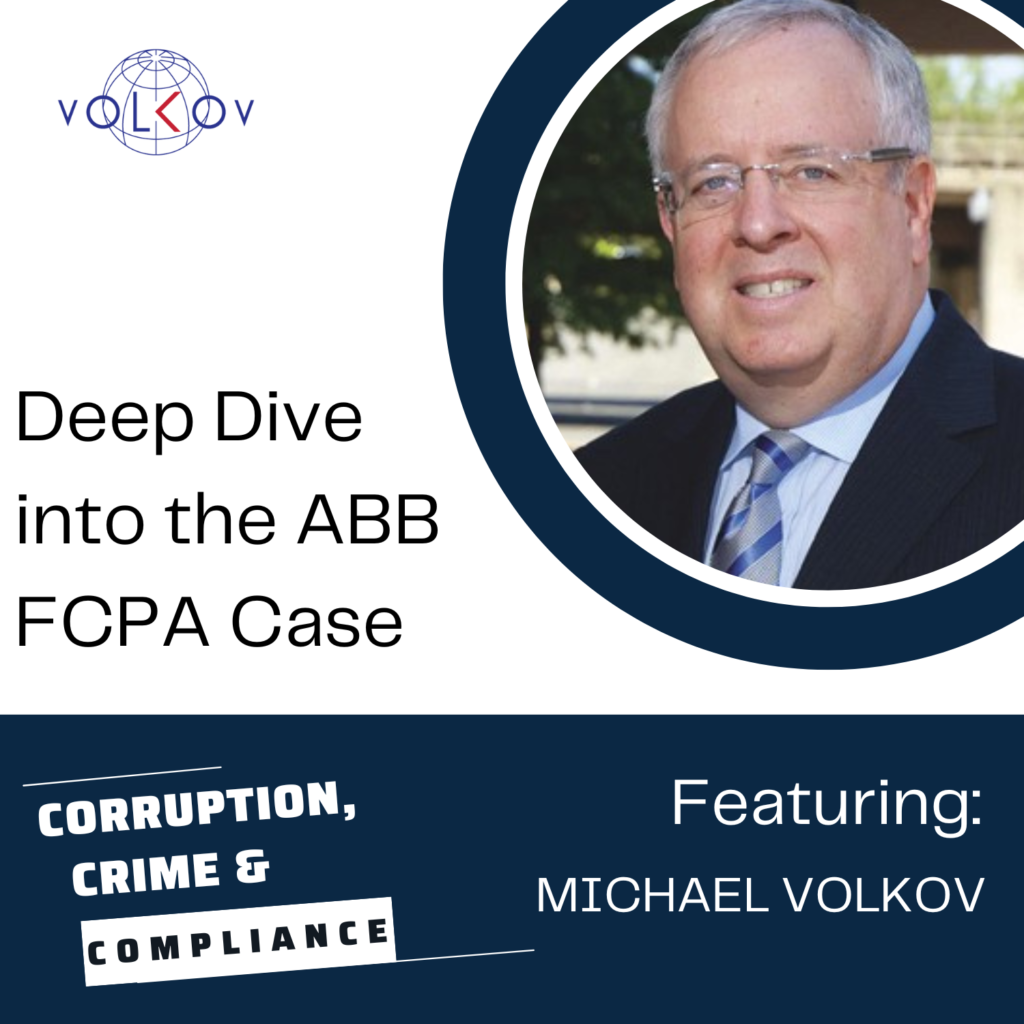
Deep Dive into the ABB FCPA Case

ABB is a three-time loser in foreign bribery enforcement but still agreed to pay $315 million to settle FCPA charges. The company also resolved SEC charges for $75 million.

ABB’s criminal history includes bid rigging and bribery violations in multiple countries. However, the DOJ cited ABB’s extraordinary cooperation and extensive remediation when they announced the settlement. In this week’s show, Michael Volkov explores ABB’s history of FCPA violations leading up to their most recent.


  • ABB paid a settlement of $315,000,000 for its extensive criminal history record, including multiple violations of the Foreign Corrupt Practices Act and a prior conviction for price fixing. The settlement raised questions about the effectiveness of the Justice Department’s new FCPA enforcement program, which is designed to prevent benefits for recidivists.
  • The case involved two ABB subsidiaries in South Africa and Switzerland, and the parent company agreed to a three-year deferred prosecution agreement. The company also resolved SEC charges for $75 million and faced foreign prosecutions in South Africa, Switzerland, and Germany.
  • ABB was also involved in a bribery scheme between 2014 and 2017 to obtain confidential information and win lucrative contracts with South Korea’s state-owned energy company, ESCOM Holdings. They engaged multiple subcontractors who were linked to a high-ranking ESCOM official and made payments to these subcontractors despite their poor qualifications and lack of experience. In exchange for these bribery payments, ABB secured improper confidential information needed for bidding and securing valuable contracts.
  • ABB established a relationship with an additional subcontractor. This subcontractor failed various portions of the ABB due diligence process, including its financial stability and qualifications. ABB required a specific waiver of due diligence requirements to be approved, which they did. On its face, the approval of a waiver creates significant red flags. 
  • ABB took important first steps in learning about the potential violation by immediately scheduling a meeting with the DOJ and committing to change. However, the settlement papers did not give any detail as to what made ABB’s cooperation extraordinary.


KEY QUOTE

“For companies that have to decide whether to disclose and may hesitate because of their criminal histories, the answer now is fairly clear that it is a better idea in many cases to voluntarily disclose, remediate and cooperate.” – Michael Volkov.


Resources

ABB Agrees to Pay Over $315 Million to Resolve Coordinated Global Foreign Bribery Case | OPA | Department of Justice

ABB Settles SEC Charges That It Engaged in Bribery Scheme in South Africa 

Email Michael: mvolkov@volkovlaw.com

Categories
All Things Investigations

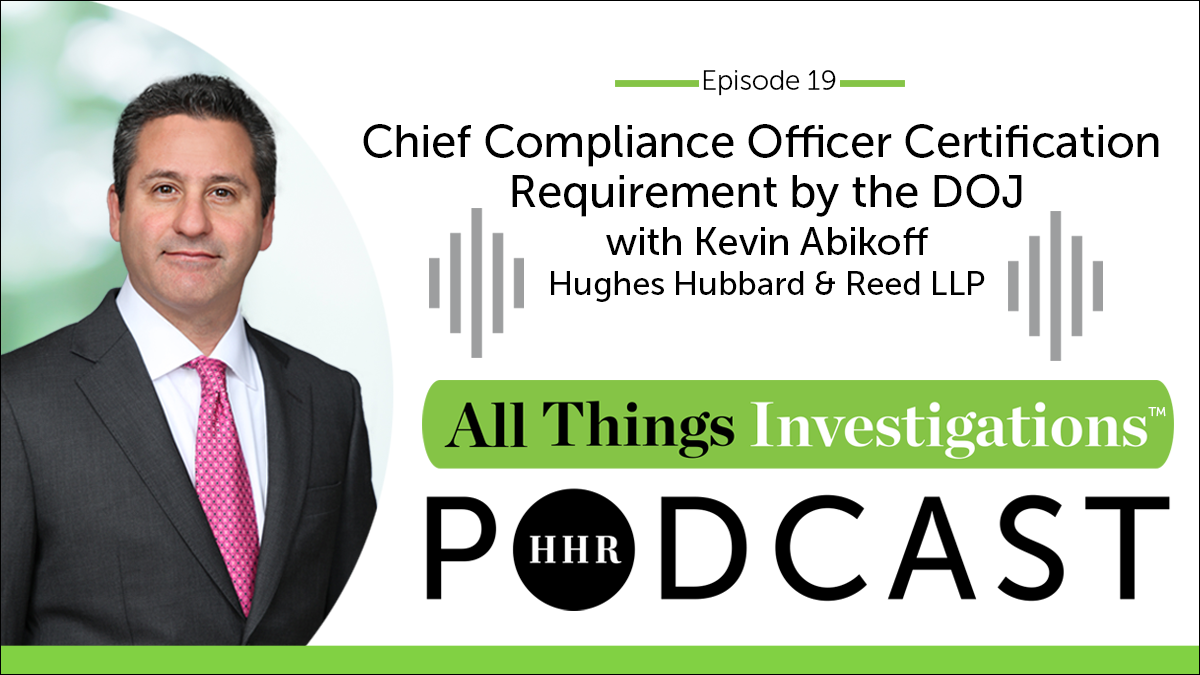
All Things Investigations: Episode 19 – Chief Compliance Officer Certification Requirement with Kevin Abikoff

Welcome to the Hughes Hubbard Anti-Corruption and Internal Investigations Practice Group’s Podcast, All Things Investigations. In this podcast, host Tom Fox and returning guest Kevin Abikoff of the Hughes Hubbard Anti-Corruption & Internal Investigations Practice Group, highlight some of the key legal issues in white collar investigations, locally and internationally.

Kevin Abikoff is partner and Deputy Chair at Hughes Hubbard, and Chairman of the firm’s Anti-Corruption & Internal Investigations Practice Group. He specializes in securities and white-collar criminal litigation, enforcement, regulation and counseling with an emphasis on the representation of entities in anti-corruption (including FCPA) matters.

Key ideas we discuss in this podcast:

  • The DOJ has instituted a new requirement for CCOs to certify that their programs are “reasonably designed” to detect and prevent violations of the law.
  • The potential for liability as a CCO.
  • How this new requirement may pressure CCOs to go beyond their usual duties in order to make the certification.
  • Corporate governance as a remediation of the CCO certification requirement.
  • The board of directors should be responsible for overseeing corporate compliance programs, rather than just nominally doing so.
  • The DOJ listens to commentators and evolves in their own thinking.

KEY QUOTE
“Part of the narrative [for CCO certification] is that it gives CCOs a seat at the table. If you don’t have a seat at the table after you’ve gone through a FCPA enforcement action, I think there are bigger problems.” – Kevin Abikoff

Resources

Hughes Hubbard & Reed website 

Kevin Abikoff on LinkedIn

Categories
The ESG Report

Data Privacy and ESG with Dan Frechtling

Tom’s guest in this episode of the ESG Report is Dan Frechtling of Boltive, a company that helps keep the Internet safe from invasive media and enforces data privacy. Data privacy and cybersecurity are ESG issues because they are significant drivers of business risk and a growing concern among investors and CEOs. The public costs of poor corporate cybersecurity management are increasingly viewed as market failures.

Dan is the CEO of Boltive. His career began as a marketer, and he has spent years learning the power of marketing. Having experienced a significant event that changed his perspective about hyper-targeting and information sharing, he transitioned to cybersecurity where he learned about data privacy issues. 


Here are some key points Dan and Tom talk about:

  • Dan talks about his professional journey and background and his role at Boltive.
  • Dan defines invasive media and describes the protection his company provides against it. 
  • Dale explains how Boltive’s solution for invasive media protects the audience from malware, redirects, and other malicious behaviors, by replacing them with revenue-generating ads.
  • Compliance with terms of service and user experience is key in order for these solutions to work, Dan tells Tom.
  • In cybersecurity, the intermediaries and third parties are often creating noncompliant and bad user experiences. Boltive solves this by creating a synthetic user experience so each step is recorded and traceable to see what went wrong.
  • Knowing and identifying if your inventory is sensitive and understanding the flow of data makes complying with ever-changing privacy regulations easier. 
  • Dan explains why the digital ad ecosystem is so convoluted and the potentially harmful effects on customers.
  • Dane highlights some of the compliance issues with online marketing. 
  • GDPR is the gold standard when it comes to privacy and data protection, but state laws should also be followed when they are more stringent than GDPR.


KEY QUOTE:

“Invasive advertising can really be many different forms and we see our role to protect brands and publishers and technology platforms so those ads don’t get inadvertently served, because the world of programmatic advertising is very lawless and algorithm-driven.” – Dan Frechtling


Resources 

Dan Frechtling LinkedIn | Twitter 

Boltive

Categories
FCPA Compliance Report

Tom Fox and Mike Volkov with the 2022 Year in Review for the FCPA, Part 2

Welcome to the award-winning FCPA Compliance Report, the longest-running podcast in compliance. In this special episode, I am joined by Mike Volkov, founder of the Volkov Law Group. We conclude with Part 2, looking back on the year 2022 in FCPA and Compliance. We consider the Monaco Memo, the key cases, and some of the important issues which arose in 2022 and how they might impact compliance in 2023.

In this episode, we consider the following:

·      Building trust and credibility in the investigative process

·      The ABB FCPA enforcement action

·      The Honeywell FCPA enforcement action

·      Why the heat is on compliance after the Monaco Memo

·      Corporate incentives and discipline, including clawbacks

·      The Glencore FCPA enforcement action and CCO Certification

Resources

Mike Volkov on LinkedIn

The Volkov Law Group

Categories
Daily Compliance News

January 23, 2023 – The Do As I Do, Not as I Say Edition

Welcome to the Daily Compliance News. Each day, Tom Fox, the Voice of Compliance, brings you compliance-related stories to start your day. Sit back, enjoy a cup of morning coffee and listen to the Daily Compliance News. All from the Compliance Podcast Network. Each day we consider four stories from the business world, compliance, ethics, risk management, leadership, or general interest for the compliance professional.

Stories we are following in today’s edition of Daily Compliance News:

  • Middle East corruption is pervasive. (National Review)
  • Amazon is under additional investigation. (WSJ)
  • Musk’s new defense is ‘do as I do, not as I say.’ (Reuters)
  • Ukraine MoD denies corruption. (Barron’s)
Categories
Blog

Operationalizing Compliance: Part 1 – Compliance Program Effectiveness

Welcome to a special five-part podcast series on Operationalizing Your Compliance Program, sponsored by Broadcat LLC. Over this series, I visit with Jennifer May, Director of Compliance Advisory; Taylor Edwards,  Director of Sales; Xinia Pirkey, Design Manager; Alex Klingelberger, Chief Executive Officer (CEO) and Jaycee Dempsey, Director of Customer Success. We consider a variety of ways to more fully operationalize your compliance regime, including the design and effectiveness of your communications, why the operationalization of compliance is a team sport, why simply data is not the answer and how to avoid being overwhelmed. In Part 1, I am joined by Jennifer May to consider what is compliance program effectiveness.

We began with one of the most well-worn words in compliance that still challenges compliance professionals, that being ‘effectiveness’. May said that it is not about getting a hundred percent completion on some sort of training module, which unfortunately in many ways has become the benchmark or the metric used. Instead, it is about getting information to individuals so you can get the right outcomes. Effectiveness is not represented by clicks but rather it is about outcomes.

You should start by identifying your highest risk activities. Begin by asking questions, which might include “Are you having good (or bad) outcomes when it comes to those risky activities? And if you’re not, why are you not? Do your employees understand what it is that they are supposed to be doing and when they are supposed to be doing it? What are those behaviors and the outcomes that we want to change or need to change to get to the appropriate outcomes?”

By asking such questions and delivering training and communications on those topics and areas, you begin to see a shift in people. It is not about a click; the result is compliant behavior. Shifting the focus and conversation to what those outcomes are allows you to start thinking about training in a different way and you can start to see how effectiveness can begin to be impacted by solid training that focuses on outcomes.

May analogized it to a closed-book or open-book test. She does not believe employees should think of compliance as a “closed-book test.” Compliant behavior is not something that you should keep behind a curtain. Your information should be out there and available to any employee who needs it in the moment that they need it. If there is a risk to manage; that is when they will need it. But if your employees need such information “the next time and the next time, and every time subsequent to that, then that’s okay too. There’s no reason why keeping that compliance information hidden or keeping it locked away and making them remember it is going to make them more effective or, more appropriately, compliant in their behaviors. Providing that information upfront and always when they need it, is really the key.”

Obviously, compliance folks cannot be everywhere all at once. Your compliance function may be a single person or a small team. Further, they cannot morph themselves into covering every single risk and every single moment of the organization every time. That is why the closed-book test does not do them any good as they cannot “be standing over someone’s shoulder every time talking about why then need to do something, what they need to do and how they need to do it.” Keep an open book approach and make compliance information openly available whenever employees need it.

We concluded with a few thoughts on credibility for your compliance program, which May believes is a very important concept for compliance. and had an interesting take on that issue. She said that credibility “honors employees as professionals in the work that they are doing.” This ties into “being open about the resources that are available, encouraging them to use them, encouraging them to find them, and perhaps, most importantly, encouraging them to reach out when they have a question.” May sees all this as a part of that credibility. This leads to engagement on a level which is about what they do and demonstrating that you, as the compliance professional, are there to support them.

Join us in Part 2 where we look at program design.

Resources

For more information, check out Broadcat here.

Categories
31 Days to More Effective Compliance Programs

Day 22 – Internal Reporting and Triaging Claims

The call, email, or tip comes into your office; an employee reports suspicious activity across the globe. That activity might well turn into an FCPA issue for your company. As the CCO, it will be up to you to begin the process, which will determine, in many instances, how the company will respond going forward. This is more than simply maintaining hotlines. Companies have to make real efforts to listen to employees. You need to have managers trained on handling employee concerns; they must be incentivized to take on this compliance responsibility, and you must devote communications resources to reinforcing the company’s culture and values to create an environment and expectation that managers will raise employee concerns. The Monaco Memo’s emphasis on internally detecting such actions and self-reporting makes this more important.

The reason is that a business’s employees are the company’s best source of information about what is going on in the company. It is certainly a best practice for a company to listen to its employees, particularly to help improve its processes and procedures. But more than listening to its employees, a company should provide a safe and secure route for employees to escalate their concerns. This is the underlying rationale behind an anonymous reporting system within any organization. Both the U.S. Sentencing Guidelines and the Organization of Economic Cooperation and Development (OECD) Good Practices list as one of their components an anonymous reporting mechanism by which employees can report compliance and ethics violations. Of course, the Dodd-Frank Whistleblower provisions also heed the implementation of a hotline.

Given the number of ways that information about violations or potential violations can be communicated to government regulators, a robust triage system is an important way for a company to determine what resources to bring to bear on a compliance problem.

Jonathan Marks has articulated a five-stage triage process that allows for an early assessment of any allegations and a manner to think through your investigative approach. Marks cautions you must have an experienced investigator or other seasoned professional making these determinations, if not a more well-rounded group or committee. Next, consider the types of evidence to review going forward. Finally, before selecting a triage solution, understand what tools are available, including forensic and human, to complete the investigation.

 Three key takeaways:

1. The DOJ and SEC put special emphasis on internal reporting lines.

2. Test your hotline regularly to make sure it is working.

3. Every claim should be triaged before starting an investigation.

Categories
Sunday Book Review

January 22, 2023 – Top Ethics Books To Read in 2023 Edition

In the Sunday Book Review, I consider books that interest the compliance professional, the business executive, or anyone who might be curious. It could be books about business, compliance, history, leadership, current events, or anything else that might interest me. In today’s edition of the Sunday Book Review, we consider some of the top ethics books which every compliance professional should read in 2023:

·       Ethics for Behavior Analysts by Jon Bailey and Mary Burch

·        Stoic Philosophy and the Control Problem of AI Technology: Caught in the Web by Edward Spence

·       The Rise of Business Ethics by Bernard Mees

·        Business Ethics for Better Behavior by Jason Brennan, William English, John Hasnas, and Peter Jaworski

Resource

20 Best New Ethics Books To Read In 2023 by Annemarie Slaughter

Categories
31 Days to More Effective Compliance Programs

Day 21 – Continuous Improvement in a Compliance Program

The 2020 Update was clear about the need for continuous improvement in any compliance program. It succinctly stated, “One hallmark of an effective compliance program is its capacity to improve and evolve. Implementing controls in practice will necessarily reveal areas of risk and potential adjustment. A company’s business changes over time, as do the environments in which it operates, the nature of its customers, the laws that govern its actions, and the applicable industry standards. Accordingly, prosecutors should consider whether the company has engaged in meaningful efforts to review its compliance program and ensure it is not stale.”

Continuous improvement through monitoring or similar techniques will help keep your compliance program abreast of any changes in your business model’s compliance risks and allow growth based on new and updated best practices specified by regulators. A compliance program is, in many ways, a continuously evolving organism, just as your company is. It would be best to build a way to keep pace with the market and regulatory changes to have a truly effective anti-corruption compliance program.

 Three key takeaways:

  1. Your compliance program should be continually evolving.
  2. Monitoring and auditing are different yet complimentary tools for continuous improvement.
  3. Cultural assessment and monitoring are also now required as well.