What makes some people so confident and successful, while others struggle and are frustrated? Is it what they do?
Research says it’s the habits they practice, in fact all successful people practice some of the same habits.
In this special Jamming With Jason 3 part series we feature the #fireandearthpodcast where we talk about two of those previously mentioned habits. So listen in to learn how you can start practicing these habits in your life to unlock your limitless potential.
And since this is a series, you will want to listen to all three success habit episodes and share with your friends and family.
Listen in at: http://www.jasonmefford.com/jammingwithjason200/
I’m talking today with Sam Osbourne about how to beat imposter syndrome.
Imposter syndrome is the fear that your own inadequacies (whether real or not) will be exposed to your peers and thus discredit your accomplishments.
Does this sound like you? Well this may sound a bit cliche, but YOU ARE NOT ALONE.
So tune in to todays episode to learn how you can beat imposter syndrome!
Learn more about Sam at: https://samosbourne.com/
Listen in at: http://www.jasonmefford.com/jammingwithjason198/
Mistakes from some of the largest companies in the world on return to the office is costing billions of dollars.
Don’t want to make the same mistakes? Listen to this #JammingwithJason #podcast where I talk with Dr. Gleb Tsipursky about what the result of research from organizations like Harvard, SHRM, Microsoft and others is showing about the reality of bring employees back into the office.
And the numbers are shocking!! You’ll see how much more productive employees are when they work from home, how 50% of employees will look for a new job if they don’t have remote work options, and how ineffective it is to manage people in person versus remotely.
We discuss what employees really want based on the research, cognitive biases leaders continue to make when it comes to returning to the office (some of which are very discriminatory), and how a team led hybrid with some full remote options is quickly becoming the new normal, along with what you need to do to be successful and more productive.
You can get a copy of Gleb’s new book “Returning to the Office and Leading Hybrid and Remote Teams: A Manual on Benchmarking to Best Practices for Competitive Advantage” on Amazon here:
https://www.amazon.com/-/es/Gleb-Tsipursky-ebook/dp/B095J5NNJW/ref=sr_1_1?__mk_es_US=%C3%85M%C3%85%C5%BD%C3%95%C3%91&crid=NIBH8I6FUAAY&dchild=1&keywords=gleb+tsipursky&qid=1626801990&sprefix=gleb+tsi%2Caps%2C188&sr=8-1
Listen in at: http://www.jasonmefford.com/jammingwithjason/
You’ve probably heard the term “mindfulness” but does it have any place in corporate #leadership??
Top organizations all around the world are starting to embrace the concept, so this week I’m talking with Marc Lesser on the #JammingwithJason #podcast.
I met Marc several years ago at the Mindful Workplace Summit in northern California who not only has been studying and practicing mindfulness for decades, but he’s also been the CEO of several companies, so he knows exactly how mindfulness fits into corporate leadership.
And since command and control, dictator style leadership hurts people, organizations, and is dying… wouldn’t you rather learn how to embrace the future of leadership?
Marc Lesser is a speaker, facilitator, workshop leader, and executive coach. He is known for his engaging, experiential presentations that integrate mindfulness and emotional intelligence practices and training. He is the author of 4 books, including Seven Practices of a Mindful Leader: Lessons from Google and a Zen Monastery Kitchen, and CEO of ZBA Associates, an executive development and leadership consulting company.
Marc helped develop the world-renowned Search Inside Yourself (SIY) program within Google – a mindfulness-based emotional intelligence training for leaders which teaches the art of integrating mindfulness, emotional intelligence, and business savvy for creating great corporate cultures and a better world.
He founded and was CEO of 3 companies, and has an MBA degree from New York University. Marc was a resident of the San Francisco Zen Center for 10 years, and director of Tassajara, Zen Mountain Center, the first Zen monastery in the western world. He leads Mill Valley Zen, a weekly meditation group.
Learn more about Marc at: https://marclesser.net/
Listen in at: http://www.jasonmefford.com/jammingwithjason/
In today’s edition of Daily Compliance News:
- Varsity Blues goes to trial. (Reuters)
- Facebook rules apply to all, except when they don’t. (WSJ)
- Biden names privacy expert to FTC. (NYT)
- When does harm to business outweigh rights of whistleblowers? (CorderyCompliance)
Welcome to this special podcast series, Integrity Matters: Culture, Training and Compliance, sponsored by K2 Integrity. This week I visit with Koby Bambilia, Managing Director, and Tina Rampino, Associate Managing Director. Over this series, we will break down corporate culture, compliance training and communications. Topics include breaking down the big picture on culture, espresso shots of training, skills development and regulatory changes, tailored and risked based training and operational aspects of training. In Part 2, I am joined by Tina Rampino who discusses ‘espresso shots’ of training to help facilitate attainable training demands.
We began with the status of compliance training after 18 months of Covid-19. Here Rampino noted, “in the early phase of the pandemic, institutions had to quickly change to a fully virtual working environment. They had to find creative solutions to adapt their training programs in response. All planned instructor-led training was cancelled or transitioned to virtual training.”
But what was the impact of Covid-19 on compliance training plans? She said it varied between each organization but “the delays, rescheduling, and redesigning of mandatory trainings to accommodate the virtual working environment caused a big training load and a heavy training burden for institutions. Many institutions delayed mandatory training as they tried to work through issues as mundane as bandwidth as all employees were now remotely logged in to the same Learning Management Systems at the same time every day.” The bottom line is that many organizations pushed training to the end of the year or into 2021 and competing priorities and demands had to be managed. Moreover, we are now into Q3 2021 and even though the virtual work environment has become routine for compliance professionals, the pressure is on to get back up to speed on all those trainings.
If your organization finds itself in that place, Rampino advised on what she called “an espresso shot” of compliance training which can be both shorter and more concise, but drills down to specific risks relevant to an institution. She went on to relate that she has been involved in creating solutions that can deliver shorter and more tailored training which will result in increased relevance to the employee and have a lighter burden of training hours. Rampino said, “The concept of espresso shot training can assist employees to better manage their workload while keeping up with important issues relevant to their roles. For example, institutions should think creatively on delivery and modality of training content. Not only in an e-learning format: something engaging, cartoons, videos, interactive virtual training.”
I think that every compliance professional strives to find the right balance between training on general awareness topics and shorter, more relevant and practical training opportunities. Unfortunately, compliance training is viewed as a “check the box” activity or worse, something that is dreaded and is usually ineffective. Rampino suggested compliance training incorporates real life scenarios, case studies or simulations to give employees an opportunity to learn in a sand box environment and to practice the skills that they are being taught.
Some of her suggestions include keeping your compliance training segments concise as “shorter, bite-size learning is a trend in training programs.” This means that instead of offering half-day and full-day sessions, break programs into shorter segments of 20 minutes or less, which are easier for participants to absorb – and schedule. Another example is that short cartoons or animated videos can be excellent quarterly reminders. Done properly, they do not feel like an assessment or certainly not a ‘check-the-box’ exercise. The bottom line is that with all training most employees must undergo now and even more so in the continued time of the Covid-19 Delta Variant, espresso shots give people back a lot of time.
K2 Integrity has developed an online training platform and resource center, Dedicated Online Financial Integrity Network (DOLFIN), to help clients with their training requirements and provide more diverse options for training content and modalities. Find out more about DOLFIN here. For more information on K2 Integrity click here.

Mythbusting ESG & FAQs Part 2

Mythbusting ESG & FAQs Part 2
In this second episode of a special two-part series on ESG, CSS’s Regulatory Content Manager, Greg Hotaling and ESG Specialist, Marye Cherry demystify the complicated world of ESG including the latest regulatory developments, the complexity of ESG data, and what ESG actually means for investment managers.
About Our Guest Speakers:

Marye Cherry is the EU Regulatory Counsel and Head of ESG at Compliance Solutions Strategies (CSS). With more than 10 years of legal and compliance experience, Marye specializes in transparency and regulatory reporting issues in the financial services industry, including sensitive industries and ESG. At CSS, Marye focuses on European financial regulations that affect fund managers’ operations worldwide and helps translate those requirements into automated reporting solutions.
Greg Hotaling is a Regulatory Content Manager at CSS, addressing global regulatory matters relevant to the financial industry. Since its inception, Greg has led the regulatory research and content team for CSS’s global Investment Monitoring platform that facilitates compliance with shareholder disclosure and position limit rules around the world
Episode 079 – Matt Elton

In this episode of The Ethics Experts, Nick welcomes Matt Elton, director of international strategy and cybersecurity, data privacy & GRC practitioner, to the show.
The UK’s Office of Financial Sanctions Enforcement issued a guidance on the developing situation in Afghanistan. Listen in as The Kitchen takes a closer look.

Tom Fox is pleased to welcome Stephen Martin, Partner at StoneTurn, to this week’s episode of the ESG Report. Stephen, an expert in ESG CSR, helps clients proactively improve their ESG programs so they can be better corporate citizens. He and Tom discuss the ESG framework he developed with his team, why mission and governance matter, and the exciting future of ESG.
Mission and Governance at the Core
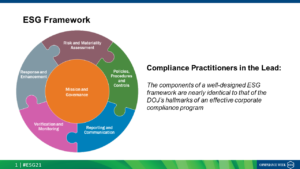
Stephen believes that compliance professionals have the right skillset to help organizations understand their wider responsibility. It’s more than just making money, he emphasizes; it’s about making a positive impact on the communities you serve. Compliance officers can help companies make strategic moves to accomplish this goal. Stephen tells Tom that mission and governance are critical. Your mission – what your company is designed to do – would inform how you build out your ESG program and who you select to oversee it. Governance means that you assign the right people and resources to accomplish your objectives. “Until you define your mission and appropriately resource it,” Stephen points out, “you’re never really going to be effective in moving forward on an ESG program front.”
5 Elements of ESG Framework
Tom asks Stephen to outline the elements of the ESG framework he developed with his team. Stephen responds that the elements are:
- Risk and materiality assessment – what risks and material impact does your ESG initiative pose to the company and stakeholders?
- Policies, procedures, and controls – set these to streamline your processes to accomplish your goals.
- Reporting and communication – to educate internal and external stakeholders on why this is important and what your mission is and how you’re going to execute on it.
- Verification and monitoring – ensuring the data you put out is accurate and that you’re delivering on your mission.
- Response and enhancement – making refinements over time to improve the program.

The Future of ESG
Stephen has seen compliance evolve into the robust infrastructure it is today. Tom asks him what he envisions as the future of ESG. “We’re very much at the early stages of ESG and CSR,” Stephen replies, “but I’m very excited because this is going to be a game-changer on having corporations do more than just make money… You want to have strong economics, you want to have capitalism-driving things. But I think you really can be an organization that cares about the broader areas than just money; and more importantly, the companies that do it the right way, that really embrace this, can really maximize the performance of the entity in all ways.”
Resources
Stephen Martin on LinkedIn | Email
StoneTurn.com