 Today is the 20th anniversary of the attacks upon America on September 11, 2001. Like most Americans, this was the seminal event in the history of our country. I have been thinking a lot about that date and the anniversary; even more so with the fall of Afghanistan and the evacuation from Kabul. I wanted to do something to commemorate this anniversary, so I decided to do a podcast series featuring the personal stories of persons in the compliance field with their thoughts about what the date of 9/11 means to them, how it changed our profession and their thoughts looking back some 20 years later. The lineup for this week has been:
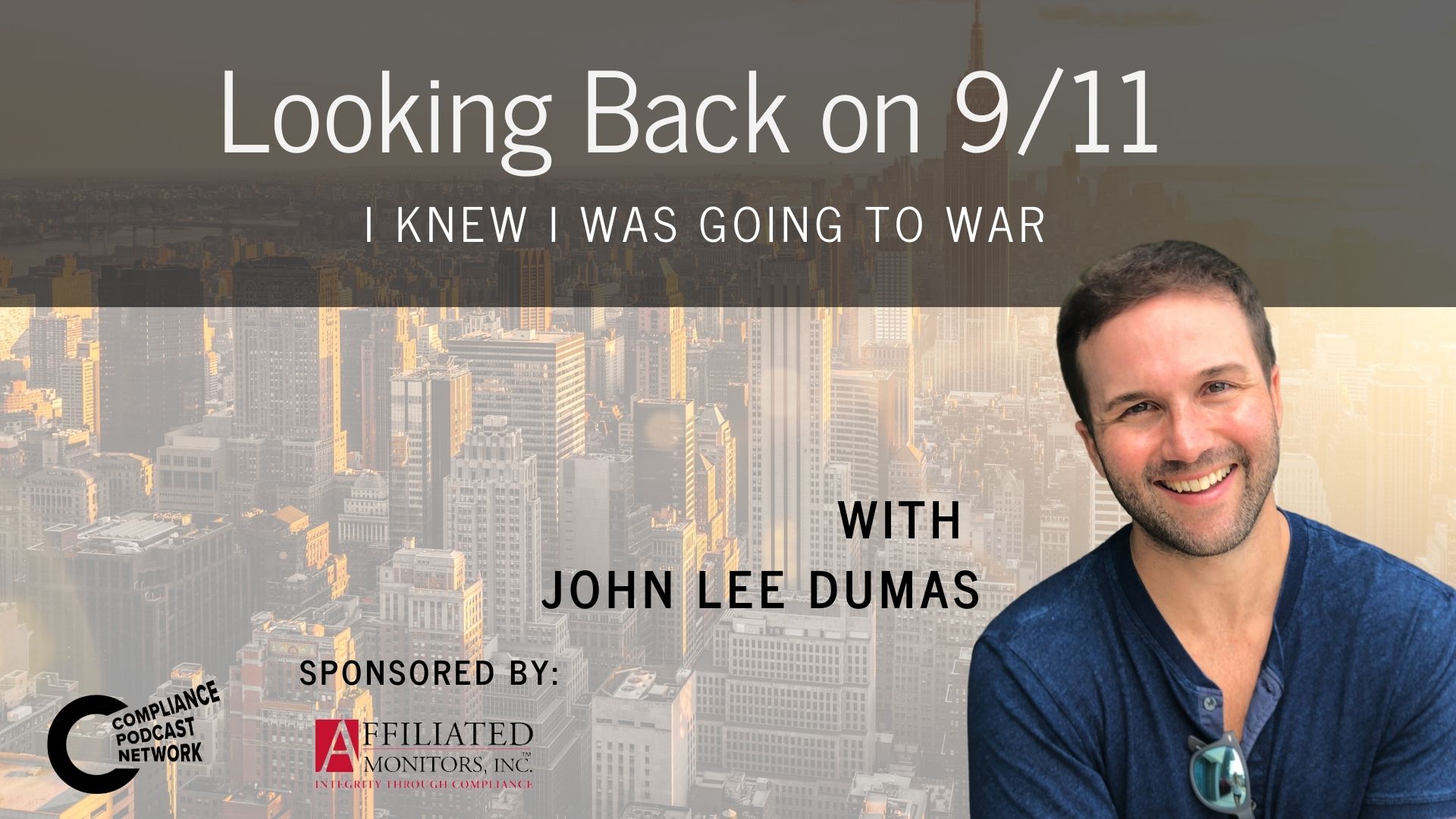
I conclude this series by visiting with John Lee Dumas, host of the uber popular podcast Entrepreneur on Fire. On 9/11 Dumas was a college senior at Providence College. John had one of the most powerful stories I have ever heard around the events of 9/11.
Dumas was also an Officer Candidate in ROTC on 9/11. He said, “I remember I woke up in the morning and one of my roommates said, “Hey, turn the TV on”. We turned on the TV and we just saw the tower smoking. Very shortly after that the collapsing live on the television screen. One of my roommates who was also in ROTC, we looked at each other and we both knew without saying anything that our next four years of active-duty army experience went from being in the peacetime army to looking like we were going to war of some kind. We knew when that tower collapsed that we were going to be playing a very active roles as officers in the US Army. Within a couple hours, we actually had a real world briefing at our ROTC headquarters on campus where the commander of our ROTC battalion, gave us a real-world breakdown. It confirmed what we were thinking when we saw that the tower collapse. We just became officers in the US Army during a time of war.”
We turned to leadership lessons Dumas learned from his time in the Army. He commanded a tank platoon, which was four M1 Abrams tanks and 16 men. Yet, as the tank commander, Dumas was one of the least knowledgeable persons within his own platoon about how a tank worked, the best operations, how to drive a tank, how to load the Sable rounds, how to actually fire the weapon and even how to navigate. He related, “I was the platoon leader at 22 years old and one of the least experienced and least knowledgeable people in my platoon. That’s how the military works. And I learned right at the beginning, I needed to stand upon the shoulders of giants. I needed to go to my Platoon Sergeant, at the time, who seemed like an old man at 37 years old. But it was me, like a little baby.”
Dumas went to Sergeant Walker with humility and humbleness and asked him, “what do I need to know? How can you respectfully in front of the men? How can you respectfully be my mentor?” He really appreciated the fact that “I was not trying to pretend like I knew what I didn’t know and going to him for advice. That was a big lesson. And I’m standing upon the shoulders of giants and learning from those who have been there, done that with experience.””
Another key leadership lesson for Dumas was that “a good decision now is better than a great decision later.” He said that he has seen a lot of people in the entrepreneurship and business world paralyzed, trying to make a great decision. “They are trying to be like General Patton, trying to make the one decision that’s going to win the war.” The problem is that if you “try to wait around and wait while the bullets were flying to make a great decision, you and probably other people are going to die because time is everything. Action is everything. Just coming up with a good decision and implementing it right now, that’s going to be the fraction, that separates life and death for a lot of people, I learned that firsthand and that is something that will always stay with me. I took that lesson from the military and applied it to entrepreneurship. I’m not going to sit around and try to make a great decision on this aspect of my podcast, on that aspect of my business, on this aspect of this, I’m just going to make a good decision take action. And if I need to adjust later, I will.”
We talked about losing men in combat. Dumas said he learned at age 22 and 23, the finality of death. He said, “somebody you had breakfast with that morning, they were talking about their hopes, their dreams, their aspirations, what they were going to do when they got back that evening, what they’re going to do when they get back home from combat. And then all of a sudden it’s over. None of that is going to happen. None of their hopes, none of their dreams will ever be realized. There’s just such a finality to it. It made me pledge to myself to never forget number one, of course, the sacrifice that these soldiers make, but never forget to just the finality of death and how we can all have the best of intentions.”
He learned that if you “don’t take action on them, death can wipe those best intentions away and you can be left essentially having never done or accomplished anything that you set out to do in this life so quickly. This put a ticking time bomb mentality in my mind of if I don’t feel like this is the right path for me, I’m not going to waste any more time, fussing around having the sunk cost fallacy.” This led him to his current profession which he loves.
I concluded by asking Dumas about his reflections of 9/11 and of going to war in Iraq some 20 years later. He said, “My reflections on 9/11 was just travesty terror, confusion, panic, nobody really knowing what was coming next. The major message that I do want to pass across for people today is something that was really obvious to me living in Iraq for 13 months and living in a world where there really was no police. There really was no law. There really was no cohesion. There was no repercussions. This is a great country, and it is the home of the free because of the brave. And I hope that’s just something that we will always remember.”
I wanted to thank all those who participated in this series. I brought up a lot of emotions for everyone but has John said it is something we all need to talk about. I hope you will take a moment on this most solemn day to reflect on 20 years after 9/11.



 Many Chief Compliance Officers (CCOs) are still challenged by the concept of internal marketing for a compliance program. Indeed folks like