Categories
Blog

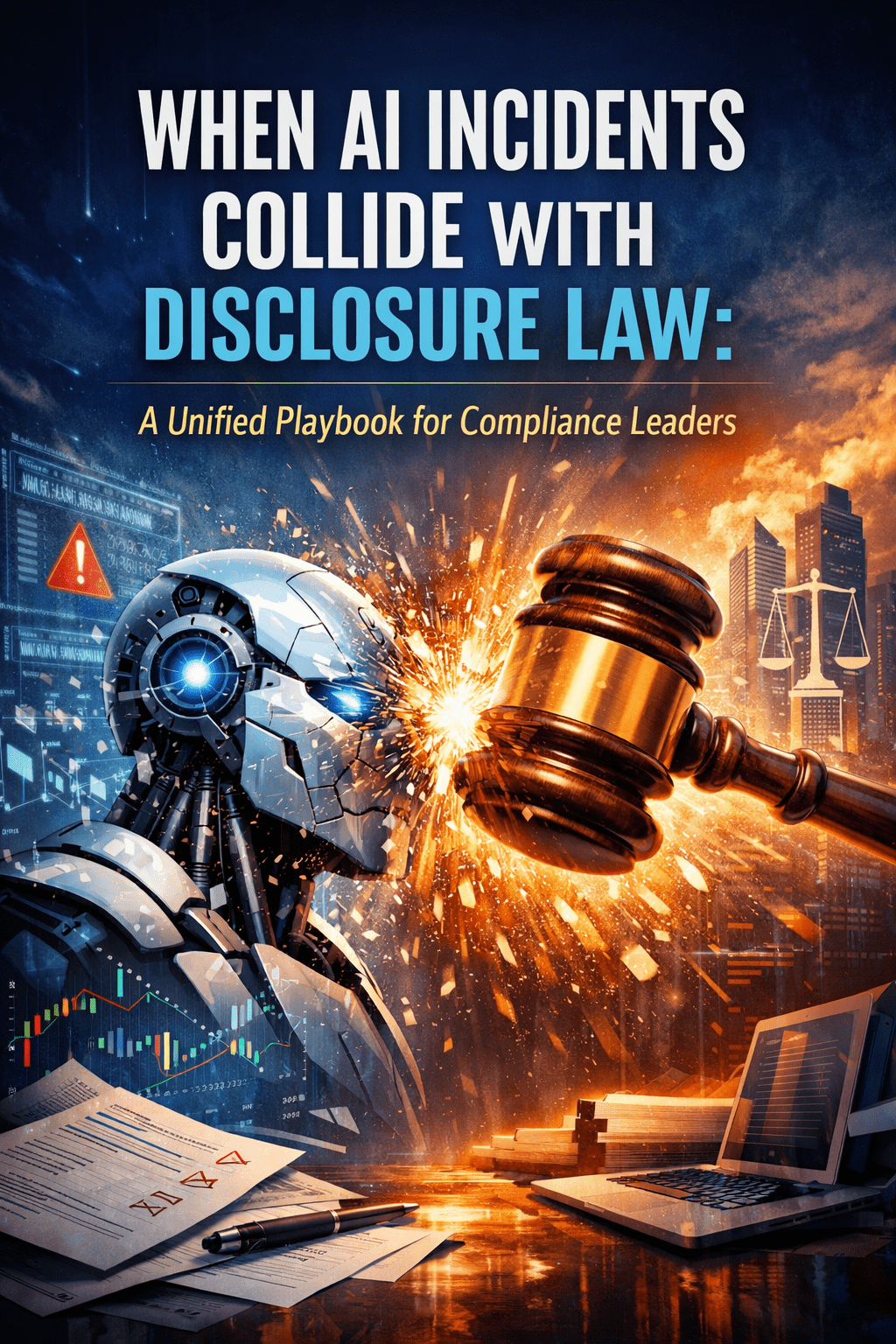
When AI Incidents Collide with Disclosure Law: A Unified Playbook for Compliance Leaders

There was a time when the risk of artificial intelligence could be discussed as a forward-looking innovation issue. That time has passed. AI governance now sits squarely at the intersection of operational risk, regulatory enforcement, and securities disclosure. For compliance professionals, the question is no longer whether AI risk will mature into a board-level issue. It already has.

If your organization deploys high-risk AI systems in the European Union, you face post-market monitoring and serious incident reporting obligations under the EU AI Act. If you are a U.S. issuer, you face potential Form 8-K disclosure obligations under Item 1.05 when a cybersecurity incident becomes material. Add the NIST AI Risk Management Framework for severity evaluation, ISO 42001 governance expectations for evidence and documentation, and the compliance function, which stands at the crossroads of law, technology, and investor transparency.

The challenge is not understanding each framework individually. The challenge is integrating them into one operational escalation model. Today, we consider what that means for the Chief Compliance Officer.

The EU AI Act: Post-Market Monitoring Is Not Optional

The EU AI Act requires providers of high-risk AI systems to implement post-market monitoring systems. This is not a paper exercise. It requires structured, ongoing collection and analysis of performance data, including risks to health, safety, and fundamental rights. Where a “serious incident” occurs, providers must notify the relevant national market surveillance authority without undue delay. A serious incident includes events that result in death, serious harm to health, or a significant infringement of fundamental rights. The obligation is proactive and regulator-facing. Silence is not an option.

This means that if your AI-enabled hiring tool systematically discriminates, or your AI-driven medical device produces dangerous outputs, you may face mandatory reporting obligations in Europe even before your legal team finishes debating causation. The compliance implication is straightforward: you need an operational definition of “serious incident” embedded inside your incident response process. Waiting to interpret the statute after the event is not governance. It is risk exposure.

SEC Item .05: The Four-Business-Day Clock

Across the Atlantic, the Securities and Exchange Commission (SEC) has made its expectations equally clear. Item 1.05 of Form 8-K requires disclosure of material cybersecurity incidents within four business days after the registrant determines the incident is material. Here is where compliance professionals must lean forward: AI incidents can trigger cybersecurity implications. Data exfiltration through model vulnerabilities, adversarial manipulation of training data, or unauthorized system access to AI infrastructure may constitute cybersecurity incidents.

The clock does not start when the breach occurs. It starts when the company determines materiality. That determination must be documented, defensible, and timestamped. If your AI governance framework does not feed into your materiality assessment process, you have a structural weakness. Compliance must ensure that AI incident severity assessments are directly connected to the legal determination of materiality. The board will ask one question: When did you know, and what did you do? You must have an answer supported by contemporaneous documentation.

NIST AI RF: Speaking the Language of Severity

The NIST AI Risk Management Framework provides the operational vocabulary compliance teams need. Govern, Map, Measure, and Manage are not theoretical constructs. They form the backbone of defensible severity assessment. When an AI incident arises, you must evaluate:

  • Scope of affected stakeholders
  • Magnitude of operational disruption
  • Likelihood of recurrence
  • Financial exposure
  • Reputational harm

This impact-likelihood matrix is what transforms noise into signal. It allows the organization to distinguish between model drift requiring retraining and systemic failure requiring regulatory notification. Importantly, severity classification must not be left solely to engineering teams. Compliance, legal, and risk must participate in the evaluation. A purely technical assessment may underestimate regulatory or investor impact.

If the NIST severity rating is high-impact and high-likelihood, escalation must be automatic. There should be no debate about whether the issue reaches executive leadership. Governance means predetermined thresholds, not ad hoc discussions.

ISO 42001: If It Is Not Logged, It Did Not Happen

ISO 42001, the emerging AI management system standard, adds another layer of discipline: documentation. It requires structured governance, defined roles, documented controls, and demonstrable evidence of monitoring and incident handling. For compliance professionals, this is where audit readiness becomes real. When regulators ask for logs, you must produce:

  • Model version identifiers
  • Training data provenance
  • Decision traces and outputs
  • Operator interventions
  • Access logs and export records
  • Timestamps and system configurations

In other words, you need a chain of custody for AI decision-making. Without logging discipline, you will not survive regulatory scrutiny. Worse, you will not survive shareholder litigation. ISO 42001 forces organizations to treat AI systems with the same governance rigor as financial controls under SOX. That alignment should not surprise anyone. Both concern trust in automated decision systems.

One Incident, Multiple Obligations

Consider a practical scenario. A vulnerability in a third-party model component has compromised your AI-driven customer analytics platform. Sensitive customer data is exposed. The compromised system also produced biased credit scores during the attack window. You now face:

  • Potential serious incident reporting under the EU AI Act
  • Cybersecurity disclosure analysis under SEC Item 1.05
  • Data protection obligations under GDPR
  • Internal audit review of governance controls
  • Reputational fallout

If your organization handles each of these as separate tracks, you will lose time and coherence. Instead, you need a unified incident command structure with embedded regulatory triggers. As soon as the issue is identified, you preserve logs. Within 24 hours, severity scoring occurs under NIST criteria. Within 48 hours, the legal team evaluates materiality. By 72 hours, the evidence packet is assembled for board review. The board should receive:

  • Incident timeline
  • Severity classification
  • Regulatory reporting analysis
  • Financial exposure estimate
  • Remediation plan

This is not overkill. This is operational discipline.

The Board’s Oversight Obligation

Boards are increasingly being asked about AI governance. Institutional investors want transparency. Regulators want accountability. Plaintiffs’ lawyers want leverage. Directors should demand:

  1. Clear definitions of serious AI incidents.
  2. Pre-established escalation thresholds.
  3. Integrated disclosure decision protocols.
  4. Evidence preservation policies aligned with ISO standards.
  5. Regular tabletop exercises involving AI scenarios.

If your board has not run an AI incident simulation that includes SEC disclosure timing and EU reporting triggers, it is time to schedule one. Calm leadership during a crisis does not happen spontaneously. It is built through preparation.

The CCO’s Moment

This convergence of AI regulation and securities disclosure creates an opportunity for compliance professionals. The CCO can position the compliance function as the integrator between engineering, legal, cybersecurity, and investor relations. That requires proactive steps:

  • Embed AI into enterprise risk assessments.
  • Update incident response playbooks to include AI-specific triggers.
  • Align AI logging architecture with evidentiary standards.
  • Train leadership on materiality determination for AI incidents.
  • Report AI governance metrics to the board quarterly.

The compliance function should not be reacting to AI innovation. It should be shaping its governance architecture.

Governance Is Strategy

Too many organizations treat AI governance as defensive compliance. That mindset is outdated. Effective governance builds trust. Trust drives adoption. Adoption drives competitive advantage.

A well-documented post-market monitoring system demonstrates operational maturity. A disciplined severity assessment process demonstrates strong internal control. Transparent disclosure builds investor confidence. Conversely, fragmented incident handling erodes credibility. The market will reward companies that demonstrate responsible AI oversight. Regulators will scrutinize those who do not.

Conclusion: Integration Is the Answer

The EU AI Act, SEC Item 1.05, NIST AI RMF, and ISO 42001 are not competing frameworks. They are complementary lenses on the same reality: AI systems create risk that must be monitored, measured, disclosed, and documented.

Compliance leaders who integrate these frameworks into a single escalation and reporting architecture will protect their organizations. Those who treat them as separate checklists will struggle. AI risk is no longer hypothetical. It is operational, regulatory, and financial. The compliance function must be ready before the next incident occurs. Because when it does, the clock will already be ticking.
 

Categories
Compliance Tip of the Day

Compliance Tip of the Day: Factors in Board Investigation

Welcome to “Compliance Tip of the Day,” the podcast where we bring you daily insights and practical advice on navigating the ever-evolving landscape of compliance and regulatory requirements.

Whether you’re a seasoned compliance professional or just starting your journey, our aim is to provide you with bite-sized, actionable tips to help you stay on top of your compliance game.

Join us as we explore the latest industry trends, share best practices, and demystify complex compliance issues to keep your organization on the right side of the law.

Tune in daily for your dose of compliance wisdom, and let’s make compliance a little less daunting, one tip at a time.

In this episode, we consider some of the factors which could lead to a successful Board of Director-led investigation.

For more information on the Ethico ROI Calculator and a free White Paper on the ROI of Compliance, click here.

Categories
Compliance Tip of the Day

Compliance Tip of the Day: Board Selection of Investigative Counsel

Welcome to “Compliance Tip of the Day,” the podcast where we bring you daily insights and practical advice on navigating the ever-evolving landscape of compliance and regulatory requirements.

Whether you’re a seasoned compliance professional or just starting your journey, our aim is to provide you with bite-sized, actionable tips to help you stay on top of your compliance game.

Join us as we explore the latest industry trends, share best practices, and demystify complex compliance issues to keep your organization on the right side of the law.

Tune in daily for your dose of compliance wisdom, and let’s make compliance a little less daunting, one tip at a time.

In this episode, we consider some of the factors a Board of Directors should consider when selecting outside counsel to investigate claims or potential compliance violations.

For more information on the Ethico ROI Calculator and a free White Paper on the ROI of Compliance, click here.

Categories
Compliance Tip of the Day

Compliance Tip of the Day: Board Led Investigations

Welcome to “Compliance Tip of the Day,” the podcast where we bring you daily insights and practical advice on navigating the ever-evolving landscape of compliance and regulatory requirements.

Whether you’re a seasoned compliance professional or just starting your journey, our aim is to provide you with bite-sized, actionable tips to help you stay on top of your compliance game.

Join us as we explore the latest industry trends, share best practices, and demystify complex compliance issues to keep your organization on the right side of the law.

Tune in daily for your dose of compliance wisdom, and let’s make compliance a little less daunting, one tip at a time.

In this episode, we review how an organization should think through a Board of Directors-led investigation.

For more information on the Ethico ROI Calculator and a free White Paper on the ROI of Compliance, click here.

Categories
Great Women in Compliance

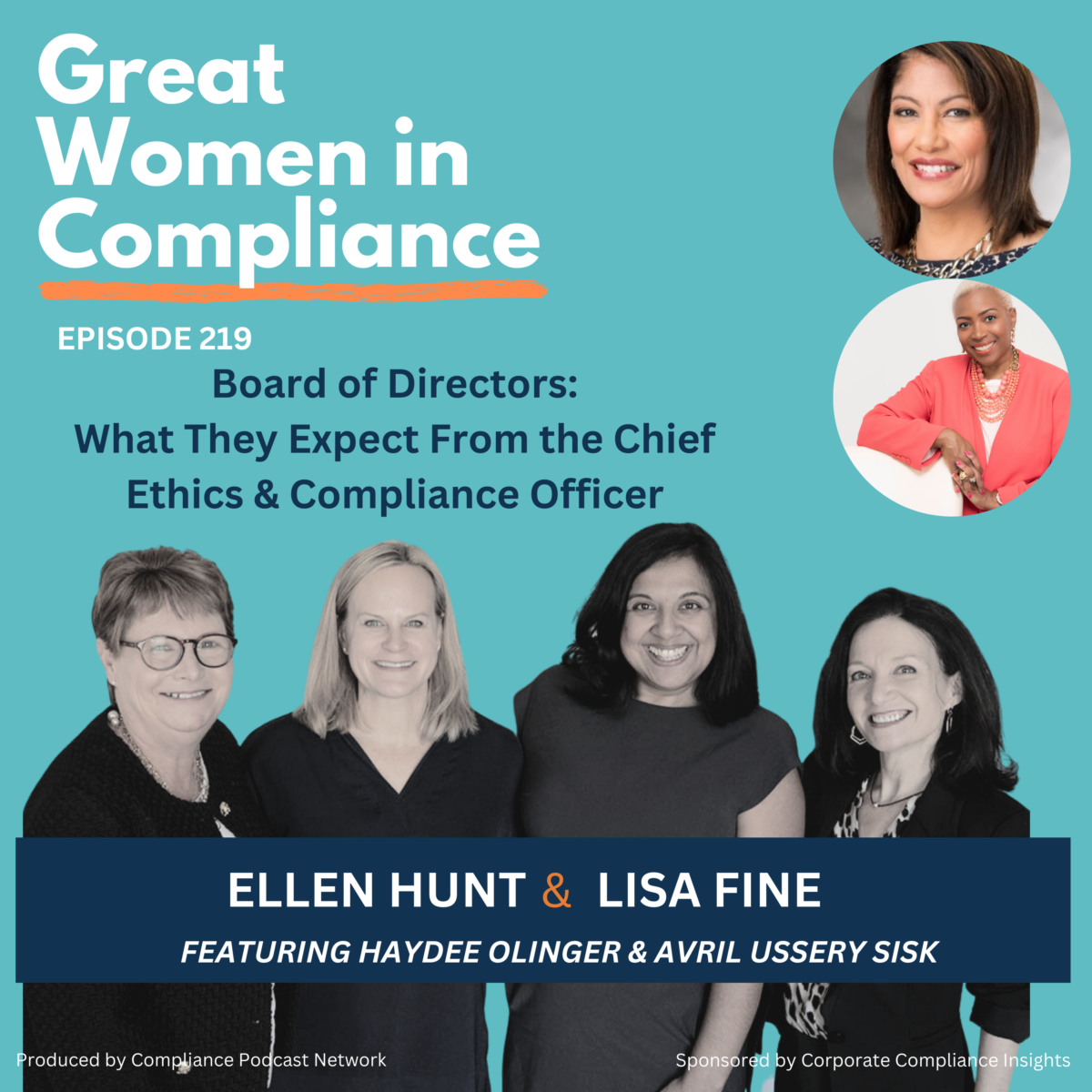
Great Women in Compliance – Roundtable Discussion on Board of Directors and What They Expect from The Chief Ethics & Compliance Officer with Haydee Olinger and Avril Ussery Sisk

Welcome to the Great Women in Compliance! In this episode, Lisa and Ellen have as guests Haydee Olinger and Avril Ussery Sisk to discuss the Board and Compliance.

The Chief Ethics &Compliance Officer should be reporting regularly to the Board, but how do you know what the Board expects, especially if there are layers between you and the Board?  In this #GWIC episode, Lisa Fine and Ellen Hunt talk with Haydee Olinger and Avril Ussery Sisk, both current board members and ethics experts, about what they expect from the Chief Ethics and Compliance Officer.

You can hear this episode on Corporate Compliance Insights or wherever you hear podcasts. https://lnkd.in/d9VGcfw

Listen in for how these Board members want the Chief Ethics & Compliance Officer to provide pre-reads, meaningful metrics, and focus on the “high hard risks.” Learn about how to build relationships with the Board and ask for resources, as well as how to gain financial knowledge and business acumen. If you are thinking about getting on a board, Haydee and Avril share their journey and thoughts about how you can get started on your journey.  

Resources:

Join the Great Women in Compliance community on LinkedIn here.

Categories
All Things Investigations

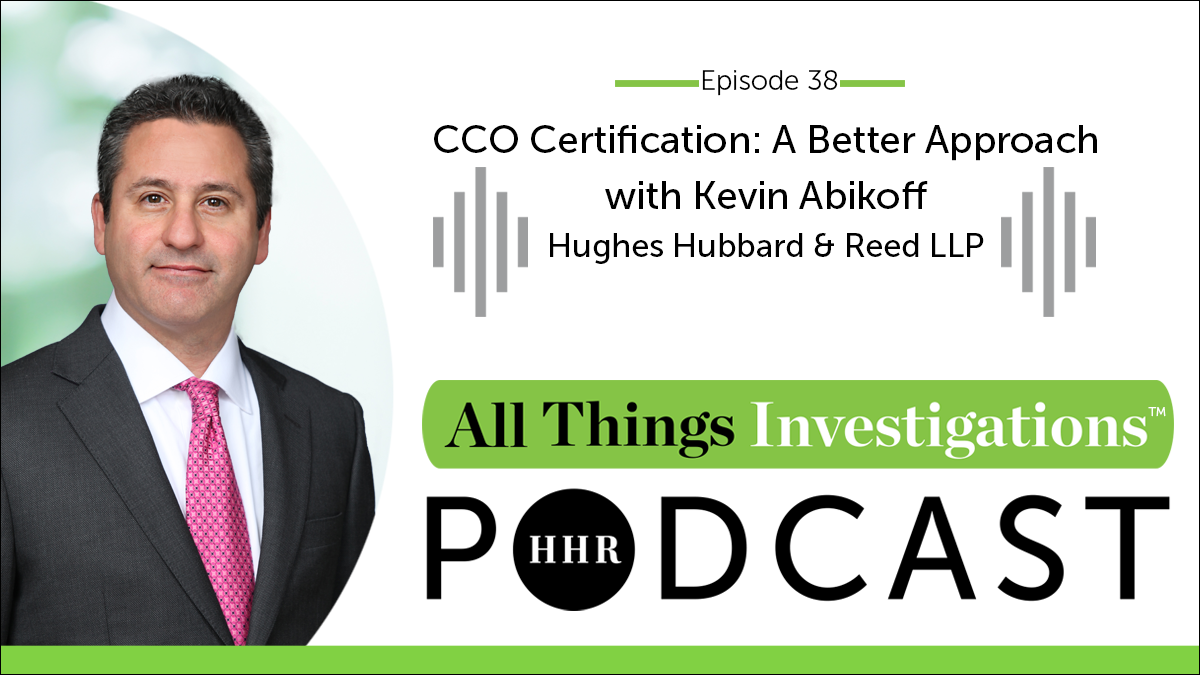
All Things Investigations: Episode 38 – CCO Certification – A Better Approach with Kevin Abikoff

In this episode of All Things Investigation, Tom Fox and guest Kevin Abikoff discuss the Department of Justice’s introduction of a CCO certification in the wake of FCPA violations. Kevin offers his unique perspective on this issue; their conversation also explores broader issues of corporate governance and the role of the Board of Directors.

Kevin Abikoff is a Partner and Deputy Chair at Hughes Hubbard & Reed. He is a recognized authority in corporate governance and compliance. 

You’ll hear Tom and Kevin discuss:

  • Kevin questions the necessity of the CCO certification, suggesting it addresses a problem that doesn’t exist, given the absence of complaints from the Department of Justice about dishonesty during monitorships.
  • A more practical approach, Kevin posits, is a certification 12 to 24 months after a monitorship ends to empower CCOs during periods of vulnerability truly.
  • Measuring compliance effectiveness is subjective and may be void of vagueness in a legal context.
  • In the broader realm of corporate governance, the board has a pivotal role in overseeing compliance. Parallels to the Caremark duty and Delaware law are drawn.
  • Kevin raises concerns about the burden on CCOs to assess program effectiveness retrospectively, especially considering the dynamic nature of compliance programs over time.
  • Boards should take responsibility for compliance certifications and should sign off on these certifications, mirroring similar practices in financial reporting.
  • Innovation within compliance may be stymied if CCOs fear that enhancing a program might be used against them in the future, Kevin points out.

KEY QUOTES:

“I’ve just never heard, especially from the context of Chief Compliance Officer, that the DOJ feels like they’re being lied to. If that’s not the problem they’re trying to solve, I think the solution they have paved is, again, a solution in search of a problem that doesn’t exist…” – Kevin Abikoff

“If you’re going to have a certification and you want to empower the chief compliance officer, have the certification twelve months, 24 months after the conclusion of the monitorship and have the CCO certify that they continue to believe that the policies, procedures, things that have been put in place, continue to be in place.” – Kevin Abikoff

“Now what you fail to investigate can kill you.” – Kevin Abikoff

Resources:

Hughes Hubbard & Reed website 

Kevin Abikoff on LinkedIn

Categories
31 Days to More Effective Compliance Programs

One Month to a More Effective Compliance Program with Boards – Board Failures

Next, consider a couple of landmark failures at the Board level around bribery and corruption.

VimpelCom Ltd. In 2015 (now Veon Ltd.), the DOJ alleged that Dutch telecom VimpelCom sought to enter the telecom market through the acquisition of a local player, Unitel, as an entrée into the Uzbekistan market. Unitel made clear to VimpelCom that to have access to, obtain, and retain business in the Uzbeki telecom space, VimpelCom would have to, according to the DPA, “regularly pay Foreign Officials millions of dollars” to Gulnara Karimova, the daughter of the then President of the country. VimpelCom also acquired another entity Butzel, that was at least partially owned by an Uzbeki government official, who hid their interest through a shell company, which was known to VimpelCom. VimpelCom did not articulate a legitimate business reason for the deal and paid $60 million for Buztel.

Ultimately, VimpelCom agreed to pay approximately $800 million in fines for these activities in 2016. 

BizJet. Another FCPA enforcement action involved the Tulsa-based company BizJet International Sales and Support Inc. (BizJet), which had four senior executives convicted for their participation in a bribery scheme. But this case also involved the Board of Directions. In the Criminal Information, it stated that in November 2005:

…at a Board of Directors meeting of the BizJet Board, Executive A, and Executive B discussed with the Board that the decision of where an aircraft is sent for maintenance work is generally made by the potential customer’s director of maintenance or chief pilot, that these individuals are demanding $30,000 to $40,000 in commissions, and that BizJet would pay referral fees in order to gain market share.

In both cases, this is where the rubber hits the road. If a company is willing to commit bribery and engage in corruption to secure business, no amount of doing compliance is going to help. If senior management is ready, willing, and able to lie, cheat and steal, the Board is the final backstop to prevent such conduct. Both the VimpelCom and BizJet Boards sorely failed in their compliance duties.  

Three key takeaways:

  1. Board liability will be severe based upon similar conduct going forward.
  2. Board members must critically challenge management on its conduct.
  3. The Board is the ultimate backstop against bribery and corruption.

For more information, check out The Compliance Handbook, 4th edition, available here.

Categories
31 Days to More Effective Compliance Programs

One Month to a More Effective Compliance Program with Boards – Board Governance and Risk Oversight

One of the ongoing questions from members of the Board of Directors is how to resolve the tension between oversight and management. I recently had the opportunity to visit with Joe Howell, former Executive Vice President (EVP) of Workiva, Inc., on this subject. Howell has worked on and with Boards of Directors at various companies, and I wanted to garner his understanding of the role of a Board, senior management, and a Chief Compliance Officer (CCO). Howell’s short response was an excellent starting point for understanding the role; put sand in management’s shoes.

The key to such a metaphor succeeding is that a Board of Directors, “by continuing to challenge management on these scenarios that management has considered and the stories management is telling itself about what could go wrong,” can “help get management out of its comfort zone by and large executive teams begin to believe themselves when they talk about how well they’re doing. The independent challenge that the board can offer is putting a little bit of sand in the shoe to make sure you’re thinking about things carefully can cause you to step back and focus your resources where they’re needed.”

Howell noted that the role of the Board is not management but oversight, focusing on governance. To do so, an effective Board should challenge senior management not only on what they have planned for but what they may not have considered or may not even know about. He said, “One perfect example is the reputation of those stakeholders involved in the company, and that can be the management team itself, the employees, and the board members themselves.” This is because reputational damage hurts everyone. Howell stated, “It’s essential as we go through some ways the Board can help management in that role. I think the things that make a difference to management is when the Board can be an effective devil’s advocate. Not managing management but helping them in their governing role by helping management to step back and think critically of their underlying assumptions and biases.”

A Board is more than just there to be a rubber stamp for senior management. It must exercise independent judgment, action, and oversight. Further, it is the Board’s role to ask hard, difficult, and probing questions to ensure management is doing its job and has considered other risk possibilities.

Three Key Takeaways:

  1. Boards should force management to open up the company to itself.
  2. Boards should be a grain of sand in the shoe of management.
  3. Boards should ensure senior management is aware of and planning for known and unknown risks.
Categories
31 Days to More Effective Compliance Programs

One Month to a More Effective Compliance Program with Boards – The Board Compliance Committee

Under the U.S. Sentencing Guidelines, the Board must exercise reasonable oversight on the effectiveness of a company’s compliance program. The DOJ Prosecution Standards posed the following queries: 1) Do the directors exercise independent review of a company’s compliance program? and 2) Are directors provided information sufficient to enable the exercise of independent judgment? Moreover, the  FCPA Resource Guide, 2nd edition required a CCO to have direct access to the Board or an appropriate sub-committee and requires a tangible commitment from the top levels of an organization, starting with the Board of Directors, that the company creates an ethical culture.

This requirement was brought forward in 2017 in the FCPA Corporate Enforcement Policy. Finally, nn the 2020 Update to the Evaluation of Corporate Compliance Programs, under the section entitled Oversight, it posed the following questions What compliance expertise has been available on the board of directors? Have the board of directors and/or external auditors held executive or private sessions with the compliance and control functions?
Today’s regulatory climate and hyper-transparency in social media make a Board Compliance Committee’s task seem Herculean. But more than simply the regulatory climate, shareholders are taking a much more active role in asserting their rights against Boards of Directors. It is incumbent that Boards seek out and obtain sufficient information to fulfill their legal obligations and keep their company off the front page of the New York Times, Wall Street Journal or Financial Times, just to name a few, to prevent serious reputational damage. A Board Compliance Committee is a good place to start.
Three key takeaways:

  1. The Board Compliance Committee exists to provide oversight and assist the CCO, not to substitute its judgment for that of the CCO.
  2. The Board Compliance Committee should work to hold the CCO accountable to hit appropriate metrics.
  3. The Board Compliance Committee is ideal for leading the efforts around strategic planning.

For more information check out The Compliance Handbook, 3rd edition, available from LexisNexis here.

Categories
Compliance Into the Weeds

SVB Failure – Lessons for Compliance

The award winning, Compliance into the Weeds is the only weekly podcast which takes a deep dive into a compliance related topic, literally going into the weeds to more fully explore a subject. In this episode, Matt and I continue our exploration of the collapse of Silicon Valley Bank (SVB) and take a deeper dive into the compliance angles. Silicon Valley Bank had taken some big risks which led to depositors having a near-death experience, shareholders losing all their money, and taxpayers ultimately supporting the bank’s bailout. Despite the auditors giving an anodyne report on the bank’s risk management, the board, management and regulators all missed the big strategic risks. As a result, the bank collapsed, leaving Matt to question whether stakeholders were given the right assurance on the right things.

Key Highlights

·      What risk management strategies did SVB senior management and Board miss or ignore that could have prevented the financial disaster?

·      Why did SVB’s management decline to pursue improvements to their risk management practices after being warned by BlackRock consultants?

·      Did regulators miss the red flags raised by the San Francisco Fed examiners 18 months before the collapse of SVB?

Notable Quotes:

1.     “We should remember that really, the auditors’ report is going to give assurance on two points: Number one, is there a risk of material misstatement in the financial statements? And number two, does the audit firm have any substantial doubt about the organization’s ability to continue as a going concern for roughly the next twelve months or so? That’s how long it is. But it’s those two things.”

2.     “When you have Elizabeth Warren and conservatives both raising hell at the same time, it’s a valid issue to go and look at then because that does not happen too often.”

3.    “It’s like nobody had thought about this when really once we rolled back DoddFrank protections and supervisory constraints specifically for mid-sized banks, which Republicans pushed through in 2018, once that happened, that became the systemic risk that regulators had to think about.”

4.    “Everybody kind of sort of knew there was a problem, but a whole lot of finger pointing and not enough planning and assurance and communication to the public at large and to investors.”

 Resources

Matt  on LinkedIn

Matt on Radical Compliance

Tom on LinkedIn