

Categories
Blog

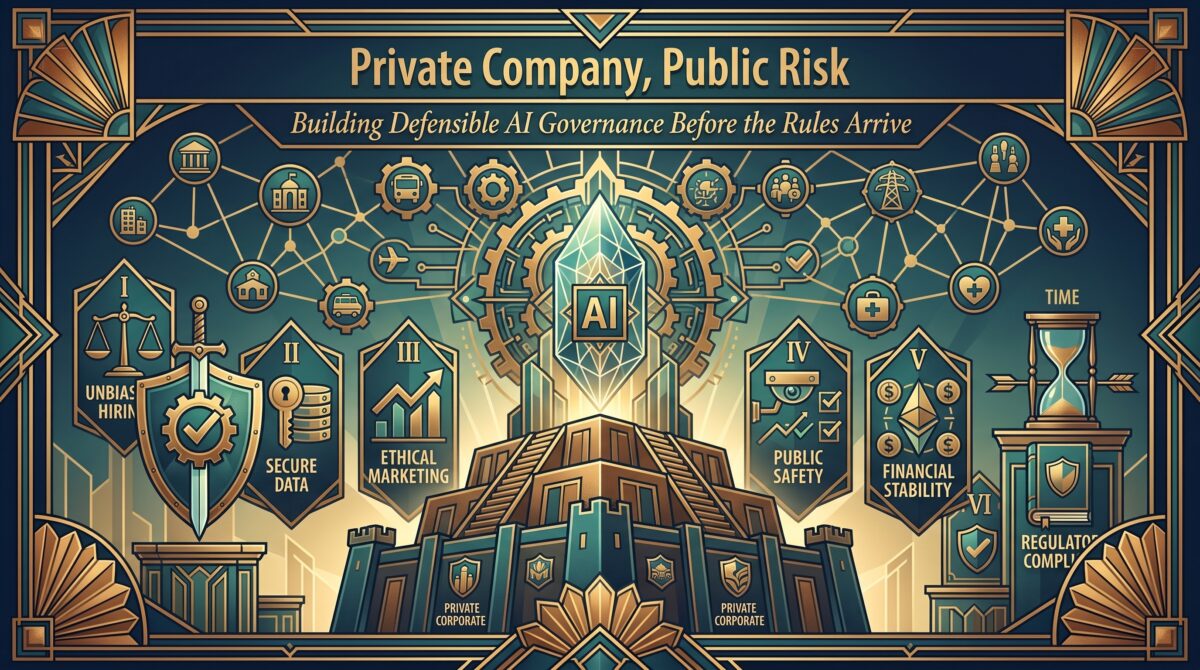
Private Company, Public Risk: Building Defensible AI Governance Before the Rules Arrive

For private companies, the central question about artificial intelligence is no longer whether the technology is in the business. It is whether anyone can explain where it is, what it does, what data it touches, and who is accountable when it fails.

That is the warning in “AI Governance for Private Companies,” by Hillary Flynn, Drew Morales, and Courtney Hugger of Wellington Management, which was recently posted in the Harvard Law School Forum on Corporate Governance. The authors report that nearly three in four companies plan to deploy agentic AI within two years, while only one in five has a mature governance model for autonomous agents. That is not merely a technology gap. It is a governance gap.

Private ownership does not make AI risk private. The consequences arrive through customers, employees, regulators, investors, lenders, insurers, and business partners. A company may not yet face a single comprehensive AI law, but it can still face a privacy complaint, contract dispute, cyber incident, customer loss, or damaged valuation. For compliance professionals, governance should precede scale.

Private Does Not Mean Exempt

Private companies are moving quickly because AI can increase productivity, improve customer service, accelerate analysis, support coding, and help a growing company scale. The article also identifies a critical lesson from Wellington’s portfolio companies: the largest barriers are often organizational, not technical. Companies making the strongest progress combine AI investment with employee training, clear governance, and defined expectations.

This is where the Chief Compliance Officer can reframe the discussion. AI governance is the discipline that allows useful experimentation without unmanaged legal and business exposure. The goal is not a thick policy on a shared drive. The goal is an operating system for accountable decisions.

The European Union AI Act is being implemented in phases through 2027, with expectations around transparency, human oversight, documentation, risk management, monitoring, and AI literacy. In the United States, NIST guidance, ISO standards, sector rules, state laws, and customer requirements are shaping expectations, even without a federal AI statute. A private company can therefore face AI governance demands through a contract or transaction long before a regulator knocks on the door.

Begin With the Business Objective

One of the article’s strongest recommendations is also one of the simplest: start with the business problem, not the AI tool. This is precisely what Carl Hahn has consistently maintained: always ask, “What is the Business Value?”Teams should define the desired outcome before selecting a model or vendor. Is it lower cost, faster response, better quality, increased revenue, fewer errors, or reduced risk?

Governance cannot evaluate an undefined promise. A measurable objective gives management a basis for deciding whether the use case works and whether its benefits justify its risks. It also creates stopping rules. Approval should identify what failure, customer impact, control breakdown, or scope change will trigger redesign, escalation, suspension, or retirement.

Compliance should insist on this discipline, particularly when an AI use case affects payments, eligibility, claims, pricing, employment, healthcare, education, financial products, or customer communications. Those are not ordinary software deployments. They are decisions and interactions with consequences for real people.

Inventory First, Then Tier the Risk

A company cannot govern what it cannot see. The foundation is an inventory of models, vendors, internal tools, embedded features, customer-facing systems, employee-built applications, and known shadow AI. It does not need to be perfect. It needs an owner, an update process, and enough information to support risk decisions.

Each use case should then be placed into a risk tier. Relevant factors include data sensitivity, degree of autonomy, importance of the business process, impact on customers or employees, regulatory exposure, ability to explain the result, and ease of reversing an error. Low-risk uses can follow a streamlined path. High-impact uses should receive enhanced testing, documented approval, human oversight, monitoring, and senior-level escalation.

Risk tiering prevents two failures. Treating every use as equally dangerous overwhelms review and encourages employees to route around it. Treating every use as ordinary technology leaves consequential applications without meaningful controls. Good governance applies greater rigor where potential harm is greater.

Put a Name Next to the Risk

Every AI system should have a business owner who remains accountable for its outcome. Accountability cannot be delegated to the model, the data science team, or the vendor. The owner should understand the intended purpose, approved users, permitted data, performance standard, escalation route, and circumstances under which the system must be paused.

Higher-risk applications should receive cross-functional review involving the business, product, engineering, legal, compliance, privacy, cybersecurity, procurement, and risk functions. This does not require a new bureaucracy. It requires a repeatable process with recorded approvals and clear responsibility.

Agentic AI raises the stakes because the risk moves from a wrong answer to a wrong action. Permissions should be limited, high-stakes actions should require human approval, and activity should be logged. Test override and shutdown mechanisms. The chatbot manipulated into agreeing to sell a vehicle for one dollar shows how weak boundaries turn a novelty into an operational event.

Treat Vendors as Part of the System

Most private companies will rely on external models, platforms, and software. That makes AI governance inseparable from third-party risk management. Traditional security questionnaires are not enough. Diligence should address how vendors use data, whether customer data trains models, how model changes are communicated, what transparency is available, how performance is tested, who bears liability, and whether data and workflows can be moved if the relationship ends.

The company should monitor model updates, service degradation, changes in terms, and features that expand access or autonomy. A tool approved for summarization should not silently become authorized to send messages, approve transactions, or alter customer records.

Monitor the System in Practice

AI governance does not end at approval. Model updates, new data, and user behavior can alter performance. Companies should monitor accuracy, reliability, bias, drift, misuse, repeated failures, and customer impact. An incident protocol should define how to pause the system, preserve evidence, escalate, remediate harm, and communicate with affected stakeholders.

This is where AI governance meets familiar compliance principles. The DOJ’s Evaluation of Corporate Compliance Programs asks whether a program works in practice. COSO emphasizes control activities, information, monitoring, and accountability. NIST’s AI Risk Management Framework helps organizations govern, map, measure, and manage AI risk. ISO/IEC 42001 offers a management-system approach. A company should select a coherent baseline and produce evidence that its controls operate.

A Practical Agenda for Boards and CCOs

Establish ownership. Name an executive accountable for AI governance and identify the board committee that will oversee material AI risk.

Build the inventory: capture sanctioned tools, embedded vendor capabilities, customer-facing uses, agentic applications, and known shadow AI.

Tier the use cases. Apply enhanced review where AI affects sensitive data, consequential decisions, critical operations, or autonomous action.

Strengthen the vendor process. Add AI-specific diligence, contractual protections, change controls, exit planning, and ongoing monitoring.

Test the failure plan. Confirm that the company can detect a harmful outcome, stop the system, preserve evidence, assign responsibility, and remediate the impact.

The author’s bottom line is the right one for compliance leaders: the winners will not necessarily be the companies that deploy AI fastest. They will be the companies that combine innovation with accountability, customer awareness, and disciplined execution. For a private company, defensible AI governance is not preparation for some distant regulatory future. It is how management protects value today.
Categories
FCPA Compliance Report

FCPA Compliance Report – Upping Your Game in Compliance

Welcome to the award-winning FCPA Compliance Report, the longest-running podcast in compliance. This is a very special episode. This podcast comes from a webinar hosted by KonaAI on Tom Fox’s latest book, Ûpping Your Game. On this webinar, Tom is joined by Vince Walden, CEO of konaAI; Hemma Lomax, Deputy General Counsel, Vice President, Global Head of Ethics and Compliance at Docusign; and Carl Hahn and Matt Galvin, both from Gentic Global Advisors PLLC.

The discussion revolves around compliance, with thought leaders delving into how organizations can enhance their performance by utilizing emerging technologies and compliance strategies. The conversation begins with a focus on the transformative role of AI in compliance, highlighting its ability to support continuous monitoring, predictive analytics, and embedding compliance into day-to-day business operations. The panel emphasizes the rise of “compliance as a service” and the growing need to prioritize user experience, particularly in third-party risk management and digital transformations. The panel addresses key challenges, such as overcoming resistance from business process owners, and emphasizes the importance of using data strategically to drive better compliance outcomes. The panel introduces the concept of the “Office of Unlock” as a collaborative model to break down silos and promote agility. They also discuss change management, AI governance, and tailoring compliance communications to specific audiences. The episode concludes with practical advice for compliance officers and a forward-looking discussion on aligning compliance programs with evolving organizational and regulatory landscapes.

Key highlights:

  • Upping Your Game
  • Embedded Compliance
  • What’s the business value?
  • What steps should you take right now

Resources:

Hemma Lomax on LinkedIn

Vince Walden on LinkedIn

Matt Galvin on LinkedIn

Carl Hahn on LinkedIn

KonaAI

Gentic Global Advisors

Tom Fox

Instagram

Facebook

YouTube

Twitter

LinkedIn

For more information on the use of AI in compliance programs, see Tom Fox’s new book, Upping Your Game. You can purchase a copy of the book on Amazon.com.

Categories
Blog

Upping Your Game – Compliance Moves into the 2030s

On February 10, 2025, the Trump Administration suspended investigations under and enforcement of the Foreign Corrupt Practices Act via Executive Order. Many compliance professionals have since wondered what this will mean for corporate compliance programs. Hui Chen, in a blog post entitled Pause in FCPA Enforcement: Crisis or Opportunity?, said, “Many in the compliance world have expressed lament, concerns, and anger. Understandably so. This may feel like an existential crisis for an industry so dependent on enforcement as its raison d’être. Yet, in every crisis, there is an opportunity. This is no exception.” She stated, “We will have the opportunity to find out which companies do not believe they need to engage in bribery to be competitive. But we will also see companies recalibrate their risk tolerance not because the door to foreign bribery has been wedged open, but because their past fear-driven strategy resulted in a sometimes overly narrow view of corporate risk and responsibility in this space.” She listed three key areas to start, the third being “it’s time to up your game.”

I agreed wholeheartedly with Chen. Inspired by Chen, I wanted to write a book for compliance professionals about how they could think through ‘Upping Their Game’ using currently existing Generative AI (GenAI) tools to improve their compliance programs dramatically. It all starts with the precept from Carl Hahn, “To me, the animating reason for our compliance program was to deliver business value. And that was my proposition on day one. It is a positive business-forward proposition based on returning on investment, returning value to the business, being part of the business strategy, enabling the achievement of strategic goals, and enabling the company to successfully deliver to its customers, investors, stakeholders, and employees.” As compliance professionals, it is critical to recognize that this moment is not merely about incremental improvements. The Trump Executive Order brings to the compliance profession a rare inflection point where revolutionary technological advancements, if harnessed strategically, can elevate our profession to a new level of effectiveness, efficiency, and organizational value.

Once reliant on manual oversight, reactive reporting, and periodic audits, compliance monitoring is evolving into a proactive, real-time capability empowered by sophisticated AI technologies. Compliance professionals historically functioned as gatekeepers, viewed as necessary but inconvenient barriers to business velocity. But now, driven by AI, compliance stands poised to shed that restrictive image, embedding directly into core operational workflows and thus shifting from gatekeeper to integral business partner.

Today, the cutting edge of compliance is driven by two primary strands of AI: predictive analytics, leveraging machine learning, and GenAI. Each has distinct capabilities, but combined, they represent a powerhouse able to address the vast majority of traditional compliance challenges and emerging risks. At its core, compliance seeks to identify, manage, and mitigate risks. Traditionally, this has meant looking backward, investigating past issues, and reacting to problems after they occur. AI fundamentally shifts compliance from this rearview mirror perspective to a forward-looking, predictive posture. Machine learning technologies empower compliance officers to train AI models on vast quantities of historical data, teaching systems to recognize patterns and indicators that suggest elevated risk in real-time.

Today, a compliance officer can use predictive analytics to tag transactional data by risk category, identifying potential bribes, improper payments, fraud, conflicts of interest, and sanctions violations. With these capabilities, compliance teams can proactively identify, isolate, and remediate issues before they escalate, significantly reducing organizational exposure and regulatory risk.

This shift from reactive to proactive risk management also enhances compliance agility. Organizations equipped with AI-powered monitoring can swiftly pivot to address new regulatory developments or emerging business risks. Because AI can integrate and analyze data in real-time from diverse sources, such as financial records, employee communications, operational metrics, and third-party data, the organization is positioned to respond to regulatory inquiries swiftly, accurately, and effectively, thus greatly enhancing compliance resilience.

AI offers a transformative capacity to integrate compliance directly into essential business processes by embedding compliance directly into an organization’s operations. Andrew McBride’s approach is termed the “Holy Grail” for compliance professionals who seek to seamlessly embed compliance responsibilities within operational workflows, enabling employees to carry out compliance tasks without interrupting their regular business activities.

For all these reasons and more, I am thrilled to announce the publication of my latest book, Upping Your Game: How Compliance and Risk Management Move to 2030 and Beyond. The compliance function is uniquely situated to lead the management of risk going forward, and in this book, I provide every compliance professional with key tactics, concepts, and strategies to move forward with GenAI today to answer the call to Up Your Game. Each chapter is dedicated to one area of a compliance program: risk management, third parties, training, chatbots, and embedded compliance. I provide key lessons for compliance professionals in each chapter and a case study on how one or more companies have created GenAI tools that can be adapted for compliance. Each one of these strategies meets Hahn’s precept to enhance business value.

I  interviewed some of the top thinkers on GenAI in the compliance field for this book. Contributors included Vincent Walden, CEO of konaAI, a global, AI-driven technology company focused on anti-fraud, anti-corruption, and compliance risks. Matt Galvin, co-founder of Gentic Global Advisors. Carl Hanh, co-founder of Gentic Global Advisors. Dr. Hemma Lomax, Deputy General Counsel, Vice President, Global Head of Ethics and Compliance at Docusign. Jag Lamba is the founder and CEO of Certa. Eric Sydell is a co-founder and CEO of Vero AI.

I hope you check out the book and use it as a basis for Upping Your Game going forward. KonaAI, a leading data analytics firm, sponsored this book.

You can purchase a copy of the book on Amazon.com.

Categories
Compliance Week Conference Podcast

Carl Hahn on Using Data Analytics to Improve Compliance

In this episode of the Compliance Week 2023 Speaker Preview Podcasts series, Carl Hahn discusses some of his panel at Compliance Week 2023, “Data Analytics to Improve Compliance.” 

Some of the issues he will discuss in his presentations are:

  •   The expectations for compliance professionals in using data analytics in their programs;
  • Insights from both sides of the coin – government and compliance professionals on lessons in creating and cultivating data-driven compliance programs; and
  • A sense of what’s coming down the pike, including technical advancements creating opportunities for compliance, ethics, and risk professionals

I hope you can join me at Compliance Week 2023. This year’s event will be May 15-17 at the JW Marriott in Washington, DC. The line-up of this year’s event is simply first-rate, with some of the top ethics and compliance practitioners around.

Gain insights and make connections at the industry’s premier cross-industry national compliance event offering knowledge-packed, accredited sessions and take-home advice from the most influential leaders in the compliance community. Back for its 18th year, compliance, ethics, legal, and audit professionals will gather safely face-to-face to benchmark best practices and gain the latest tactics and strategies to enhance their compliance programs. And many others to:

  • Network with your peers, including C-suite executives, legal professionals, HR leaders, and ethics and compliance visionaries.
  • Hear from 75+ respected cross-industry practitioners who are CEOs, CCOs, regulators, federal officials, and practitioners to help inform and shape the strategic direction of your enterprise risk management program.
  • Hear directly from the two SEC Commissioners, gain insights into the agency’s enforcement areas, and walk away with guidance on remaining compliant within emerging areas such as ESG disclosure, third-party risk management, cybersecurity, cryptocurrency, and more.
  • Bring actionable takeaways from your program from various session types, including ESG, Human Trafficking, Board obligations, and many others, for you to listen, learn and share.
  • Compliance Week aims to arm you with information, strategy, and tactics to transform your organization and career by connecting ethics to business performance through process augmentation and data visualization.

I hope you can join me at the event. For information on the event, click here. Listeners of this podcast will receive a discount of $200 by using code TF200 on the link here.