As AI technology evolves, businesses face challenges in ethical implementation. In this episode of the Principled Podcast, Amy Hanan, LRN’s Chief Marketing Officer, talks with Justin Garten, LRN’s Senior Director of AI and Data Science, about the AI Implementation Principles the White House and Department of Labor brought forth.
With experience at Mantium and Google, Justin shares insights on balancing innovation with ethical caution, fostering social innovation, and establishing transparent AI governance. Tune in to discover strategies for mitigating AI’s impact on workers, aligning with regulations, and preparing for AI’s future.
Guest: Justin Garten
Justin Garten is the Senior Director for AI and Data Science at LRN. As an AI consultant, he has led the development of cutting-edge AI applications. Before joining LRN, he was at Mantium and Google, where he developed, trained, and deployed various AI models while contributing to policy development on data privacy and AI usage.
Host: Amy Hanan
Amy Hanan is the chief marketing officer at LRN. Amy, a B2B digital marketing leader, has a nearly 20-year track record in product, brand, lifecycle, and demand-generation marketing and corporate communications for media, professional services, and technology companies. One of her central areas of expertise is executing tech-enabled marketing initiatives for growth. Before joining LRN, Amy was the chief digital officer at Baretz+Brunelle, a marketing and communications agency serving the legal and financial services industries. Her previous experience includes Reorg Research, ALM Media, and The Associated Press. She holds a Bachelor of Arts degree from Northern Arizona University.
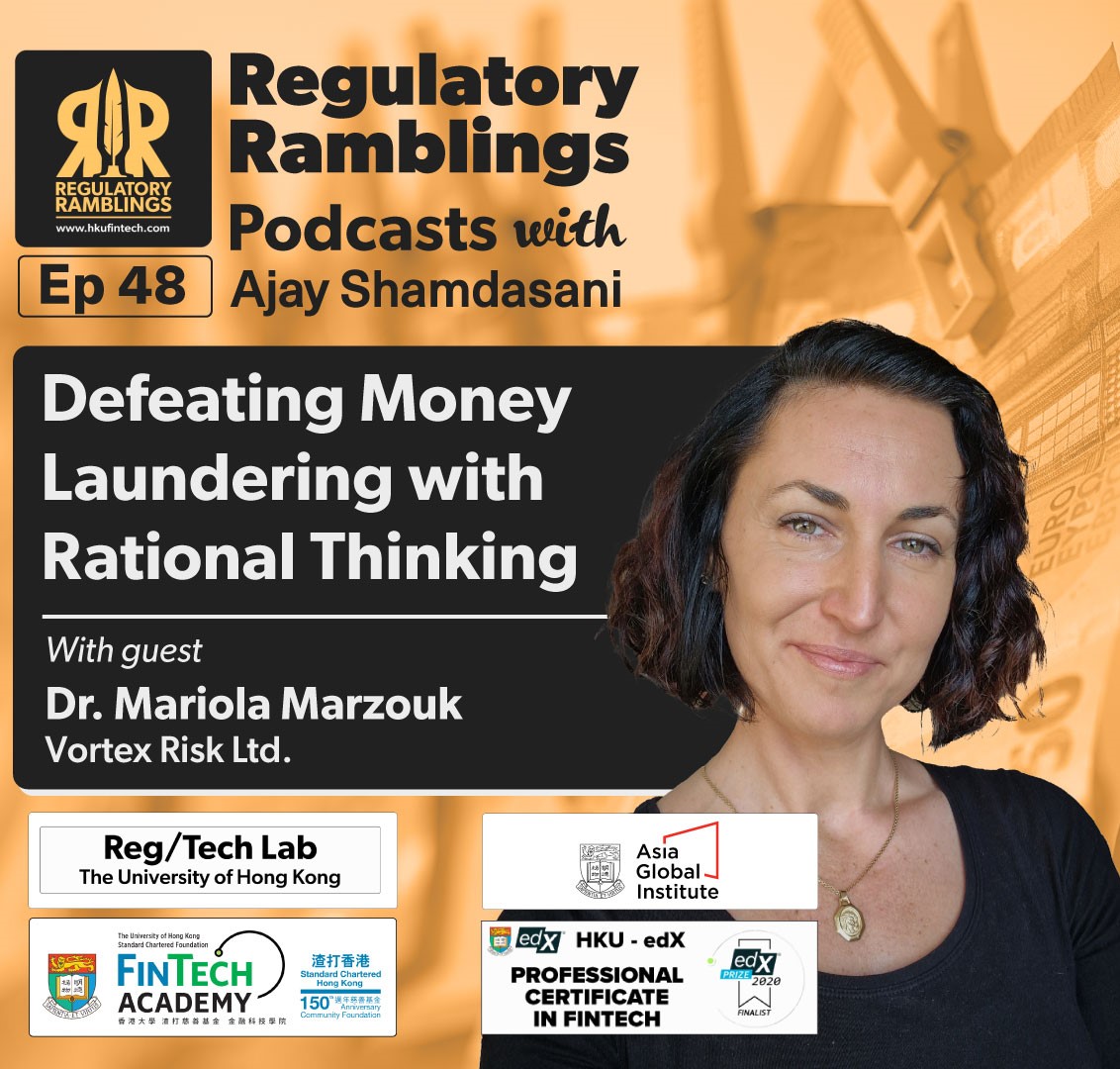
Dr. Mariola Marzoukis isan anti-money laundering (AML) professional with extensive experience in regulatory software and consulting across the public and private sectors. Her career has involved working with global banks on how to use technologies to address regulatory compliance demands.
In 2023, after completing her doctorate in criminal justice focused on trade-based money laundering (TBML) and technology, she co-founded Vortex Risk Ltd. with her colleague Dr Nicholas Gilmour (himself a guest on episode #18 of Regulatory Ramblings). The firm provides insights into money laundering practices to individuals and organizations worldwide. Vortex Risk’s approach empowers clients by offering perspectives akin to rational-thinking criminals operating discreetly to evade regulatory suspicion.
Over the course of her career, Mariola has held strategic product management positions at internationally recognized companies such as British Aerospace and Engineering (BAE) Applied Intelligence, EY, NICE Actimize, and Napier AI.
She specializes in financial crime prevention and has demonstrated expertise in detecting money laundering schemes using advanced technologies. Over time, her focus extended to the ever-growing specter of TBML, and her research in this area has garnered recognition within the industry. Mariola’s pilot study on Brexit’s impact on TBML has been published in the Journal of Money Laundering Control, featured on GTR News, and cited by the Institute of Export and International Trade UK.
In this episode of Regulatory Ramblings, she chats with host Ajay Shamdasani, describing her path from Poland to the UK, first as a student and now as a much sought-after financial crime professional in London.
The conversation underscores Mariola’s philosophy: defeating money laundering requires rational thinking and not merely compliance red flags. She eschews the notion of compliance as an exercise in perfunctory box-ticking and form-filing – a perennial lament in the profession.
She shares that her approach towards AML more generally is to precisely deploy RegTech to aid regulated entities in detecting criminality. While acknowledging that data analytics and artificial intelligence (AI) are essential tools in the battle against financial crime, she stresses that technology is not a panacea and works best when used in tandem with the skills, temperament, wisdom, and judgment that experienced professional researchers and investigators have developed over time. AI is no substitute for analysis by a human and good old common sense.
Mariola admits that while she does not have a background in science, technology, engineering, or math (STEM), her experience as a product manager and corporate strategist has afforded her insight into what customers need from technical solutions and a sense of discernment about when to apply which technologies, if at all. While not a techie per se, she has developed an understanding of technological development and how and when it should be deployed to solve specific problems. Ultimately, tools should meet the objectives of problem-solving, she says.
She recounts the various learning curves she experienced from the business side while coping with the more technical aspects of roles throughout her career.
The discussion concludes with Mariola stating her views on the prevailing hypocrisy in AML and sanctions enforcement. The financial world is all too often regulated from Washington, New York, London, and Brussels. Yet, while the US and UK are some of the most aggressive jurisdictions regarding financial crime enforcement actions, their regulatory apparatus is often used to further their geopolitical goals. It is a view outside of the West that Mariola says is not without merit.
Podcast Discussion
3:09 Mariola Marzouk’s Journey into Financial Crime
9:58 Combating Trade-Based Money Laundering: A Personal Pursuit of Restorative Justice
15:25 Disrupting the Norm: Money Laundering and Regulatory Realities
In this episode of Trekking Through Compliance, we consider the episode Friday’s Child, which aired on December 1, 1967, Star Date 3497.2.
Kirk attempts to secure a mining agreement for topaline on Capella 4, where Bones had once been stationed. He warns Kirk that although the Capellans are scrupulously honest, they are war-like. After beaming down, a security guard pulls out a phaser to shoot a Klingon emissary and is instantly killed by a fleet-wielding Capellan.
On the planet, the leader is killed in a coup, and his pregnant wife Eleen is sentenced to death because she carries a royal child. After giving birth, Eleen escapes and runs to give herself up to the Capellans. She claims to have killed the child and the Earthmen as they slept. The Klingon does not believe her and demands that the Capellans, under threat of phaser fire, verify Eleen’s story. Suddenly, Kirk shoots the Klingon with an arrow, and an exchange between the Capellans and Kirk and Spock follows. The Klingon threatens to shoot anyone who raises a weapon against him. This does him no good, however, since Maab exchanges his life for that of Eleen by confronting the Klingon, and Keel uses the opportunity to kill the Klingon. Kirk gains mining rights when Eleen is regent for the child Tierr-to-be, Leonard James Akaar.
Commentary
The narrative showcases key compliance themes, including the importance of due diligence, respect for local customs, avoiding conflicts of interest, clear communication and transparency, and adaptability in conflict resolution. Through the interactions with the Capellans and Klingons, the episode illustrates how a lack of understanding and respect for cultural norms can jeopardize high-stakes negotiations. The discussion also touches upon the complexities of the Prime Directive and its application in interstellar relations.
Key Highlights
Episode Overview: Friday’s Child
Mining Agreement on Capella IV
Conflict with the Klingons
Discussion: The Prime Directive
Compliance Lessons from Friday’s Child
Resources
Excruciatingly Detailed Plot Summary by Eric W. Weisstein
Welcome to “Compliance Tip of the Day,” the podcast where we bring you daily insights and practical advice on navigating the ever-evolving landscape of compliance and regulatory requirements.
Whether you’re a seasoned compliance professional or just starting your journey, our aim is to provide you with bite-sized, actionable tips to help you stay on top of your compliance game.
Join us as we explore the latest industry trends, share best practices, and demystify complex compliance issues to keep your organization on the right side of the law.
Tune in daily for your dose of compliance wisdom, and let’s make compliance a little less daunting, one tip at a time.
In today’s episode, we learn how and why the humble reference check can be a key tool in your hiring, evaluation, and due diligence processes.
For more information on the Ethico ROI Calculator and a free White Paper on the ROI of Compliance, click here.
To check out The Compliance Handbook, 5th edition, click here.
In this episode of Trekking Through Compliance, we consider the episode Journey to Babel, which aired on November 17, 1967, and occurred on Star Date 3842.3.
The Enterprise transports ambassadors to a conference to discuss the admission of Corridon to the Federation. Sarek is the ambassador from Vulcan, accompanied by his wife, Amanda. To Kirk’s surprise, they turn out to be Spock’s parents. Also, to Kirk’s surprise, Sarek is cool towards Spock because Spock has chosen to devote his life to Starfleet instead of Vulcan science.
The Tellerite ambassador is murdered, and Sarek falls under suspicion. Meanwhile, Spock detects titanium emissions from an alien ship’s hull after it transmits a message. Sarek requires an open heart operation, and Spock provides a blood transfusion.
Kirk is attacked and requires medical attention, so Spock assumes command. Under these circumstances, he says he cannot take time off to give the transfusion to Sarek and cannot pass the command on to anyone else because he is the best-qualified person to command the Enterprise. His mother pleads with him, but he refuses.
The Enterprise is attacked by an alien ship while Sarek and Spock are on the operating table, endangering their lives. Kirk fools the alien ship by turning off shields and internal power, luring the enemy ship for the kill. Kirk hits it with phasers and disables it when it begins moving in.
However, they blow themselves up before he can ask them to surrender.
McCoy confines the injured Kirk and the recovering Spock to sickbay, shushing all protests. “Well, what do you know,” he says with a grin, “I finally got the last word.”
Commentary
The story features the Enterprise transporting ambassadors, including Spock’s parents, Sarek and Amanda, to a conference on Babel. Amidst diplomatic challenges, an unidentified transmission and a Tellarite ambassador’s murder put Sarek under suspicion. Despite suffering from a heart condition, Sarek is saved through Spock’s blood transfusion. The episode emphasizes medical technology, diplomatic protocols, conflict management, inclusive cultures, whistleblower protection, crisis preparedness, and cybersecurity—offering valuable lessons for modern compliance programs.
Key Highlights
Sarek’s Medical Emergency
Uncovering the Spy
The Final Confrontation
Medical Science in Star Trek
Cultural and Compliance Lessons
Resources
Excruciatingly Detailed Plot Summary by Eric W. Weisstein
Recently, the Supreme Court delivered several rulings that have caught the attention of compliance professionals. This blog post will dissect these rulings and explore their implications for corporate compliance. Matt Kelly and I took a deep dive into this week’s Compliance into the Weeds to see if you prefer the audio format.
Jarkesy Decision: SEC and In-House Tribunals
The Jarkesy decision ruled that the SEC cannot use in-house tribunals for enforcement proceedings, mandating that cases be brought to federal court. This ruling is likely to have a minor impact from a compliance perspective. Here’s why:
Federal Court Preference: For severe charges under the Foreign Corrupt Practices Act (FCPA), the SEC has historically opted to bring cases to U.S. district courts. These cases typically involve criminal charges, and the SEC has not utilized in-house tribunals for FCPA enforcement in over a decade.
Corporate vs. Individual Defendants: The ruling primarily benefits defendants who can now have their cases heard in federal court instead of administrative tribunals. However, for corporate compliance officers, this distinction is largely irrelevant. Corporate cases are typically resolved in federal courts through settlements without the need for protracted legal battles.
Loper Case: Overturning the Chevron Doctrine
The Loper case overturned the Chevron doctrine and is another landmark decision. The Chevron doctrine allowed courts to defer to agency interpretations of ambiguous statutes. Here’s what this means for compliance:
Guidelines vs. Rules: Compliance officers should understand that DOJ guidelines for effective compliance programs are just guidelines, not rules. These guidelines are not subject to Chevron’s deference and are regularly updated to reflect best practices.
Practical Impact: Eliminating Chevron’s deference might make it more challenging for agencies to introduce new rules without facing legal challenges. However, this does not directly impact existing guidelines or enforcement practices related to corporate compliance.
Increased Litigation Risk: Future regulations may face more scrutiny and litigation, potentially leading to increased enforcement of existing rules rather than creating new ones. Compliance professionals should prepare for more rigorous enforcement actions based on current regulations.
Snyder Decision: Federal Anti-Corruption Law
The Snyder decision narrowed the scope of federal anti-corruption law, particularly concerning bribes paid to state and local officials. This ruling has some interesting implications:
Case Background: The case involved the former mayor of Portage, Indiana, who awarded a contract to a specific company and later received a $13,000 consulting fee as a reward. The Supreme Court ruled this as a gratuity rather than a bribe, complicating enforcement under federal anti-corruption laws.
Corporate Compliance Concerns: While this ruling applies to state and local officials, compliance officers must remain vigilant about maintaining clear anti-corruption policies. The ruling doesn’t directly affect the FCPA, which targets foreign officials, but highlights the importance of robust internal controls and transparent record-keeping.
Ethical Implications: Compliance programs should continue emphasizing ethical behavior and avoiding corruption, whether labeled as a gratuity or a bribe. The moral imperative against corruption remains unchanged despite legal nuances.
The recent Supreme Court decisions may not drastically alter corporate compliance programs’ day-to-day operations, but they highlight the evolving legal landscape that compliance professionals must navigate. Here are some key takeaways:
Stay Informed: Regularly update your knowledge of legal developments and understand their potential impact on your compliance program.
Focus on Ethics: Reinforce the ethical foundation of your compliance efforts. Emphasize that any corrupt behavior, whether technically legal or not, is unacceptable.
Prepare for Increased Scrutiny: With the potential for more litigation around new regulations, ensure your compliance program is robust and well-documented. Be ready to demonstrate your commitment to ethical practices and effective compliance.
Engage with Legal Experts: Work closely with legal counsel to interpret these rulings and adjust your compliance strategies accordingly. Legal guidance is crucial in navigating complex regulatory changes.
In conclusion, while the Jarkesy, Loper, and Snyder decisions may seem weighty, their direct impact on corporate compliance programs is limited. However, they serve as a reminder of the dynamic nature of compliance and the need for ongoing vigilance and adaptability. By focusing on ethical behavior and maintaining strong internal controls, compliance professionals can continue to safeguard their organizations against legal and reputational risks.
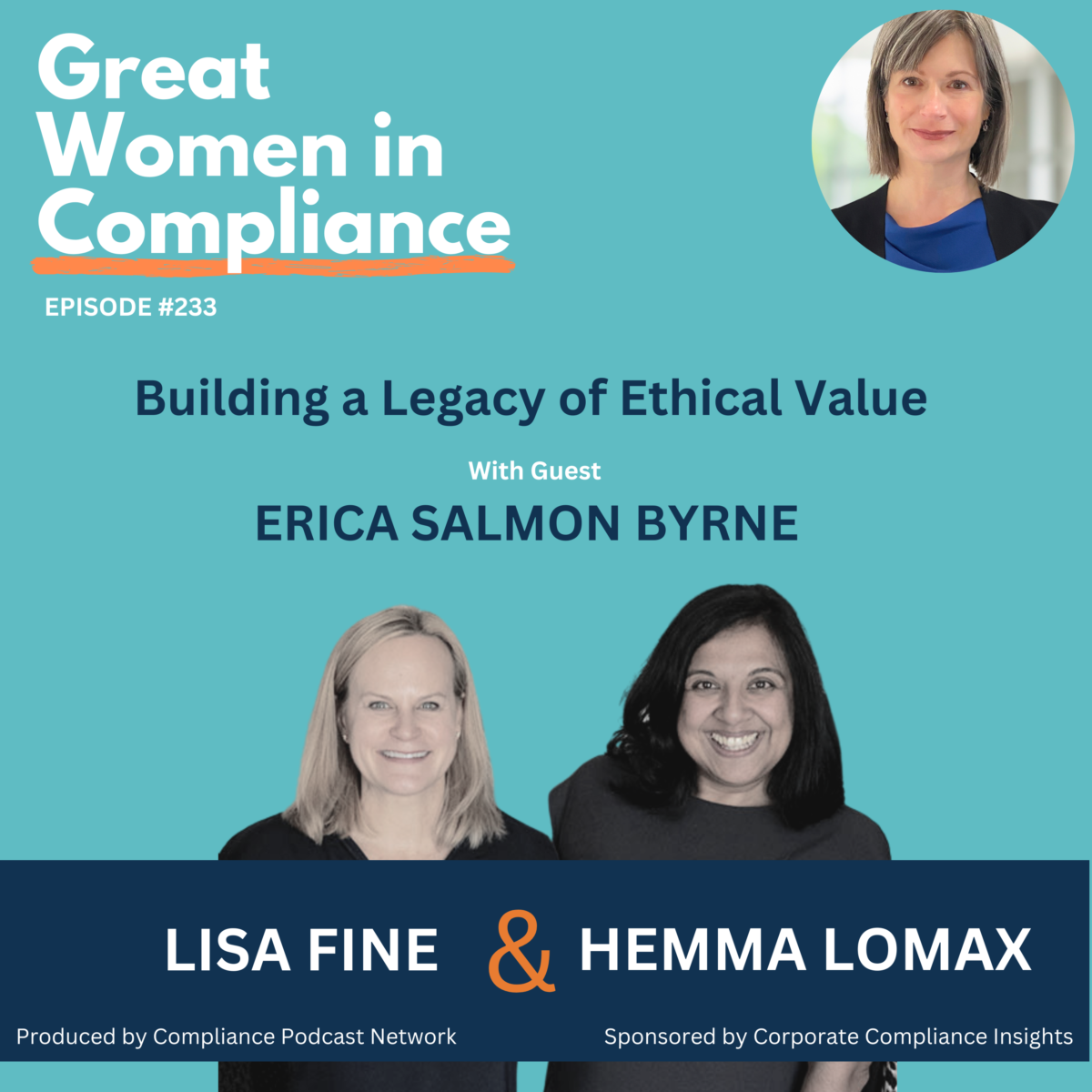
In this episode of Great Women in Compliance, Hemma visits with Erica Salmon Byrne, Chief Strategy Officer and Executive Chair of Ethisphere. Having long admired Ethisphere for its commitment to advancing business integrity in a meaningful way, Hemma invites Erica to share how her organization backs that up with research, data from industry benchmarking and culture assessments, and the creation of a strong compliance community. Erica shares her ethics and compliance origin story and critical insights on building a legacy of ethical value and business integrity.
Highlights include the compliance value creation story and how not to be merely a cost center, how to stay outcome-driven rather than activity-based, what we can learn from decades of data on measuring culture, the crucial role of managers in ethics and compliance, the meaning of an employee-centered approach and treating employees as tangible assets, and the power of community in compliance.
Erica is the Chief Strategy Officer and Executive Chair for Ethisphere, the global leader in defining and advancing the standards of ethical business practices that fuel corporate character, marketplace trust, and business success. In this role, Ms. Salmon Byrne oversees product strategy and M&A initiatives for the company while advancing Ethisphere’s founding ethos—that businesses that focus on the long term, commit to doing business with integrity, and invest in their stakeholder communities will outperform their peers.
Erica is also the Chair of the Business Ethics Leadership Alliance (BELA), where she works with the BELA community to advance dialogue, collaboration, and best practices around ethics and governance.
Over her tenure at Ethisphere, Erica has held several roles, including overseeing Ethisphere’s products and solutions, including data-driven program assessments; The Sphere, which offers benchmarking against peers and best practices, along with expertise and related regulatory guidance; ethical culture assessments; and the World’s Most Ethical Companies. To learn more about Ethisphere’s work, visit www.ethisphere.com
A prolific public speaker, Erica is known throughout the ethics and compliance industry as a leader, educator, and advocate for ESG, values-based leadership, and business integrity. In 2022, she was recognized as a Modern Governance 100 Leader by governance firm Diligent. Erica has been featured in the Wall Street Journal, The Washington Post, Fast Company, Forbes, SXSW, and various ethics and compliance publications and podcasts.
You can join the LinkedIn podcast community. Join the Great Women in Compliance podcast community here.
In this episode of the Principled Podcast, host Amy Hanan, LRN’s Chief Marketing Officer, is joined by Ayumi Kijima, Head of Group Compliance at ORIX, headquartered in Tokyo. This episode examines the evolving landscape of global compliance programs in Japan and internationally and how organizations like ORIX Group are shaping them to meet the challenges of a rapidly changing business environment while staying true to their core values.
Guest: Ayumi Kijima
Ayumi Kijima works at ORIX Corporation as its Assistant General Counsel and Head of Group Compliance, designing, implementing, and overseeing the compliance program for the ORIX Group companies in Japan and overseas. Before joining ORIX Corporation, Ayumi worked as an Associate at the Tokyo office of Squire Patton Boggs. She is qualified to practice law in California.
Host: Amy Hanan
Amy Hanan is the chief marketing officer at LRN. Amy, a B2B digital marketing leader, has a nearly 20-year track record in product, brand, lifecycle, and demand-generation marketing and corporate communications for media, professional services, and technology companies. One of her central areas of expertise is executing tech-enabled marketing initiatives for growth. Before joining LRN, Amy was the chief digital officer at Baretz+Brunelle, a marketing and communications agency serving the legal and financial services industries. Her previous experience includes Reorg Research, ALM Media, and The Associated Press. She holds a Bachelor of Arts degree from Northern Arizona University.
In this episode of Trekking Through Compliance, we consider the episode Metamorphosis, which aired on November 10, 1967, and occurred on Star Date 3219.4.
Commissioner Nancy Hedford, who had been on a diplomatic mission to stop a war, is ill with Sicuro’s disease and needs treatment aboard the Enterprise. The shuttlecraft is forced down on a small planetoid, and Kirk cannot contact the Enterprise despite the communications equipment functioning perfectly. On the planet, they find a man named Cochrane, who claims he has been marooned but has a being known as the Companion.
Cochrane is greatly disturbed by the knowledge that the Companion is in love with him and storms out, saying he doesn’t want to be “fodder for any inhuman monster.” Hedford, in a feverish daze, remarks that it is strange that Cochrane runs from love while she has never had the opportunity to be loved. But the Companion occupies and cures the body of Commissioner Hedford, who had been on the verge of death and restores the shuttlecraft and communication devices to working order. However, the Companion cannot leave the planet without dying, and Cochrane decides to remain with her. As they prepare to depart, Kirk agrees not to mention his adventure with Cochrane.
Commentary
The episode features Zephryn Cochran, the discoverer of the Space Warp, who is kept alive by a sentient alien entity known as the Companion. Key ethical issues discussed include the dangers of absolute power, the importance of consent, respecting diversity and self-determination, the balance between duty of care and paternalism, and the need for transparency and accountability. Cochran’s interactions with the Companion serve as a backdrop to highlight these important ethical principles for compliance professionals.
Key Highlights
Plot Summary of ‘Metamorphosis’
The Companion’s True Nature
Ethical Analysis of the Episode
Ethical Lessons for Compliance Professionals
Resources
Excruciatingly Detailed Plot Summary by Eric W. Weisstein
Welcome to “Compliance Tip of the Day,” the podcast where we bring you daily insights and practical advice on navigating the ever-evolving landscape of compliance and regulatory requirements.
Whether you’re a seasoned compliance professional or just starting your journey, our aim is to provide you with bite-sized, actionable tips to help you stay on top of your compliance game.
Join us as we explore the latest industry trends, share best practices, and demystify complex compliance issues to keep your organization on the right side of the law.
Tune in daily for your dose of compliance wisdom, and let’s make compliance a little less daunting, one tip at a time.
In today’s episode, we consider three key obstacles to culture change that a compliance professional may face or need to address.
For more information on the Ethico ROI Calculator and a free White Paper on the ROI of Compliance, click here.