Categories
Compliance Into the Weeds

Compliance into the Weeds: What is Driving Compliance Engagement at the Board?

The award-winning, Compliance into the Weeds is the only weekly podcast that takes a deep dive into a compliance-related topic, going into the weeds to explore a subject more fully and looking for some hard-hitting insights on sanctions compliance. Look no further than Compliance into the Weeds!

In this episode, co-hosts Tom Fox and Matt Kelly dissect the Navex 2023 State of Risk and Compliance Report. Tom and Matt delve into Navex’s annual benchmarking report, which surveyed 1,300 compliance professionals. The report revealed that 53% of respondents described their compliance programs as mature. Matt and Tom question whether the board is driving the conversation or if compliance officers request updates due to potential liability. The report’s findings on cybersecurity and privacy concerns, survey results on where compliance should reside in a company, and the importance of having a mature anti-bribery anti-corruption compliance program are all discussed. Tune in to hear more about how compliance officers can address pressing concerns such as cybersecurity breaches and attacks.

Key Highlights:

  • Navex’s benchmark report on compliance programs
  • Board-Compliance Officer Relationship & Cybersecurity in Compliance
  • The necessity of Dedicated Compliance Committees
  • Survey Finds Diverse Views on Compliance Placement in Companies
  • The Importance of Anti-Bribery Compliance for Cybersecurity
  • Compliance Officer Reporting to CISO Dynamics

 Resources:

Matt 

LinkedIn

Blog Post in Radical Compliance

Tom 

Instagram

Facebook

YouTube

Twitter

LinkedIn

Categories
31 Days to More Effective Compliance Programs

One Month to a More Effective Compliance Program with Boards – Three Areas of Board Inquiry

Directors should focus on three core areas to help establish and maintain an effective compliance program: structure, culture, and risk management.

Structural questions. This area consists of questions that will aid in determining the fundamental sense of a company’s overall compliance program. The questions should begin with the basics of the program through to how the program operates in action.

Cultural questions. This area of inquiry should focus on the organization’s culture regarding compliance. Board members should understand what message senior management and middle management communicate. Equally important, the Board needs to understand what message is being heard at the lowest levels within the company.

Risk management questions. Board members need to understand the company’s process being used to identify emerging risks, their evaluation, and management. Such risk analysis would be broader than simply a compliance risk assessment and should be tied to other broader corporate matters.

Three key takeaways:

  1. A Board of Directors should inquire into the structural component of the compliance program as it will aid in determining the fundamental sense of a company’s overall compliance program.
  2. Cultural questions should be asked to understand what message is being communicated by senior and middle management.
  3. Risk management questions should be asked to understand the company’s process being used to identify emerging risks, their evaluation, and management.
Categories
Innovation in Compliance

Messaging Compliance in a Shifting Regulatory Landscape: Part 2 – Is Business Innovation Being Stifled by Regulatory Actions?

Is messaging compliance giving your compliance function headaches? Welcome to a special 5 part podcast post series, messaging compliance in a shifting regulatory landscape, sponsored by Global Relay. Over this series, I will visit with Chip Jones, Executive Vice President – Compliance at Global Relay; Alex Viall, Chief Strategy Officer at Global Relay; Rob Mason, Director, Regulatory Intelligence at Global Relay; Jennifer Clarke, Head of Content at Global Relay; and Raewyn Danvers, Sales Manager, Unified Communications. Over this series, we will consider the US and UK regulatory framework for messaging apps, consider if business innovation is being stifled by regulatory action, preview the Global Relay Report: Compliant Communications in 2023, and look down the road on how to stay Ahead of regulation with the compliant communications in one app.

In this Part 2, I visit with Alex Viall UK regulatory compliance expert, to explore the intersection of regulation and innovation, and in this thought-provoking podcast as they discuss the dynamics between business innovation and regulatory compliance. Discover how the evolution of technology is causing a generational shift in communication and how this impacts businesses in the industry. Hear about the importance of capturing conversations and messages for law enforcement purposes and the need for policies and procedures to manage risks effectively.

Take advantage of expert insights on practical solutions, training, and monitoring policies to stay compliant. Learn why banning communication isn’t the answer and how a proactive attitude can lead to better risk management and regulatory compliance.

Key Highlights:

  • Balancing Innovation and Compliance in Messaging
  • Challenges of Ephemeral Messaging in Business
  • Communications Compliance and Training for Business Conversations
  • Overcoming the Ineffectiveness of Communication Bans

For more information, go to Global Relay.

Join us in our next episode, where we examine the current UK regulatory landscape for messaging apps.

Categories
Blog

Messaging Compliance in a Shifting Regulatory Landscape: Is Regulation Stifling Business Innovation?

Are you ready to learn how to implement electronic communications capture and supervision in your firm for better compliance and prevention of regulatory violations? Is messaging compliance giving your compliance function headaches? Welcome to a special 5 part blog post series on messaging compliance in a shifting regulatory landscape, sponsored by Global Relay. In this Part 2, I visited with Alex Viall on the provocative topic of where regulation stifles innovation in messaging apps.

The ever-increasing use of instant messaging in businesses brings about the need for compliant messaging policies. With proper guidelines, compliance officers and entrepreneurs can ensure that their company’s communication practices are up to par with regulatory standards and that potential risks are minimized. This enhances the overall efficiency and transparency of the business and provides peace of mind for those involved in managing and maintaining these communication platforms.

Here are some key steps:

  • Assess current communication platforms and habits
  • Create clear, transparent messaging policies
  • Implement regular employee training sessions
  • Monitor messaging compliance and address breaches
  • Explore tech solutions for messaging management

1. Assess current communication platforms and habits.

Developing compliant messaging policies for your business begins with assessing your company’s current communication platforms and habits. This critical first step involves thoroughly examining how employees communicate internally and externally and the tools and channels they utilize. You can effectively mitigate potential non-compliance issues by deeply understanding your business’s communication landscape. Identifying areas where innovation and improvements can be made while minimizing impacts on operations and employee experience is crucial. Therefore, it’s essential to keep an open mind and be prepared to adapt to the evolving nature of technology and ever-changing communication trends.

Viall underscored embracing business innovation while ensuring regulatory compliance and risk management. Communication habits constantly change, and organizations must adapt effectively while maintaining auditable trials for every conversation. Proper employee training is critical to fostering change and adopting new communication practices. This training should focus on creating comprehensive, practical policies that everyone can easily understand and adhere to, steering clear of generic policies that merely act as a checkbox.

Remember that senior management is pivotal in setting a positive tone and demonstrating a commitment to transparency and policy adherence.  Understanding and addressing the critical first step of assessing your business’s current communication platforms and habits is vital for compliance officers and entrepreneurs because doing so equips them with valuable insights into potential shortcomings, risks, and opportunities for growth. Organizations can proactively tackle potential compliance pitfalls by developing relevant and practical messaging policies while encouraging innovation and seamless communication. Ultimately, this will result in a more robust and resilient business that can effectively navigate the ever-evolving communication technology landscape and maintain a competitive edge in the market.

2. Create clear, transparent messaging policies.

Effective communication is essential for businesses today, and as technology evolves, so do the platforms and devices we use to communicate with one another. This shift in communication methods has increased the importance of creating clear, transparent messaging policies for companies. While internal and external communication may change, one thing remains constant: the need for proper risk management, regulatory compliance, and corporate hygiene. To achieve this, companies should develop comprehensive, practical policies for instant messaging that employees can easily understand and implement. The goal is to avoid creating generic policies that are simply a box-ticking exercise while supporting business innovation and maintaining auditable communication trails.

Viall noted that effective communication requires changing employees’ mindsets and ongoing training to ensure a secure and compliant messaging environment. Furthermore, senior management must set the right tone, reiterating the importance of compliance with these policies. Companies need to have procedures in place for monitoring, remediation, and promptly addressing any non-compliance issues. As technology continues to evolve, new tools and solutions for managing messaging compliance will become increasingly available, making it more important than ever for businesses to stay ahead of the curve.

Creating clear messaging policies cannot be overstated, particularly for compliance officers and entrepreneurs operating in an instant, ephemeral messaging age. With regulatory compliance and risk management at the forefront of business concerns, having practical, transparent policies can help ensure that a company maintains its competitive edge. This is especially true given the rapid advancements in technology and the potential consequences of non-compliance, which could lead to serious repercussions for businesses, both legally and financially. By focusing on transparent messaging policies, companies will be poised to manage risk effectively and thrive in today’s fast-paced, interconnected world of business communication.

3. Implement regular employee training sessions.

The nature of business is that it continues to evolve and adapt to new technologies, and communication methods are also changing. Gone are the days of only relying on traditional face-to-face conversations or even phone calls to get things done. With the rise of instant messaging platforms, companies now have a fast and effective way to communicate internally with team members and externally with clients. This new, dynamic form of conversation has greatly improved workplace efficiency and speed. Still, it also presents a significant challenge – ensuring that all communication is properly documented and compliant with various rules and regulations.

According to Viall, implementing regular employee training sessions is one crucial aspect of achieving this. These sessions should cover all of the proper procedures to be followed when using instant messaging in a professional setting and the potential risks and consequences of not adhering to these guidelines.  Conducting regular employee training sessions on messaging compliance helps create a company culture that prioritizes open communication, transparency, and, ultimately, accountability. When employees are knowledgeable and confident about what is expected of them, they are more likely to abide by the rules and demonstrate better judgment when faced with challenging situations. This reduces the likelihood of regulatory issues or scandals related to non-compliant messaging for businesses.

As compliance officers and entrepreneurs managing instant messaging in business, staying on top of evolving regulations and ensuring your company is adhering to best practices is crucial. You can significantly improve your organization’s regulatory compliance and risk by assessing your current communication platforms and habits, creating clear and transparent messaging policies, implementing regular employee training sessions, monitoring messaging compliance, and exploring tech solutions for messaging management. Do not hesitate to implement these steps and reap the benefits of a compliant and efficient messaging system.

Join me tomorrow as we consider changes in the UK regulatory schemes regarding messaging apps and compliance.

For more information, go to www.globalrelay.com

Categories
31 Days to More Effective Compliance Programs

One Month to a More Effective Compliance Program with Boards – Incorporating Compliance into a Long-Term Corporate Strategy

How can a Board work incorporate the compliance function into a long-term business strategy of the organization?

The starting point for a Board of Directors is to develop a framework for incorporating compliance into your long-term strategy. To set up the framework for evaluating compliance into your Board’s long-term strategy is a three-step process, which you can use to determine how comprehensive the Board’s role in your compliance program is as a starting point.

1. Has the company identified the compliance issues relevant to the Board?

2. Has the company assessed and incorporated those compliance issues into its long-term strategy?

3. Has the company communicated its approach to compliance and the influence of those factors on its overall strategy?

From this initial inquiry, you can move into some specific questions that the Board can use to determine the overall state of your company’s compliance program. First, a Board can work to identify compliance issues material to your organization. This can be accomplished with compliance-related KPIs, which a Board should prioritize to elevate their impact on compliance. A Board should consider these through the life cycle of a business line or geographic sales area. Next, the Board should work to move compliance into the company’s long-term strategy and have the CCO detail the long-term strategy for the compliance function.

The Board should oversee incorporating KPIs into senior management performance evaluations and compensation. Once again building upon the 2020 Update, which asks how the company monitors its senior leadership’s behavior and how senior leadership models proper behavior to subordinates, the Board should make certain systems are in place to quantify or measure performance related to compliance issues, should establish performance goals against which they measure compliance achievement and disclose to shareholders the material compliance issues that drive compensation, the specific goals or performance targets that management must achieve and report on the actual performance against established goals to justify compensation payouts.

Finally, the Board should work to communicate the influence of compliance factors on overall corporate strategy by demonstrating how compliance was integrated into the business. Not only is this good from a business perspective and shareholder expectation, but it is also, as the 2020 Update makes clear, what the government expects is the operationalization of compliance going forward.

1. Having a long-term strategy is critical.

2. What is the Board’s framework for assessing compliance?

3. Create KPIs to measure senior management’s actions around compliance.

Categories
Innovation in Compliance

Messaging Compliance in a Shifting Regulatory Landscape: Part 1 – The Future is Now: U.S. Regulatory Compliance

Is messaging compliance giving your compliance function headaches? Welcome to a special 5 part podcast post series, messaging compliance in a shifting regulatory landscape, sponsored by Global Relay. Over this series, I will visit with Chip Jones, Executive Vice President – Compliance at Global Relay;  Alex Viall, Chief Strategy Officer at Global Relay; Rob Mason, Director, Regulatory Intelligence at Global Relay; Jennifer Clarke, Head of Content at Global Relay; and Raewyn Danvers, Sales Manager, Unified Communications. Over this series, we will consider the US and UK regulatory framework for messaging apps, consider if business innovation is being stifled by regulatory action, preview the Global Relay Report: Compliant Communications in 2023, and look down the road on how to stay Ahead of regulation with the compliant communications in one app.

In this Part 1, I visit with Chip Jones, Executive VP of Compliance at Global Relay, on the current US regulatory landscape for messaging apps and discuss the challenges of maintaining communication compliance in various industries, focusing on off-channel communications, particularly in the financial services industry. Chip shares insights on the recent collective settlement issued by the SEC, which sends a clear message to firms about the importance of adhering to internal communication retention and supervision policies. Learn about how Global Relay is helping firms monitor their communications to detect fraudulent activities and avoid compliance issues. Take advantage of this informative podcast, which ends with a teaser for the next episode on the impact of regulatory action on business innovation.

Key Highlights:

  • The Challenges of Regulatory Compliance in the US
  • SEC enforcement actions on communication violations
  • Monitoring Electronic Communications in Financial Services
  • Off-channel Communications Consequences

For more information, go to Global Relay.

Join us in our next episode, where we ask: Is business innovation stifled by regulatory action?

Categories
Blog

Messaging Compliance in a Shifting Regulatory Landscape: U.S. Regulatory Compliance

Are you ready to learn how to implement electronic communications capture and supervision in your firm for better compliance and prevention of regulatory violations? Is messaging compliance giving your compliance function headaches? Welcome to a special 5 part blog post series on messaging compliance in a shifting regulatory landscape, sponsored by Global Relay. In this Part 1, I visited with Chip Jones on the current US regulatory landscape for messaging apps.

The importance of capturing and supervising electronic communications cannot be overstated for financial services compliance professionals. By properly managing these communications, you are taking a proactive approach to preventing potential regulatory violations and protecting both your personal and professional reputation. Through implementing a robust communication compliance policy, training your employees, and establishing a monitoring process, you can ensure a secure and compliant environment in which your firm can thrive.

Here are the key steps:

  • Understand electronic communication regulations;
  • Choose a reliable communication capture tool;
  • Implement a clear communication compliance policy;
  • Train employees on communication best practices; and
  • Establish a monitoring and supervision process.

 1. Understand electronic communication regulations.

In the ever-evolving world of financial services, electronic communication regulations play a critical role in ensuring transparency, accountability, and compliance. Familiarizing yourself with these regulations is the first essential step in implementing effective Electronic Communications Capture and Supervision (ECCS) processes at your firm. By understanding the governing rules and industry standards, financial service professionals can avoid potential pitfalls and unwarranted regulatory scrutiny.

In light of the SEC’s enforcement actions against large investment banks, it becomes apparent how crucial it is to stay informed of these regulations and maintain proactive supervision. The use of electronic communication tools, enables firms to monitor their internal communications closely and prevent regulatory violations. One effective method is to actively flag specific phrases and keywords that indicate off-channel communications, which in turn draws attention to and helps monitor those potential risks.

2. Choose a reliable communication capture tool.

Implementing electronic communication capture and supervision within a financial firm is essential for ensuring compliance with regulatory requirements and maintaining a transparent and accountable work environment. When choosing a reliable communication capture tool, it is crucial to consider its effectiveness in monitoring and archiving all forms of electronic communication within the organization. This includes emails, instant messages, social media interactions, and any other relevant communication channels. A dependable tool should be able to capture and retain all electronic communications while additionally providing the option to search, analyze, and review the retained data for potential regulatory violations or areas of concern.

One way their solution helps is by tracking phrases and words that may suggest an attempt to shift discussions to off-channel platforms. This raises a red flag, which allows compliance professionals to identify potential violations and take appropriate action. The Securities and Exchange Commission (SEC) is increasingly focusing on individuals within firms who breach regulatory guidelines. As a result, the SEC may impose stronger consequences such as termination or monetary actions to deter similar violations from occurring.  The implementation of a reliable communication capture tool is essential for a firm’s overall compliance efforts, as it helps promote transparency and instills accountability within the organization.

Ensuring that electronic communications are monitored and retained reduces the likelihood of rogue representatives pushing unsuitable investments or engaging in other illegal activities. Furthermore, the use of reliable tools can provide financial firms with a solid foundation for communication compliance supervision, which regulators are increasingly emphasizing. As compliance professionals are likely to face more individual-level enforcement actions, firms must have the right tools and processes in place to maintain compliance and mitigate potential risks.

 3. Implement and train employees on a clear communication compliance policy.

Implementing a clear communication compliance policy is an essential step in ensuring your firm’s electronic communications are appropriately supervised and within regulatory requirements. By establishing a well-structured policy, compliance professionals can effectively monitor and mitigate potential risks, which may result in regulatory violations and penalties. A comprehensive compliance policy should address the monitoring of on- and off-channel communications, identify patterns of misconduct, and establish procedures to escalate and resolve potential issues.

A robust policy should educate employees on the importance of proper communication compliance and the dangers of using personal devices for business communications.  The regulators, including the SEC, are closely monitoring and enforcing communication compliance rules, increasing the potential for individual-level actions, such as termination or monetary penalties, against those violating such requirements.  Understanding and implementing a communication compliance policy is crucial for financial services compliance professionals to mitigate the risk of regulatory violations.

By proactively monitoring electronic communications and capturing data, firms can equip their compliance teams with invaluable information to identify and address potential issues early. Moreover, implementing a robust compliance policy can help encourage employees to maintain transparency in their communications and understand the importance of using appropriate channels for business purposes. In doing so, organizations can effectively minimize regulatory risks, protect their reputation, and ensure the highest standard of integrity in their business operations.

In today’s fast-paced financial services industry, ensuring compliance with electronic communication regulations is more vital than ever. By following the steps outlined in this blog post, compliance professionals like you can significantly reduce the risk of regulatory violations and protect your firm’s reputation. Remember, a well-thought-out communication compliance policy, coupled with employee training and a reliable communication capture tool, can provide the foundation for a robust compliance program. Don’t hesitate to take action – invest in the right tools and processes to safeguard your firm’s future.

Join us tomorrow when we ask the provocative question: Is Regulation stifling innovation?

Categories
Corruption, Crime and Compliance

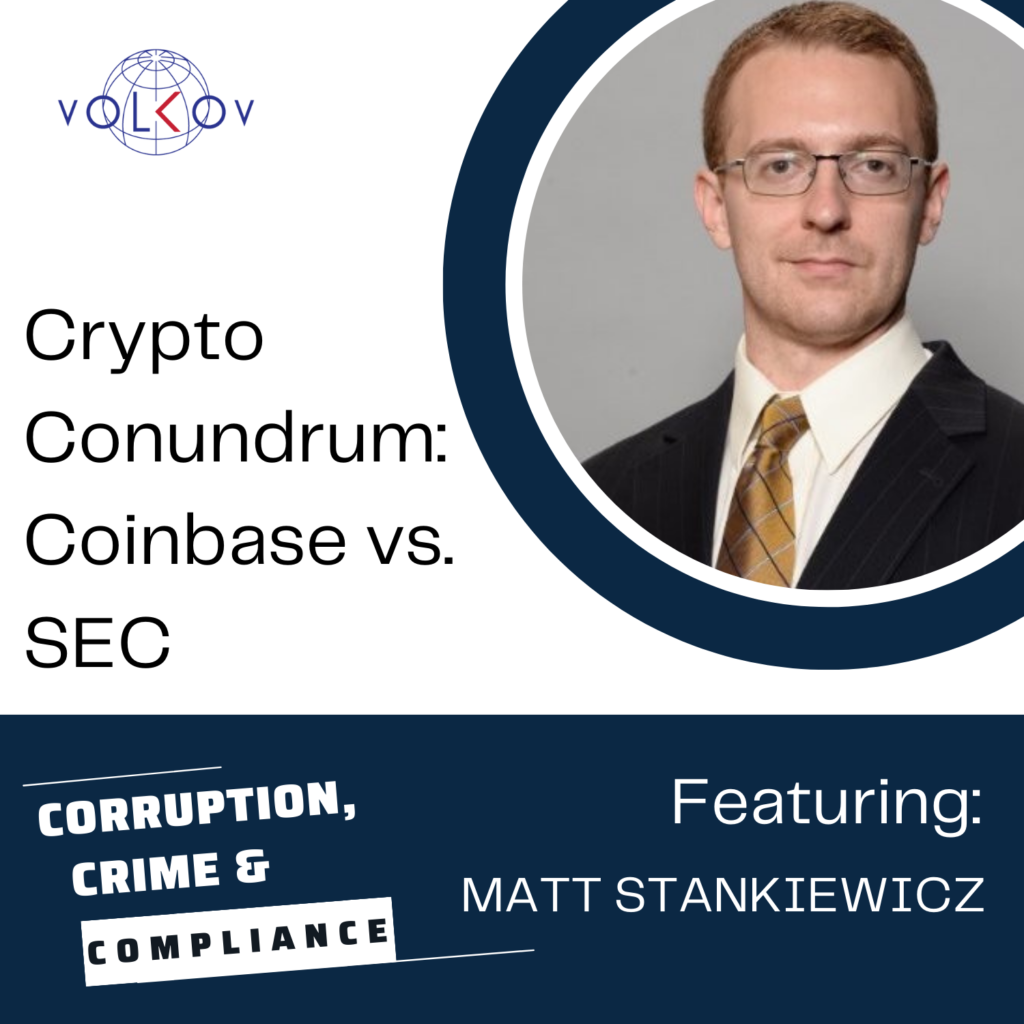
Crypto Conundrum: Coinbase vs. SEC – A Deep Dive with Matt Stankiewicz

The complex relationship between digital currencies and global financial regulations is highlighted yet again with the SEC’s recent crack down on major crypto exchanges Binance and Coinbase. Michael Volkov welcomes Matt Stankiewicz, also known as Crypto Max, to share his insight on these ongoing cases. He discusses the implications these enforcement actions might have on the industry, the securities law-related legal issues, and the internal mechanics of these exchanges.

Matt Stankiewicz is a Managing Counsel at The Volkov Law Group. His expertise includes financial regulation and compliance, with a focus on securities, anti-money laundering (AML), and cryptocurrency regulation. Given his professional background and interest in crypto regulations, he is a frequent speaker on legal matters concerning cryptocurrency exchanges and the SEC.


You’ll hear Michael and Matt discuss:

  • The SEC’s enforcement actions hinge on their assertion that Binance was serving US customers without the proper registration, thereby violating securities laws. They allege that Binance knowingly allowed and even encouraged US customers to utilize their offshore platform, enhancing their profits and trading volumes but breaching US regulations in the process.
  • Rather than directly challenging the status of specific tokens, the SEC is targeting exchanges like Binance and Coinbase. By regulating these exchanges, the SEC could effectively control the access points to the crypto industry, thus having a broader impact.
  • Binance is preparing for a legal fight with the SEC over these compliance issues, including allegations of wash trading to artificially inflate trading volume. The platform’s potential troubles are linked to similar issues faced by FTX and their trading arm, Alimator Research.
  • Given the recent pattern of the SEC bringing complaints without the DOJ pursuing criminal cases, it’s unlikely that the DOJ will bring a criminal case against Binance. 
  • Coinbase’s IPO was approved by the SEC despite allegations that the company had engaged in illegal activities related to the trading of unregistered securities. The SEC argues that the approval of an IPO doesn’t guarantee the legality of the company’s underlying operations, but this could be seen as contradictory to the SEC’s stated role of protecting investors.
  • Coinbase, in attempting to comply with securities regulations and being continuously rebuffed by the SEC, is the most compliant cryptocurrency exchange. However, should the SEC crack down on Coinbase and other major U.S. exchanges, it could push investors to offshore exchanges where the SEC has limited jurisdiction and where there is a higher risk of fraud. 


KEY QUOTES

“The SEC is taking obvious actions to show that they are very aggressive in their enforcement actions.” – Matt Stankiewicz


“This is a perfect reminder for everyone listening, whether you’re into crypto or not. If you are working internally with your email or you’re in [a] corporate chat, that can all be discoverable in future litigation. And you need to be careful what you say.” – Matt Staniewicz


“It is a very poor look in the court of public opinion for the SEC to stand on the ground of saying, ‘We are here to protect investors,’ but [avoid] stopping this before investors have a chance to throw all their money in that IPO.” – Matt Stankiewicz


Resources

Matt Stankiewicz on LinkedIn

Categories
31 Days to More Effective Compliance Programs

One Month to a More Effective Compliance Program with Boards – The Board and Succession Planning

The 2023 ECCP mandated a Board of Directors ensure “the sufficiency of the personnel and resources within the compliance function, in particular, whether those responsible for compliance have: (1) sufficient seniority within the organization; (2) sufficient resources, namely, staff to effectively undertake the requisite auditing, documentation, and analysis; and (3) sufficient autonomy from management, such as direct access to the board of directors or the board’s audit committee.”

It went on to pose the following questions about the “sufficiency of the personnel” in the following manner. Under the topic, Seniority, and

 Stature, are the following questions:

How does the compliance function compare with other strategic functions in the company in terms of stature, compensation levels, rank/title, reporting line, resources, and access to key decision-makers? and What role has compliance played in the company’s strategic and operational decisions?

Under the topic Experience and Qualifications are the following questions:

Do compliance and control personnel have the appropriate experience and qualifications for their roles and responsibilities? Has the level of experience and qualifications in these roles changed over time? How does the company invest in further training and development of the compliance and other control personnel? Who reviews the performance of the compliance function and what is the review process?

All of this leads to the inescapable conclusion that the Board of Directors needs to be involved in not only the hiring process for a CCO but also the succession planning. Yet many Boards fall short on that score. In a Chapman and Cutler LLP quarterly update, entitled, Advancing Board Refreshment Through the Director Succession Planning Process, William Libit and Todd Freier laid out a framework for Boards to use which I have adapted for CCO succession. There are some key traits you should consider in succession planning for any senior management position, including a CCO.

  1. Examine the key corporate documents.
  2. Use an assessment framework.
  3. Conduct due diligence.
  4. Maintain a pipeline.
  5. Assess Board policies.
  6. Disclose your succession strategy.
  7. Benchmark your succession strategy.

 Three key takeaways:

1. Refreshment is a hot topic in corporate governance.

2. Review your Board policies to understand what your company will need going forward.

3. Transparency in succession planning.

Categories
Principled Podcast

Principled Podcast – S9 E 19 – The Value of Cross-Functional Collaboration for Compliance Program Effectiveness

What you’ll learn on this podcast episode

As the regulatory environment continues to evolve and organizations adapt, it is becoming increasingly important for ethics and compliance professionals to break down department silos.  But how do you do that effectively when so many stakeholders are involved? How do you develop a stronger network of assurance partners inside your organization? On this episode of LRN’s Principled Podcast, host Dave Hansen talks about the impact of cross-functional collaboration on program effectiveness with Tony Tocco, the chief ethics and compliance officer and assistant corporate secretary of DT Midstream.

Guest: Tony Tocco

Tony Tocco – Grayscale

Anthony M. Tocco (Tony) is the chief ethics and compliance officer and assistant corporate secretary at DT Midstream. He is responsible for overseeing the development and implementation of effective programs and processes to promote an ethical culture and compliance with applicable laws and regulations. He also provides board governance and support responsibilities as the assistant corporate secretary.  

Tony joined DT Midstream as part of the business unit spin from DTE, where he began as the manager of Audit Services in 2001 as a result of the merger with MCN Energy Group.  In 2002, he was promoted to assistant general auditor and subsequently performed as interim general auditor for a period. During this time, Tony directed the developing and implementing of the independent centralized testing center for Sarbanes-Oxley Act compliance and supporting corporate governance policies and procedures. 

Prior to joining DTE Energy, Tony held leadership positions in the MCN Energy Internal Audit department and Michigan Consolidated Gas Company’s Corporate Security & Investigations department. Tony has approximately 30 years of compliance-related experience in the utility and energy industry. Tony also has four additional years of compliance experience working for the Department of Defense in reviewing and auditing defense contracts and also established the internal audit department for a major Michigan public university. 

Tony earned a Bachelor of Science degree in accounting from Detroit College of Business, an MBA from Wayne State University, and a Master of Science degree in security administration from the University of Detroit-Mercy. Tony is a Certified Compliance and Ethics Professional (CCEP), a Certified Internal Auditor (CIA), and a Certified Fraud Examiner (CFE).   

Tony is a member of the Ethics and Compliance Institute (ECI), the Society for Corporate Compliance and Ethics (SCCE), the Institute of Internal Auditors (IIA), the Association of Certified Fraud Examiners (ACFE), and the Society for Corporate Governance.   

Tony also has lectured for the Institute of Internal Auditors, the Society for Corporate Compliance and Ethics, the Compliance and Ethics Officer Association, Compliance Week, and the University of Detroit-Mercy. Tony is a former chairperson for the Ethics and Compliance Officer Association Utility Industry Group, which is comprised of approximately 70 utility companies. Tony serves on the CCEP Exam Writing Committee and is on the Board of Big Brothers Big Sisters of Metropolitan Detroit as development committee chair. 

Host: Dave Hansen

Principled_Podcast_Dave-Hansen_Host

Dave Hansen is the global advocacy marketing director at LRN, an organization focused on ethics and compliance solutions that help people around the world do the right thing. His team drives LRN’s customer obsession by building community, deepening customer engagement, and finding meaningful opportunities for collaboration. Dave is passionate about learning, having spent most of his career in higher education or training. He loves sharing customer stories and best practices in the name of continuous improvement. Dave is a proud dad, coffee enthusiast, drummer, and scuba diver. In his spare time, he enjoys cooking and reading!